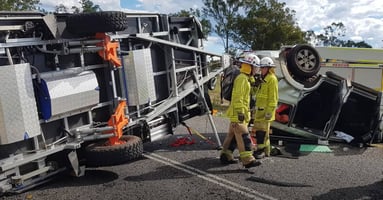
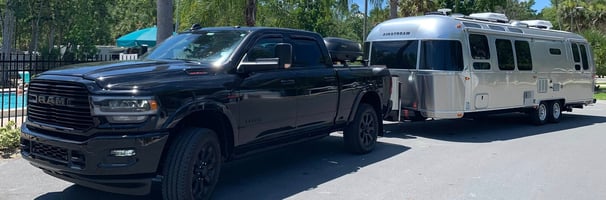
If you’ve ever experienced trailer sway, you’ve probably heard advice like “slow down,” “load better,” or “get more seat time.” While those tips sound reasonable, they miss the real issue entirely.
Trailer sway is not a driving problem. It’s a physics problem.
Understanding that difference is the key to safer towing, less stress, and choosing the right trailer sway control hitch—one that actually eliminates the problem instead of asking the driver to manage it.
What Trailer Sway Really Is (From a Physics Standpoint)
Trailer sway occurs when lateral forces cause the trailer to pivot side to side behind the tow vehicle. These forces come from:
- Crosswinds
- Passing trucks
- Road irregularities
- Steering inputs
- Sudden braking or acceleration
Once sway starts, the trailer behaves like a pendulum. Each oscillation feeds the next, often growing stronger unless something physically stops it.
This is not about driver skill—it’s about mechanical leverage and pivot points.
Why the Hitch Ball Is the Core of the Problem
Conventional towing setups allow the trailer to pivot freely on the hitch ball. From a physics perspective, this creates:
- A pivot point behind the tow vehicle’s rear axle
- A long lever arm (the trailer) pushing side to side
- Increasing lateral momentum as speed rises
Once sway begins, the trailer is literally steering the tow vehicle, not the other way around.
No amount of steering finesse can change where that pivot point exists.
Why “Good Driving” Can’t Eliminate Sway
Even the most experienced drivers can’t override physics.
Here’s why:
- Steering corrections often add energy to the sway cycle
- Braking shifts weight and can intensify oscillation
- Speed reduction helps—but doesn’t remove the instability
Drivers aren’t failing—the system itself allows sway to exist.
This is why sway can happen:
- When you’re within tow ratings
- With proper tongue weight
- On straight, flat highways
Weight Distribution Helps—But It’s Not the Solution
Weight distribution hitches are excellent for:
- Restoring front axle load
- Leveling the tow vehicle
- Improving braking and steering feel
But from a physics standpoint:
- They do not change the pivot point
- They do not prevent lateral movement
- They do not eliminate sway
Weight distribution manages vertical forces. Trailer sway is a horizontal force problem.
Why Friction-Based Anti-Sway Hitches Fall Short
Friction-based systems attempt to:
- Resist sway after it begins
- Add drag to reduce motion
But friction:
- Changes with rain, dust, and wear
- Can be overwhelmed by strong forces
- Reacts after sway starts
From a physics perspective, friction is reactive—not preventive.
True Trailer Sway Elimination Requires a Different Physics Model
To eliminate sway, you must eliminate the trailer’s ability to pivot freely on the ball.
That’s exactly what the ProPride 3P® Hitch does.
Using patented Pivot Point Projection™, the ProPride 3P®:
- Projects the trailer’s pivot point forward
- Places it near the tow vehicle’s rear axle
- Prevents side-to-side pivoting at the ball
When the pivot point moves forward, sway physics collapse. The trailer can no longer generate the leverage needed to oscillate.
Why ProPride Feels Different Immediately
Owners often say:
- “The trailer just follows the truck.”
- “Passing trucks don’t move me anymore.”
- “I stopped fighting the wheel.”
That’s not perception—it’s physics working in your favor.
With trailer sway elimination, the system is stable by design. The driver no longer compensates for instability.
The Mental and Physical Impact of Solving the Physics
Once sway is eliminated:
- Steering corrections decrease
- Muscle tension drops
- Driver fatigue is dramatically reduced
This is why ProPride owners tow:
- Longer distances
- At consistent highway speeds
- With far less stress
The vehicle behaves as a single, stable unit—because the physics finally make sense.
Final Takeaway: Don’t Blame the Driver, Fix the Design
Trailer sway isn’t caused by bad drivers. It’s caused by towing systems that allow instability to exist.
No amount of skill can change pivot geometry. But the right hitch can.
The ProPride 3P® Hitch doesn’t ask drivers to manage sway—it removes it entirely by solving the physics problem at its source.
When towing stability is engineered, not improvised, confidence comes naturally—and the drive becomes what it was meant to be.