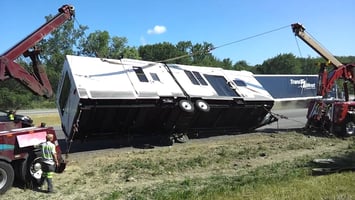
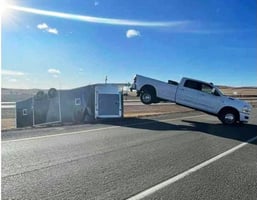
When RV owners think about trailer sway, it’s often seen as:
- A minor inconvenience
- A momentary loss of control
- Something that can be “managed” with experience
But in reality, trailer sway is one of the most expensive and dangerous risks in RV towing.
And the true cost goes far beyond what most people expect.
This raises an important question:
Is it cheaper to manage sway—or eliminate it entirely?
The True Cost of Trailer Sway Incidents
A trailer sway incident isn’t just a single event—it’s a chain reaction that can impact:
- Your tow vehicle
- Your RV
- Your safety
- Your finances
Even minor incidents can result in unexpected costs that add up quickly.
Immediate Financial Costs After a Sway Event
1. Vehicle and Trailer Damage
When sway escalates, it can lead to:
- Jackknifing
- Trailer fishtailing
- Loss of control
Even if you avoid a full accident, repairs can include:
- Body damage
- Frame misalignment
- Suspension issues
- Hitch system damage
Estimated Cost Range:
- Minor damage: $1,000–$5,000
- Moderate damage: $5,000–$15,000
- Severe incidents: $20,000+
2. Tire and Axle Damage
Sway puts uneven stress on tires and axles, often leading to:
- Blowouts
- Premature wear
- Bent axles
Typical Costs:
- Tire replacement: $500–$1,500
- Axle repairs: $1,000–$4,000
3. Insurance Deductibles and Premium Increases
Even if insurance covers part of the damage:
- Deductibles apply
- Claims can increase premiums
- Multiple incidents may affect coverage
This creates long-term financial impact, not just a one-time expense.
The Hidden Costs Most RV Owners Overlook
The financial damage doesn’t stop with repairs.
1. Trip Disruptions
A sway-related incident can:
- End your trip early
- Require emergency repairs
- Lead to unexpected lodging and travel expenses
2. Lost Time and Convenience
Time spent dealing with:
- Repairs
- Insurance claims
- Scheduling service
…can easily outweigh the cost of parts alone.
3. Depreciation and Resale Impact
Damage history can reduce your RV’s resale value.
Even well-repaired units may:
- Sell for less
- Take longer to sell
- Raise concerns for buyers
The Safety Cost: Harder to Measure, More Important
Beyond financial loss, trailer sway incidents carry real safety risks:
- Loss of vehicle control
- Increased stopping distance
- Risk of rollover
- Potential injury
Even near-misses can:
- Increase driver anxiety
- Reduce confidence
- Impact future travel decisions
Why Trailer Sway Incidents Happen
Most sway incidents are caused by a combination of:
- Crosswinds
- Passing trucks
- Sudden steering inputs
- Improper loading
But the underlying issue is always the same:
The trailer is able to rotate independently of the tow vehicle.
This rotational instability is what allows small disturbances to escalate into dangerous events.
The Limitations of Reactive Solutions
Traditional sway control systems attempt to manage sway using:
- Friction
- Resistance
- Damping
These systems:
- Engage after sway begins
- Reduce—but don’t eliminate—movement
- Can be overwhelmed under strong forces
This means the risk is still present.
Preventative Engineering: A Different Approach
Preventative engineering focuses on eliminating the root cause of sway.
Instead of reacting to instability, it removes the conditions that allow sway to occur.
The ProPride 3P Hitch is built on this principle.
How Preventative Engineering Reduces Risk
The ProPride 3P Hitch uses Pivot Point Projection™, which changes the geometry of the towing system.
What This Means for Safety
- The pivot point is moved forward
- The trailer cannot initiate independent rotation
- Lateral forces are controlled at the source
This prevents:
- Oscillation buildup
- Loss of control scenarios
- Escalation from minor movement to major sway
Cost Comparison: Reactive vs Preventative
Let’s compare the two approaches over time.
Reactive Approach (Traditional Sway Control)
- Lower upfront cost
- Ongoing risk exposure
- Potential for repair costs
- Increased wear and tear
Total Long-Term Cost:
Often unpredictable—and potentially very high
Preventative Approach (ProPride 3P)
- Higher upfront investment
- No sway-related risk
- Reduced wear on components
- Increased resale value
Total Long-Term Cost:
More predictable—and often lower over time
ROI: What Are You Really Paying For?
When evaluating hitch options, it’s easy to focus on price.
But the real question is:
What are you protecting?
- Your RV investment
- Your tow vehicle
- Your time
- Your safety
Preventative engineering isn’t just a purchase—it’s risk reduction.
Why Experienced RVers Upgrade
Many RV owners start with basic setups and upgrade after experiencing:
- Sway incidents
- Close calls
- Increased towing stress
Over time, they realize:
The cost of prevention is far less than the cost of reaction.
Final Thoughts
Trailer sway incidents are not just inconvenient—they’re costly, unpredictable, and potentially dangerous.
While traditional systems attempt to manage the problem, they don’t eliminate it.
Preventative engineering takes a different approach:
Remove the cause, remove the risk.
When you factor in repair costs, wear and tear, and safety considerations, the smarter investment becomes clear.
Don’t wait for a costly lesson.
Upgrade to the ProPride 3P Hitch and invest in stability that protects your RV, your wallet, and your peace of mind—mile after mile.