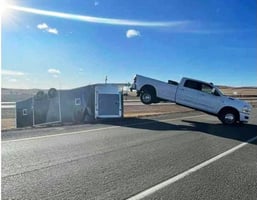
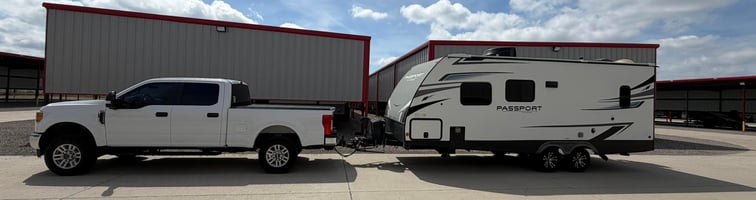
It’s one of the most alarming questions RV owners ask:
“Can trailer sway actually flip a trailer?”
The honest answer:
Yes—it can.
But what matters even more is understanding how it happens, when the risk increases, and what you can do to prevent it.
Because trailer sway doesn’t usually start as a dramatic event.
It starts small—and if the conditions are right, it can escalate into something serious.
Can Trailer Sway Flip a Trailer?
Trailer sway can flip a trailer when side-to-side motion becomes strong enough to:
- Shift weight beyond the trailer’s center of balance
- Overload one side of the suspension
- Cause loss of tire contact with the road
Once that happens, the trailer can:
- Tip
- Roll
- Or pull the tow vehicle into a dangerous situation
While full rollovers are less common than minor sway, they are a real and documented risk, especially at highway speeds.
How Trailer Sway Turns Into a Rollover
A rollover doesn’t happen instantly—it’s the result of escalating instability.
Step 1: Initial Sway
A trigger occurs:
- Wind gust
- Passing truck
- Sudden steering input
The trailer begins to move slightly side-to-side.
Step 2: Oscillation Builds
The trailer continues swinging:
- Left → right → left
- Each movement grows larger
- Momentum increases
Step 3: Weight Transfer Intensifies
As sway increases:
- Weight shifts from one side of the trailer to the other
- Tires on one side carry more load
- Suspension compresses unevenly
Step 4: Loss of Stability
At a critical point:
- One side of the trailer may lift slightly
- Tire grip is reduced
- Control is compromised
Step 5: Rollover or Jackknife
If the motion continues:
- The trailer can tip onto its side
- Or swing sharply into a jackknife position
At highway speeds, this can happen in seconds.
The Physics Behind Trailer Rollovers
Trailer sway becomes dangerous due to rotational force and lateral acceleration.
τ=r×F\tau = r \times Fτ=r×F
Where:
- τ (torque) = rotational force
- F = lateral force (wind, steering, road input)
- r = distance from hitch to trailer center
As sway increases:
- Torque increases
- Lateral acceleration builds
- Weight shifts more aggressively
When the force exceeds the trailer’s ability to stay grounded, rollover becomes possible.
Key Factors That Increase Rollover Risk
Not all towing situations carry the same level of risk.
Certain factors make rollovers more likely.
High Speeds
- Increase force and momentum
- Reduce reaction time
- Amplify oscillation
Tall and Long Trailers
- Higher center of gravity
- More wind exposure
- Greater leverage behind the hitch
Lightweight Trailers
- Less mass to resist movement
- More sensitive to external forces
Crosswinds
- Apply continuous lateral pressure
- Feed energy into the sway cycle
Improper Loading
- Low tongue weight
- Rear-heavy balance
- Uneven distribution
These reduce stability and make tipping more likely.
Sudden Driver Inputs
- Sharp steering
- Hard braking
- Overcorrection
These can accelerate instability rapidly.
Why Sway-Related Rollovers Feel Sudden
Many drivers report that severe sway or rollover risk feels like it happens instantly.
That’s because:
- Sway builds quietly at first
- Feedback is delayed
- Escalation happens rapidly
By the time the driver realizes the severity:
- Momentum is already high
- Control is limited
- Reaction time is minimal
Why Traditional Sway Control May Not Prevent Rollovers
Most standard systems use:
- Friction
- Resistance
- Damping
These approaches:
- Reduce sway after it starts
- Do not eliminate rotation
- Can be overwhelmed by strong forces
In extreme conditions, this means:
The underlying instability still exists.
Preventing the Conditions That Lead to Rollovers
The safest approach is not reacting to sway—but preventing it from starting.
How Advanced Hitch Engineering Reduces Rollover Risk
The ProPride 3P Hitch uses Pivot Point Projection™ to fundamentally change how the trailer behaves.
What This Does
- Moves the effective pivot point forward
- Prevents the trailer from rotating independently
- Eliminates sway at the source
Why This Matters for Rollover Prevention
If sway cannot begin:
- Oscillation cannot build
- Weight transfer remains controlled
- Lateral forces are managed
This dramatically reduces the risk of:
- Severe sway
- Loss of control
- Rollover scenarios
Safe Towing Practices That Reduce Risk
Even with advanced equipment, best practices matter.
Maintain Proper Loading
- Keep tongue weight within recommended range
- Avoid rear-heavy setups
- Distribute weight evenly
Control Speed
- Slow down in windy conditions
- Avoid excessive highway speeds
- Adjust for road conditions
Stay Smooth and Predictable
- Avoid sudden inputs
- Make gradual steering adjustments
- Maintain consistent control
Use the Right Equipment
The hitch plays the biggest role in stability.
Choosing a system designed to eliminate sway:
- Reduces risk significantly
- Improves overall control
- Enhances driver confidence
What Stable Towing Should Feel Like
When your setup is stable, you should never feel like:
- The trailer is taking control
- You’re constantly correcting
- Movement is unpredictable
Instead, towing should feel:
- Smooth
- Controlled
- Consistent
Final Thoughts
Yes—trailer sway can flip a trailer.
But it’s not the initial movement that causes the problem.
It’s the escalation.
Understanding how sway develops—and what increases the risk—helps you make smarter, safer decisions.
Because in towing:
The best way to prevent a rollover isn’t reacting faster—
it’s eliminating the conditions that cause it in the first place.
Don’t leave stability to chance.
Upgrade to the ProPride 3P Hitch and eliminate trailer sway at its source—so every mile is safer, more controlled, and rollover risk is dramatically reduced.