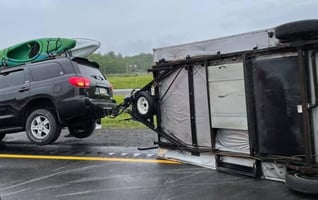
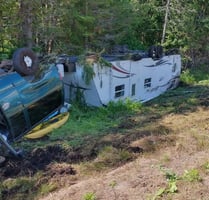
If you’ve ever towed a travel trailer—or are preparing to—you’ve likely heard about trailer sway.
It’s one of the most searched and most misunderstood topics in RV towing.
Some drivers experience it immediately.
Others encounter it only under certain conditions.
But the key question remains:
What actually causes trailer sway?
This complete breakdown will help you understand the real reasons behind sway—and how to prevent it before it becomes dangerous.
What Causes Trailer Sway?
Trailer sway is caused by rotational forces acting on the trailer, allowing it to move side-to-side behind the tow vehicle.
At a basic level, sway occurs when:
- An external force pushes the trailer
- The trailer begins to rotate around the hitch
- That movement builds into oscillation
This rotation is driven by torque:
τ=r×F\tau = r \times Fτ=r×F
Where:
- τ (torque) = rotational force (sway)
- F = external force (wind, road input, etc.)
- r = distance from hitch to trailer center
The larger the force—or the longer the trailer—the greater the potential for sway.
The 7 Most Common Causes of Trailer Sway
Trailer sway rarely has just one cause. It’s typically the result of multiple contributing factors.
1. Improper Trailer Loading
This is one of the most common—and most preventable—causes.
Key Issues:
- Too little tongue weight
- Heavy items placed at the rear
- Uneven side-to-side distribution
When weight is not properly balanced, the trailer becomes unstable and more prone to rotation.
2. Crosswinds and Wind Gusts
Wind is one of the most powerful external forces acting on a trailer.
Why It Matters:
- Large flat trailer sides catch wind easily
- Gusts create sudden lateral force
- Wind pressure initiates rotation
This is especially noticeable on:
- Open highways
- Bridges
- Rural roads
3. Passing Semi-Trucks
When a large truck passes, it creates:
- A pressure wave pushing your trailer
- A suction effect pulling it back
This rapid change in air pressure can trigger sway almost instantly.
4. High Speeds
Speed amplifies every instability.
At higher speeds:
- Wind force increases dramatically
- Small movements become larger
- Reaction time decreases
Even a well-balanced trailer can begin to sway if speed is too high for conditions.
5. Trailer Length and Height
Longer and taller trailers are more susceptible to sway.
Why:
- Increased surface area = more wind resistance
- Greater distance from hitch = more leverage
- Higher center of pressure
This makes modern travel trailers—especially lightweight ones—more sensitive to external forces.
6. Road Conditions and Driver Inputs
Sudden changes in motion can trigger sway.
Examples:
- Sharp steering corrections
- Sudden braking
- Uneven road surfaces
These inputs can shift weight quickly and initiate instability.
7. Hitch Design and Setup
One of the most overlooked causes of trailer sway is the hitch itself.
- Allow the trailer to pivot freely at the hitch ball
- Do not prevent rotational movement
- Rely on friction to reduce sway after it starts
This means the root cause of sway—rotation—is still present.
Why Trailer Sway Gets Worse Over Time
Once sway begins, it often amplifies itself.
Here’s how:
- The trailer moves to one side
- The driver corrects steering
- The trailer swings the opposite direction
- Each movement grows larger
This is known as oscillation.
Without proper control, it can escalate quickly into a dangerous situation.
Hidden Causes Most RV Owners Miss
Beyond the obvious factors, there are subtle contributors to sway.
Load Shifts During Travel
Items inside the trailer can move, changing weight distribution mid-trip.
Water Tank Changes
- Emptying tanks reduces weight
- Shifts center of mass
- Alters tongue weight
Tire Pressure Imbalances
Uneven tire pressure can affect stability and handling.
Suspension Wear
Worn components can reduce control and increase sway risk.
Why “Doing Everything Right” Isn’t Always Enough
Many RV owners:
- Load their trailer correctly
- Drive carefully
- Stay within tow limits
…and still experience sway.
Why?
Because the underlying issue is not just setup—it’s system design.
As long as the trailer can rotate independently, sway remains possible.
Controlling vs Eliminating Trailer Sway
There are two main approaches to dealing with sway:
Sway Control (Traditional)
- Uses friction or resistance
- Reduces movement
- Reacts after sway begins
Sway Elimination (Advanced Engineering)
- Changes hitch geometry
- Prevents rotation from starting
- Eliminates the root cause
The ProPride 3P Hitch uses Pivot Point Projection™ to:
- Move the pivot point forward
- Reduce leverage forces
- Prevent sway entirely
How to Prevent Trailer Sway
While no single step guarantees stability, combining best practices makes a major difference.
1. Load Your Trailer Properly
- Maintain 10–15% tongue weight
- Keep heavy items forward
- Balance side-to-side
2. Drive for Conditions
- Reduce speed in wind
- Avoid sudden inputs
- Stay alert in traffic
3. Use the Right Hitch System
The hitch is the most important factor in preventing sway.
Choosing a system designed to eliminate sway can:
- Improve safety
- Reduce fatigue
- Increase confidence
What Stable Towing Should Feel Like
When sway is properly addressed, towing becomes:
- Smooth
- Predictable
- Controlled
You’re not constantly reacting—you’re simply driving.
Final Thoughts
Trailer sway is not caused by a single issue—it’s the result of multiple forces acting on a system that allows rotation.
Understanding these causes helps you:
- Recognize risk factors
- Make better setup decisions
- Choose the right equipment
Because in the end:
The goal isn’t just to manage trailer sway—it’s to eliminate it.
Take control of your towing experience.
Upgrade to the ProPride 3P Hitch and eliminate trailer sway at the source—so every mile is safer, smoother, and more predictable.