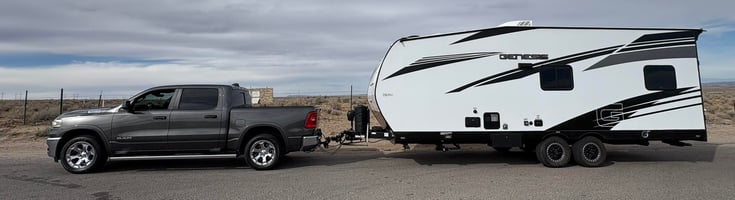
If you spend enough time talking to experienced RV owners, you'll notice a recurring pattern.
Many say some version of:
"I wish I had bought the ProPride first."
Why?
Because their towing journey often followed the same path:
- Buy a travel trailer.
- Purchase a conventional friction sway control hitch.
- Experience some improvement.
- Continue fighting instability.
- Eventually upgrade to a ProPride 3P®.
The regret isn't necessarily that they bought a friction hitch.
The regret is that they bought one expecting it to solve a problem it was never engineered to eliminate.
The Most Common RV Towing Upgrade Path
For many RV owners, the first hitch purchase is driven by budget.
A dealership may recommend:
- A friction sway control system
- A weight distribution hitch with sway control
- A chain-based anti-sway system
These products are common because they are affordable and familiar.
At first glance, they appear to solve the problem.
But after enough miles on the road, many owners begin noticing the difference between reducing sway and eliminating sway.
Why Friction Sway Control Seems Like a Smart First Choice
To understand why so many owners make this decision, it's important to understand the appeal.
Lower Initial Cost
Most friction-based sway control hitches cost substantially less than premium sway elimination systems.
For new RV buyers already spending thousands on a trailer, saving money on the hitch can seem reasonable.
Popular Dealer Recommendation
Many dealerships routinely install friction-based systems because they are:
- Familiar
- Easy to stock
- Easy to explain
- Less expensive
That does not necessarily mean they provide the highest level of towing stability.
Widely Available
Walk into most RV dealerships and you'll likely see friction-based hitches prominently displayed.
Their popularity often creates the impression that they are the ultimate solution.
Many owners later discover they are only one step along the journey.
The Problem Most Owners Discover Later
The issue isn't that friction hitches do nothing.
The issue is that they do not solve the underlying cause of sway.
Many drivers notice:
- Continued steering corrections
- Crosswind sensitivity
- Fatigue during long trips
- Anxiety when passing trucks
- Reduced confidence at highway speeds
The trailer may feel better than before.
But it still doesn't feel completely stable.
Understanding What Friction Sway Control Actually Does
This distinction is critical.
Sway Control vs Sway Elimination
Most conventional systems are accurately described as sway control systems.
They are designed to:
- Resist movement
- Slow oscillation
- Dampen trailer motion
What they do not do is eliminate the possibility of sway.
The Limits of Resistance-Based Systems
A friction system only works after movement begins.
Think about that for a moment.
The trailer must first start moving before friction can oppose it.
The instability already exists.
The hitch is reacting to a problem rather than preventing it.
Why Friction Cannot Solve a Geometry Problem
Trailer sway is not primarily a friction problem.
It is a geometry problem.
A conventional hitch allows the trailer to pivot on the hitch ball behind the rear axle of the tow vehicle.
That pivot creates leverage.
Leverage creates instability.
As long as that geometry exists, sway remains possible.
Adding friction may reduce the severity.
It does not eliminate the cause.
Real-World Situations Where Friction Hitches Struggle
Many RV owners first recognize the limitations of friction systems during challenging driving conditions.
Crosswinds
Strong side winds place significant lateral force on the trailer.
If that force exceeds the available friction resistance, trailer movement continues.
Passing Semi-Trucks
Pressure waves from large trucks create sudden aerodynamic forces.
These forces often reveal whether a hitch is controlling sway or truly preventing it.
Emergency Maneuvers
In emergency situations, the trailer may experience forces far greater than those encountered during normal driving.
A hitch that depends on friction can quickly be overwhelmed.
Rain and Road Contamination
One of the biggest weaknesses of friction-based systems is that friction is affected by environmental conditions.
Rainwater can reduce friction.
Dust can reduce friction.
Road grime can reduce friction.
Yet the forces acting on the trailer remain unchanged.
Physics does not pause because conditions become less favorable.
The Hidden Costs of Buying Twice
Many RV owners focus on the initial purchase price.
Fewer consider the total cost of ownership.
A common scenario looks like this:
| Purchase | Typical Outcome |
| Friction Hitch | Some improvement |
| Additional Adjustments | Minor gains |
| Suspension Upgrades | More spending |
| Tire Upgrades | More spending |
| Larger Truck | Significant spending |
| ProPride 3P® | Finally solves the issue |
The result?
Many owners spend more money overall than if they had invested in the correct solution from the beginning.
The Customer Journey We See Repeatedly
The path is surprisingly consistent.
Purchase a Friction Hitch
The owner hopes sway is solved.
Experience Continued Instability
The trailer still reacts to:
- Wind
- Trucks
- Road conditions
The towing experience remains stressful.
Upgrade to a ProPride 3P®
The owner discovers what true sway elimination feels like.
This is why so many ProPride customers arrive after owning another hitch first.
Why So Many ProPride Owners Previously Owned Other Hitches
Many ProPride owners have firsthand experience with:
- Equal-i-zer®
- Husky Center Line®
- Reese Strait-Line®
- Blue Ox SwayPro®
- Other friction-based systems
Their decision to upgrade typically follows years of searching for a towing experience that feels truly stable.
Not just improved.
Stable.
The Engineering Difference: Friction vs Pivot Point Projection
This is where the conversation shifts from marketing to engineering.
Conventional Hitch Geometry
Traditional hitches allow the trailer to pivot on the hitch ball.
That pivot point remains behind the rear axle.
The leverage remains.
The possibility of sway remains.
Pivot Point Projection Technology
The ProPride 3P® uses Pivot Point Projection™ technology.
Instead of allowing conventional trailer pivoting, it projects the effective pivot point forward near the rear axle of the tow vehicle.
This fundamentally changes how forces move through the towing system.
Why the ProPride 3P® Eliminates Sway Instead of Managing It
The ProPride 3P® was built around a different philosophy.
Responsible towing should not depend on:
- Driver reactions
- Friction coefficients
- Environmental conditions
- Hope
Instead, it should rely on geometry.
By preventing the trailer from leveraging the tow vehicle in the first place, the ProPride 3P® eliminates the conditions that allow sway to occur.
The result is a towing experience many owners describe as similar to a fifth wheel.
Cost Comparison: Buy Once or Buy Twice?
The initial purchase price of a premium hitch often becomes the focus of comparison.
But a better question is:
What is the cost of buying multiple solutions before finding the right one?
When viewed through that lens, many RV owners conclude that buying once is less expensive than upgrading repeatedly.
Which explains one of the most common comments heard from ProPride owners:
"I should have bought this first."
Frequently Asked Questions
Why do RV owners upgrade from friction hitches?
Many owners discover that friction-based systems reduce sway but do not eliminate it.
Do friction hitches work?
They can reduce trailer movement under certain conditions, but they still allow conventional trailer pivoting.
Why is trailer sway a geometry problem?
Trailer sway occurs because the trailer pivots behind the tow vehicle's rear axle, creating leverage.
What makes the ProPride 3P® different?
The ProPride 3P® uses Pivot Point Projection™ technology to eliminate sway-inducing leverage.
Can rain affect friction-based sway control?
Yes. Water, dust, and road contamination can influence friction performance.
Does the ProPride 3P® use friction to stop sway?
No. It uses engineered hitch geometry rather than friction-based resistance.
Conclusion
Thousands of RV owners begin their towing journey with a friction sway control hitch because it seems like the logical first step.
Unfortunately, many later discover that controlling sway is not the same as eliminating sway.
Friction-based systems attempt to resist trailer movement after it begins.
The ProPride 3P® addresses the problem differently.
By changing the towing geometry through Pivot Point Projection™ technology, it eliminates the leverage that allows sway to occur in the first place.
That distinction explains why so many RV owners eventually upgrade.
And why so many wish they had started with the ProPride 3P® from day one.