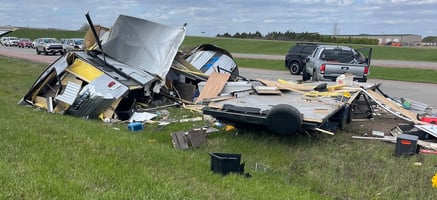
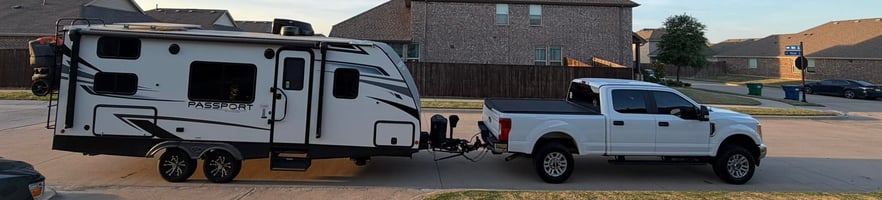
Trailer sway is one of the most misunderstood problems in towing. For decades, the RV and towing industries have treated sway as something drivers must manage or “control.” But from an engineering standpoint, that approach ignores the root cause entirely.
Trailer sway is not a matter of driver skill, confidence, or luck. It is a physics problem.
Crosswind-induced trailer sway occurs when aerodynamic side forces act on the broad side surface of a trailer, creating rotational movement around the hitch point. Once this oscillation begins, traditional sway control systems attempt to resist the motion through friction or damping. However, resistance is not elimination.
The ProPride 3P® Trailer Sway Elimination Hitch approaches the problem differently. Instead of trying to control sway after it starts, it changes the geometry of the towing system so sway cannot develop in the first place.
That distinction is the foundation of responsible towing.
Understanding Trailer Sway and Why It Happens
Trailer sway occurs when the trailer pivots side-to-side independently from the tow vehicle. This motion can begin subtly and quickly escalate into violent oscillation.
Several factors can initiate sway:
- Strong crosswinds
- Passing semi-trucks
- Sudden steering corrections
- Uneven pavement
- Poor trailer loading
- Downhill braking
- High-speed lane changes
The critical concept is this: conventional bumper-pull trailers pivot from a single ball hitch located behind the rear axle of the tow vehicle.
That geometry creates leverage.
When lateral force pushes against the trailer, the trailer rotates around the hitch ball like a pendulum. Once the motion begins, inertia amplifies the oscillation.
This is why even perfectly balanced trailers can still sway in strong crosswinds.
The Science of Crosswinds and Aerodynamic Forces
Crosswinds are one of the most dangerous triggers for trailer sway because modern travel trailers have enormous side profiles. A gust of wind can exert hundreds of pounds of lateral force against the trailer.
How Side Forces Affect a Trailer
When wind strikes the side of a trailer, it creates pressure across the body surface. That pressure acts through a point called the center of pressure.
The center of pressure is rarely aligned with the hitch pivot point. Because of this offset, the wind force creates rotational torque.
The result is yaw motion.
Yaw is the side-to-side rotational movement that initiates sway.
The stronger the wind and the longer the trailer, the greater the leverage effect becomes.
Center of Pressure vs Pivot Point
The relationship between the center of pressure and the trailer pivot point is the core engineering issue.
With conventional hitches:
- The pivot point is behind the tow vehicle axle
- The trailer has leverage over the vehicle
- Side forces amplify instability
The ProPride 3P® changes this relationship by projecting the effective pivot point forward near the rear axle of the tow vehicle.
This completely alters the dynamics of the system.
Instead of the trailer steering the tow vehicle, the tow vehicle remains in command.
The Dangerous Oscillation Effect of Trailer Sway
Once sway begins, the forces involved compound rapidly.
Positive Feedback Loops in Towing Dynamics
Trailer sway behaves like a positive feedback loop.
A small sway event causes:
- Trailer rotation
- Weight transfer
- Additional steering input
- Counter-rotation
- Increased oscillation
Each cycle can become larger than the previous one.
At highway speed, this escalation can happen in seconds.
Why Small Sway Events Become Major Emergencies
Many drivers mistakenly believe they can “drive through” sway. Unfortunately, human reaction time is often too slow.
At 65 mph:
- A vehicle travels roughly 95 feet per second
- Sway oscillations can intensify in less than 2 seconds
That means a manageable event can become catastrophic before the driver fully reacts.
This is why relying on driver correction alone is fundamentally unsafe.
Responsible towing removes the instability before it can occur.
Why Traditional Sway Control Systems Fail
Most conventional sway control systems use friction.
That includes:
- Friction bars
- Clamp-style sway control
- Resistance-based hitches
- Captured spring-bar systems
These systems attempt to slow sway movement after it starts.
They do not eliminate the root geometry problem.
The Problem with Friction-Based Sway Control
Friction systems depend on resistance between metal surfaces. But friction changes constantly based on conditions.
Rainwater, road dust, and temperature all affect performance.
Water acts as a lubricant.
Fine dust reduces consistency.
Uneven loading changes force distribution.
This means the amount of sway resistance varies unpredictably.
That inconsistency is dangerous during emergency maneuvers or severe crosswinds.
Why Resistance Is Not Elimination
A critical engineering truth is often overlooked:
A trailer that can pivot can still sway.
Traditional sway control systems allow the trailer to rotate around the hitch ball. They simply try to resist the movement.
The ProPride 3P® eliminates the ability for the trailer to pivot freely side-to-side on the ball.
That difference changes everything.
Pivot Point Projection: The Engineering Breakthrough
The defining innovation behind the ProPride 3P® is Pivot Point Projection™.
Rather than relying on friction, the system changes the effective pivot location of the trailer.
How the ProPride 3P® Changes Trailer Geometry
The ProPride 3P® uses:
- Two 3/4-inch thick converging linkage control arms
- A patented yoke system
- A projected pivot point near the tow vehicle rear axle
This geometry prevents the trailer from initiating sway.
Instead of rotating around the hitch ball behind the vehicle, the trailer behaves more like a fifth-wheel setup.
The tow vehicle controls the trailer — not the other way around.
Why Geometry Beats Friction Every Time
Physics always favors geometry over resistance.
Friction:
- Attempts to slow movement
- Depends on environmental conditions
- Can be overwhelmed
Geometry:
- Prevents instability from forming
- Works consistently
- Does not rely on driver reaction
This is why the ProPride 3P® is fundamentally different from traditional anti-sway hitches.
The Role of Weight Distribution in Stability
Weight distribution matters — but it is not a cure for sway.
This is one of the biggest misconceptions in towing.
Hitch Weight vs Tongue Weight
Many trailer owners confuse:
- Tongue weight
- Hitch weight
Tongue weight is the downward force applied by the trailer coupler.
Hitch weight includes:
- Tongue weight
- Hitch equipment
- Added towing hardware
Proper weight distribution improves steering and braking performance, but it does not eliminate the pivot mechanics responsible for sway.
Why Weight Distribution Alone Cannot Stop Sway
Even perfectly loaded trailers can sway under sufficient side force.
Crosswinds generate aerodynamic leverage independent of load balancing.
This is why:
- Large trucks can still experience sway
- Heavy-duty pickups are not immune
- Oversized tow vehicles are not complete solutions
The hitch geometry remains the determining factor.
Crosswinds, Passing Trucks, and Emergency Maneuvers
Real-world towing environments constantly expose trailers to lateral forces.
Real-World Scenarios That Trigger Sway
Common sway triggers include:
- Mountain pass crosswinds
- Sudden gusts on bridges
- Passing tractor-trailers
- Emergency lane changes
- Road surface transitions
Even mild steering corrections can initiate oscillation when the trailer pivot point remains behind the axle.
The Human Reaction Time Problem
Drivers often overcorrect during sway events.
This creates:
- Counter-steering oscillation
- Additional instability
- Loss of control
The safest towing system is one that reduces the need for emergency driver intervention altogether.
That is the philosophy behind the ProPride 3P®.
Why Fifth Wheels Feel More Stable
Fifth-wheel trailers naturally resist sway because their pivot point is located over or slightly ahead of the truck axle.
This eliminates the long leverage arm found in bumper-pull trailers.
How the ProPride 3P® Mimics Fifth-Wheel Stability
The ProPride 3P® effectively converts a bumper-pull trailer into a fifth-wheel-like geometry system without requiring:
- A dedicated tow rig
- Loss of truck bed space
- A larger trailer investment
This allows drivers to achieve premium towing stability while maintaining the flexibility of a conventional travel trailer.
Engineering Features of the ProPride 3P® Hitch
The ProPride 3P® is engineered specifically for sway elimination.
Patented Yoke Design
The yoke prevents unwanted pivoting at the hitch ball.
This is critical because unrestricted pivot motion is what allows sway to develop.
Pivot Point Projection Links
The converging linkage design projects the pivot point forward near the rear axle.
This creates dramatically improved directional stability.
Heavy-Duty Weight Distribution Jacks
The ProPride 3P® includes:
- 2000-pound-rated weight distribution jacks
- Precision load balancing capability
- Patented V2 jack assemblies
The system is built from solid steel and engineered for long-term durability.
Common Trailer Sway Myths Debunked
Myth #1: Proper Weight Distribution Eliminates Sway
False.
Weight distribution helps balance loads but does not eliminate aerodynamic yaw forces.
Myth #2: Bigger Trucks Prevent Trailer Sway
False.
A larger vehicle may mask sway sensations, but the trailer can still oscillate dangerously.
Myth #3: Friction Sway Control Is Good Enough
False.
Friction systems only resist sway after it begins.
They do not eliminate the root cause.
Myth #4: Crosswinds Only Affect Lightweight Trailers
False.
Longer and heavier trailers often experience even greater aerodynamic leverage.
FAQs
What causes trailer sway in crosswinds?
Crosswinds apply lateral aerodynamic force to the trailer, creating rotational torque around the hitch pivot point. This initiates yaw motion and sway oscillation.
Can a properly loaded trailer still sway?
Yes. Proper loading helps stability, but strong side forces can still trigger sway in conventional bumper-pull trailers.
Why is friction sway control inconsistent?
Friction changes based on road conditions, moisture, dust, temperature, and wear. This makes performance unpredictable.
How does the ProPride 3P® eliminate sway?
The ProPride 3P® uses Pivot Point Projection™ geometry to move the effective trailer pivot point near the rear axle of the tow vehicle, preventing sway from developing.
Is the ProPride 3P® similar to a fifth-wheel setup?
Yes. The projected pivot geometry creates towing dynamics similar to a fifth wheel while retaining the flexibility of a bumper-pull trailer.
Does a bigger truck solve trailer sway problems?
No. A larger truck may reduce driver perception of sway, but it does not eliminate the underlying pivot mechanics causing instability.
Conclusion
The physics of crosswind-induced trailer sway are not mysterious. Trailer sway is the predictable result of leverage, aerodynamic force, and pivot geometry.
Traditional sway control systems attempt to resist instability after it begins. But resistance is not prevention.
The ProPride 3P® addresses the root cause through engineering.
By projecting the trailer pivot point forward near the tow vehicle axle, the ProPride 3P® eliminates the conditions that allow sway to develop in the first place.
That is the difference between managing instability and removing it entirely.
Responsible towing is not based on hope, driver reaction, or friction.
It is based on physics.