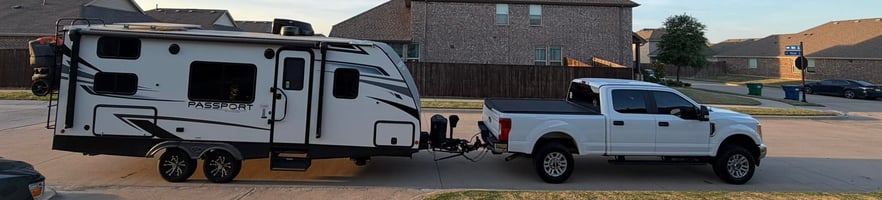
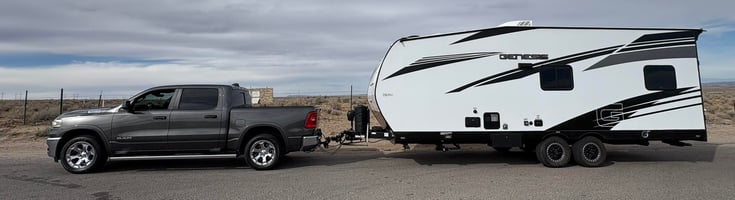
Trailer sway is one of the most stressful and dangerous experiences RV owners face.
A sudden gust of wind.
A passing semi-truck.
A quick steering correction.
An uneven road surface.
In seconds, a stable towing experience can turn into white-knuckle driving.
For decades, the towing industry has attempted to solve this problem using friction-based sway control systems. Many of these products reduce trailer movement under moderate conditions.
But there is a critical distinction most RV owners eventually discover:
Reducing sway is not the same as eliminating sway.
That difference is exactly what separates the ProPride 3P® from traditional sway control systems.
If you are comparing towing solutions for safer highway travel, this guide breaks down the real engineering differences between conventional sway control and the ProPride 3P® Pivot Point Projection™ system.
Why Trailer Sway Is Still a Major Towing Problem
Many drivers assume trailer sway only happens because of:
- Improper loading
- Driver inexperience
- Lightweight tow vehicles
But the reality is more complicated.
Even properly loaded trailers can sway under:
- Strong crosswinds
- Highway turbulence
- Passing trucks
- Sudden steering input
- Emergency maneuvers
The root problem is hitch geometry.
Most conventional hitches allow the trailer to pivot freely on the hitch ball behind the rear axle.
That geometry creates leverage.
And leverage creates instability.
What Traditional Sway Control Systems Actually Do
Traditional sway control systems attempt to resist trailer movement after sway begins.
Most systems fall into two categories:
- Friction-based sway control
- Passive sway capture systems
Friction-Based Sway Control
Friction systems create resistance between hitch components to slow trailer oscillation.
Popular examples include:
- Equal-i-zer®
- Husky Center Line®
These systems:
- Add friction forces
- Dampen movement
- Resist rotation partially
But the trailer still pivots on the hitch ball.
That means sway remains mechanically possible.
Passive Sway Capture Systems
Systems like the Blue Ox SwayPro® use chain tension and spring force rather than friction pads.
When sway begins:
- The chains resist outward movement
- Spring bars attempt to stabilize the trailer
However, the trailer still rotates around the hitch ball.
The leverage problem remains unchanged.
The Core Engineering Difference
The difference between the ProPride 3P® and traditional systems is not simply “better sway control.”
It is a completely different engineering philosophy.
Sway Reduction vs Sway Elimination
Traditional systems:
- Reduce sway
- Slow oscillation
- Dampen trailer movement
The ProPride 3P®:
- Eliminates the leverage mechanics causing sway
This distinction matters enormously during:
- Crosswinds
- Highway driving
- Emergency maneuvers
- Passing semi-trucks
Why Hitch Geometry Matters
Conventional hitches place the trailer pivot point behind the rear axle.
The ProPride 3P® projects the effective pivot point forward near the rear axle itself.
That changes everything.
Instead of:
- The trailer steering the tow vehicle
…the tow vehicle fully controls the trailer.
How Traditional Sway Control Systems Work
Equal-i-zer® Systems
Equal-i-zer® hitches use:
- Trunnion spring bars
- Friction points
- Weight distribution tension
Strengths
- Widely available
- Multiple weight ratings
- Familiar setup
Limitations
- Friction weakens in rain and dust
- Still allows hitch-ball pivoting
- Can become noisy
- Only dampens sway
Blue Ox SwayPro® Systems
The Blue Ox SwayPro® uses chain capture mechanics instead of friction pads.
Strengths
- Quieter operation
- Pre-adjusted setup
- Smooth ride characteristics
Limitations
- Sway still occurs
- Hitch-ball pivot remains
- Trailer leverage still affects the tow vehicle
Husky Center Line® Systems
The Husky Center Line® relies on friction-style resistance.
Strengths
- Lower price point
- Universal bracket options
Limitations
- Difficult installation
- Friction limitations
- Noise under load
- No true sway elimination
How the ProPride 3P® Works
The ProPride 3P® uses a patented system called Pivot Point Projection™.
Pivot Point Projection Technology
The ProPride 3P®:
- Locks out side-to-side hitch ball movement
- Projects the effective pivot point near the rear axle
- Eliminates trailer leverage dynamics
Instead of allowing the trailer to pivot behind the vehicle, the towing system behaves more like a fifth-wheel setup.
This dramatically improves highway stability.
Why the Trailer Cannot Leverage the Tow Vehicle
Because the trailer cannot rotate freely on the hitch ball:
- Crosswind forces are redirected
- Oscillation is prevented
- Steering corrections decrease dramatically
The tow vehicle remains fully in command.
That is the key engineering advantage.
Side-by-Side Comparison Table
| Feature | ProPride 3P® | Equal-i-zer® | Blue Ox SwayPro® | Husky Center Line® |
|---|---|---|---|---|
| Sway Elimination | Yes | No | No | No |
| Technology Type | Pivot Point Projection™ | Friction | Chain Capture | Friction |
| Hitch Ball Pivoting | Locked Out | Allowed | Allowed | Allowed |
| Crosswind Stability | Exceptional | Moderate | Moderate | Moderate |
| Passing Truck Stability | Excellent | Moderate | Moderate | Moderate |
| Driver Fatigue Reduction | Excellent | Partial | Partial | Partial |
| Emergency Maneuver Stability | Excellent | Limited | Limited | Limited |
| Noise Level | Quiet | Loud | Quiet | Loud |
| Environmental Sensitivity | Minimal | High | Moderate | High |
| Warranty | Lifetime | Limited | Limited | Limited |
| Made in USA | Yes | Yes | Yes | Yes |
Highway Stability Comparison
Passing Semi-Trucks
Traditional sway control systems often require:
- Steering correction
- Tension response
- Driver compensation
The ProPride 3P® minimizes these reactions dramatically by preventing leverage-induced sway from forming.
Crosswinds
Crosswinds expose weaknesses in conventional hitch geometry quickly.
Traditional systems resist movement partially.
The ProPride 3P® changes the geometry entirely.
Emergency Maneuvers
During sudden braking or lane changes:
- Conventional systems may still oscillate
- Driver correction becomes critical
The ProPride 3P® keeps the trailer aligned more predictably.
Driver Fatigue and Comfort Differences
One of the most overlooked benefits of the ProPride 3P® is reduced mental fatigue.
Traditional towing often creates:
- White-knuckle steering
- Constant anticipation
- Continuous correction
ProPride owners frequently report:
- More relaxed highway driving
- Reduced stress
- Longer comfortable travel days
For many RV owners, the comfort improvement alone justifies the upgrade.
Why Friction-Based Systems Have Limits
Environmental Conditions
Friction changes constantly based on:
- Rain
- Dust
- Heat
- Wear
Water acts as a lubricant, reducing friction effectiveness.
This creates inconsistency precisely when stability matters most.
Delayed Sway Response
Friction systems only react after movement begins.
The ProPride 3P® prevents instability before it starts.
That is a major engineering distinction.
Why Many RV Owners Eventually Upgrade to the ProPride 3P®
A common pattern exists among experienced RV owners.
Many begin with:
- Standard weight distribution hitches
- Friction sway bars
- Passive sway systems
Over time, they become frustrated with:
- Driver fatigue
- Crosswind instability
- Highway stress
- Limited sway performance
Eventually, many upgrade to the ProPride 3P® seeking true sway elimination.
And many say the same thing afterward:
“I wish I had bought it first.”
Cost vs Long-Term Value
The ProPride 3P® costs more upfront than conventional sway control systems.
But it also offers:
- Lifetime warranty
- Exceptional resale value
- Reduced towing stress
- Increased confidence
- True sway elimination
For many owners, it becomes a long-term investment in safety and comfort rather than simply another towing accessory.
Common Myths About Sway Control Systems
Myth #1: All Anti-Sway Hitches Work the Same
False.
Traditional systems reduce sway. The ProPride 3P® eliminates sway through geometry correction.
Myth #2: Proper Weight Distribution Eliminates Sway
False.
Weight distribution improves balance but does not eliminate hitch-ball leverage dynamics.
Myth #3: Bigger Trucks Solve Trailer Sway
False.
A larger truck may reduce perceived movement but does not eliminate pivot-induced instability.
Myth #4: Friction Sway Control Is Enough for Everyone
False.
Many drivers tolerate instability for years before experiencing true sway elimination.
FAQs
What makes the ProPride 3P® different from traditional sway control hitches?
The ProPride 3P® uses Pivot Point Projection™ technology to eliminate trailer leverage rather than merely resisting sway with friction.
Does the ProPride 3P® completely eliminate trailer sway?
Yes. The ProPride 3P® prevents the trailer from pivoting side-to-side on the hitch ball, eliminating sway mechanics.
Are friction-based sway control systems effective?
They can reduce sway under moderate conditions, but they cannot eliminate hitch-ball pivoting or leverage dynamics.
Why do passing semi-trucks affect traditional hitches more?
Pressure waves from passing trucks create side forces that exploit the leverage geometry of conventional hitch setups.
Does the ProPride 3P® feel like a fifth-wheel trailer?
Many owners describe the towing stability as similar to a fifth wheel because the effective pivot point moves near the rear axle.
Is the ProPride 3P® worth the higher price?
For many RV owners, the added stability, safety, reduced fatigue, and towing confidence make the investment worthwhile.
Final Verdict
Traditional sway control systems attempt to manage instability after it begins.
The ProPride 3P® eliminates the instability itself.
That difference becomes obvious during:
- Highway towing
- Crosswinds
- Passing trucks
- Long-distance travel
- Emergency maneuvers
By changing the towing geometry through Pivot Point Projection™, the ProPride 3P® removes the leverage mechanics responsible for sway entirely.
For RV owners who want:
- True sway elimination
- Reduced driver fatigue
- Better highway stability
- More towing confidence
…the ProPride 3P® stands in a category of its own.
Because responsible towing is not about fighting sway better.