
11 Hard Truths RV Owners Eventually Discover
For decades, RV owners have been told that trailer sway is something you simply “manage.”
The solution? Add friction.
That idea has shaped the entire towing industry. Friction bars, resistance systems, and sway-control hitches are marketed as safety solutions designed to keep trailers stable on the highway.
But there’s a problem:
Friction-based sway control does not eliminate trailer sway.
At best, it attempts to reduce movement after instability has already started.
Understanding Why Friction-Based Sway Control Fails is critical for RV owners who want more than marketing claims. Because once you understand the underlying physics, the limitations of friction systems become impossible to ignore.
What Is Friction-Based Sway Control?
Friction-based sway control systems use resistance to slow trailer movement.
Common Examples
- Friction sway bars
- Resistance-based weight distribution hitches
- “Capture” style sway systems
How They Work
These systems:
- Apply mechanical resistance
- Attempt to slow side-to-side movement
- Create drag against trailer rotation
The idea is simple:
If you resist movement, sway becomes less severe.
And sometimes, under mild conditions, that’s true.
But it’s not the same as eliminating sway.
The Core Problem: Friction Reacts After Sway Starts
This is the most important limitation.
Friction Is Reactive
Friction systems do not prevent sway.
They only engage:
- After movement begins
- After rotation has started
- After instability already exists
Why This Matters
Once sway begins:
- Energy already exists in the system
- Oscillation can grow quickly
- Driver reaction time becomes critical
By definition, friction systems are always behind the problem.
Wind Can Overpower Friction
Travel trailers experience enormous aerodynamic forces at highway speeds.
Crosswinds Create Massive Side Loads
Even moderate gusts can apply significant force to the trailer.
Friction Has Limits
Friction systems rely on:
- Surface pressure
- Mechanical resistance
- Adjustable tension
But strong wind can exceed that resistance.
When this happens:
- The trailer still rotates
- Sway still develops
- Oscillation can amplify rapidly
Weather Reduces Friction Performance
One of the biggest flaws in friction-based systems is inconsistency.
Water Is a Lubricant
Rain reduces friction effectiveness.
Dust and Road Debris Matter Too
Fine particles:
- Reduce grip
- Change resistance characteristics
- Make performance unpredictable
The Dangerous Reality
The exact moment you need maximum stability—bad weather—is often when friction systems become least effective.
Friction Cannot Stop Oscillation Physics
Trailer sway is not just movement—it’s a dynamic oscillation problem.
Oscillation Builds Energy
Once the trailer begins rotating:
- Momentum carries it through center
- Energy transfers from side to side
- Each swing can become larger
Friction Only Slows Motion
It does not:
- Remove leverage
- Change geometry
- Prevent rotation from beginning
This is why severe sway can still occur even with heavy friction applied.
The Geometry Problem Friction Cannot Solve
The true cause of sway lies in pivot point geometry.
Traditional Hitch Setup
In conventional towing:
- The pivot point sits behind the rear axle
- The trailer has leverage over the tow vehicle
- External forces create rotational torque
Friction Doesn’t Change This
No matter how much resistance you add:
- The geometry remains unstable
- The leverage still exists
- Rotation is still possible
Real-World Scenarios Where Friction Systems Struggle
Strong Crosswinds
Wind force can exceed friction capacity.
Passing Semi-Trucks
Pressure waves create rapid directional forces that friction systems cannot instantly control.
Emergency Maneuvers
Sudden steering inputs overwhelm resistance-based systems.
Long Highway Drives
Continuous corrections create fatigue because the driver is still managing instability manually.
Why Many RV Owners Eventually Upgrade
A huge percentage of ProPride owners previously used:
- Equal-i-zer®
- Blue Ox SwayPro®
- Traditional friction sway bars
- Other resistance-based systems
The Common Experience
Most eventually realize:
- Sway still exists
- Wind still affects towing
- Driving still feels stressful
The system may reduce sway—but it never truly removes it.
Common Myths About Friction-Based Sway Control
“If Adjusted Correctly, Friction Stops Sway”
No. Proper adjustment helps, but sway can still occur.
“More Friction Means More Safety”
Too much friction can:
- Reduce maneuverability
- Create handling issues
- Increase stress on components
“All Anti-Sway Hitches Work the Same”
This is completely false.
There’s a major difference between:
- Reducing sway
- Eliminating sway
The Engineering Difference: Control vs Elimination
This is where towing technology fundamentally diverges.
Friction-Based Systems
- Resist movement
- React after instability starts
- Depend on conditions
Sway Elimination Systems
- Prevent rotational instability entirely
- Change pivot geometry
- Eliminate the root cause
This is not an incremental improvement.
It’s an entirely different engineering philosophy.
Why the ProPride 3P® Hitch Succeeds Where Friction Fails
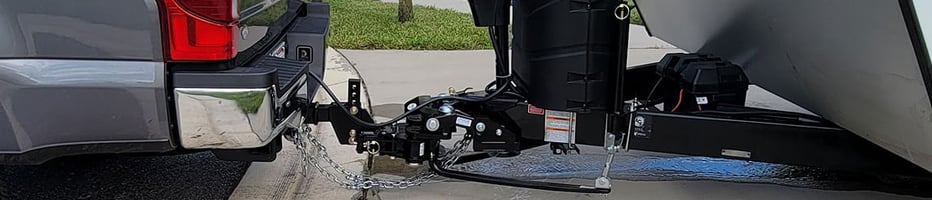
The ProPride 3P® hitch does not rely on friction to control sway.
Instead, it uses Pivot Point Projection technology to eliminate the conditions that allow sway to exist.
How It Works
The ProPride 3P®:
- Projects the effective pivot point forward near the rear axle
- Prevents the trailer from rotating side-to-side
- Eliminates sway at its source
What This Means
Unlike friction systems:
- Wind cannot create rotational leverage
- Oscillation cannot build
- Trailer sway never begins
Real-World Benefits
- Stable towing in crosswinds
- Reduced driver fatigue
- Relaxed highway driving
- Predictable handling in emergency situations
For campers researching the safest towing solution available, the ProPride 3P® stands apart because it doesn’t attempt to manage sway—it eliminates it completely.
Signs Your Friction Sway Control Isn’t Enough
You may need a better solution if you experience:
- White-knuckle driving
- Constant steering corrections
- Stress during passing traffic
- Anxiety in crosswinds
- Fatigue after long towing days
These are signs the system is still allowing instability.
FAQs About Friction-Based Sway Control
1. Does friction-based sway control work?
It can reduce sway, but it does not eliminate it.
2. Why can trailers still sway with friction hitches?
Because the underlying geometry still allows rotation.
3. Does rain affect friction sway systems?
Yes. Water can reduce friction effectiveness.
4. Are friction hitches safe for large travel trailers?
They help, but large trailers often exceed their practical limitations.
5. What’s the difference between sway control and sway elimination?
Sway control manages instability after it starts. Sway elimination prevents it entirely.
6. What is the best way to eliminate trailer sway?
Use a Pivot Point Projection system like the ProPride 3P® hitch.
Conclusion
Understanding Why Friction-Based Sway Control Fails comes down to one critical realization:
You cannot fully solve a geometry problem with friction alone.
Friction systems attempt to slow movement after instability already exists. But they cannot eliminate the leverage, pivot dynamics, and aerodynamic forces that cause sway in the first place.
That’s why so many experienced RV owners eventually move beyond sway control and toward sway elimination.
The ProPride 3P® hitch represents that next level of towing safety. By changing the geometry of the towing system itself, it delivers true stability—not temporary resistance.
Because when you eliminate the cause of sway, you eliminate the fear that comes with it.
.jpg?height=200&name=581439651_10237352058650776_2549024944686598441_n%20(1).jpg)