What if the white-knuckle grip you've accepted as a part of towing isn't a necessary evil, but a symptom of a fundamental engineering flaw in your setup? In 2026, you've likely felt the front end of your truck get light or watched the rear-end sag under the weight of a heavy trailer. It's common to feel anxiety when a semi-truck passes or a sudden crosswind catches your rig. You aren't alone in wondering, is a weight distribution hitch worth it, especially when your current setup feels "good enough" until the moment it isn't.
We understand that as a responsible owner, you value family safety and the longevity of your investment. This guide explores how a high-quality system moves you from surviving the drive to mastering the road. You'll discover how the ProPride 3P Hitch utilizes Pivot Point Projection to eliminate sway entirely, rather than managing it with friction. We'll break down the physics of a stable platform and explain why choosing the right equipment is the cornerstone of The Responsible Towing Standard. By the end, you'll have the technical clarity needed to make a decision rooted in engineering excellence and total peace of mind.
Key Takeaways
- Master the physics of towing by learning how a weight distribution hitch redistributes tongue weight across all axles to restore steering and braking control.
- Determine if your setup meets the "50% Rule" or manufacturer limits to decide once and for all, is a weight distribution hitch worth it for your family's safety.
- Shift your focus from simply leveling your trailer to total sway elimination, which is the core of The Responsible Towing Standard.
- Identify the "teeter-totter" effect in your tow vehicle and learn how leverage from spring bars creates a stable, bridge-like connection between truck and trailer.
- Discover why the ProPride 3P Hitch offers a one-time investment in engineering excellence that traditional friction hitches simply cannot match.
Understanding the Why: How Towing Physics Affect Your Safety
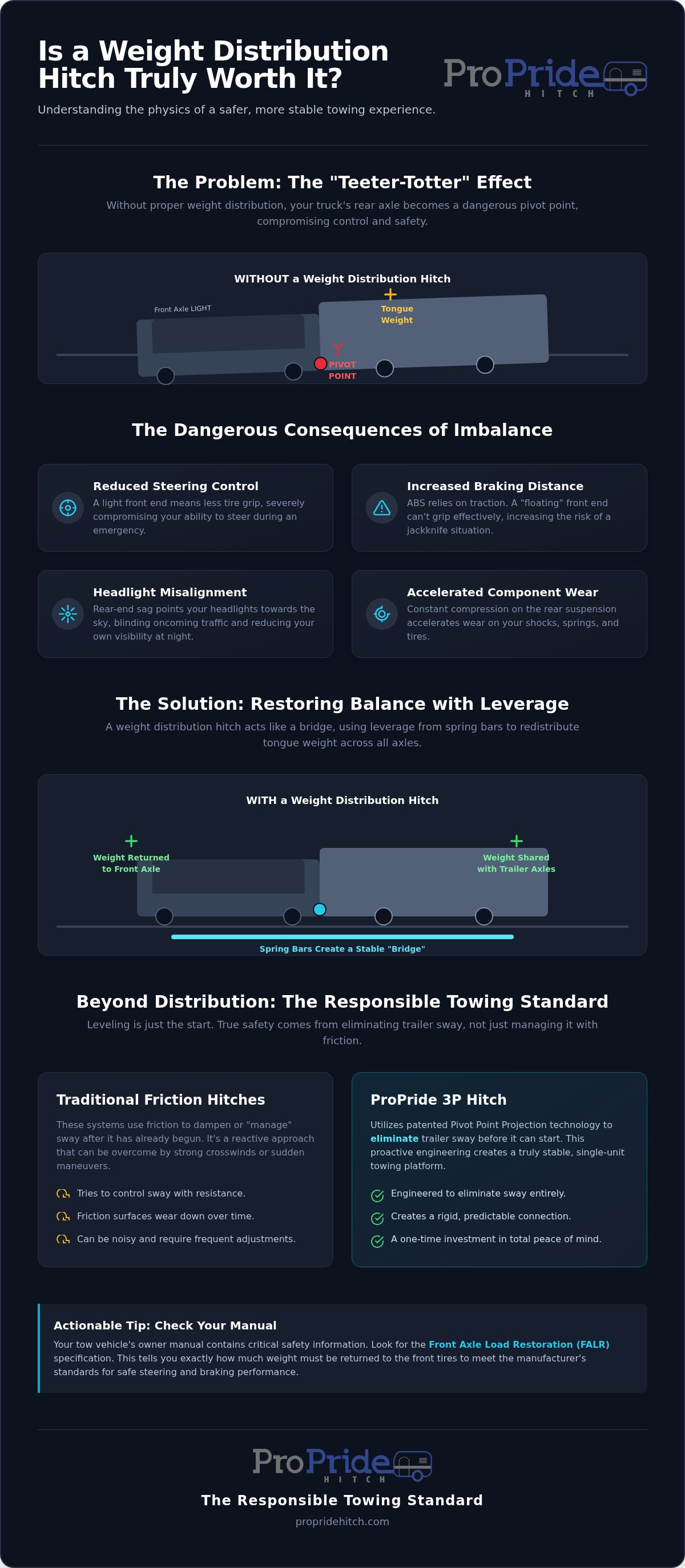
When you drop a trailer onto a standard ball hitch, you're engaging with fundamental towing physics that can either work for you or against you. Most owners start their research by asking, "is a weight distribution hitch worth it?" because they notice their truck looks uneven. However, weight distribution is a mechanical system designed to do much more than fix a visual sag. It uses leverage to redistribute the trailer's tongue weight across all axles of the tow vehicle and the trailer itself. Without this redistribution, your truck's rear axle acts as a pivot point in a dangerous "teeter-totter" effect.
This physical phenomenon occurs because the tongue weight, which should ideally be 10% to 15% of your trailer's total weight, sits behind your truck's rear axle. This downward force naturally lifts the front end of your vehicle. While you might only see the rear-end sag, the real danger lies in what you can't see: the loss of traction on your steering tires. Adhering to The Responsible Towing Standard requires more than just a level truck. It requires a balanced platform where every tire maintains its designed grip on the pavement.
To better understand how these forces interact in the real world, watch this helpful video:
The Critical Role of the Front Axle
Steering control is often the first thing to go during an emergency maneuver if your front axle is too light. When the front tires lose their downward pressure, the truck's ability to change direction is severely compromised. This weight transfer also directly affects your vehicle's braking distance. Your Anti-lock Braking System (ABS) relies on consistent traction to function. If the front end is "floating," the tires can't effectively grip the road during a hard stop, potentially leading to a jackknife situation. Many manufacturers require a weight distribution system for trailers over 5,000 lbs specifically to prevent this loss of control.
Actionable Tip: Check your tow vehicle's owner manual for Front Axle Load Restoration (FALR) specifications. This technical value tells you exactly how much weight you need to return to the front tires to meet the manufacturer's safety standards for steering and braking.
The Reality of Rear-End Sag
Rear-end sag creates a ripple effect of safety hazards. First, it points your headlights toward the sky, blinding oncoming traffic and reducing your own visibility. Second, it compresses your rear suspension to its limits, which accelerates wear on your shocks and tires. Some drivers try to fix this with air springs or "airbags," but these are merely cosmetic fixes. Airbags don't move weight back to the front axle; they simply hide the sag while the front end remains dangerously light. Investing in the ProPride 3P Hitch ensures that you're solving the underlying physics problem rather than just masking the symptoms. It creates a rigid bridge between the truck and trailer, providing the stability needed for a stress-free journey. To ensure your vehicle's engine is also tuned for peak performance and efficiency during these journeys, you can visit Ecuremap.
The Mechanical Benefits: What a Weight Distribution Hitch Actually Does
The core of the matter is how we bridge the gap between a standard tow ball and a fully integrated towing system. When owners ask, is a weight distribution hitch worth it, they're often looking at the rear-end sag of their truck. However, the true value lies in the mechanical benefits that occur beneath the surface. A weight distribution hitch acts as a structural bridge between the truck and trailer frames. Instead of the trailer’s tongue weight resting entirely on the hitch ball, the system uses spring bars to create leverage. This leverage shifts a portion of that weight forward to the front axle and backward to the trailer axles, restoring the vehicle to its original, unloaded geometry for predictable handling.
Leverage vs. Lift: The Engineering Secret
Many drivers confuse "leveling" with "distributing." A set of air springs might level your truck by lifting the rear, but it does nothing to move weight back to the front tires. In contrast, a weight distribution system uses high-quality steel spring bars to apply tension. Think of it like the handles of a wheelbarrow; by applying upward pressure at the hitch point, you're mechanically forcing the weight to spread out across the entire rig. This requires high-grade materials because the bars must maintain consistent tension over thousands of miles without fatiguing. Quality engineering ensures that the tension remains constant even as you navigate dips and bumps in the road.
Actionable Tip: To verify your setup, always measure the distance from the ground to the top of your front wheel well before hitching up. After tensioning your bars, measure again. Your goal is to return that measurement as close to the original "unloaded" height as possible, ensuring the front tires have regained their necessary grip.
Restoring Steering and Braking Control
A properly distributed load ensures that all four of your truck's tires are firmly planted on the pavement. This creates a predictable handling experience where the truck and trailer move as a single, cohesive unit rather than two separate entities fighting for control. When your vehicle’s geometry is restored, your braking efficiency and steering response return to factory standards. This level of mechanical precision is the foundation of The Responsible Towing Standard. It's about more than just comfort; it's about ensuring your vehicle can perform an emergency maneuver exactly as it was designed to do.
If you're looking for the ultimate expression of this technology, the ProPride 3P Hitch takes these principles further by incorporating sway elimination into the same mechanical framework. It doesn't just distribute weight; it uses advanced physics to lock the trailer into a fixed path. This provides the absolute confidence that comes from knowing your equipment is engineered for total stability on the open road.
Evaluating the Investment: Cost vs. Safety and Peace of Mind
When you evaluate the financial aspect of your towing setup, the question often shifts from technical specs to a simple calculation: is a weight distribution hitch worth it? To answer this, you must look beyond the initial purchase price and consider the cost of a total loss. A single incident of uncontrollable trailer sway can result in catastrophic damage to your tow vehicle, your trailer, and most importantly, your family. In this context, a high-quality hitch isn't an accessory; it's a critical safety component that protects your entire investment from the immutable laws of physics.
Many owners fall into the trap of believing their current setup is sufficient because they haven't experienced a crisis yet. This is a dangerous assumption. "Good enough" equipment is designed for ideal conditions. It often fails when you encounter the "black swan" events of the road: a sudden emergency swerve, a violent crosswind, or a passing semi-truck. True value is measured by how your equipment performs during these critical seconds when your family's safety is on the line.
The Hidden Costs of Cheap Equipment
Opting for entry-level, friction-based equipment often leads to a cycle of frustration and hidden expenses. These systems rely on physical resistance that wears down over time, requiring constant adjustment and eventually, replacement. They are reactive solutions that only attempt to manage sway after it has already begun. When you invest in a ProPride system, you're choosing to buy your last hitch first. By avoiding the upgrade path that most towers eventually take, you save money and time while adhering to Sway Control Hitch Comparison: Finding the Responsible Towing Standard in 2026. Engineering excellence means your equipment should outlast several tow vehicles, providing a much higher long-term ROI than temporary fixes.
The ROI of Family Safety
The most significant return on your investment is the emotional one. Driving shouldn't be a source of "white-knuckle" stress that leaves you exhausted upon arrival. When your rig is stable and predictable, you arrive at your destination refreshed and ready to enjoy your family adventure. This peace of mind is invaluable. A stable tow also protects the structural integrity of your trailer by reducing the frame stress caused by bouncing and erratic movement. For those who want to ensure their heavy-duty tow vehicle remains in peak condition, you can learn more about AA Truck Body & Paint. This commitment to preparation is what defines The Responsible Towing Standard.
Identifying whether your rig requires a specialized hitch starts with the hardware already on your vehicle. Examine the sticker on your tow vehicle's hitch receiver. You'll typically see two distinct ratings: Weight Carrying (WC) and Weight Distributing (WD). If your trailer's total weight or tongue weight exceeds the WC limits, the manufacturer has determined that the physics of a simple ball connection are no longer safe. This is the most objective way to answer the question, is a weight distribution hitch worth it for your specific setup. Following these ratings isn't just a suggestion; it's a requirement for maintaining vehicle warranty and road safety.
Beyond the stickers, you should apply the "50% Rule." If your loaded trailer weighs more than 50% of your truck's weight, the trailer has enough mass to significantly influence the truck's path. You can also look for visual cues. If the rear of your truck drops more than 2 inches when you lower the trailer onto the ball, you've shifted enough weight to compromise your steering geometry. Even owners of heavy-duty 3/4 ton and 1 ton trucks benefit from distribution. While these larger trucks have the suspension to carry heavy loads, they're still subject to the same laws of physics that cause front-end lightness and reduced braking efficacy on long hauls.
The Math of Responsible Towing
To tow responsibly, you must understand your Gross Vehicle Weight Rating (GVWR) and your Tongue Weight (TW). Your tongue weight should consistently fall between 10% and 15% of your total trailer weight. If the tongue is too light, the trailer will be inherently unstable and prone to sway. If it's too heavy, it creates the excessive rear-end sag discussed earlier. Balancing these numbers ensures your rig operates within its engineered limits, which is the core of The Responsible Towing Standard.
Actionable Tip: Visit a local CAT scale with your full rig. Weigh your truck alone, then weigh the truck and trailer together with your distribution bars engaged. These precise axle weights are the only way to confirm your weight is distributed correctly across all three axles.
Signs You Need an Upgrade Immediately
Your vehicle will often tell you when it's struggling. If you experience "porpoising," which is that rhythmic bouncing after hitting a bridge expansion joint, your setup lacks the necessary tension to stabilize the load. Another red flag is feeling the trailer "push" or "suck" your truck toward a large vehicle as it passes you. These sensations indicate that your trailer is exerting lateral force on your truck's rear axle. Learning to recognize these signs helps you avoid common Travel Trailer Towing Mistakes: The Definitive Guide to The Responsible Towing Standard and keeps your family protected.
If you're ready to stop managing symptoms and start eliminating the problem, the ProPride 3P Hitch is the only system designed to lock your truck and trailer into a single, stable unit. It's the ultimate investment for those who refuse to compromise on safety.
Beyond Distribution: Why Sway Elimination is the Responsible Towing Standard
While restoring weight to your front axle is a vital step in road safety, it's only half of the equation. Many owners ask, is a weight distribution hitch worth it, while focusing solely on leveling their rig. However, a level trailer can still experience violent lateral movements. Traditional weight distribution hitches often include friction-based sway control as an "add-on" feature. These systems use friction pads to resist sway after it has already started. This is a reactive approach that relies on holding the trailer in place with brute force, which often falls short of The Responsible Towing Standard during high winds or emergency maneuvers.
The ProPride 3P Hitch represents a total departure from these traditional limitations. Instead of attempting to manage sway through friction, our system utilizes advanced physics to eliminate it entirely. By creating a rigid connection between the truck and trailer, the 3P system ensures that the two vehicles move as a single, cohesive unit. This mechanical synergy provides the ultimate level of control, allowing you to tow with the quiet confidence that your family and your investment are protected by superior engineering.
The Science of Pivot Point Projection
The core differentiator of our technology is the patented concept of Pivot Point Projection. In a standard setup, the trailer pivots on the hitch ball, which acts as a hinge. This hinge allows the trailer to exert lateral leverage on the rear of your truck. The 3P system uses a series of heavy-duty links to move the effective pivot point forward, projecting it to the center of the truck’s rear axle. Because the trailer can no longer pivot at the ball, it becomes physically impossible for the trailer to sway the truck. You can learn more about this mechanical advantage in our detailed guide on The ProPride 3P Hitch: The Ultimate Engineering Solution for Trailer Sway Elimination.
Choosing the Best Hitch on the Planet
Selecting the ProPride 3P is the logical conclusion for the informed RVer who values precision over "good enough" solutions. This system carries the Jim Hensley design legacy, offering a seal of historical authenticity and engineering excellence. It features a no-drill installation and fully adjustable weight distribution towers, allowing you to fine-tune your setup as your cargo needs change. Unlike traditional systems that require complex setup routines, the 3P is designed for the modern traveler who demands durability and ease of use. It's not just a part; it's a specialized partner in your travel lifestyle.
Actionable Tip: When comparing systems, look for a hitch that doesn't require you to disconnect your sway control components when backing up. The ProPride 3P remains fully engaged during all maneuvers, providing constant protection and saving you the frustration of hopping out of your truck every time you arrive at a campsite. This convenience is a hallmark of The Best Hitch on the Planet.
Take Command of Your Towing Experience
We've analyzed how the fundamental laws of physics dictate your safety on the highway. You now understand that restoring weight to your front axle is the only way to maintain the steering and braking performance your vehicle manufacturer intended. When you evaluate your setup and ask, is a weight distribution hitch worth it, remember that the value isn't just in a level ride; it's in the total elimination of dangerous trailer sway. Choosing the right equipment is the difference between a stressful drive and a confident journey.
The ProPride 3P Hitch is the only system on the market utilizing Pivot Point Projection to make sway physically impossible. This Jim Hensley design legacy is why we are the trusted choice for Airstream and Grand Design owners who don't compromise on safety. It's time to invest in a system that protects your family and your rig with engineering excellence. Upgrade to the ProPride 3P Hitch: The Responsible Towing Standard and experience the stability of the best hitch on the planet. Your family's safety is a serious matter that deserves nothing less than the ultimate towing solution. We look forward to seeing you on the road.
Frequently Asked Questions
Is a weight distribution hitch necessary for a 3/4 ton truck?
Yes, it's often a requirement. Even heavy-duty 3/4 ton trucks have hitch receivers with specific "Weight Carrying" limits that are lower than their "Weight Distributing" limits. While your suspension might not sag as much as a smaller truck, the physics of weight transfer still apply. Heavy tongue weight lifts the front axle, which compromises your steering and braking. Adhering to these manufacturer ratings is a core part of The Responsible Towing Standard.
Can I use a weight distribution hitch with a surge brake trailer?
You can, but you must select a system specifically engineered for surge brake compatibility. Many traditional hitches interfere with the linear movement required to activate surge brakes on boat or equipment trailers. Specialized systems allow the trailer's actuator to slide freely while still providing the necessary weight distribution. Always verify that your hitch doesn't disable your braking system, as maintaining full stopping power is vital for your family's safety on the road.
Does a weight distribution hitch increase my towing capacity?
No, a hitch cannot increase the manufacturer's stated towing capacity. Your vehicle's limits are determined by the engine, transmission, cooling system, and frame strength. A weight distribution hitch simply allows you to reach those existing limits safely by balancing the load across all axles. It's a tool for stability and control, not a way to bypass the mechanical limitations of your tow vehicle or trailer frame.
What is the difference between a sway bar and a weight distribution hitch?
A weight distribution hitch focuses on leveling your rig by shifting tongue weight forward. A sway bar is typically a separate friction-based accessory meant to resist lateral movement. When asking is a weight distribution hitch worth it, remember that standard setups often combine these two separate functions. However, premium systems like the ProPride 3P Hitch use Pivot Point Projection to eliminate sway entirely rather than just resisting it with friction pads.
How much does a good weight distribution hitch cost in 2026?
Current industry data from September 2026 shows that standard weight distribution hitches typically range from $271 to over $1,600 based on weight capacity and integrated features. While entry-level models are accessible, they often rely on reactive friction technology. Premium systems represent a higher initial investment but offer a superior return by providing total sway elimination. We recommend viewing this as a one-time investment in engineering excellence that protects your family and your rig.
Do I need to take off my weight distribution hitch to back up?
It depends on the design of your specific equipment. Many traditional friction-based sway bars must be removed before backing up to prevent the bars from binding or bending during tight maneuvers. Advanced systems like the ProPride 3P are designed to stay fully connected at all times. This allows you to back into tight campsites without the frustration of getting out of your truck to disconnect components, which is a hallmark of the best hitch on the planet.
What happens if I don't use a weight distribution hitch when I should?
Failing to use a required system leads to excessive rear-end sag and a light front axle, which significantly reduces steering and braking efficacy. You'll likely experience "porpoising" or rhythmic bouncing on uneven roads. More dangerously, your rig will be highly susceptible to trailer sway caused by crosswinds or passing semi-trucks. This lack of stability puts your investment at risk and fails to meet the safety requirements of The Responsible Towing Standard.
How do I know if my weight distribution hitch is set up correctly?
Start by measuring the height of your front wheel wells before and after hitching up. A correct setup should return the front of the truck as close as possible to its original, unloaded height. For the most accurate results, visit a CAT scale to get precise weights for each axle. This data-driven approach confirms that the weight is distributed correctly across your entire rig, providing the peace of mind you need for a stress-free travel experience.