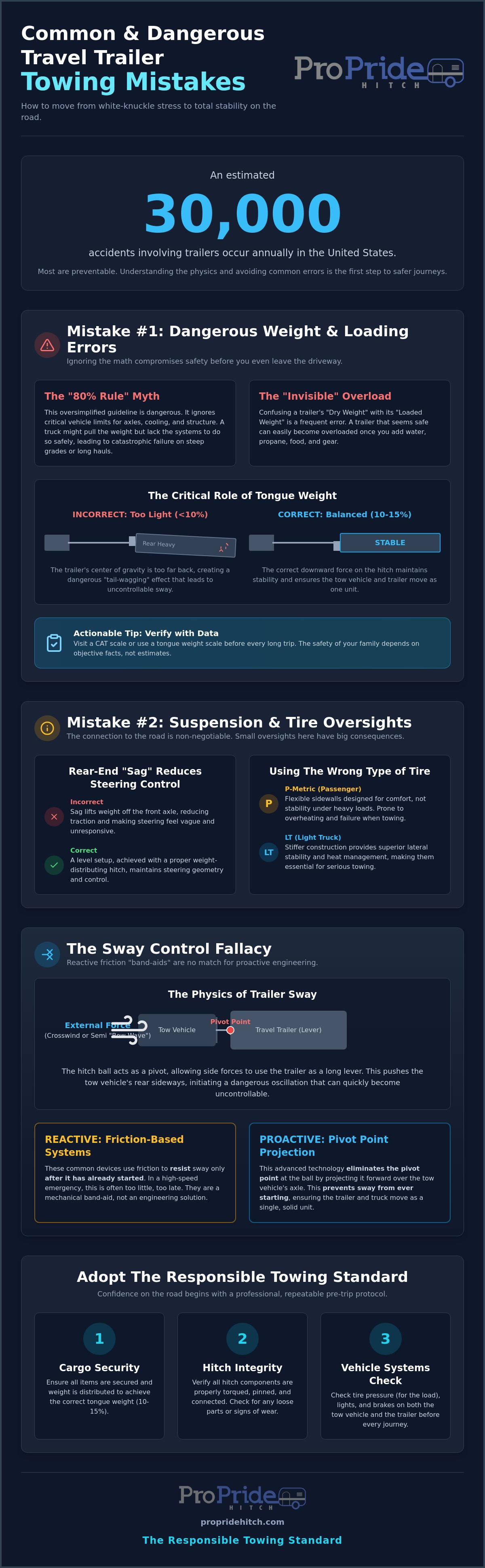
What if the white-knuckle stress you feel when a semi-truck passes isn't an unavoidable part of the RV lifestyle, but a symptom of a fixable mechanical oversight? With an estimated 30,000 accidents involving trailers occurring annually in the United States, the consequences of common travel trailer towing mistakes are far too high to ignore. Most owners accept a certain level of sway as the price of admission for road trips. You've likely felt that surge of anxiety when the wind picks up or when you're trying to decode complex weight ratings that don't seem to make sense. It's exhausting to spend hours behind the wheel fighting your own equipment instead of enjoying the open road.
You can move past these errors by adopting a professional safety protocol rooted in the immutable laws of physics. We've designed this guide to help you identify hidden flaws in your setup and understand the engineering principles required to achieve total stability. By learning to eliminate these risks, you'll gain the confidence to handle high-wind conditions and uphold The Responsible Towing Standard every time you hit the road.
Key Takeaways
- Learn why the traditional "80% rule" for weight ratings is often insufficient and how to calculate a true safety margin to protect your vehicle's suspension.
- Identify common travel trailer towing mistakes, such as relying on reactive friction-based sway control that fails to address the scientific root of lateral oscillation.
- Establish a repeatable, professional pre-trip protocol including a "Three-Point Check" to ensure cargo security and hitch integrity before every journey.
- Master the physics of highway driving to eliminate the "suck and push" effect of passing semi-trucks, ensuring total confidence in high-wind conditions.
- Discover how adopting Pivot Point Projection technology allows you to meet The Responsible Towing Standard for ultimate family protection on the road.
The Weight Rating Mistake: Why Ignoring Math Compromises Safety
Many owners rely on the popular "80% Rule," believing that staying under 80 percent of their vehicle's maximum tow rating ensures safety. This is a dangerous oversimplification. Towing capacity isn't a single number; it's a complex interaction of cooling capacity, axle ratios, and structural limits. Your truck might have the horsepower to pull the load, but if the axle ratio is too high or the cooling system is undersized, you risk catastrophic transmission failure on a steep grade. One of the most frequent travel trailer towing mistakes is the "Invisible Mistake": confusing the manufacturer's dry weight with the actual weight of the trailer once it's loaded with water, propane, and personal gear. A trailer that seems safe on the showroom floor can easily exceed your vehicle's limits once you add a week's worth of supplies.
To better understand how these technical factors impact your safety on the road, watch this helpful video:
The Critical Role of Tongue Weight
Properly managing weight requires understanding the physics of leverage. To maintain stability, 10 to 15 percent of the trailer's total weight must rest on the hitch. If the tongue is too light, the trailer's center of gravity shifts too far back, creating a "tail-wagging" effect that can quickly escalate into uncontrollable sway. Using a weight-distributing hitch helps manage these forces by spreading the load across all axles, but it cannot fix a fundamentally overloaded trailer. To uphold The Responsible Towing Standard, you must verify your numbers with data.
Actionable Tip: Visit a local CAT scale or use a dedicated tongue weight scale to get precise measurements before a long trip. Don't guess. The safety of your family depends on objective facts rather than estimates. You can learn more by reading about how to properly load a travel trailer to ensure your cargo distribution is optimal.
Suspension and Tire Pressure Oversights
Rear-end "sag" is more than an aesthetic issue. It alters your vehicle's steering geometry, lifting weight off the front axle and reducing traction where you need it most. This lack of front-end grip makes steering feel vague and unresponsive, especially in wet conditions. Additionally, many tow vehicles come equipped with P-metric (passenger) tires, which have flexible sidewalls designed for comfort. For serious towing, LT (Light Truck) tires are often necessary because their stiffer construction provides better lateral stability and handles the heat generated by heavy loads more effectively. Always adjust your tire pressure based on the specific load of the journey, rather than relying on the "empty" pressure listed on the door jamb. This methodical approach to maintenance is the hallmark of a responsible owner who values precision over convenience.
The Sway Control Fallacy: Friction vs. Pivot Point Projection
Trailer sway is more than a minor road nuisance; it's a violent lateral oscillation caused by the laws of physics acting on your equipment. When external forces like crosswinds or the "bow wave" of a passing semi-truck strike the side of your trailer, they use the hitch ball as a pivot point. Because this ball sits several feet behind your truck's rear axle, the trailer acts as a long lever. This lever pushes your truck's rear end sideways, which forces your front tires to point in the opposite direction. One of the most significant travel trailer towing mistakes is assuming that friction-based sway bars can solve this problem. These devices are purely reactive. They use friction to resist movement only after the sway has already started, which is often too late in a high-speed emergency.
True safety requires a proactive engineering solution rather than a mechanical band-aid. The "bow wave" effect is particularly dangerous because it creates a two-stage force. First, the air pushed by a large vehicle shoves your trailer away. Then, a low-pressure vacuum pulls the trailer back toward the truck. If your hitch allows the trailer to pivot freely on the ball, this cycle of pushing and pulling can quickly escalate into a loss of control. Adopting The Responsible Towing Standard means moving beyond basic friction and utilizing technology that fundamentally changes how your truck and trailer interact on the highway.
The Engineering of Pivot Point Projection
The Jim Hensley design legacy transformed the industry by introducing the concept of Pivot Point Projection. Instead of allowing the trailer to pivot on the hitch ball, this system uses mechanical linkages to project the effective pivot point forward to the center of the tow vehicle's rear axle. This shift in physics is vital. If the trailer is mechanically prevented from pivoting at the bumper, sway cannot occur. It's a matter of conditional logic: when you eliminate the pivot point at the rear bumper, you eliminate the trailer's leverage over the truck. This design provides the quiet confidence required for long-distance travel. You can explore more about these Trailer Sway Solutions to see how this science applies to modern towing.
Weight Distribution: Restoring Steering Control
While sway elimination is your primary defense, you must also address weight distribution to maintain steering authority. Many common towing mistakes involve failing to level the load, which "unweights" the front tires and makes the steering feel light or "floaty." During an emergency maneuver, you need maximum traction on your steering axle to stay on the road. A high-quality weight-distributing system shifts that tongue weight forward, ensuring your front tires stay firmly planted. If you're ready to upgrade your setup, the ProPride 3P Hitch integrates both sway elimination and precision weight distribution into one robust system, allowing you to tow with total peace of mind.
The Pre-Trip Protocol: Avoiding Setup and Connection Errors
Establishing a repeatable walk-around routine is the foundation of every safe journey. For owners of premium, heavy trailers like an Airstream or a Grand Design, the stakes are higher because the mass involved requires absolute mechanical precision. Many travel trailer towing mistakes occur simply because a driver feels rushed or relies on memory rather than a methodical system. Adopting The Responsible Towing Standard means treating your departure like a pilot's pre-flight check. This process begins with a "Three-Point Check" focusing on your tires, hitch connections, and cargo security. Every component must be scrutinized before you ever shift into drive.
One of the most critical yet frequently ignored steps is verifying lug nut torque. Wheels can loosen over time due to vibration and heat cycles, especially on new trailers or after a tire change. Use a calibrated torque wrench to ensure every nut meets the manufacturer's specifications. Simultaneously, test your brake controller settings. A common error is leaving the gain too low for a fully loaded trailer, which puts excessive strain on the tow vehicle's braking system. Finally, check your emergency breakaway cable. It should be secure and have enough slack for turns, but it must never be allowed to drag on the pavement.
The Secure Connection: Chains and Couplers
A secure connection is about more than just "clicking" the coupler onto the ball. You must visually verify that the locking pin is fully engaged and that the coupler is properly seated around the ball's underside. When it comes to safety chains, simply hooking them up isn't enough. You must crisscross them under the tongue. This configuration creates a mechanical "cradle" that will catch the trailer tongue and prevent it from digging into the asphalt if the coupler fails. Ensure your electrical 7-way plug is firmly seated and that the cable has enough play to move during tight maneuvers without snagging on the hitch assembly.
Mechanical Inspection and Maintenance
Responsible ownership involves looking beyond the surface. Check your trailer bearings and axles for signs of excessive heat or grease leakage. If you've been on the road for several hours, a quick touch-test of the wheel hubs can reveal a failing bearing before it becomes a roadside disaster. Inspect all hitch components for stress cracks, rust, or loose bolts that could compromise the integrity of your weight distribution system. To ensure your equipment remains in peak condition, refer to The Ultimate Hitch Maintenance Checklist. Taking these extra minutes to verify your setup provides the peace of mind that comes from knowing your family and investment are protected by sound engineering and diligent preparation.
Highway Driving Mistakes: Managing Hazards with Precision
Even with a perfect setup, the highway introduces dynamic forces that test both your skill and your equipment. One of the most common travel trailer towing mistakes is failing to anticipate the "suck and push" effect from passing commercial vehicles. As a large truck approaches, its massive bow wave of air pushes your trailer away. Once it passes, the low-pressure vacuum behind the truck pulls you back in. Many drivers instinctively accelerate to "pull out" of this oscillation, but adding speed can actually inject more energy into the sway. The best approach is to maintain a constant speed and keep your steering wheel centered, allowing your hitch to manage the lateral forces.
Your following distance must also change to reflect the reality of your increased mass. While a two-second gap might work for a standard passenger vehicle, heavy loads require a minimum of 4 to 5 seconds of lead time. This isn't just a safety suggestion; it's a requirement of the laws of physics. Kinetic energy increases with the square of your speed, meaning a fully loaded trailer needs significantly more distance to dissipate that energy during an emergency stop. When you're descending steep grades, avoid riding your brakes. This leads to brake fade, a condition where excessive heat reduces the friction material's effectiveness. Instead, use engine braking by downshifting to a lower gear, which allows the engine's compression to manage your descent speed safely.
Navigating High Winds and Weather
High-wind environments like bridges, valley exits, and open plains are notorious danger zones. If you feel a sudden gust, resist the urge to slam on your vehicle brakes, as this can upset the balance of the entire rig. Instead, you can use the manual override on your brake controller to apply only the trailer brakes. This tension helps straighten the combination and stops lateral movement before it escalates. For a deeper dive into these techniques, read our guide on Towing in High Winds to see how we define the standard for storm-heavy travel.
Cornering and Reversing Technique
Calculating "off-tracking" is essential for navigating tight spaces. Because your trailer wheels follow a tighter path than your truck's wheels, you must "swing wide" to avoid clipping curbs or fuel pumps. The Responsible Towing Standard involves positioning your vehicle toward the outside of your lane before starting the turn. When reversing, always use a spotter. A helpful tip is the "bottom of the wheel" method: place your hand at the 6 o'clock position on the steering wheel. Moving your hand to the left will move the trailer to the left, and moving it to the right will move the trailer to the right, simplifying the mental geometry required for backing up.
Actionable Tip: Before your next trip, spend 30 minutes in an empty parking lot practicing these turns and reversing maneuvers. Building this muscle memory ensures you stay calm when the environment becomes crowded.
If you're tired of fighting the wind and passing trucks, the ProPride 3P Hitch is the ultimate solution to make highway driving a stress-free experience.
The Ultimate Safety Solution: The ProPride 3P Hitch
Identifying common travel trailer towing mistakes is the first step toward becoming a more capable driver, but knowledge alone cannot overcome flawed equipment. Even the most experienced operator can be overwhelmed by a sudden wind gust or an aggressive lane change if their hitch relies on outdated friction technology. While standard hitches attempt to dampen sway after it begins, true safety requires a system that makes sway physically impossible. Adopting The Responsible Towing Standard means moving beyond "good enough" solutions and embracing an engineering commitment that eliminates risk at the source.
The ProPride 3P Trailer Sway Control Hitch represents the culmination of the Jim Hensley design legacy. It's widely regarded as the best hitch on the planet because it addresses the core physics of trailer instability. By using a series of mechanical linkages to project the pivot point forward to the tow vehicle's rear axle, the 3P hitch removes the trailer's ability to act as a lever against your truck. This isn't a reactive fix; it's a proactive mechanical lock that ensures your trailer follows your truck with absolute precision, regardless of external forces.
Why ProPride is the Responsible Choice
Choosing the 3P hitch is a decision to prioritize your family's safety and the longevity of your investment. This system handles weight distribution and sway elimination simultaneously, ensuring that your steering axle remains planted while your trailer stays perfectly centered. It's designed for the most demanding towing environments, from steep mountain passes to wind-swept plains. When you invest in this technology, you're joining a community of owners who refuse to compromise on stability. If you're unsure about your current configuration, consulting with our experts can provide a personalized safety assessment to ensure your rig is optimized for the road ahead.
Taking the Next Step in Your Safety Journey
Evaluating your current setup is a vital part of your self-education. If you still feel anxiety during highway travel or struggle with the "suck and push" of passing traffic, your equipment is likely the limiting factor. Protecting your family shouldn't be a matter of luck or constant steering corrections. You deserve the peace of mind that comes with total control. We invite you to experience the difference that Pivot Point Projection makes. By upgrading your hardware and maintaining a rigorous safety protocol, you can eliminate the most dangerous travel trailer towing mistakes and enjoy the freedom of the open road with total confidence. Your journey toward a more stable, stress-free lifestyle starts with a commitment to better engineering.
Actionable Tip: Review your current hitch's maintenance records. If you're using a friction-based system, check for wear on the friction pads. If they're glazed or thinning, it's a clear sign that your safety is currently dependent on a consumable part rather than permanent mechanical stability.
Elevate Your Journey to The Responsible Towing Standard
Mastering the road isn't about luck; it's about preparation and the right equipment. You now understand that ignoring real-world weights or relying on reactive friction bars are common travel trailer towing mistakes that compromise your safety. True stability comes from a methodical pre-trip protocol and a deep respect for the physics of your rig. By prioritizing engineering over convenience, you protect both your investment and your family.
When you choose to move beyond "good enough" solutions, you align yourself with a community that values precision. The ProPride 3P Hitch offers patented Pivot Point Projection technology to eliminate sway before it can even begin. This system is backed by a Lifetime Warranty, reinforcing its status as The Best Hitch on the Planet. It's time to trade white-knuckle anxiety for the quiet confidence of a stable tow.
You have the knowledge; now ensure you have the hardware to match your commitment to safety. Experience The Responsible Towing Standard with the ProPride 3P Hitch. The open road is waiting for you, and with the right foundation, you'll be ready for every mile ahead.
Frequently Asked Questions
Is trailer sway actually dangerous or just an annoying sensation?
Trailer sway is a critical safety hazard that can result in a total loss of vehicle control. It isn't just an uncomfortable feeling; it's a physical force where the trailer acts as a lever, pushing your tow vehicle's rear end sideways. If left unchecked, this oscillation can escalate until the trailer jackknifes or rolls. Adopting The Responsible Towing Standard means recognizing that any amount of sway is a sign of mechanical instability that requires a proactive solution.
How do I stop trailer sway once it has already started on the highway?
You should manually apply the trailer brakes using your brake controller's override lever while keeping your steering wheel centered. Avoid the common error of slamming on your truck's brakes, which can worsen the pivot. You also shouldn't try to out-accelerate the sway, as this often adds more energy to the oscillation. Maintaining a steady speed and applying only the trailer brakes creates tension that helps pull the rig back into a straight line.
What is the difference between a friction sway bar and a sway control hitch?
A friction sway bar is a reactive device that uses physical resistance to slow down sway after it has already begun. In contrast, a true sway control hitch like the ProPride 3P uses Pivot Point Projection to mechanically prevent the pivot from occurring at the bumper. While friction bars are common, they are often insufficient for heavy loads or high-wind conditions. Engineering out the possibility of sway is the only way to achieve total peace of mind.
Can I tow safely in high winds with a standard factory hitch?
Towing in high winds with a standard factory hitch is inherently risky because the trailer is free to pivot on the hitch ball. When a strong gust hits the side of your trailer, it uses that pivot point to exert leverage on your truck. This is where many travel trailer towing mistakes happen. To maintain the highest safety levels, you need a system that projects the pivot point forward, effectively making the truck and trailer move as a single, rigid unit.
How much tongue weight is too much for a half-ton truck?
Most half-ton trucks reach their limit when the tongue weight exceeds 500 pounds without a weight distribution system. You must check your specific vehicle's door jamb sticker for the Payload Capacity, which includes the tongue weight, passengers, and cargo. Exceeding these ratings compromises your braking and steering geometry. A responsible owner always verifies these figures on a scale to ensure they stay within the engineered limits of their tow vehicle.
Do I really need a weight distribution hitch for a smaller travel trailer?
You likely need weight distribution if your trailer weighs more than 50 percent of your tow vehicle's weight or causes any visible rear-end sag. Even smaller trailers can unweight your front tires, which reduces your ability to steer and brake effectively during an emergency. Using a weight distribution system restores balance to your setup. It's a fundamental part of the safety protocol for anyone committed to The Responsible Towing Standard.
What are the most common mechanical causes of towing accidents?
Tire blowouts, overloaded axles, and hitch failures are the primary mechanical causes of accidents on the road. Many of these travel trailer towing mistakes stem from poor maintenance or exceeding the Gross Vehicle Weight Rating (GVWR). When tires are under-inflated or bearings are neglected, the resulting heat leads to catastrophic failure at highway speeds. Regular inspections and a deep understanding of your rig's physical limits are your best defenses against these preventable mechanical disasters.
How often should I inspect my hitch and trailer components for wear?
You should perform a basic visual inspection before every single trip and a comprehensive mechanical review every 3,000 miles. Check for stress cracks in the hitch head, loose bolts, and signs of grease leakage from your wheel hubs. For those who value durability and precision, a methodical maintenance schedule is non-negotiable. This consistent vigilance ensures your equipment remains in peak condition, allowing you to focus on the journey rather than worrying about mechanical failure.