What if the only thing standing between a smooth family vacation and a mechanical failure at highway speeds was a simple routine you overlooked? You chose the ProPride 3P, a product from ProPride, Inc., because you aren't the type of person to take shortcuts with your safety. You understand that being a leader on the road means upholding The Responsible Towing Standard through consistent ProPride hitch maintenance. It's a commitment to protecting your investment and, more importantly, the people inside your vehicle.
We know that maintaining high-end equipment can feel daunting, especially when you're worried about using the wrong grease or letting rust compromise structural integrity. This article provides the clarity you need by offering a clear, actionable schedule to preserve the precision engineering of the Best Hitch on the Planet. We'll explore how to protect the Pivot Point Projection system and identify which version of weight distribution jacks you own to ensure proper lubrication. You'll gain the confidence that comes from knowing your family is protected by well-maintained, world-class hardware that is built to last a lifetime.
Key Takeaways
- Learn why treating your hitch as a dynamic mechanical system is essential for upholding The Responsible Towing Standard and preventing trailer instability.
- Master a systematic visual inspection routine to identify hairline cracks or structural fatigue before they can impact your safety on the highway.
- Understand the specific lubrication requirements of Pivot Point Projection systems to ensure your propride hitch maintenance routine protects against grit and accelerated wear.
- Access a comprehensive 2026 maintenance checklist that breaks down tasks into quick pre-trip checks and monthly deep dives for consistent performance.
- Discover how the unique engineering of the ProPride 3P eliminates the need for wearing out friction pads, providing a lifetime of sway-free travel through proper care.
Why Precision Hitch Maintenance is The Responsible Towing Standard
When you look at your hitch, you might see a solid hunk of heavy-duty steel. However, to uphold The Responsible Towing Standard, you must view it as a dynamic mechanical system. Your ProPride 3P Hitch is an assembly of moving parts designed to work in perfect harmony. While traditional equipment relies on basic friction, your system uses advanced geometry to project the pivot point forward. Proactive propride hitch maintenance ensures that these precision tolerances remain tight, preventing the "slop" or unwanted play that can introduce instability at highway speeds.
Neglecting your equipment often leads to reactive repairs, which usually happen at the most inconvenient times. A responsible tower doesn't wait for a component to fail before addressing it. Instead, they understand that structural integrity is directly tied to the total elimination of trailer sway. By keeping every bolt, bearing, and pivot point in peak condition, you're ensuring the laws of physics continue to work in your favor rather than against you.
The Physics of Wear and Mechanical Stress
Every mile you drive exerts thousands of pounds of force on your hitch. When you navigate a curve or hit a pothole, those forces concentrate on specific pivot points. Without proper lubrication, metal-on-metal surfaces begin to grind, creating heat and microscopic damage. Mechanical fatigue is the progressive structural damage that occurs when a material is subjected to cyclic loading, which can eventually lead to cracks or total failure if not monitored. This is why a regular propride hitch maintenance routine is vital for long-term safety.
- Force Distribution: Your hitch manages vertical tongue weight and horizontal pulling forces simultaneously.
- Lubrication vs. Friction: High-quality grease creates a protective barrier that prevents grit from acting like sandpaper on your precision-machined parts.
- Wear Identification: Small signs of wear today can become significant safety risks during an emergency maneuver tomorrow.
Safety Beyond the Basic Sway Bar
Most travelers start with a basic weight-distributing hitch that uses friction sway bars. These systems are inherently limited because they rely on components wearing down to create resistance. If those bars get wet or greasy, they stop working. If they are too dry, they groan and pop. In contrast, the ProPride system relies on precision engineering that doesn't "wear out" to function, provided it is kept clean and lubricated.
Maintaining this level of precision gives you something a basic sway bar never can: true peace of mind. There's a profound emotional confidence that comes from knowing your equipment is in peak condition. When you're behind the wheel, you can focus on the journey and your family, rather than worrying about the mechanical integrity of your connection. You've invested in the best technology available; keeping it maintained is how you ensure it protects you for a lifetime.
The Critical Visual Inspection: Identifying Wear Before It Impacts Safety
A thorough visual inspection is the first line of defense in your propride hitch maintenance routine. It's about more than just a quick glance before you pull out of the driveway. To uphold The Responsible Towing Standard, you need a systematic approach that starts at the truck's hitch receiver and moves through to the main unit of the ProPride 3P Hitch. This process ensures that every component is physically capable of handling the immense stresses of travel.
Start by looking at the welds. You're searching for hairline cracks, which are tiny, spider-web-like lines in the paint or metal. These often indicate structural fatigue from years of heavy use or extreme stress. If you see paint flaking away specifically around a weld, it's time to investigate further. Next, look at the receiver pin holes. Over time, the force of towing can cause these holes to "egg" or elongate. If the hole is no longer a perfect circle, the pin will shift. This creates "slop," or unwanted movement, that vibrates through the entire system and degrades your towing experience.
Don't forget the supporting players. Check your safety chains for any stretched links or heavy rust that could compromise their strength in an emergency. Inspect your electrical umbilical cord for frayed wires or corroded pins. A secure mechanical connection is only half the battle; you need reliable braking and lighting to stay truly safe. If you need to refresh any of your hardware, you can find genuine components at propridehitch.com to maintain your system's integrity.
Examining the Receiver and Ball Mount
Grab the hitch head and give it a firm shake. There should be minimal movement within the receiver. If you notice excessive slop, it could mean the receiver itself is worn or the pin is undersized. Inspect the hitch ball for scoring or flat spots. These marks suggest that the ball wasn't properly lubricated or the torque has backed off. Since the receiver pin is a critical single point of failure, we recommend replacing it every few seasons as a cheap insurance policy for your peace of mind. Consistent propride hitch maintenance at this connection point prevents small vibrations from turning into major structural issues.
Checking Bolts, Pins, and Fasteners
Precision requires the right tools. You should use a torque wrench to verify that every mounting bolt is tightened to factory specifications. A bolt that looks tight might still be loose enough to vibrate under load. Look for "rust bleeding," which is a streak of orange or brown coming from underneath a bolt head or nut. This is a classic sign that the fastener is moving slightly, grinding away at the metal and allowing moisture in. Finally, ensure all snap pins and locking mechanisms click into place smoothly. If they bind, clean them with a bit of solvent and a light lubricant to keep them operational.
Lubrication and Corrosion Protection for Pivot Point Projection Systems
Most towing guides focus on greasing friction surfaces to quiet the groaning of a standard ball mount. However, your ProPride 3P trailer sway control hitch operates on an entirely different set of physical principles. Because it uses Pivot Point Projection to eliminate sway rather than friction to dampen it, your propride hitch maintenance must focus on ensuring total freedom of movement within the internal bearings. Maintaining The Responsible Towing Standard means understanding that any resistance in the linkage can interfere with the hitch's ability to project the pivot point forward.
Using the wrong lubricant is often worse than using none at all. Thick, sticky greases applied to exposed sliding components can act as a magnet for road grit and sand. This creates a grinding paste that accelerates wear on your precision-machined surfaces. For internal components, you need a waterproof, heavy-duty grease that can withstand the thousands of pounds of pressure exerted during a typical haul. This protective barrier keeps moisture out and ensures your ProPride hitch's innovative design continues to function flawlessly for decades.
Choosing the Right Lubricants for Your Hitch
Not all lubricants are created equal. For the main zerk fittings on your hitch head, we recommend a high-quality molybdenum disulfide (moly) grease. This type of grease is specifically engineered for high-pressure, metal-on-metal contact. While white lithium grease is excellent for light-duty hinges, it often lacks the film strength required for heavy towing. For external components like the weight distribution bars where they slide into the receivers, a dry silicone or Teflon-based spray is often preferred. These provide the necessary slip without attracting the dirt that a wet grease would. As a general rule, you should grease your zerk fittings every 1,000 miles or at the start of every major trip to ensure optimal performance.
Managing Rust and Surface Degradation
Salt destroys steel. It's that simple. If you travel through coastal areas or on roads treated for winter, you must wash your hitch thoroughly with fresh water as soon as you reach your destination. Grime and road chemicals can hide in the crevices of the unit, leading to creeping oxidation that eats away at the powder coating. If you notice a chip in the finish, don't wait to fix it. Clean the area with a wire brush and apply a high-quality touch-up paint to seal the metal. Rust on a hitch is a structural concern, not just a cosmetic one. By being proactive with your propride hitch maintenance, you prevent surface rust from evolving into deep pitting that could eventually compromise the thickness and strength of the steel components.
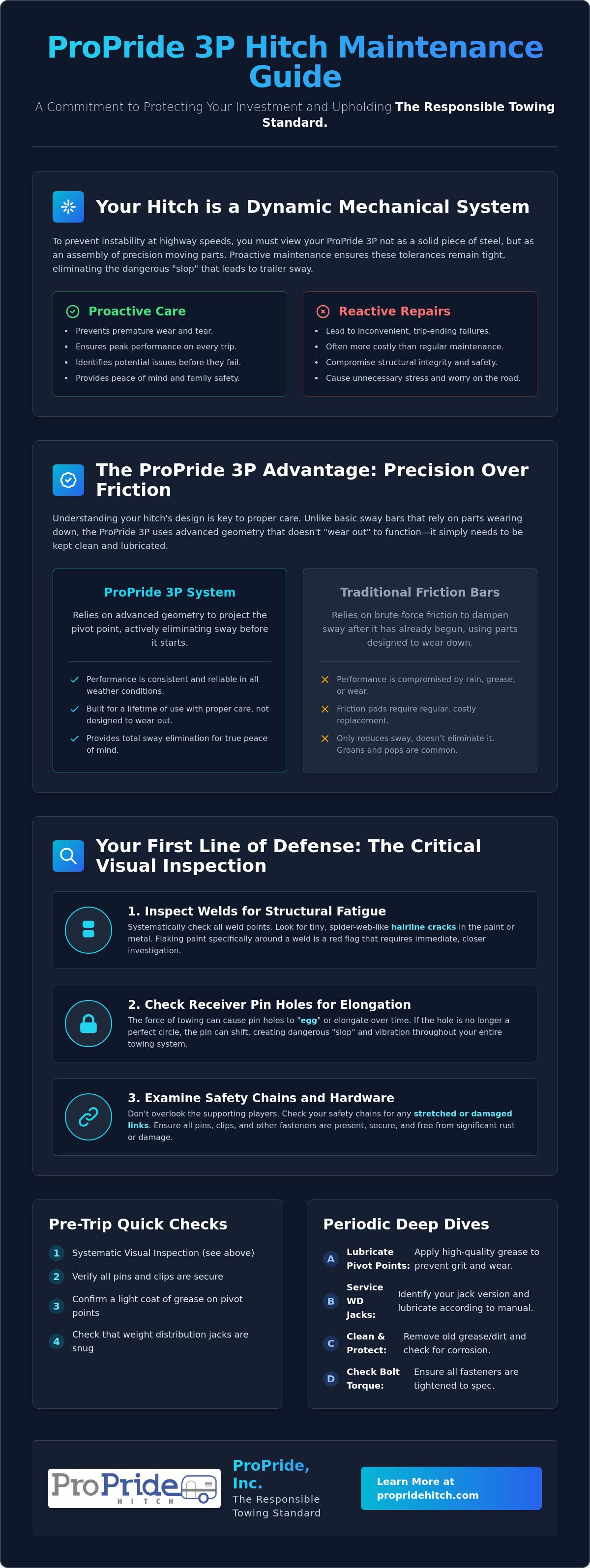
The 2026 Comprehensive Hitch Maintenance Checklist: Pre-Trip to Annual
A proactive approach to propride hitch maintenance is what separates a prepared traveler from one facing an avoidable roadside crisis. By following a structured schedule, you ensure that the precision engineering of your ProPride 3P Hitch remains in peak condition. The Responsible Towing Standard isn't just about owning the best equipment; it's about the discipline of regular upkeep. This 2026 guide breaks down your responsibilities into three manageable phases to maximize safety and equipment lifespan.
The Pre-Trip Safety Protocol
Before you pull out of your driveway, spend five minutes performing a high-level safety check. This small investment of time can save your entire vacation. Focus on the connection points where the truck meets the trailer. Ensure the coupler is fully engaged and the locking mechanism is seated without any gaps. If the mechanism feels "sticky," it might need a quick cleaning to ensure it's fully locked.
- The Tug Test: With the trailer brakes set, gently pull forward with your truck to confirm the hitch is securely locked into the receiver.
- Jack Operation: Test your weight distribution jacks to ensure they move smoothly. If you have the first version of these jacks, apply a few drops of 3-in-one oil; the second version requires no lubrication.
- Visual Confirmation: Verify that safety chains are crossed and the breakaway cable is properly routed.
The Annual Professional-Grade Service
Once a year, or every 10,000 miles, your hitch deserves a deep-dive service. This isn't just about surface cleaning. It's about maintaining the convergence and alignment that makes the ProPride system so effective. Remove the hitch head to inspect the internal bearings and pivot links for any signs of unusual wear. This is the time to clean out old, contaminated grease that may have collected road grit and replace it with fresh, high-quality molybdenum disulfide grease. Re-torque every mounting bolt to factory specifications to ensure the unit remains a rigid, stable extension of your vehicle's frame.
Off-Season Storage and Protection
Leaving a hitch in the receiver all winter is a recipe for disaster. Moisture and road salt can cause the steel to seize, making removal nearly impossible without heavy tools. When you aren't traveling, remove the main unit and store it in a dry, climate-controlled environment if possible. If you must leave the hitch mounted, always use a dedicated hitch cover to shield the sensitive mechanical parts from UV damage and rain. Protecting the finish and the moving parts during the off-season ensures your gear is ready to perform the moment the next travel season begins. For replacement parts or specialized covers, visit propridehitch.com to keep your setup in top-tier condition.
Maintaining The Best Hitch on the Planet: Long-Term Reliability of the ProPride 3P
When you choose a ProPride 3P Hitch, you aren't just buying a piece of hardware; you're investing in a legacy of engineering excellence. Most travelers are used to equipment that wears out by design. Friction-based systems rely on sacrificial pads that grind away every time you turn a corner. In contrast, the 3P is the ultimate engineering solution for trailer sway because it eliminates the problem through geometry rather than resistance. This fundamental difference is why propride hitch maintenance is so rewarding. You aren't just delaying the inevitable replacement of worn-out parts; you're preserving a precision machine that maintains its value and performance for a lifetime.
This system represents The Responsible Towing Standard. It's designed for the driver who refuses to settle for "good enough." Because the 3P doesn't rely on friction, it doesn't suffer from the performance degradation common in traditional hitches. As long as you keep the internal bearings lubricated and the structural bolts torqued, the hitch will perform exactly the same on its tenth year as it did on its first day. It's the gold standard for those who value long-term reliability and the total elimination of risk on the highway.
Low Maintenance, High Performance
Traditional hitches require constant tinkering with friction sockets and tension bars to keep sway under control. If you look at a sway control hitch comparison, you'll see that the total cost of ownership for a ProPride is significantly lower over time when you factor in the longevity of the components. The maintenance labor is minimal because the critical components are largely protected from road grime. By spending a few minutes on propride hitch maintenance each season, you're ensuring that the Pivot Point Projection remains fluid and responsive. This high-performance design means you spend less time under your truck and more time enjoying a stress-free travel experience.
Joining the Community of Responsible Towers
You're never alone in your journey as a ProPride owner. We pride ourselves on offering technical support that matches the quality of our engineering. If you ever have a question about a specific lubricant or a torque setting, our team is ready to help you uphold The Responsible Towing Standard. Proper care ensures your 3P remains "The Best Hitch on the Planet" for decades, potentially even outlasting the trailers it pulls. It's an investment that grows with your towing experience and provides a level of stability that traditional equipment simply cannot match. Don't wait for a problem to arise. Conduct your spring inspection today and experience the absolute confidence that comes from towing with perfectly maintained, world-class gear.
Secure Your Future on the Open Road
Mastering the routine of propride hitch maintenance is the final step in becoming a truly informed traveler. You've learned that a few minutes of visual inspection and the right heavy-duty grease can preserve the patented Pivot Point Projection technology for a lifetime. By following the 2026 checklist, you ensure that every mile driven is backed by the engineering excellence of the Jim Hensley design legacy.
This commitment to upkeep is what defines The Responsible Towing Standard. It's about more than just equipment; it's about the peace of mind that comes from knowing your family is protected by a system that won't fail you. Because we offer a Lifetime Warranty on our hardware, you can travel with the certainty that your investment is as durable as your desire to explore.
Ready to experience the Best Hitch on the Planet? Invest in the ProPride 3P: The Responsible Towing Standard and take control of your travel experience today. You've done the research and you have the knowledge; now it's time to hit the road with absolute confidence.
Frequently Asked Questions
How often should I grease my ProPride 3P hitch?
You should grease the zerk fittings on your hitch head every 1,000 miles or before starting any major trip. Regular lubrication ensures the internal bearings move freely, which is essential for the Pivot Point Projection system to function correctly. If you're towing in dusty or wet conditions, you should increase this frequency to prevent grit from contaminating the internal components and causing premature wear on the precision surfaces.
Can I use any type of grease for my trailer hitch maintenance?
No, you must use a high-quality molybdenum disulfide grease for the internal bearings and zerk fittings. Standard bearing grease often lacks the film strength needed to handle the thousands of pounds of pressure exerted on the pivot points during travel. For external sliding components, a dry silicone or Teflon spray is a better choice because it won't attract road grime. Using the correct products is a vital part of propride hitch maintenance.
Is it normal for my weight distribution hitch to make noise?
Your ProPride 3P should operate almost silently under normal towing conditions. Unlike traditional friction-based hitches that pop and groan by design, our system relies on smooth mechanical links that don't require friction to control sway. If you hear metal-on-metal noise, it's usually a signal that your zerk fittings need grease or that a bolt has loosened. Addressing these sounds immediately helps you maintain The Responsible Towing Standard and prevents damage to the unit.
What should I do if my hitch is stuck in the receiver?
If your hitch is stuck, apply a generous amount of penetrating oil to the receiver opening and let it sit for several hours. You can then use a rubber mallet to gently tap the shank to break the bond of rust or debris. Once you've removed it, use a wire brush to clean both the shank and the inside of the receiver. Applying a light coat of dry lubricant before reinserting the shank can prevent this from happening again.
How do I know if my hitch bolts need to be re-torqued?
You should verify the torque on all mounting bolts at least once a year using a calibrated torque wrench. A visual sign that a bolt is loose is "rust bleeding," which appears as orange streaks coming from behind the bolt head or nut. Even if they look secure, vibrations from the road can cause fasteners to back off over time. Keeping these bolts tight is critical for maintaining the structural integrity of your sway control system.
Can I leave my hitch on my truck when I am not towing?
It's best to remove the hitch from your receiver when you aren't planning to tow for an extended period. Leaving it exposed to the elements can lead to the shank seizing inside the receiver due to moisture and road salt. If you must leave it on, always use a high-quality hitch cover to protect the moving parts from UV rays and rain. Removing the unit also protects your investment from potential theft or accidental damage.
How does rust affect the safety of my sway control system?
Surface rust is generally a cosmetic issue, but deep pitting can eventually compromise the thickness and strength of the steel components. When rust eats into the metal, it creates weak points that could fail under the extreme stress of an emergency maneuver. Effective propride hitch maintenance involves cleaning road salt off the unit and touching up any paint chips immediately. This proactive care ensures your system remains a reliable safety tool for years to come.
Do I need to maintain my safety chains and electrical plugs too?
You should inspect your safety chains for stretched links and your electrical plugs for corrosion during every pre-trip check. A secure mechanical connection is only effective if your trailer brakes and lights function perfectly every time you hit the road. Clean corroded electrical pins with a wire brush and apply dielectric grease to ensure a solid connection. Upholding The Responsible Towing Standard means ensuring every part of your towing setup is in peak condition.