What if the "sway control" you're relying on isn't actually stopping the sway, but just trying to slow it down after it's already started? Most responsible drivers feel that familiar grip of anxiety when a semi-truck blazes past or a sudden gust of wind catches the side of their trailer. You've likely spent hours conducting a sway control hitch comparison because you know that "good enough" isn't an option when your family's safety is on the line. It's a common struggle to distinguish between systems that merely dampen movement and those that fundamentally change the towing dynamic through superior engineering.
We agree that you deserve to feel absolute confidence at highway speeds, regardless of the weather or traffic conditions. This article promises to clarify the mechanical differences between friction-based hitches and projection-style systems, helping you identify the safest choice for your specific needs. We'll walk you through the physics of pivot point projection and explain how the right equipment can turn a stressful drive into a relaxed journey. By the end, you'll understand why setting The Responsible Towing Standard with ProPride, Inc. is the only way to ensure a one-and-done investment in your long-term peace of mind.
Key Takeaways
- Understand the critical difference between friction hitches that merely dampen movement and projection-style systems that eliminate trailer sway through physics.
- Use our sway control hitch comparison checklist to verify if a hitch relies on unreliable brake-pad material or a permanent mechanical linkage.
- Learn how to maintain total control during high-wind events and when passing semi-trucks by projecting the trailer's pivot point over the rear axle of your truck.
- Identify the convenience of "one-and-done" systems that allow you to back up and navigate tight corners without ever removing or adjusting sway bars.
- Discover why prioritizing engineering excellence over traditional equipment is the only way to meet The Responsible Towing Standard for your family.
Table of Contents
-
Comparing the Three Main Technologies: Friction, Cam-Lock, and Projection
-
Performance Breakdown: How Hitches Handle Real-World Hazards
-
Your Comparison Checklist: How to Choose a Responsible System
Why Not All Sway Control Hitches Are Created Equal
Trailer sway isn't just a minor annoyance. It's a powerful physical force that happens when your trailer tries to pivot independently from your truck. If you've spent any time looking through a sway control hitch comparison, you've probably noticed that there are dozens of options. However, most of them work by using friction to mask the problem. They don't stop the physics of sway; they just try to make the trailer harder to move. At ProPride, Inc., we believe that a sway control hitch is the most safety-critical link between your truck and trailer.
We advocate for "The Responsible Towing Standard." This means your equipment should be designed to handle the actual physics of towing, not just the symptoms. Think of it this way: sway reduction is like putting a bandage on a wound, while sway elimination is like preventing the injury in the first place. Most traditional hitches use friction, which is basically resistance created by two surfaces rubbing together. While this works for small bumps, it often fails when things get serious on the highway. We believe in mechanical solutions that change how your vehicles interact.
The Danger of "Good Enough" Equipment
When you're driving at highway speeds, you're constantly fighting "bow waves." This is a massive wall of air that a passing semi-truck pushes, which hits the side of your trailer and tries to shove it out of your lane. If your hitch relies on "good enough" friction, those forces can overcome that resistance. This leads to that terrifying "white-knuckle" feeling where you're constantly fighting the steering wheel, which is an emotional drain on any family trip.
Setting the Evaluation Criteria
When you start comparing hitches, you need to look at more than just the price. Focus on stability, durability, and how much work the hitch adds to your day. Safety should always be the main factor. For example, some hitches require you to remove parts just to back into your driveway. A truly responsible system, like a high-quality weight-distributing hitch, stays out of your way while keeping you safe.
Actionable Tip: Before you spend a dime, find out your trailer's Gross Vehicle Weight Rating (GVWR) and its actual tongue weight. The GVWR is the maximum your trailer can safely weigh when loaded. Your tongue weight is the downward force on the hitch ball and should be between 10% and 15% of your total trailer weight. Knowing these numbers helps you choose the right gear for your specific setup.
Comparing the Three Main Technologies: Friction, Cam-Lock, and Projection
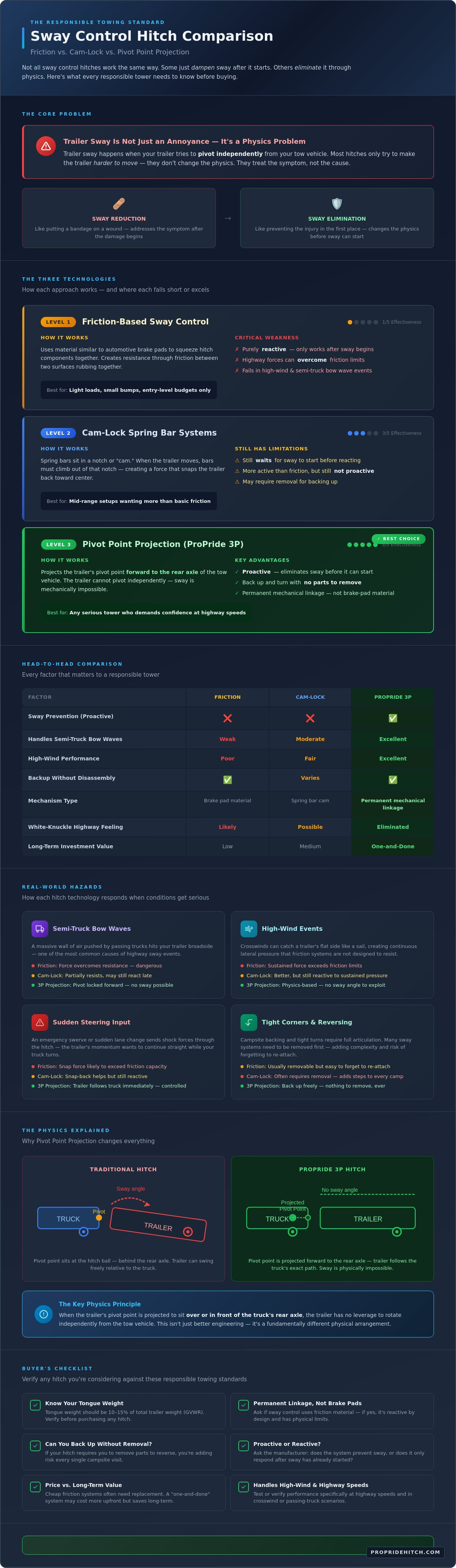
To make a smart choice, you need to understand the three distinct ways these sway control systems actually operate. Most traditional hitches rely on friction. These use material similar to automotive brake pads to squeeze the hitch components together. While this creates resistance, it's reactive. It only starts working after the trailer has already begun to move. In a sway control hitch comparison, it's clear that friction systems are the entry-level option, but they have physical limits that can't be ignored.
Cam-locking systems are a step up. They use spring bars that sit in a notch or "cam." When the trailer moves, the bars have to climb out of that notch, which creates a force that tries to snap the trailer back into center. While more active than friction, it still waits for the sway to happen before reacting. Then there is Pivot Point Projection, the technology used by ProPride, Inc. in the ProPride 3P Hitch. This system uses a trapezoidal linkage. Imagine a set of four mechanical arms arranged in a specific shape that forces the trailer to pivot as if it were connected directly to your truck's rear tires rather than the hitch ball. This mechanical connection makes it physically impossible for the trailer to sway the truck.
The Mechanical Limits of Friction
Friction systems are popular because they're inexpensive, but they come with significant chores. Because they rely on physical rubbing, they wear out over time and generate a lot of noise. They also don't perform well in the rain. Water acts as a lubricant, which means your sway control can suddenly drop in effectiveness during a storm. You'll also find that you often have to get out and loosen the bars before backing into a campsite to avoid damaging the trailer frame. For those who want to follow The Responsible Towing Standard, these constant adjustments and weather risks make friction a less-than-ideal long-term solution.
The Physics of Pivot Point Projection
The engineering behind Pivot Point Projection is what truly sets ProPride, Inc. apart. This design, which honors the Jim Hensley design legacy, creates a virtual pivot point over your truck's rear axle. In a normal setup, the trailer is like a long lever that can push the back of your truck around. By moving that pivot point forward, you eliminate that lever's power. It turns the truck and trailer into a single, stable unit. If you're looking for a stress-free experience where the trailer can't take control of the truck, this is the logical conclusion.
Actionable Tip: If you're currently using a friction hitch, check your friction pads for "glazing." If the pads look shiny and smooth like glass, they've lost their ability to create resistance and aren't doing much to help you. If you're tired of the constant maintenance and checking, it might be time to invest in a mechanical solution that doesn't wear out.
Performance Breakdown: How Hitches Handle Real-World Hazards
The true test of your equipment happens when a semi-truck blazes past you on the interstate. This creates a high-pressure wall of air that pushes against your trailer. In a typical sway control hitch comparison, you'll see that most hitches try to fight this push by creating resistance at the hitch ball. However, because the trailer is still pivoting on that ball, it can still act like a lever that shoves the back of your truck. This is why many drivers find themselves constantly correcting their steering. A truly stable system from ProPride, Inc. is designed so that the truck and trailer feel like a single, solid unit rather than two vehicles fighting for control.
This level of stability is a core part of following The Responsible Towing Standard. It's actually a concept supported by official safety discussions. For instance, some NHTSA safety standards highlight the importance of weight-distributing hitches with sway control for managing heavier loads. By using engineering that eliminates the physical possibility of sway, you aren't just reacting to the road; you're staying ahead of it. Matching your equipment to these real-world hazards is the most important part of any sway control hitch comparison.
Stability in Extreme Conditions
High winds can be just as unpredictable as traffic. While friction hitches rely on the physical grip of their pads, that grip can be overcome if the wind is strong enough. Pivot Point Projection doesn't rely on grip; it uses mechanical linkage. This means crosswinds can't turn your trailer into a lever against your truck. It's also important to remember that weight distribution plays a huge role here. If your hitch doesn't properly distribute weight to your truck's front axle, your steering will feel light and unresponsive during an emergency.
Actionable Tip: To see how your current setup handles stress, find a large, empty parking lot and practice a controlled emergency lane change at a safe, moderate speed. If you feel the trailer "wagging" or pulling the back of your truck after you've straightened out, your current sway control is being overcome by the trailer's momentum.
The Backing and Turning Comparison
One of the biggest headaches with traditional gear is the "un-hitching" process. Many friction-based hitches require you to remove the sway bars before you can back into a campsite. If you forget, the tight angles can bend your bars or damage the hitch. With the ProPride 3P Hitch, ProPride, Inc. has removed this chore entirely. The mechanical linkage allows for a full turning radius without any interference. You get the convenience of a "hitch it and forget it" system that works just as well in the campground as it does on the interstate.
Your Comparison Checklist: How to Choose a Responsible System
When you visit a dealership, you'll often be steered toward whatever equipment is currently sitting in their parts department. This is rarely the best way to choose a safety-critical component. As an informed owner, your sway control hitch comparison should be based on objective engineering criteria rather than convenience or stock levels. Selecting a system that meets The Responsible Towing Standard requires looking past marketing promises and examining the mechanical reality of how the hitch operates under pressure.
To help you navigate this decision, use the following checklist to evaluate any potential system:
-
Mechanical Linkage vs. Friction: Does the hitch use a permanent mechanical linkage to eliminate sway, or does it rely on consumable friction pads that only dampen it?
-
Backing and Maneuverability: Can you back into a tight campsite or make sharp turns without getting out of the truck to remove or loosen sway bars?
-
On-the-Fly Adjustability: Can you adjust the weight distribution tension easily without unhooking the trailer?
-
Support and Warranty: Does the manufacturer stand behind the product with a lifetime warranty and provide accessible, US-based technical support?
-
Sway Elimination: Does the design move the pivot point forward to make sway physically impossible, or is it just trying to reduce the symptoms?
If a hitch cannot answer these questions satisfactorily, it likely isn't the right tool for a family focused on total safety. You can see how a professional-grade system meets these criteria by exploring the ProPride 3P Hitch.
Evaluating Long-Term Value vs. Initial Cost
It's easy to be swayed by a lower price tag, but safety equipment is the ultimate "buy once, cry once" investment. A premium hitch doesn't just provide peace of mind; it protects your much larger investments in your tow vehicle and your trailer. Cheap friction hitches wear out, require constant replacement parts, and can lead to expensive repairs if a sway event causes a jackknife or a loss of control. Choosing a high-end system is a financial decision that pays dividends in longevity and safety. These systems also tend to hold a very high resale value among experienced RVers who understand the worth of superior engineering.
Actionable Tip: Before you buy, search online marketplaces for used versions of the hitches you're considering. You'll quickly notice which brands retain their value over time and which ones are being sold off by owners who are ready for a real solution.
The Responsibility of the Driver
No matter how advanced your equipment is, it remains a tool in the hands of a responsible operator. Your commitment to conducting a thorough sway control hitch comparison shows that you take this role seriously. Engineering excellence is meant to support your skills, not replace them. By prioritizing physics and proven design over marketing hype, you're making a conscious choice to protect your family. This level of preparation leads to more confident travel, allowing you to focus on the road ahead rather than the trailer behind you. True responsibility starts with education and ends with the best equipment available.
The ProPride 3P: Engineering the End of Trailer Sway
After completing a thorough sway control hitch comparison, the evidence points toward a single conclusion: the ProPride 3P is the most advanced solution for safe towing. This system represents the ultimate evolution of the original Jim Hensley design legacy, refined through modern engineering to provide unparalleled stability. We don't just aim to reduce sway; we use physics to eliminate it entirely. This commitment to precision is why the ProPride 3P is widely regarded as "The Best Hitch on the Planet." It's a specialized partner for your lifestyle, designed for owners who refuse to compromise on the safety of their families.
For the DIY-minded owner, the installation process is straightforward and well-supported. You don't need a professional shop to achieve a professional-grade setup. Each component is manufactured with heavy-duty materials to ensure it stands up to the rigors of long-haul travel. If you're ready to secure your investment, you can Shop the ProPride 3P Trailer Sway Control Hitch and start your journey toward stress-free towing today.
Why We Don’t Use Friction
Our refusal to use friction material is based on a simple fact: friction is unreliable. As we've explored in previous sections, traditional equipment relies on brake-pad material that wears down and fails under extreme pressure. The ProPride 3P uses heavy-duty steel linkage and Pivot Point Projection to maintain a rigid connection that won't degrade. Whether you are pulling a 10,000 lb. travel trailer or a massive 15,000 lb. luxury coach, our systems are built to handle the load without breaking a sweat. This engineering excellence ensures that your hitch remains as durable as the truck you use to tow it.
Join the Responsible Towing Community
Choosing the right equipment is about more than just hardware; it's about joining a community of drivers who prioritize preparation and knowledge. When you upgrade your setup, you are investing in total peace of mind for every person in your vehicle. You're setting The Responsible Towing Standard for yourself and everyone else on the road. Don't let another trip be defined by anxiety or the fear of a passing semi-truck. Upgrade to the system that makes trailer sway a thing of the past and regain your confidence on the open road.
Actionable Tip: Every towing setup is unique. Before you make your final decision in your sway control hitch comparison, contact us for a personalized fitment consultation. Our team can help you determine the exact specifications needed for your specific truck and trailer combination to ensure a perfect, safe fit from your very first mile.
Take Command of the Open Road
Choosing the right towing equipment is the most significant safety decision you'll make for your family. As this sway control hitch comparison has shown, relying on friction to mask the symptoms of sway is a compromise that modern physics has rendered obsolete. By moving the pivot point forward, you eliminate the trailer's ability to influence your truck. This ensures you remain in total control during high winds or sudden maneuvers. This shift from reactive dampening to proactive elimination defines the difference between a stressful drive and a confident journey.
Investing in the Jim Hensley design legacy means choosing a system backed by a lifetime warranty and patented Pivot Point Projection technology. It's about more than just hardware. It is about adopting The Responsible Towing Standard for every mile of your travels. Don't let equipment limitations dictate your comfort level on the highway. You have the knowledge to make an informed choice that protects your investment and your loved ones for years to come. Experience the Responsible Towing Standard with the ProPride 3P and enjoy the stability you deserve on every trip.
Frequently Asked Questions
Is a sway control hitch the same as a weight distribution hitch?
No, they serve two distinct purposes, though they are often integrated into a single system. Weight distribution uses spring bars to move a portion of the trailer's tongue weight from the rear axle of the truck to the front axle. Sway control is a separate function designed to manage or eliminate the side-to-side movement of the trailer. In any sway control hitch comparison, it's vital to choose a system that masters both functions to ensure maximum stability.
Can I use a friction sway bar with any trailer?
You can technically install a friction sway bar on most trailers, but they have significant physical limitations. These bars are generally designed for smaller, lighter trailers where the lateral forces are minimal. As trailers increase in size and weight, the force of a passing semi-truck or a crosswind can easily overcome the resistance of a friction pad. For larger trailers, relying on friction fails to meet The Responsible Towing Standard because it only dampens movement rather than stopping it.
Why is the ProPride 3P more expensive than traditional friction hitches?
The ProPride 3P is a more significant investment because it replaces basic friction pads with a complex mechanical linkage. While standard systems use resistance to slow down sway after it starts, the 3P uses Pivot Point Projection to prevent it from ever beginning. This system is a "one-and-done" investment in the Jim Hensley design legacy. It provides a level of engineering excellence and safety that mass-produced, friction-based equipment simply cannot provide.
Do I need to remove my sway control hitch when backing up?
You don't need to remove or adjust the ProPride 3P when backing into a campsite or maneuvering in tight spaces. Traditional friction-based sway bars often require removal because the extreme angles of backing up can bend the bars or damage the friction material. Because ProPride, Inc. utilizes a permanent mechanical linkage, it allows for a full turning radius. You can go from highway speeds to a jackknife backup without ever touching your hitch components.
How does Pivot Point Projection eliminate trailer sway?
This technology uses a trapezoidal linkage to move the trailer's effective pivot point from the hitch ball to the rear axle of your tow vehicle. This change in physics means the trailer can no longer act as a lever that pushes the back of the truck side-to-side. By projecting the pivot point forward, the system makes it physically impossible for the trailer to initiate sway. This makes it "The Best Hitch on the Planet" for drivers who value total control.
Can a sway control hitch prevent all accidents?
No hitch can prevent every possible accident, as factors like speed, tire maintenance, and driver attention are always critical. However, a high-quality system from ProPride, Inc. eliminates the primary cause of towing-related loss of control: trailer sway. Using the right equipment is a core part of being a responsible operator, but it must be paired with safe driving habits and proper trailer loading. Safety is a combination of superior engineering and responsible decision-making.
Is the ProPride 3P difficult to install on an Airstream or Jayco?
The ProPride 3P is designed for straightforward DIY installation on almost any trailer with a standard A-frame, including Airstream and Jayco models. Most owners can complete the process in a few hours with basic hand tools. The system is engineered to fit around common tongue components like propane tanks and battery boxes. This allows you to upgrade to The Responsible Towing Standard without needing professional modifications to your trailer's frame.
How much tongue weight can a sway control hitch handle?
Tongue weight capacity varies by model, but the ProPride 3P is built to handle heavy-duty loads ranging from 1,000 lbs to 1,500 lbs. It's essential to keep your tongue weight between 10% and 15% of your total trailer weight to maintain proper balance. Matching your hitch to your specific tongue weight is a critical step in your sway control hitch comparison. This ensures the weight distribution and sway elimination features perform exactly as intended for your specific rig.