Most "sway control" systems on the market don't actually stop trailer sway; they just try to slow it down after it's already started. It's a reactive approach to a physical problem that demands a proactive, engineered solution. When you're hauling a high-value investment with your family in the cab, simply "managing" a dangerous side-to-side motion isn't enough. Understanding the mechanical divide in sway elimination vs sway control is the first step toward reclaiming your confidence on the open road.
You've likely felt that heart-stopping moment when a passing semi-truck or a sudden gust of wind makes your trailer twitch. We'll show you how to move past that anxiety by explaining the difference between resisting sway and eliminating it entirely. This guide explores the physics of Pivot Point Projection and how adhering to The Responsible Towing Standard ensures your equipment works with science, not against it. As a quick tip for your next trip, always verify your tongue weight is between 10% and 15% of your total load to provide a stable foundation for your hitch to do its job. We're going to break down exactly how the right engineering creates a truly stress-free towing experience.
Key Takeaways
- Learn why traditional friction hitches only mask the symptoms of sway, while Pivot Point Projection addresses the mechanical root cause.
- Discover how the physics of sway elimination vs sway control determines whether your trailer remains a separate moving part or an integrated extension of your vehicle.
- Get a step-by-step checklist for calculating your tongue weight to ensure your setup aligns with The Responsible Towing Standard.
- Explore how the Jim Hensley design legacy allows for a smoother hitching experience and eliminates the maintenance of wearable friction pads.
- Understand the concept of convergence and why preventing small trailer movements from reaching your steering wheel is vital for family safety.
The Critical Link Between Weight Distribution and Sway Control
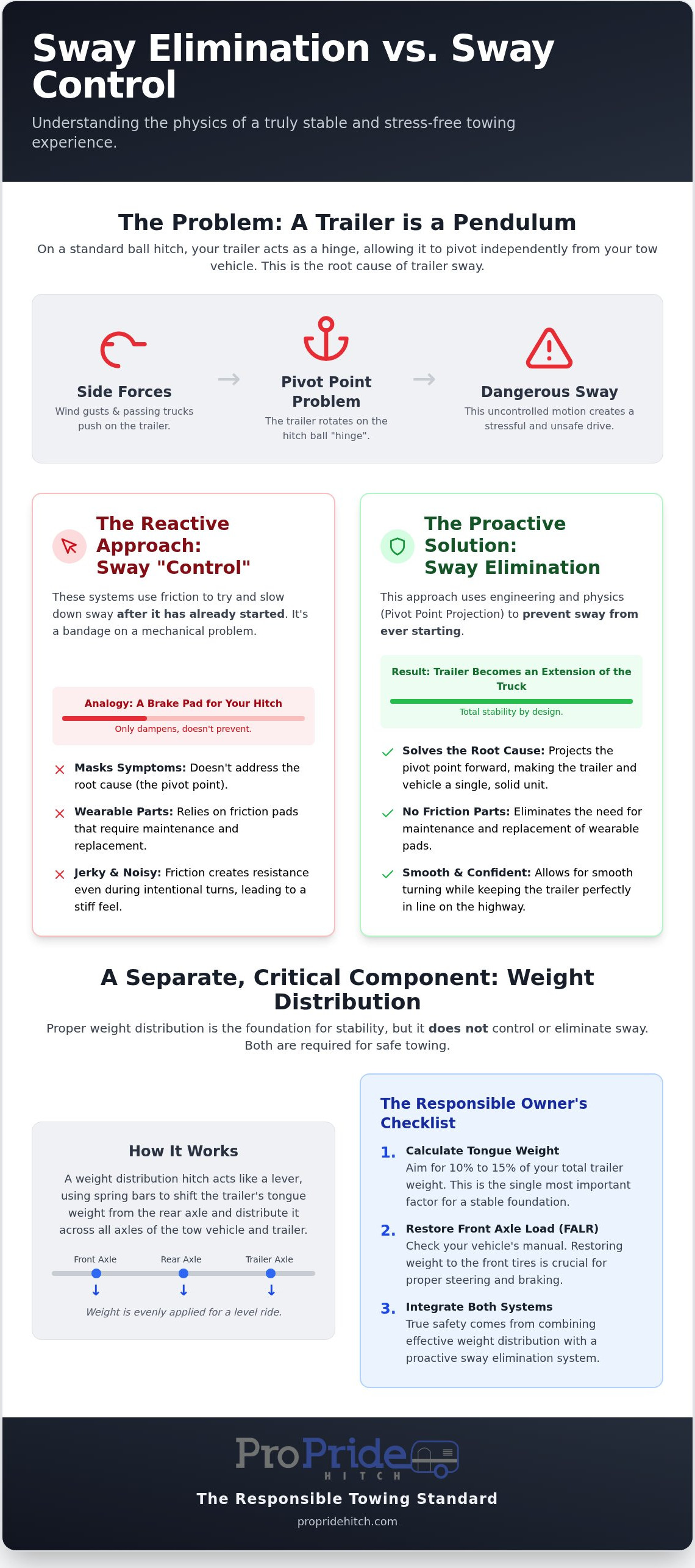
Understanding the mechanics of your tow rig starts with a clear distinction between two vital functions: weight distribution and sway control. While these are often discussed as a single unit, they address different physical forces acting on your vehicle. Weight distribution is the process of shifting the tongue weight of your trailer across all axles of both the tow vehicle and the trailer. In contrast, sway control is the mechanical method used to keep the trailer tracking directly behind you. When you look at the debate of sway elimination vs sway control, it's clear that many drivers mistakenly believe that a well-balanced load removes the need for a dedicated sway system. This is a dangerous assumption.
Following The Responsible Towing Standard means acknowledging that while these systems work together to provide stability, they solve separate engineering challenges. A trailer that has its weight distributed correctly might still whip violently in a crosswind. Conversely, a trailer with sway control but poor weight distribution will be difficult to steer. True safety requires the integration of both to achieve total stability on the road.
How Weight Distribution Improves Steering and Braking
Imagine your truck and trailer as a giant teeter-totter. When you drop a heavy trailer onto the hitch ball, the rear of the truck sinks and the front end lifts. This unmanaged tongue weight removes pressure from your front tires, which are responsible for steering and a significant portion of your braking power. A Weight-distributing hitch uses spring bars to leverage that weight forward, restoring the "bite" of your front tires on the pavement. This prevents the "floaty" steering feeling that often leads to driver fatigue and slower reaction times during emergencies.
Actionable Tip: Consult your tow vehicle's owner manual for its specific "Front Axle Load Restoration" (FALR) requirements. This technical specification tells you exactly how much weight needs to be returned to the front wheels to maintain the manufacturer's safety standards under load.
Why Sway Control is a Separate Safety Necessity
Even a perfectly balanced trailer can succumb to external forces. You might have the weight distributed perfectly, but physics doesn't care when a semi-truck passes you at highway speeds. This creates a "bow wake" effect, a wall of air that pushes the trailer to the side. If your hitch only handles weight and not the lateral movement, that trailer will begin to pivot like a hinge. Relying on a heavy truck to "outmuscle" a swaying trailer is a common but dangerous towing myth. A larger vehicle might mask the feeling of sway for a moment, but it doesn't change the mechanical reality of the trailer's momentum. True safety requires a system like the ProPride 3P trailer sway control hitch, which integrates weight distribution with the physical elimination of the pivot point. This dual-purpose approach is what separates a stressful drive from a confident journey.
Understanding the Physics: Why Trailers Sway and How to Stop It
Every trailer on a standard ball hitch is essentially a pendulum. The connection point acts as a mechanical hinge, allowing the trailer to rotate independently from your truck. This is the "Pivot Point" problem. When a side force like a wind gust or a passing semi-truck hits the trailer, it rotates on that ball. Road ruts and sudden maneuvers can also trigger this rotation, pushing the back of your truck in the opposite direction. This often leads to convergence, where small trailer movements amplify into the tow vehicle's steering. You feel this as a tugging sensation that forces you to constantly adjust the wheel to keep the rig straight.
The difference between reactive safety and proactive safety is the core of the sway elimination vs sway control debate. Controlling sway means you are waiting for the trailer to move and then trying to dampen that motion. Eliminating sway means you use engineering to ensure the trailer cannot pivot independently in the first place.
The Limits of Friction-Based Sway Bars
Traditional sway control relies on friction bars to stiffen the hinge at the hitch ball. Think of it as a brake pad for your hitch. While this provides some resistance, it's a reactive solution. It waits for the sway to happen and then tries to slow it down. These systems often create jerky steering during intentional turns because the friction doesn't know the difference between a wind gust and a curve in the road. Rain, road grime, or even excess grease can lubricate those pads, significantly reducing their effectiveness when you're already dealing with compromised road conditions.
Actionable Tip: If you use a friction-based system, regularly inspect the pads for glazing or grease contamination. Even a small amount of moisture can compromise your safety by reducing the "grip" the bars provide.
The Concept of Sway Elimination
Sway elimination uses linkage geometry to move the effective pivot point from the bumper to near the rear axle of your truck. This turns the trailer into an extension of the vehicle's chassis rather than a separate, swinging object. By utilizing linkage arms to project the pivot point forward, the trailer is mechanically locked into tracking directly behind the tow vehicle.
Proactive safety means stopping the sway before it starts. Instead of a hinge that wants to fold, you have a solid connection that only allows the trailer to move when the truck moves. It's a sophisticated way to achieve a stress-free experience. If you're ready to see how this engineering changes your drive, you can explore the ProPride 3P design and see why it's the gold standard for serious travelers. This approach ensures you're following The Responsible Towing Standard by choosing physics over friction.
Friction vs. Pivot Point Projection: A Technical Breakdown
When you analyze sway elimination vs sway control, you're really looking at the difference between managing a crisis and preventing one. Traditional sway control relies on fighting physics with friction. It's a constant battle. You feel every ripple in the road because the hitch is trying to resist movement that has already begun. This leads to the "white-knuckle" factor. It's that exhausting mental strain of anticipating the next gust of wind or the next passing semi-truck. True sway elimination allows you to virtually ignore those external forces because the trailer is mechanically incapable of swinging on the hitch ball.
This technological leap is rooted in a pioneering design principle: the understanding that as long as the hitch acts as a pivot point, sway is an inevitable byproduct of momentum. Through the application of complex linkage geometry, a method was developed to project that pivot point forward. The ProPride 3P Hitch represents the definitive evolution of this concept. It takes those original principles and refines them into a durable, high-performance system that sets The Responsible Towing Standard for modern travelers who refuse to compromise on safety.
Why Friction Hitches Require Constant Adjustment
Friction hitches are high-maintenance by design. Because they rely on physical resistance, the friction surfaces eventually wear down or become glazed. This means you have to regularly replace pads or tighten bolts to maintain any level of effectiveness. There's also the risk of over-correction. In a sharp turn, a friction hitch might hold too much tension, making the truck feel stiff or jerky as it tries to return to center. This interference with natural cornering can be unsettling during emergency maneuvers. For a deeper look at how these systems stack up, see our Sway Control Hitch Comparison: Finding the Responsible Towing Standard in 2026.
The ProPride 3P Difference: Pivot Point Projection
The 3P hitch uses its patented linkage to project the pivot point over the rear axle of your truck. This is the secret to the rigid-unit feel. When you drive straight, the truck and trailer move as one. The trailer cannot move sideways unless the truck moves first. This eliminates the "tail wagging the dog" sensation entirely. It provides a level of peace of mind that friction bars simply cannot match, especially in high-wind environments or on uneven highways.
Actionable Tip: Choose a system that doesn't require you to disconnect your sway control when backing into a campsite. Many friction-based systems can be damaged if you jackknife them while backing up. The 3P design stays connected, allowing you to focus on your surroundings rather than worrying about your equipment.
Evaluating Your Towing Setup: A Responsible Owner’s Checklist
A responsible owner doesn't rely on luck for a safe trip. You rely on data and verified engineering. While we have already explored the technical divide of sway elimination vs sway control, applying that knowledge to your specific rig requires a methodical audit. Use this checklist to determine if your current setup meets the safety requirements of your travel lifestyle.
- Step 1: Know your numbers. Accurately calculate your Gross Trailer Weight (GTW) and actual Tongue Weight (TW). Guesses lead to instability.
- Step 2: Assess your route. Evaluate your typical towing environment. If you frequently travel through high-wind plains or mountainous passes, basic friction resistance is often insufficient to maintain control.
- Step 3: Audit the connection. With your trailer hitched, can the trailer pivot independently at the ball? If the answer is yes, your system is reactive rather than proactive.
- Step 4: Review your standard. Does your equipment align with The Responsible Towing Standard? Ask yourself if your hitch is designed to stop sway before it begins or merely dampen it once it starts.
- Step 5: Hardware inspection. Inspect your hardware for wear. Focus on the thickness of friction pads or any loose linkage components that could compromise the system's integrity.
Calculating Tongue Weight Responsibly
Proper weight distribution is the foundation of any safe tow, but it starts with the 10 to 15 percent rule. Your trailer's tongue weight should fall within this range of your total loaded trailer weight. If your tongue is too light, the trailer will naturally want to oscillate. If it's too heavy, you risk overloading your tow vehicle's rear axle and losing steering traction. For a deeper dive into common setup errors, read our guide on Travel Trailer Towing Mistakes: The Definitive Guide to The Responsible Towing Standard.
Actionable Tip: Don't rely on bathroom scales or "level looks" to judge your weight. Use a dedicated tongue weight scale or a hitch with a built-in gauge to get real-time safety data before every trip.
Signs Your Current Sway Control is Failing
Physics doesn't lie, and your steering wheel will often tell you when your sway control is reaching its limit. If you feel a distinct "tug" in the wheel when a semi-truck passes, your hitch is allowing the trailer to dictate the vehicle's path. You might also notice the trailer oscillating or fish-tailing after you hit a simple pothole or a sudden gust of wind. These small movements require constant steering corrections to keep the vehicle in its lane, which leads to driver fatigue. If you're tired of the white-knuckle experience, it may be time to invest in the ProPride 3P Hitch to eliminate these risks entirely. True safety means your truck and trailer move as a single, predictable unit regardless of the road conditions.
The ProPride 3P: Setting the Responsible Towing Standard
Choosing the right equipment for your trailer is about more than just matching weight ratings; it's about choosing a philosophy of safety. The ProPride 3P is widely regarded as "The Best Hitch on the Planet" because it refuses to settle for the "good enough" results of traditional friction systems. When you weigh the options of sway elimination vs sway control, you're deciding whether you want to manage a dangerous physical force or remove it from the equation entirely. By utilizing the Jim Hensley design legacy, the 3P uses complex linkage geometry to ensure your trailer remains a stable extension of your truck's chassis.
Hitching up shouldn't be a source of frustration or physical strain. Unlike traditional hitches that require you to lug heavy, greasy friction bars every time you stop, the main unit of the 3P stays mounted to your trailer. You simply back your vehicle's stinger into the hitch box. This design is not only more convenient but also safer, as it eliminates the wearable friction pads that lose effectiveness over time. This system is a lifetime investment in durability and precision, designed for those who adhere to The Responsible Towing Standard.
Advanced Engineering for Peace of Mind
The 3P provides a level of stability that feels like driving a single, rigid vehicle. This is achieved through Pivot Point Projection, which is the ultimate barrier against the dangerous side-to-side oscillations caused by wind and traffic. This system is engineered to work seamlessly with the industry’s most popular trailer brands, including Airstream, Jayco, and Grand Design. For a more granular look at the mechanics, you can read about The ProPride 3P Hitch: The Ultimate Engineering Solution for Trailer Sway Elimination. By projecting the pivot point near the rear axle, the hitch prevents small trailer movements from ever reaching your steering wheel.
Investing in Your Family’s Safety
Safety is a long-term commitment that requires the best possible tools. The ProPride 3P is a premium engineering solution for serious towers who want to protect their family and their high-value investment. It's about more than just preventing an accident; it's about the peace of mind that comes from knowing your equipment is built to the highest standards of physics and durability. With models rated to handle up to 14,000 pounds, it provides the capacity needed for modern, heavy-duty travel trailers.
Actionable Tip: Before making your purchase, contact an expert from ProPride, Inc. to ensure you select the correct shank for your specific truck and trailer height. Getting the geometry right from the start is essential for maintaining the perfect level of weight distribution and stability. When you're ready to join the community of travelers who prioritize safety, you can Experience the ProPride 3P Trailer Sway Control Hitch and see the difference that true sway elimination makes on the open road.
Reclaiming the Open Road with Engineering Excellence
You now understand that the choice between sway elimination vs sway control isn't just about comparing different products; it's about choosing between two entirely different approaches to physics. While friction-based systems try to react to instability after it begins, true elimination prevents it from ever starting. By embracing the Jim Hensley original design evolution, you're choosing a system that projects the pivot point forward to ensure your trailer tracks with absolute precision. This level of stability is the foundation of The Responsible Towing Standard.
The ProPride 3P Hitch utilizes patented Pivot Point Projection technology to turn your rig into a single, cohesive unit. This engineering ensures you can pass semi-trucks or face high winds without the anxiety of a "white-knuckle" drive. We believe in our design so much that we provide lifetime customer technical support to every member of our towing community. As you prepare for your next adventure, remember to perform a final check of your hitch connection and weight distribution before you leave the driveway. Your family's safety and your peace of mind are worth the investment in superior engineering.
Secure Your Journey with the ProPride 3P Hitch
We look forward to seeing you out on the road, driving with the confidence you deserve.
Frequently Asked Questions
What is the difference between a sway bar and a weight distribution hitch?
A weight distribution hitch is designed to manage vertical load by shifting tongue weight across all axles of your vehicle and trailer. A sway bar is a separate component meant to resist lateral, or side-to-side, movement. While these systems are often sold together, they solve different physical problems. One ensures your truck stays level and steerable, while the other tries to dampen the "fishtailing" caused by external forces like wind.
Do I really need sway control if I have a heavy-duty 3/4-ton or 1-ton truck?
Yes, because a larger truck only masks the symptoms of sway rather than curing the mechanical cause. Even a heavy-duty truck can be pushed by a swaying trailer during a sudden maneuver or high wind event. This is why understanding the difference between sway elimination vs sway control is vital for every driver. Relying on truck mass alone is a dangerous myth that ignores the momentum of a pivoting trailer.
Can you use a weight distribution hitch with a sway bar on any trailer type?
Most travel trailers with a standard A-frame tongue can use these systems, but you must check your frame's specific design. Some lightweight or specialty trailers have thinner frames that might not handle the torque of weight distribution bars. Always consult your trailer manufacturer's guidelines to ensure your equipment aligns with The Responsible Towing Standard. This prevents structural damage while you're trying to improve your road safety.
Why is the ProPride 3P considered better than traditional friction-based hitches?
The ProPride 3P is considered the gold standard because it uses Pivot Point Projection to eliminate sway entirely. Traditional hitches use friction pads to resist movement after it starts, which is a reactive and often inconsistent approach. The 3P design, based on the Jim Hensley design legacy, creates a rigid connection that keeps the trailer tracking directly behind you. It's often called "The Best Hitch on the Planet" for this reason.
Is it difficult for a DIY owner to install a weight distribution hitch with sway control?
Most responsible owners can install our system with basic hand tools and a few hours of time. The process involves bolting the hitch head to the trailer frame and setting the proper height for your specific tow vehicle. We provide detailed instructions and lifetime technical support to help you get it right. Taking the time to do a proper installation is a key part of maintaining The Responsible Towing Standard.
Does sway control work in reverse when I am backing up my trailer?
Traditional friction-based sway control often requires you to get out and disconnect the bars before backing into a tight spot to avoid damaging the equipment. The ProPride 3P hitch doesn't have this limitation because its linkage geometry works naturally in both directions. You can back into your campsite without any extra steps, which makes the end of a long drive much less stressful for you and your family.
How much tongue weight can the ProPride 3P hitch safely handle?
The ProPride 3P is engineered to handle heavy loads, with models rated for tongue weights up to 1,400 pounds. It's built for trailers with a gross weight of up to 14,000 pounds. This high capacity ensures that even large, modern travel trailers stay stable and secure. Always verify your specific trailer's tongue weight with a scale to ensure you're within the rated limits for your equipment.
Will a weight distribution hitch stop my trailer from bouncing on uneven roads?
A weight distribution hitch significantly reduces "porpoising," which is the rhythmic bouncing motion you feel over bridge expansion joints or dips. By spreading the tongue weight across all axles, the hitch helps the truck and trailer move as a single unit. While it won't replace the need for good trailer suspension, it provides a much smoother and more controlled ride for everyone in the cab.