Your trailer starts swaying at 65 miles per hour, and every instinct you have is probably wrong. That's the brutal reality of trailer fishtailing recovery: the moment most drivers panic and brake hard or steer into the sway is the exact moment they lose the fight. If you've experienced that stomach-dropping oscillation behind your tow vehicle, even once, you already know that "just be careful out there" isn't good enough advice when your family is in the vehicle ahead of a 10,000-pound trailer.
You're right to take this seriously. The fear is legitimate, the stakes are real, and the conflicting advice floating around online makes an already terrifying situation even more confusing. You deserve a clear answer, not a patchwork of forum opinions.
This guide will walk you through a calm, repeatable emergency protocol for the moment sway begins, then go a level deeper to explain the engineering principles behind why trailers fishtail in the first place. Because understanding the root cause isn't just interesting; it's the foundation of The Responsible Towing Standard and the key to making sure you're never white-knuckling a recovery again.
Key Takeaways
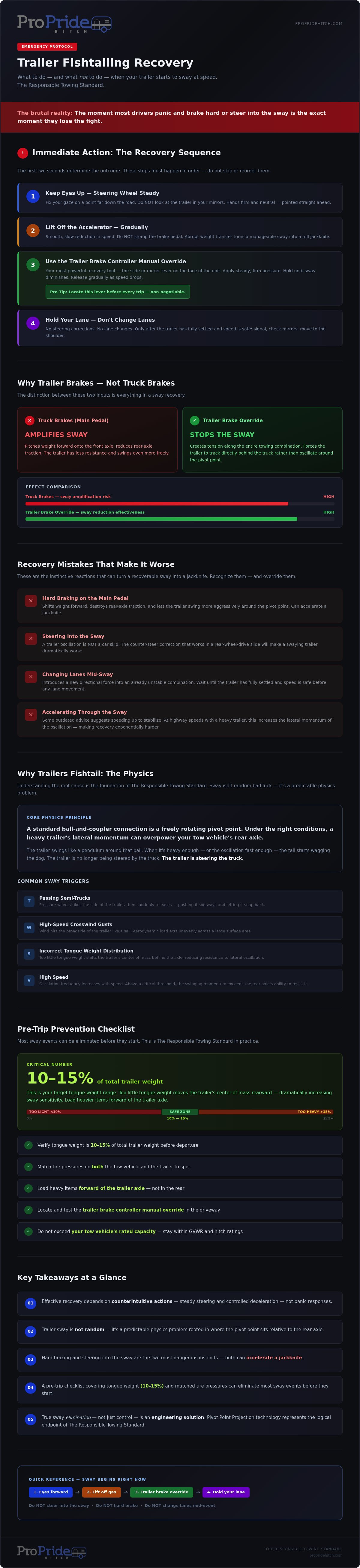
- Effective trailer fishtailing recovery depends on counterintuitive actions — steady steering and controlled deceleration — not the panic responses most drivers instinctively reach for.
- Trailer sway isn't random bad luck; it's a predictable physics problem rooted in where the pivot point sits relative to your tow vehicle's rear axle, and understanding that changes everything.
- Common recovery instincts like hard braking and steering into the sway can actually accelerate a dangerous jackknife situation rather than stop it.
- A pre-trip checklist covering tongue weight (10–15% of total trailer weight) and matched tire pressures on both the tow vehicle and trailer can eliminate most sway events before they start.
- True sway elimination — not just control — is an engineering solution, and the ProPride 3P Hitch's Pivot Point Projection technology represents the logical endpoint of The Responsible Towing Standard.
Immediate Action: How to Recover from Trailer Fishtailing on the Road
The first two seconds of a sway event are where most recoveries are won or lost. Your brain is screaming at you to do something, and that urgency is exactly what gets people into trouble. Effective trailer fishtailing recovery isn't about reacting faster; it's about reacting correctly. That means overriding some deeply wired instincts and replacing them with a short, deliberate sequence of actions.
Here's that sequence, in order of priority:
- Keep your eyes up and your steering wheel steady. Fix your gaze on a point far down the road, not on the trailer in your mirrors.
- Lift your foot off the accelerator gradually. Don't stomp the brake pedal. A slow, smooth reduction in speed avoids the abrupt weight transfer that can turn a manageable sway into a full jackknife.
- Reach for your trailer brake controller's manual override lever. This is your most powerful recovery tool, and it's the one most drivers forget they have.
- Hold your lane. Don't attempt to change lanes or make any steering corrections until the trailer has fully settled behind you.
The Manual Brake Controller Technique
Before your next trip leaves the driveway, locate the manual override lever on your trailer brake controller. It's typically a slide or rocker lever on the face of the unit, separate from the main brake pedal input. Knowing exactly where it is before you need it is non-negotiable under The Responsible Towing Standard.
When sway begins, push or slide that lever to apply the trailer brakes independently of your tow vehicle's brakes. This is the critical distinction. Applying your truck's brakes pitches weight forward onto the front axle and reduces rear-axle traction, which can actually amplify the sway. Applying the trailer brakes does the opposite: it creates tension along the entire towing combination, effectively stretching it taut so the trailer is forced to track directly behind the truck rather than oscillate around it.
Apply steady, firm pressure on the override. Don't pulse it. Hold it until you feel the sway diminish, then release gradually as your speed drops.
What to Do with the Steering Wheel
Resist every instinct to steer into the sway. A trailer oscillation is not a car skid; the correction that works on a rear-wheel-drive vehicle in a slide will make a swaying trailer dramatically worse. Your hands should stay firm and neutral on the wheel, pointed straight ahead, while your eyes lock onto a point well down the road ahead of you.
Once the trailer has settled and your speed has dropped to a safe level, only then should you signal, check your mirrors, and move toward the shoulder. Patience here isn't passive; it's the most active safety decision you can make.
The Physics of Instability: Why Trailers Start to Fishtail
Recovery technique matters enormously, but it only addresses half the problem. To truly understand trailer fishtailing recovery, and to stop sway before it ever demands a recovery, you need to understand what's actually happening at the mechanical level. The short version: a standard ball-and-coupler connection is, by design, a freely rotating pivot point. Your trailer is physically free to swing left and right around that ball, and under the right conditions, it will.
That's not a defect in your specific hitch. It's the fundamental geometry of the system.
When a trailer begins to oscillate, its mass is swinging like a pendulum around that pivot point. If the trailer is heavy enough, or the oscillation is fast enough, the lateral momentum of the trailer can actually overpower the rear axle of your tow vehicle. The tail starts wagging the dog. Your truck isn't steering the trailer anymore; the trailer is steering your truck. That's the moment a manageable wobble becomes a genuine emergency.
Several forces can initiate that first swing:
- Passing semi-trucks: A large truck passing in the opposite direction creates a pressure wave that strikes the side of your trailer and then suddenly releases, pushing it sideways and then letting it snap back.
- High-speed crosswind gusts: Wind doesn't push a trailer uniformly. A gust hits the broadside of your trailer like a sail, and if the aerodynamic load is greater than the stability of the hitch connection, the oscillation begins.
- Uneven road surfaces: A pothole, a lane seam, or a highway expansion joint can deliver a sharp lateral impulse to the trailer tires, nudging the whole rig slightly sideways. At highway speed, that small nudge can be enough to start the pendulum swinging.
None of these triggers are unusual. They're conditions you'll encounter on virtually every long trip. The question isn't whether these forces exist; it's whether your towing setup is engineered to absorb them without amplifying them.
The Critical Role of Tongue Weight
Load distribution is where most sway events are born, long before anyone gets on the highway. Tongue weight is the downward force your trailer's coupler exerts on the hitch ball, and the industry-standard target is 10 to 15 percent of the trailer's total loaded weight. Drop below that threshold, and you've created a rear-heavy pendulum. The trailer's center of gravity sits behind its axles, which means any lateral force is amplified rather than dampened.
Think of it this way: a dart flies straight because its weight is forward. Flip it around and throw it, and it tumbles. An improperly loaded trailer behaves the same way. Heavier items belong forward of the trailer axles, lighter items toward the rear. That single loading decision, made in the driveway before you leave, is the foundation of The Responsible Towing Standard.
Actionable tip: Use a portable tongue weight scale before every trip, not just when you've loaded the trailer differently. Cargo shifts. A few items moved to make room for something else can quietly push your weight distribution into dangerous territory.
The Limitations of Friction-Based Sway Control
Friction-based sway control bars are a common add-on, and they do provide some resistance. The problem is the word "resistance." A friction bar only engages after the trailer has already started to move sideways. It's a reactive device, not a preventive one. By the time the friction bar is doing its job, the sway event has already begun.
There's a practical degradation problem too. Friction plates depend on consistent surface contact to generate resistance. Rain, road grime, and normal wear all reduce that contact. The bar that performed adequately on a dry summer highway may offer meaningfully less resistance on a wet October interstate. You have no real-time way to know how much protection you actually have at any given moment.
Friction control is better than nothing. But it's a patch on a structural problem, not a solution to it. If you've ever felt a friction bar "give" during a hard sway event, you already know its limits. Understanding why those limits exist is what separates an informed tower from one who's simply hoping for the best. Explore how the ProPride 3P Hitch approaches the problem from an entirely different engineering premise.
Recovery Mistakes to Avoid: Why Traditional Instincts Can Fail You
Knowing what to do during a sway event matters. Knowing what not to do might matter even more. The mistakes that turn a recoverable trailer fishtailing recovery into a catastrophic jackknife aren't made by careless drivers; they're made by experienced, well-intentioned drivers whose instincts simply weren't calibrated for this specific situation. Physics doesn't care about your intentions.
Four mistakes account for the vast majority of sway events that end badly.
- Panic braking. Stomping the brake pedal shifts the tow vehicle's weight aggressively forward onto the front axle, which simultaneously reduces rear-axle traction. With less grip at the rear, the trailer's lateral momentum has less resistance to push against. The trailer doesn't slow down with the truck; it keeps swinging. Hard braking during active sway can accelerate the very jackknife you're trying to prevent.
- Oversteering. Trying to "time" your steering inputs to match the trailer's oscillation is an intuitive idea that fails in practice. The lag between the trailer's movement and your visual perception of it means your correction almost always arrives late, adding energy to the sway rather than damping it.
- Powering through it. The idea that you can accelerate out of a sway event is a myth that persists in towing forums. In rare, specific conditions with a very light trailer and a very powerful truck, it may theoretically reduce oscillation frequency. For most real-world towing setups at highway weight, adding throttle simply gives the pendulum more energy to work with. Don't try it.
- Dismissing early warning signs. That small wiggle at 62 mph isn't the road surface. Small oscillations are the system telling you it's approaching its stability limit. Ignoring them and hoping they resolve on their own is how minor wobbles become full emergencies within seconds.
The Danger of Overcorrecting
There's a meaningful lag between the moment the trailer moves and the moment your eyes and brain register that movement in your mirrors. By the time you perceive the sway and initiate a steering response, the trailer has already continued its arc. Your correction, however well-intentioned, now acts on a trailer that's already past the position you were correcting for. The result is an amplified oscillation, not a dampened one. Keep your hands firm and neutral. Steady steering isn't passive; it's the most disciplined response available to you.
When Friction Hitches Become a Liability
Friction-based sway control bars introduce a specific failure mode that rarely gets discussed honestly. During a sharp sway event, the bar can effectively lock the trailer into its swayed position, restricting the natural articulation needed to complete a turn or lane change. At that point, the device designed to help you is actively working against your ability to steer. Crosswinds at highway speed can generate lateral forces that exceed the friction bar's rated resistance entirely, leaving you with the false confidence of a safety device that's no longer functioning as advertised. For a direct comparison of how different hitch designs handle these real-world forces, the Sway Control Hitch Comparison lays out the engineering limitations clearly.
The Responsible Towing Standard doesn't accept equipment that works adequately under ideal conditions. It demands equipment engineered to perform when conditions are anything but ideal.
The Responsible Towing Standard: A Prevention Checklist
Recovery technique matters. But the driver who never needs to execute a trailer fishtailing recovery is the driver who did the work before leaving the driveway. The Responsible Towing Standard isn't just a philosophy; it's a concrete, repeatable pre-trip routine that removes the variables sway feeds on. Most towing checklists stop at "check your tires." This one goes further, because serious towers demand more than surface-level advice.
Run through these four verification points before every trip, without exception:
- Tongue weight: Confirm it falls between 10% and 15% of your trailer's total loaded weight. Use a portable tongue weight scale, not an estimate. This number changes every time your cargo changes.
- Tire pressures: Match the manufacturer's cold inflation specifications on both the tow vehicle and the trailer. Pressures checked after driving are already elevated and will give you a false reading. Check them cold, every time.
- Weight distribution adjustment: If you're running a weight distribution hitch, verify the spring bars are properly tensioned to return weight to the front axle of the tow vehicle. An improperly adjusted system provides false confidence without the actual benefit.
- Hitch hardware inspection: Visually confirm the hitch ball is tight, the coupler latch is fully engaged, the hitch pin is secured, and the safety chains are crossed and connected with appropriate slack for turning.
Proper Loading Strategies
How you load the trailer is as consequential as what you load it with. The practical standard most experienced towers follow is a 60/40 distribution: roughly 60% of the cargo weight placed in the front half of the trailer, 40% in the rear. Heavy items belong directly over or slightly forward of the trailer axles, never behind them. Rear-heavy loading pushes the center of gravity behind the pivot point, which is precisely the condition that turns a passing semi's pressure wave into a full sway event.
Securing the load matters just as much as placing it correctly. Cargo shifts during transit, especially on long highway runs with lane changes and speed variations. Use ratchet straps rated for the weight you're carrying, and check them at your first fuel stop. A load that was balanced when you left may not be balanced two hours later.
Pre-Trip Mechanical Inspection
For a deeper look at the mechanical mistakes that create sway conditions before the trip even starts, the Travel Trailer Towing Mistakes guide covers the full picture with the same level of detail this checklist demands.
If you've done all of this and still find yourself questioning whether your hitch setup is truly engineered to prevent sway rather than just manage it, that's the right question to be asking. Explore the ProPride 3P Hitch to understand what a prevention-first engineering approach actually looks like in practice.
Beyond Recovery: Why Sway Elimination is the Only Logical Conclusion
Everything covered so far, the recovery sequence, the physics of oscillation, the pre-trip checklist, represents the responsible driver doing everything right within the limits of a fundamentally flawed system. A ball-and-coupler connection allows the trailer to pivot freely. That's not a flaw you can fully compensate for with technique or preparation. At some point, the honest question becomes: why are we still designing recovery plans around a problem that can be engineered out of existence?
That's the question Jim Hensley asked decades ago. His answer became the engineering foundation of the ProPride 3P Hitch, and it changed what responsible towing actually means.
How Pivot Point Projection Works
The core problem with a standard hitch is where the pivot point lives: directly at the hitch ball, behind the truck's rear axle. Any lateral force on the trailer swings around that point, and if the force is large enough, the trailer's momentum overwhelms the rear axle's grip on the road. The trailer starts steering the truck.
Pivot Point Projection solves this by moving the effective pivot point forward to the truck's rear axle itself. The ProPride 3P accomplishes this through a trapezoidal linkage system, a series of precisely engineered arms and joints that constrain the trailer's motion geometrically. Think of it this way: the linkage doesn't fight sway after it starts; it makes the geometry of sway physically impossible in the first place.
Critically, this isn't a new idea invented for ball-hitch trailers. It's the same engineering principle that makes fifth-wheel towing inherently more stable, because the pivot point in a fifth-wheel setup sits directly over the rear axle. Pivot Point Projection brings that same geometric advantage to conventional trailer towing. The linkage allows the trailer to articulate normally through turns and corners, so you don't sacrifice maneuverability. What it eliminates is lateral oscillation, the pendulum swing that triggers every trailer fishtailing recovery scenario described in this guide.
Making the Responsible Choice
There's a reason owners of high-end trailers, Airstreams, Grand Design coaches, and similar premium units, gravitate toward the ProPride 3P. These owners have made a significant investment in their trailer and in the lifestyle it represents. They're not looking for "good enough." They want to pull into a campsite after five hours on the interstate and feel exactly as calm as when they left the driveway. That's not a luxury expectation. Under The Responsible Towing Standard, it's the baseline.
The peace of mind that comes with genuine sway elimination isn't abstract. It's your spouse relaxing in the passenger seat instead of watching the mirrors. It's your kids in the back seat, not you mentally rehearsing a recovery protocol every time a semi passes in the opposite lane. That's the real value proposition, and no friction bar or checklist can fully deliver it.
If you've read this far, you already hold yourself to a higher standard than most towers on the road. You've learned the recovery technique. You understand the physics. You know why reactive solutions have limits. The logical next step is joining the drivers who've decided that mastering trailer fishtailing recovery is a useful skill they'd rather never need. Explore the ProPride 3P Hitch and make The Responsible Towing Standard the foundation of every trip you take.
Your Next Trip Deserves Better Than a Recovery Plan
Trailer fishtailing recovery is a skill worth having. But the drivers who sleep best the night before a long haul are the ones who've engineered the problem out of their setup entirely. You now understand the physics behind sway, the counterintuitive actions that actually work in an emergency, and why reactive equipment has a ceiling on how much protection it can realistically offer.
Three things are worth carrying forward from everything covered here: tongue weight is the variable most towers underestimate, instinct is the enemy during an active sway event, and genuine prevention requires a different engineering premise than what a standard ball-and-coupler connection can provide.
That's exactly what Jim Hensley's patented Pivot Point Projection technology delivers. With a lifetime warranty and a track record built on over 15,000 hitches sold, the ProPride 3P isn't a comfort upgrade. It's the logical endpoint of The Responsible Towing Standard.
You've done the research. You know what responsible towing actually requires. Experience The Responsible Towing Standard with the ProPride 3P Hitch and make every trip one you look forward to, not one you mentally rehearse.
Frequently Asked Questions About Trailer Fishtailing Recovery
What is the very first thing I should do if my trailer starts fishtailing?
The very first thing is to keep your steering wheel steady and your eyes fixed on a point far down the road, not on your mirrors. Your instinct will be to react immediately, but sudden steering inputs during an active sway event almost always make things worse. Hold your lane, hold your line, and resist the urge to overcorrect while you move to the next step in the recovery sequence.
From there, gradually lift your foot off the accelerator and reach for your trailer brake controller's manual override lever. That sequence, steady hands, smooth deceleration, then trailer brakes, is the core of effective trailer fishtailing recovery. The order matters as much as the actions themselves.
Should I accelerate or brake when my trailer begins to sway?
Neither, at least not in the ways most drivers instinctively reach for. Hard braking shifts weight aggressively onto your front axle, which reduces rear-axle traction and gives the swaying trailer less resistance to push against. Accelerating adds energy to the oscillation rather than damping it. The correct answer is a smooth, gradual lift off the throttle combined with your trailer brake controller's manual override, which applies braking force to the trailer independently of the tow vehicle.
Can a weight distribution hitch alone stop trailer fishtailing?
A weight distribution hitch helps restore level ride height and redistributes tongue weight back onto the front axle of the tow vehicle, which improves steering control. That's genuinely useful. What it doesn't do is change where the pivot point sits in the towing system. The trailer can still swing freely around the hitch ball, which means the fundamental geometry that allows sway to develop remains unchanged. Weight distribution is a meaningful piece of the puzzle, but it's not a complete solution on its own.
How do I use my manual brake controller in an emergency?
Locate the manual override lever on your brake controller before you ever leave the driveway. It's typically a slide or rocker lever on the face of the unit, separate from the input triggered by your brake pedal. During an active sway event, push or slide that lever firmly and hold it steady. This applies braking force to the trailer wheels independently, creating tension along the entire towing combination that pulls the trailer back into alignment behind the truck. Don't pulse it; hold steady pressure until the sway diminishes, then release gradually as your speed drops.
Why do semi-trucks cause my trailer to fishtail when they pass?
A passing semi-truck creates a pressure wave, a wall of compressed air that strikes the broadside of your trailer and then releases suddenly as the truck clears. That rapid push-and-release delivers a lateral impulse to the trailer, nudging it sideways. At highway speed, even a small sideways nudge can start the pendulum swinging around the hitch ball. The larger and taller your trailer's profile, the more surface area that pressure wave has to work with, and the stronger the initial push.
This is one of the most common triggers for sway events, and it's one you'll encounter on virtually every long highway trip. The question isn't whether the pressure wave exists; it's whether your hitch setup is engineered to absorb that lateral impulse without amplifying it into a full oscillation.
Is fishtailing more common with certain types of travel trailers?
Yes. Trailers with tall, wide profiles, think large fifth-wheel-style travel trailers on ball hitches, toy haulers, and horse trailers, present more surface area to crosswinds and passing vehicles, which increases the lateral forces that trigger sway. Trailers that are rear-heavy due to poor loading are also significantly more prone to fishtailing because their center of gravity sits behind the axles, turning any lateral nudge into an amplified pendulum swing. Long trailers with a single axle positioned well forward of the rear bumper face similar instability challenges.
Can I prevent fishtailing by just driving slower?
Reducing speed lowers the energy available in a sway event and gives you more time to respond, so it does reduce risk. But speed alone isn't the root cause of trailer fishtailing; geometry and load distribution are. A trailer loaded rear-heavy with mismatched tire pressures and a pivot point sitting behind the rear axle can develop sway at speeds well below highway limits, especially in crosswinds or on uneven road surfaces. Driving slower is a reasonable precaution, but it's not a substitute for correct loading, proper tongue weight, and equipment engineered to prevent sway at the source.
What is the difference between sway control and sway elimination?
Sway control is reactive. Friction bars, standard sway control devices, and even electronic stability systems engage after the trailer has already begun to move sideways. They resist the oscillation once it's in progress, which is better than nothing but still means you're managing a problem that's already developing. The effectiveness of friction-based devices also degrades with wear, moisture, and road grime in ways you can't easily measure in real time.
Sway elimination is a different engineering premise entirely. The ProPride 3P Hitch uses Jim Hensley's patented Pivot Point Projection technology to move the effective pivot point forward to the tow vehicle's rear axle, which is the same geometric advantage that makes fifth-wheel towing inherently stable. The result isn't resistance to sway; it's a geometry that makes lateral oscillation physically impossible in the first place. That's the distinction The Responsible Towing Standard is built on: not managing a problem, but engineering it out of the system.