Most people believe that trailer sway is an unavoidable reality of life on the road that you simply have to manage. It isn't. If you've ever felt that heart-stopping tug on your steering wheel when a semi-truck passes or a crosswind hits, you know that "good enough" equipment is a risk you can't afford. Learning how to choose a weight distribution hitch is about more than just matching specs. It's about adopting The Responsible Towing Standard to protect your family and your investment.
You've likely spent hours wading through conflicting reviews, feeling more anxious than when you started. You deserve a stable, stress-free driving experience where you're in total control, even during sudden emergency maneuvers. This guide will walk you through the critical engineering factors and safety standards required to select a system that doesn't just reduce sway, but eliminates it entirely. We'll explore the legacy of Jim Hensley's designs and the physics of Pivot Point Projection so you can hit the road with absolute confidence in 2026. By understanding how geometry can override the chaotic forces of the road, you'll move from being a worried driver to a confident captain of your tow vehicle.
Key Takeaways
- Understand how weight distribution restores steering and braking control by balancing the "teeter-totter" effect on your tow vehicle's axles.
- Learn how to choose a weight distribution hitch by calculating your actual loaded trailer weight rather than relying on empty factory numbers.
- Recognize the critical difference between merely resisting sway with friction and eliminating it through advanced Pivot Point Projection geometry.
- Align your equipment with The Responsible Towing Standard to ensure your setup can handle high winds and emergency maneuvers without losing control.
- Identify your vehicle's specific tongue weight limits to protect your investment and maintain the highest safety margins on the road.
The Foundation of Towing Safety: Why You Need a Weight Distribution Hitch
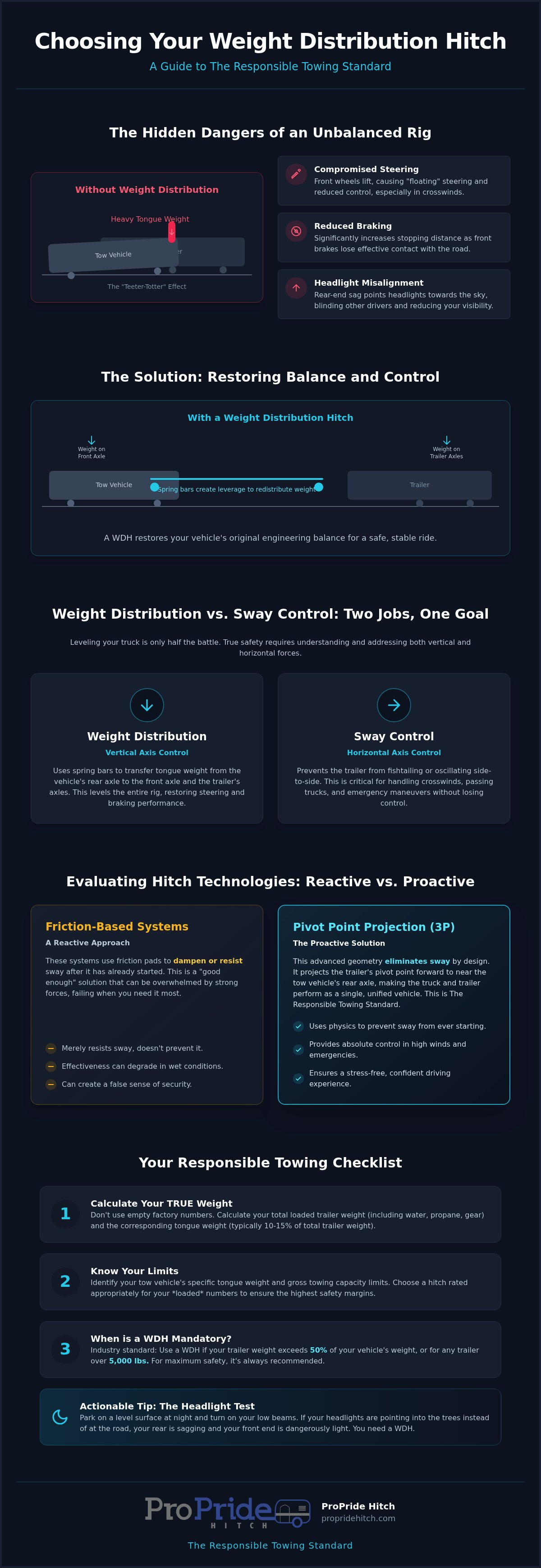
Towing a heavy trailer changes the fundamental physics of your vehicle. When you connect a trailer to a standard ball mount, you're essentially creating a giant teeter-totter with your truck's rear axle acting as the pivot point. The trailer's tongue weight pushes down on the rear, which naturally forces the front end of your truck to lift. This isn't just a cosmetic issue of "rear-end sag." It's a critical safety failure that compromises your vehicle's ability to steer and stop effectively.
A weight-distributing hitch is designed to counteract this leverage. Instead of allowing the weight to concentrate solely on the rear axle, the system uses spring bars to create leverage that distributes that load across all axles of the tow vehicle and the trailer. When you're researching how to choose a weight distribution hitch, you're looking for a tool that restores the original engineering balance of your truck. This commitment to mechanical harmony is the core of what we call The Responsible Towing Standard.
The Physical Dangers of an Unbalanced Rig
When your front tires lose contact pressure with the road, you experience what drivers call "floating" steering. This makes it difficult to maintain your lane, especially when wind or passing vehicles create lateral pressure. Even more dangerous is the impact on your braking performance. Since your front brakes provide the majority of your stopping power, a light front end significantly increases your stopping distance during an emergency. You simply can't safely navigate a crisis if your tires aren't firmly planted on the pavement.
Actionable Tip: To see if your rig is unbalanced, park on a level surface at night and turn on your low beams. If your headlights are pointing into the trees instead of at the road, your rear is sagging and your front end is dangerously light.
When is a Weight Distribution Hitch Mandatory?
While specific laws can vary, the industry standard for safety is clear. You should use a weight distribution system if your loaded trailer weighs more than 50% of your vehicle's weight. Most manufacturers also require one for any trailer over 5,000 lbs. Even for trailers that fall below these thresholds, the added stability is vital for long-term safety. Relying on the ProPride 3P Hitch ensures that you aren't just meeting the bare minimum requirements, but are operating at the highest level of safety possible. This is the only logical conclusion for a driver who values precision and the total elimination of risk.
Understanding the Mechanics: Weight Distribution vs. Sway Control
Many drivers mistakenly assume that leveling their truck automatically solves the problem of trailer sway. It doesn't. When you're researching how to choose a weight distribution hitch, it's vital to understand that weight distribution and sway control are two distinct mechanical functions. Distribution focuses on the vertical axis, moving weight from the rear axle to the front. Sway control addresses the horizontal axis, preventing the trailer from fishtailing. While a balanced rig is a prerequisite for safety, distribution alone won't stop a trailer from oscillating once a gust of wind or a passing semi-truck initiates lateral movement.
Traditional setups often rely on friction to dampen sway after it starts. This is a reactive approach that fails when the forces of physics exceed the resistance of the friction pads. The Responsible Towing Standard demands a proactive solution. By utilizing high-quality engineering, you eliminate the need for these "good enough" fixes that compromise your peace of mind. True safety comes from a design that uses geometry to prevent the trailer from ever moving independently of the tow vehicle. To truly grasp how weight distribution systems function, you have to look at the physics of leverage rather than just the height of your bumper.
How Weight Distribution Bars Create Leverage
The spring bars are the heart of the system. They act as heavy-duty springs that apply upward pressure to the hitch head. This tension creates a bridge between the truck and trailer, forcing the weight to spread across all axles. Load leveling is simply the visible byproduct of this applied torque. By tensioning these bars correctly, you ensure your vehicle maintains its engineered geometry. This prevents the rear-end squat that makes your tow vehicle feel disconnected from the road.
Actionable Tip: Measure your front wheel well height before and after hitching up. Your goal is to return the front height as close to the unhitched measurement as possible without going lower than the original height.
The Vital Link Between Balance and Stability
Stability depends on the contact patch, which is the area of your tire actually touching the pavement. If your front end is light, that patch shrinks and your steering becomes unresponsive. A balanced truck keeps those tires planted, providing the grip needed to resist initial sway inputs. However, even the best balance can't overcome the physical tendency of a trailer to pivot on a ball mount. This is why we advocate for Trailer Sway Solutions: The Science and Safety of Stable Towing in 2026 that go beyond simple friction. The ProPride 3P Hitch uses Pivot Point Projection to move the virtual pivot point forward, making sway physically impossible. This advanced engineering ensures you remain a specialized partner in your family's safety rather than just a driver reacting to road conditions.
Evaluating Hitch Technologies: Friction-Based vs. Pivot Point Projection
When you're trying to figure out how to choose a weight distribution hitch, you'll encounter two very different schools of thought. One side tries to manage the symptoms of sway using friction, while the other uses geometry to eliminate the cause. Traditional friction-based systems act like a set of brake pads clamped onto your hitch. They provide resistance, but resistance is fundamentally reactive. For a friction bar to work, the trailer must already be moving sideways. This means you're always one step behind the physics of the road, reacting to a problem that has already started.
In high winds or sudden maneuvers, these systems often reach a "break-away" point. This is the moment when the lateral force of the trailer overcomes the static friction of the hitch, and the trailer begins to oscillate uncontrollably. Managing a problem isn't the same as solving it. If you're serious about The Responsible Towing Standard, you need a solution that addresses the root cause: the pivot point itself. By shifting your focus from resistance to geometry, you move from a state of constant management to a state of total elimination.
The Friction Trap: Why Resistance Isn’t Enough
Friction hitches don't just fight the trailer; they fight you. Because the friction is always "on," the system resists your steering inputs just as much as it resists the wind. This can lead to a stiff, unnatural driving feel that increases driver fatigue over long distances. Additionally, friction pads are notorious for loud popping and groaning noises during tight turns. They also require constant maintenance and adjustment to remain even marginally effective. This is a critical step in understanding how to choose a weight distribution hitch that won't fail you when the weather turns.
Actionable Tip: Check the manufacturer’s fine print on friction-based systems. Many require you to loosen or disable the sway control bars during rain or when backing up, which are the exact moments when you need stability the most.
Pivot Point Projection: The Master Engineer’s Solution
The ProPride 3P approach utilizes Pivot Point Projection to fundamentally change the relationship between your truck and trailer. By using a series of links, the system projects the virtual pivot point forward to the rear axle of the tow vehicle. This makes the trailer behave like a fifth wheel or a semi-truck, where the trailer cannot exert lateral leverage on the truck. It's the ultimate evolution of the Jim Hensley design legacy, offering a level of stability that traditional ball mounts simply cannot match.
This isn't a "good enough" fix; it's a total mechanical transformation. When you invest in The ProPride 3P Hitch: The Ultimate Engineering Solution, you're choosing to eliminate the physics of sway before it can ever begin. This provides the peace of mind that comes from knowing your equipment meets the highest standards of engineering excellence. You aren't just buying a part; you're securing a stress-free travel experience for your family by choosing The Best Hitch on the Planet.
Key Specifications: Matching Your Hitch to Your Rig
Matching your equipment to your specific rig is the cornerstone of The Responsible Towing Standard. Many people get lost in the sea of Gross Vehicle Weight Ratings (GVWR), but that number only tells you the maximum capacity of your trailer. To truly understand how to choose a weight distribution hitch, you must focus on the real-world weight of your loaded trailer. This includes your fresh water tanks, camping gear, and supplies. Basing your safety on an empty "dry weight" is a gamble that compromises your control on the highway because dry weight doesn't account for the reality of your travel lifestyle. If you're still in the process of selecting a vehicle with the right towing specs, Auto Sale Newport features a variety of pre-owned options that can provide the power and stability you need.
Your vehicle's manual provides a Max Tongue Weight rating, which is the maximum downward force your hitch receiver can handle. Exceeding this limit can lead to structural damage or catastrophic failure of the receiver itself. A key part of being a responsible owner is the habit of regular weight verification. You should never assume your setup is "fine" just because it looks level. Precision is the only way to ensure your equipment meets the highest safety standards and protects your family during long hauls.
Safe trailer balance requires a tongue weight between 10% and 15% of your total Gross Trailer Weight. If your tongue is too light, the trailer will be inherently unstable and prone to oscillation; if it's too heavy, you risk overloading your truck's rear axle and tires. Remember that items like heavy-duty batteries, full propane tanks, and front-loaded storage compartments add significant weight directly to the tongue. When you are deciding how to choose a weight distribution hitch, always prioritize these actual measured numbers over the trailer's factory labels.
Actionable Tip: Don't rely on bathroom scales or "feeling" the weight. Use a dedicated tongue weight scale for precision or visit a certified vehicle scale to get your exact axle weights while fully loaded for a trip.
Sizing Your ProPride 3P System
We offer the ProPride 3P Trailer Sway Control Hitch with 1,000 lb or 1,400 lb spring bar options to match your specific needs. It's a common mistake to think "heavier is better" and choose the 1,400 lb bars for a lighter trailer. However, over-sizing your spring bars creates a ride that is too rigid. This rigidness transfers excessive road shock directly to your trailer frame, which can lead to popped rivets, broken cabinets, or structural cracks over time.
By selecting the bars that match your actual measured tongue weight, you ensure the system can flex and absorb road energy as intended. This provides the smooth, stable experience that has made the Jim Hensley design the gold standard in the industry. You can find the specific technical details for each capacity on our ProPride 3P Trailer Sway Control Hitch product page to ensure you're making the most informed decision for your investment.
Making the Responsible Choice: Why the ProPride 3P is the Ultimate Standard
Deciding how to choose a weight distribution hitch is a process that separates the casual traveler from the responsible owner. You've likely seen the forums where users debate whether a premium system is worth the investment. However, these debates often ignore the immutable laws of physics. Traditional hitches allow the trailer to pivot on a ball, which grants the trailer leverage over your truck. The ProPride 3P uses Pivot Point Projection to move that virtual pivot point to the rear axle. This stops sway before it can even start, making it the only logical conclusion for anyone who values precision and the total elimination of risk.
Our commitment to safety is anchored in engineering excellence rather than marketing hype. When you choose the ProPride 3P, you're not just buying a piece of hardware; you're adopting a specialized partner for your travel lifestyle. This system is designed to handle the physical dangers that "good enough" equipment simply can't manage. By removing the possibility of independent trailer movement, you secure the peace of mind that comes from knowing you've met the highest safety standards in the industry. It truly is the Best Hitch on the Planet for the educated RVer.
The Peace of Mind Factor on the Open Road
The stress-free experience of towing with a 3P hitch is something you have to feel to fully understand. Imagine driving through high-plains crosswinds or being boxed in by multiple semi-trucks without feeling a single wiggle from your trailer. This stability doesn't just keep you safe; it protects your mental energy. By eliminating the constant need for small steering corrections, the 3P reduces driver fatigue on even the longest journeys. If you want to see how we compare to other market options, our Sway Control Hitch Comparison: Finding the Standard in 2026 provides the granular detail a discerning consumer requires.
Actionable Tip: After your first 100 miles of towing with a new hitch, always perform a quick "safety walk-around" to check the tightness of your U-bolts and ensuring your weight distribution jacks are still at their recorded height.
Investing in The Responsible Towing Standard
Choosing The Responsible Towing Standard means you're investing in a lifetime of safety. We don't just sell a product; we provide direct-to-consumer expert support and a lifetime warranty that reflects our confidence in the Jim Hensley design legacy. While cheaper equipment might suffice for a sunny day on a flat road, it fails when conditions turn treacherous. Your family and your investment deserve the ultimate protection. Don't settle for traditional solutions that only offer a false sense of security. It's time to take control of your road experience and eliminate the fear of losing control. Upgrade to the ProPride 3P and Eliminate Sway Forever.
Secure Your Journey with the Ultimate Towing Standard
Choosing a hitch is one of the most critical decisions you'll make for your family's safety on the open road. By now, you understand that learning how to choose a weight distribution hitch isn't just about leveling your vehicle; it's about mastering the physics of your rig. You've seen why relying on reactive friction systems is a risk and why actual measured tongue weight is the only data point that ensures a stable connection. True peace of mind comes from knowing your equipment is engineered to handle the unexpected.
The ProPride 3P, a direct evolution of the Jim Hensley design legacy, utilizes patented Pivot Point Projection to physically eliminate sway before it starts. Supported by a lifetime warranty and US-based expert support, it remains the gold standard for drivers who value data over fluff. You've done the research and educated yourself on the mechanics of safety. Now, you're ready to hit the road with the quiet confidence that only comes from the best equipment. Experience the Responsible Towing Standard with the ProPride 3P.
Frequently Asked Questions
Do I really need a weight distribution hitch if my truck is leveled?
Yes. Leveling kits or airbags only address the visual sag of the truck; they don't solve the underlying physics problem. A weight distribution system actually moves weight from the rear axle to the front axle to restore steering and braking performance. This is why learning how to choose a weight distribution hitch is vital even for heavy-duty trucks. It's about axle load balance, not just a level bumper.
Can a weight distribution hitch actually stop trailer sway?
Most traditional weight distribution hitches only manage sway using friction, which is reactive and limited. However, the ProPride 3P hitch utilizes Pivot Point Projection to fundamentally eliminate the possibility of sway. By moving the virtual pivot point forward to the rear axle, the trailer is physically unable to exert lateral leverage on the tow vehicle. This engineering approach makes the 3P the only logical choice for total sway elimination.
What is the difference between a sway bar and a sway elimination hitch?
A sway bar uses friction to resist movement after the trailer has already started to oscillate. It is a reactive tool that often fails in high winds or emergency maneuvers. A sway elimination hitch, like the ProPride 3P, uses geometry to prevent oscillation from starting. By projecting the pivot point forward, the system removes the trailer’s ability to pivot independently on the ball, providing a stable, stress-free driving experience.
How do I know what size spring bars I need for my ProPride hitch?
You select spring bars based on your trailer's actual loaded tongue weight. We offer 1,000 lb and 1,400 lb options to ensure proper tension without creating an overly rigid ride. To find your requirement, use a dedicated tongue weight scale while your trailer is fully loaded for a trip. Choosing the correct capacity is a key part of how to choose a weight distribution hitch that protects your trailer’s structural integrity.
Is it difficult to install a ProPride 3P hitch myself?
Most of our customers choose to perform the installation themselves using standard hand tools. The 3P hitch is a bolt-on system that does not require welding or specialized shop equipment. We provide exhaustive technical documentation and direct-to-consumer expert support to guide you through the process. Installation typically takes a few hours and allows you to become intimately familiar with the equipment that secures your family’s safety on the road.
Can I use a weight distribution hitch with surge brakes?
Yes, but only if the hitch design allows for the linear movement required to trigger the surge brake master cylinder. The ProPride 3P is specifically engineered to be compatible with surge brake systems found on many boat trailers and some European-style RVs. Because the 3P does not rely on rigid friction bars that bind during movement, it allows the trailer tongue to compress and activate the brakes as intended during deceleration.
Does a weight distribution hitch increase my vehicle’s towing capacity?
No, a weight distribution hitch does not increase the mechanical towing capacity set by the vehicle manufacturer. It does, however, allow you to safely reach the Weight Distributing (WD) limits specified in your owner's manual. Without a proper system, you are restricted to the much lower Weight Carrying (WC) limits. Adhering to these ratings is a cornerstone of The Responsible Towing Standard and ensures your vehicle operates within its engineered safety margins.