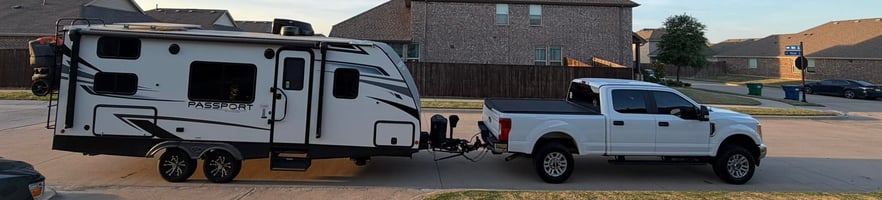
Why One Eliminates Sway and the Other Can’t
If you’ve spent any time researching a trailer sway control hitch, you’ve likely seen countless friction-based options promising “sway control.” They’re popular, affordable, and widely available. Many RV owners start with them.
But a large percentage of ProPride 3P® owners have one thing in common:
they upgraded after friction hitches failed to deliver real control.
This comparison explains why.
How Friction-Based Anti-Sway Hitches Work
Friction-based anti-sway hitches rely on resistance to slow trailer movement. They typically use:
- Steel bars pressed against friction pads
- Brackets that clamp and “capture” motion
- Adjustable tension to increase resistance
When the trailer begins to sway, friction resists the movement and attempts to dampen it.
The keyword here is reacts.
Friction systems do not prevent sway from starting — they only attempt to slow it once it has already begun.
The Fundamental Problem With Friction Sway Control
Friction is not a reliable control mechanism for something as dynamic and forceful as a moving trailer.
Why Friction Is Inconsistent
- Rain and moisture reduce friction instantly
- Dust and road debris act as lubricants
- Wear over time reduces effectiveness
- Heat buildup changes friction properties
In real-world towing conditions, friction is constantly changing, which means sway control is also constantly changing.
That inconsistency is why many drivers still experience:
- White-knuckle steering
- Constant correction
- Sudden sway during wind gusts or passing trucks
What the ProPride 3P® Hitch Does Differently
The ProPride 3P® Hitch does not rely on friction at all.
Instead, it uses Pivot Point Projection™, a geometry-based solution that physically prevents the trailer from pivoting in a way that does not allow sway to begin.
Key Difference
- Friction hitches fight sway
- The ProPride 3P® eliminates the conditions that cause sway
This isn’t a stronger reaction — it’s a smarter solution.
Pivot Point Projection™ vs Friction Control
With a traditional ball hitch, the trailer pivots freely behind the rear axle. This creates leverage that allows side-to-side oscillation.
The ProPride 3P® Hitch:
- Projects the pivot point forward
- Removes leverage
- Prevents oscillation from developing
There is nothing to “slow down” because sway never starts.
This is why towing with the ProPride feels fundamentally different from friction-based systems.
Safety in Emergency Situations
Emergency maneuvers expose the biggest weakness of friction-based anti-sway hitches.
During:
- Panic stops
- Sudden lane changes
- Hard braking in crosswinds
Friction systems can be instantly overwhelmed. Once friction is exceeded, the trailer is free to sway — often violently.
The ProPride 3P® Hitch maintains control because:
- There is no friction threshold to exceed
- Geometry remains constant
- The trailer remains aligned with the tow vehicle
This level of predictability can make the difference between a close call and a catastrophic loss of control.
Long-Term Ownership Comparison
Friction-Based Anti-Sway Hitches
- Lower upfront cost
- Require ongoing adjustment
- Performance degrades over time
- Limited resale value
- Many owners upgrade later
ProPride 3P® Hitch
- Higher upfront investment
- Minimal performance change over time
- Built from heavy-duty steel
- Retains strong resale value
- The final hitch owners buy
Many ProPride owners say the same thing:
“I wish I had bought this first.”
Driver Fatigue: The Hidden Cost of Friction Hitches
Even when friction systems “work,” they still require constant attention.
Drivers often:
- Grip the steering wheel tightly
- Anticipate sway instead of relaxing
- Reduce speed unnecessarily
- End the day exhausted
The ProPride 3P® Hitch removes that mental load. With sway eliminated, drivers report:
- One-handed steering
- Longer driving days
- Less stress
- More enjoyment of the journey
Why Friction Hitches Are Cheaper — and Why That Matters
Friction-based hitches cost less because they use:
- Less steel
- Simpler components
- No patented geometry
But lower cost also means lower capability.
A trailer sway control hitch should be judged by performance when conditions are worst — not when conditions are perfect.
Final Verdict: Elimination vs Management
If your goal is to reduce sway, a friction-based anti-sway hitch may help some of the time.
If your goal is to eliminate trailer sway, there is only one solution:
Control the pivot point.
The ProPride 3P® Hitch doesn’t manage sway.
It removes the mechanical ability for sway to exist.
For drivers who value safety, confidence, and true control, the choice becomes clear.