
Most "sway control" systems on the market don't actually stop sway; they just try to slow it down after the terror has already started. If you've ever felt the sickening push of a passing semi-truck or fought the wheel in a high wind, you've experienced the inherent limits of traditional equipment. You're likely here because you're a responsible researcher who values facts over fluff. You want to understand the mechanical reality of pivot point projection vs friction sway control before you hit the road again. It's the difference between managing a dangerous situation and preventing it from ever happening.
We agree that towing shouldn't be a test of your nerves or your reflexes. You deserve to arrive at your destination feeling refreshed, not drained by hours of high-stakes corrections. In this article, you'll discover how the Jim Hensley design legacy transformed towing by using physics to lock out the ball and eliminate movement at the source. We'll show you why shifting the trailer's effective pivot point forward is the only way to achieve total stability. By the end, you'll have the technical confidence to embrace "The Responsible Towing Standard" and enjoy a truly stress-free journey.
Key Takeaways
- Learn why traditional friction hitches are reactive and only begin to work after your trailer has already started to sway.
- Understand how Pivot Point Projection uses geometry to move the trailer's rotation axis, which effectively locks out the hitch ball to prevent movement.
- Compare the engineering reality of pivot point projection vs friction sway control to see why eliminating sway is safer than just trying to manage it.
- Identify the specific questions you should ask to evaluate your own equipment and align with The Responsible Towing Standard.
- Discover how moving beyond "good enough" solutions leads to a stress-free towing experience and total peace of mind for your family.
The Mechanics of Stability: Why Traditional Friction Sway Control Often Falls Short
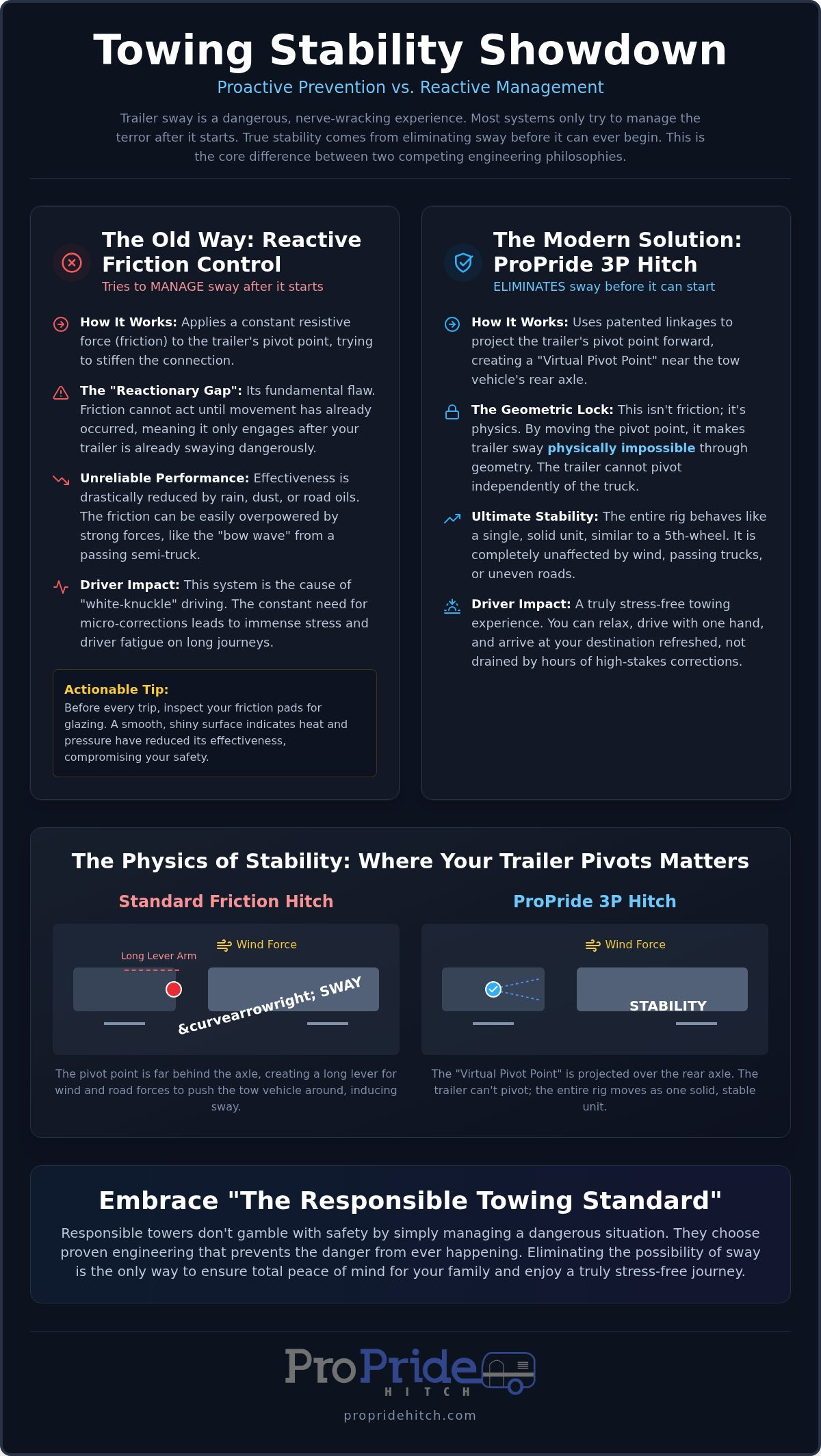
Friction sway control is the most common method used in basic tow hitch designs. It works by applying a resistive force to the trailer's pivot point, essentially trying to stiffen the connection between the truck and the trailer. While this sounds logical on paper, it relies on a fundamental flaw: friction can't act until movement has already occurred. This creates a dangerous "Reactionary Gap." In the debate of pivot point projection vs friction sway control, it's vital to recognize that friction hitches are reactive. They wait for a gust of wind or a passing semi to push your trailer before they start to resist.
How Friction Hitches Fight Physics
Most friction systems use a sliding bar or integrated pads that create resistance as the trailer tries to turn. These systems require you to manually tighten bolts or adjust handles to find the right level of tension. However, this resistance is constant, meaning it fights you during normal turns just as much as it fights the wind. You're essentially trying to overpower the laws of physics with a mechanical brake that doesn't know the difference between a controlled turn and a dangerous sway event.
Actionable Tip: Before every trip, inspect your friction pads for glazing. Glazing occurs when the pads become smooth and shiny from heat and pressure, significantly reducing their effectiveness. If they look like glass, they need cleaning or replacement to maintain even a baseline level of safety.
The Limits of Resistance in High-Stress Scenarios
Friction is notoriously unreliable in changing environments. Rain, road oils, and even dust can lubricate the friction surfaces, causing the sway control to fail exactly when you need it most. When a massive "bow wave" from a semi-truck hits the side of your trailer, the force often exceeds the holding power of the friction pads. This leads to the "white-knuckle" effect. Your body tenses up because the hitch is only managing the sway, not stopping it. This constant correction leads to massive driver fatigue over long distances.
When you compare pivot point projection vs friction sway control, the choice becomes a matter of engineering truth. Choosing a solution like the ProPride 3P Hitch represents a shift toward "The Responsible Towing Standard." Instead of relying on a threshold of resistance that can be easily overcome, responsible towers look for engineering that eliminates the cause of the problem. Managing a sway event is a high-risk gamble; eliminating the possibility of sway is the only way to ensure total peace of mind for your family.
Understanding Pivot Point Projection: The Jim Hensley Innovation
Jim Hensley's design legacy represents a fundamental shift in how we approach trailer stability and sway control. While most manufacturers were busy trying to improve the material of their friction pads, Hensley realized that the real problem wasn't the amount of friction; it was the location of the pivot point itself. This insight led to the creation of the ProPride 3P Hitch, which stands as the ultimate evolution of his original vision. When you analyze pivot point projection vs friction sway control, the most striking difference is where the trailer actually rotates.
In a standard bumper-pull setup, the trailer pivots on the ball, located several feet behind the tow vehicle's rear axle. This creates a long lever that the trailer uses to push the truck around. Pivot Point Projection (PPP) uses a patented linkage system to move that rotation axis forward. We call this the "Virtual Pivot Point." By projecting the trailer's pivot point to a location near the tow vehicle's rear axle, the 3P system effectively shortens the lever. This makes your entire rig behave like a single, solid unit on the highway, rather than two separate vehicles fighting for control.
The Geometry of Convergence
The 3P linkage system creates a point of convergence ahead of your bumper. This specific geometry mimics the stability you'd find in a 5th-wheel or gooseneck trailer. Because the trailer's pivot axis is "projected" forward, it cannot initiate a side-to-side pivot independently of the truck. Pivot Point Projection doesn't fight sway with friction; it makes sway physically impossible through geometry. This isn't just a marketing claim. It's a mechanical reality that aligns with The Responsible Towing Standard, providing the highest level of stability available for bumper-pull trailers.
Why Locking the Ball is Critical
To make this projection geometry work, the ProPride 3P Hitch actually "locks out" the hitch ball. In a traditional system, the ball is the weakest link because it allows the trailer to move freely in any direction. The 3P system uses a heavy-duty head that captures the trailer's coupler, turning the ball and coupler into a rigid connection. This eliminates the leverage a trailer normally has over the tow vehicle. By removing this independent movement, the truck stays in control of the trailer, not the other way around.
Actionable Tip: Because the 3P system locks the coupler and ball together into a rigid unit, you should never grease the hitch ball. Since there's no pivoting happening at the ball itself, grease is unnecessary and only creates a mess. Instead, focus your maintenance on the linkage zerk fittings to keep the internal bearings moving smoothly.
By understanding these principles, you can see why many experienced towers consider the ProPride 3P Hitch the only logical conclusion for safe travel. It moves the conversation from "how much sway can I handle?" to "how can I eliminate sway entirely?"
Head-to-Head: Friction Bars vs. The ProPride 3P Hitch
Traditional friction bars are a constant maintenance project. You have to tighten them, loosen them for backing up, and worry about whether they're too tight or too loose for the current weather. In the debate of pivot point projection vs friction sway control, the ProPride 3P Hitch offers a "set it and forget it" advantage. Once it's dialed in, the engineering does the work for you. This allows you to focus on the road rather than wondering if your friction pads have enough bite to handle the next gust of wind. It's a fundamental difference in how we approach the driving experience.
One of the most terrifying moments for any tower is "The Bow Wave." This happens when a large semi-truck passes you at high speed, pushing a wall of air that hits your trailer first, then your truck. With friction bars, the trailer moves, and you feel that movement through the steering wheel. Because the 3P uses Pivot Point Projection to move the rotation axis near the tow vehicle's rear axle, that air pressure pushes against the entire rig as a single unit. Your steering remains neutral, and your braking performance stays predictable because the trailer isn't trying to leverage the truck. This is why the 3P is the ultimate choice for those who adhere to The Responsible Towing Standard.
Performance in Emergency Maneuvers
Friction hitches can actually work against you during sharp corrective steering. Because they rely on resisting movement, they can "bind" or lock up, making it harder to steer the truck in the direction you need to go. The 3P linkage system remains fluid. It allows the truck to turn the trailer with zero resistance while simultaneously preventing the trailer from turning the truck. You can read more about The Science and Safety of Stable Towing to understand how this fluidity translates to real-world control during a crisis.
Long-Term Value and Durability
Friction systems are essentially wear items. You'll spend years replacing pads and adjusting bars that eventually lose their effectiveness as the materials degrade. Academic research into The Mechanics of Stability confirms that advanced linkage systems provide superior control by managing lateral forces more effectively than simple resistive friction. The ProPride 3P Hitch is built with heavy-duty steel and precision bearings designed to last as long as you own your trailer. The peace of mind you get from knowing your family is protected by the best engineering on the planet is a return on investment that goes far beyond the purchase price.
Actionable Tip: To keep your 3P performing at its peak, perform a quick pre-trip linkage check. Ensure all zerk fittings are greased and that the main linkage arms move freely. A well-lubricated linkage ensures the "Virtual Pivot Point" remains exactly where it's supposed to be for maximum stability on the highway.
Transitioning to The Responsible Towing Standard
Becoming a responsible tower starts with a shift in mindset. It’s about moving past the idea of "making it work" and toward a commitment to absolute safety. Many drivers fall into common traps by assuming that a standard hitch is sufficient for their needs. You can explore these pitfalls in our guide on Travel Trailer Towing Mistakes. When you evaluate pivot point projection vs friction sway control, you aren't just comparing two pieces of hardware. You're choosing the foundation of your family’s travel experience and the protection of your significant investment.
Towing stress is a real factor that often goes unaddressed in marketing brochures. The constant mental load of correcting for sway leads to physical exhaustion and diminished reaction times. A responsible tower asks: "Does my equipment give me the confidence to drive for eight hours and still have the energy to enjoy my family at the destination?" If you're fighting the wheel, the answer is no. Embracing "The Responsible Towing Standard" means choosing engineering that removes the burden of control from the driver and places it on the physics of the hitch itself.
Assessing Your Risk Profile
Every trailer has a specific risk profile based on its "sail area," which is the total side surface exposed to the wind. A longer, taller trailer is naturally more susceptible to lateral forces from wind gusts or passing trucks. Relying on "good enough" friction equipment is a gamble because those systems have a breaking point where the force of the wind exceeds the resistance of the pads. Even the most experienced drivers cannot react faster than the laws of physics. Total sway elimination is the only way to ensure that a sudden gust doesn't turn into a catastrophic event.
The Role of Education in Safe Towing
Safe towing requires you to look beyond hype and understand the mechanics of your rig. While sway control is the headline, proper weight distribution is the supporting act. A responsible researcher understands that these two systems must work in harmony to keep the tow vehicle’s steering and braking geometry intact. By educating yourself on how your hitch manages these forces, you move from being a passive passenger to an informed operator who prioritizes long-term safety over short-term savings.
Actionable Tip: As part of The Responsible Towing Standard, always use a dedicated tongue weight scale to verify your load before a trip. Proper tongue weight, usually between 10% and 15% of the total trailer weight, is essential for the 3P system to distribute weight correctly across your axles and maintain peak stability.
If you're ready to stop managing sway and start eliminating it, you can order the ProPride 3P Hitch today to experience the ultimate in towing stability.
Why the ProPride 3P Hitch is the Only Logical Conclusion
The ProPride 3P represents the apex of towing technology. It's the only system that takes the Jim Hensley legacy to its peak performance. When you weigh the options of pivot point projection vs friction sway control, you're looking at two different worlds of safety. One tries to patch a problem; the other solves it with mechanical certainty. The total elimination of sway isn't a luxury. It's a requirement for anyone who understands the physical risks of the open road and refuses to settle for "good enough" solutions.
Investing in the ProPride 3P Hitch Product Page is a proactive choice for your family’s future. Many people view a hitch as a simple commodity, but a responsible researcher sees it as essential insurance. The cost of a single sway-related incident, from minor damage to a total loss, far exceeds the price of the best equipment. By choosing engineering excellence today, you prevent the terrifying "what if" scenarios of tomorrow. It's the most logical financial and safety decision you can make for your towing lifestyle.
The ProPride Advantage: More Than Just a Hitch
When you choose a 3P, you aren't just buying a piece of hardware; you're joining a community of towers who refuse to compromise on stability. Our expert support team consists of specialists who understand the granular details of your specific rig. This hitch is designed with heavy-duty construction that ensures it's the last one you'll ever need to buy. It's a lifetime investment in your peace of mind, backed by a brand that treats your safety as our primary mission.
Actionable Tip: If you're unsure about how the 3P will fit your specific truck and trailer combination, reach out to our specialists. We offer personalized setup consultations to ensure your hitch is perfectly configured for your unique weight profile and equipment before you ever hit the highway.
Final Commitment to Safety
The road is unpredictable, but your hitch shouldn't be. Protecting your family and your investment is a serious responsibility that demands the highest level of preparation, including proper vehicle maintenance. For those preparing for a long haul, you might explore Full-Synthetic Oil Change options to ensure your tow vehicle is ready for the added stress of towing. By choosing a system that eliminates sway at its source, you set a new bar for your travels. This is more than a preference; it is "The Responsible Towing Standard." Don't wait for a close call to realize you need better equipment. The laws of physics don't offer second chances, so it's vital to have the right engineering on your side from the start.
Take control of your driving experience and Experience the Best Hitch on the Planet. You've done the research and you understand the physics. Now, it's time to choose the only logical conclusion for safe, stress-free towing that lasts a lifetime.
Embrace the Confidence of Engineering Excellence
You've done the research to understand the physical reality of pivot point projection vs friction sway control. Traditional friction hitches rely on resisting movement after it starts; this is a reactive gamble with your family's safety. By contrast, the Jim Hensley patented technology used in the ProPride 3P Hitch eliminates sway by shifting the pivot point forward. This creates a rig that behaves like a single, stable unit. It's the only logical choice for someone who values precision and durability over "good enough" solutions.
With over 15 years of proven sway elimination and direct engineering support for every customer, we're here to help you move beyond the stress of white-knuckle driving. You can finally enjoy the open road with total peace of mind. It's time to stop managing a problem and start preventing it at the mechanical source. Your commitment to safety deserves equipment that works as hard as you do to protect your investment.
Upgrade to The Responsible Towing Standard with the ProPride 3P and discover why we're known for the Best Hitch on the Planet. Your next journey deserves the ultimate in stability.
Frequently Asked Questions
Is Pivot Point Projection the same as a friction sway bar?
Pivot point projection is fundamentally different from a friction sway bar because it uses geometry rather than resistance. While a friction bar tries to dampen movement that has already begun, the 3P system changes the trailer's rotation axis. This prevents the trailer from gaining leverage over the tow vehicle. It's a proactive engineering solution that aligns with The Responsible Towing Standard, whereas friction is simply a reactive band-aid for a mechanical problem.
Can I use a friction hitch and a ProPride 3P together?
You cannot use a friction hitch and a ProPride 3P together because they operate on opposing mechanical principles. The 3P system is designed to lock out the hitch ball and provide a rigid connection that eliminates sway at the source. Adding friction bars would interfere with the fluid movement of the 3P linkage. Once you install the 3P, you have a complete solution that makes traditional friction-based equipment entirely unnecessary and redundant for your rig.
Does Pivot Point Projection work better in high winds than friction hitches?
Pivot point projection performs significantly better in high winds because it doesn't rely on a threshold of friction that can be overcome. In heavy crosswinds, the force against your trailer's side profile can easily exceed the holding power of friction pads. Because the 3P projects the pivot point forward to the truck's rear axle, the wind pushes against the entire rig as one unit. This ensures you maintain neutral steering even in challenging weather conditions.
Why is Pivot Point Projection more expensive than traditional sway control?
The cost difference reflects the complexity and high-quality engineering involved in the design. Traditional sway control often uses simple steel bars and replaceable friction pads. The 3P system is a precision-engineered linkage made of heavy-duty steel. When comparing pivot point projection vs friction sway control, the investment provides a lifetime of safety. It's why we're known for the Best Hitch on the Planet, eliminating the need for replacement parts while protecting your family and your investment.
Do I need to turn off friction sway control when backing up my trailer?
Many traditional friction hitches require you to loosen or remove the sway bars before backing up to prevent damage to the bars or brackets. With the ProPride 3P, there's no need for any adjustment when you reach your destination. The linkage system allows for tight turns and backing maneuvers without binding or restriction. This makes arriving at your campsite much easier and less stressful, as you don't have to step out of the truck first.
Is the ProPride 3P Hitch compatible with my specific trailer brand?
The ProPride 3P Hitch is compatible with almost any travel trailer that uses a standard A-frame chassis. This includes popular brands like Airstream, Jayco, and Grand Design. Because the system is versatile, it can be adjusted to fit different frame heights and coupler styles. If you're unsure about your specific setup, we recommend reaching out for a personalized consultation. We'll help you ensure your weight distribution is perfectly dialed in for your specific trailer brand.
How does Pivot Point Projection affect my vehicle's fuel economy compared to friction hitches?
There's no direct mechanical difference in fuel economy between pivot point projection vs friction sway control. However, the 3P system often leads to a more efficient driving experience overall. When you aren't constantly fighting sway or making micro-corrections with the steering wheel, your vehicle maintains more consistent momentum. This stability reduces driver fatigue and allows the tow vehicle to operate more smoothly. A stable rig is always more efficient than one that is constantly swaying. To further optimize your tow vehicle's torque and efficiency, you can learn more about Dynogen Remapping Solutions.
Yes, this technology is specifically designed to eliminate the sway caused by the "bow wave" of passing semi-trucks. In a standard setup, that wall of air pushes the trailer and creates a pivot at the ball. The 3P system prevents this independent movement by projecting the pivot point near the truck's rear axle. Instead of the trailer swaying independently, the entire rig stays in line, keeping your steering straight and your family safe on the road.

