
You've likely felt that sudden, sickening tug on your steering wheel as a massive semi-truck passes you at highway speeds. Most drivers assume this white-knuckle experience is just an unavoidable part of the journey, but the truth is that your equipment might be fighting a losing battle against the laws of physics. It's a terrifying feeling when the trailer begins to dictate the direction of your truck, leaving you to wonder if a simple friction bar is actually enough to keep your family safe during a long cross-country trip.
We know how exhausting it is to sort through conflicting marketing claims about sway control versus total elimination. You deserve to understand the fundamental mechanical differences of pivot point projection vs friction sway control without the typical sales fluff. This guide explores the engineering reality behind these two approaches, showing you why traditional friction hitches act only as a reactive band-aid. By the end, you'll see why changing the trailer's physical pivot point is the only way to achieve a truly stable, stress-free towing experience. We're here to help you make an informed choice and adopt The Responsible Towing Standard for your next adventure.
Key Takeaways
- Understand why friction hitches rely on a "Reactionary Gap" that only attempts to slow down sway once it has already begun.
- Learn how the engineering of pivot point projection vs friction sway control moves the trailer's pivot point forward to create a single, stable unit.
- Compare the high maintenance of traditional friction bars with the "set it and forget it" reliability of the Jim Hensley design legacy.
- Identify the critical questions every researcher should ask to ensure their equipment meets The Responsible Towing Standard.
- Discover how to protect your family from the "Bow Wave" effect caused by passing semi-trucks through total sway elimination.
The Mechanics of Stability: Why Traditional Friction Sway Control Often Falls Short
Understanding the engineering truth behind pivot point projection vs friction sway control begins with a look at how most trailers are connected to tow vehicles. Traditional friction sway control functions as a resistive force. It uses friction pads or sliding bars to create tension at the trailer's pivot point. This setup is a common addition to a standard Weight-distributing hitch, intended to dampen side-to-side movement by making it harder for the trailer to turn independently of the truck.
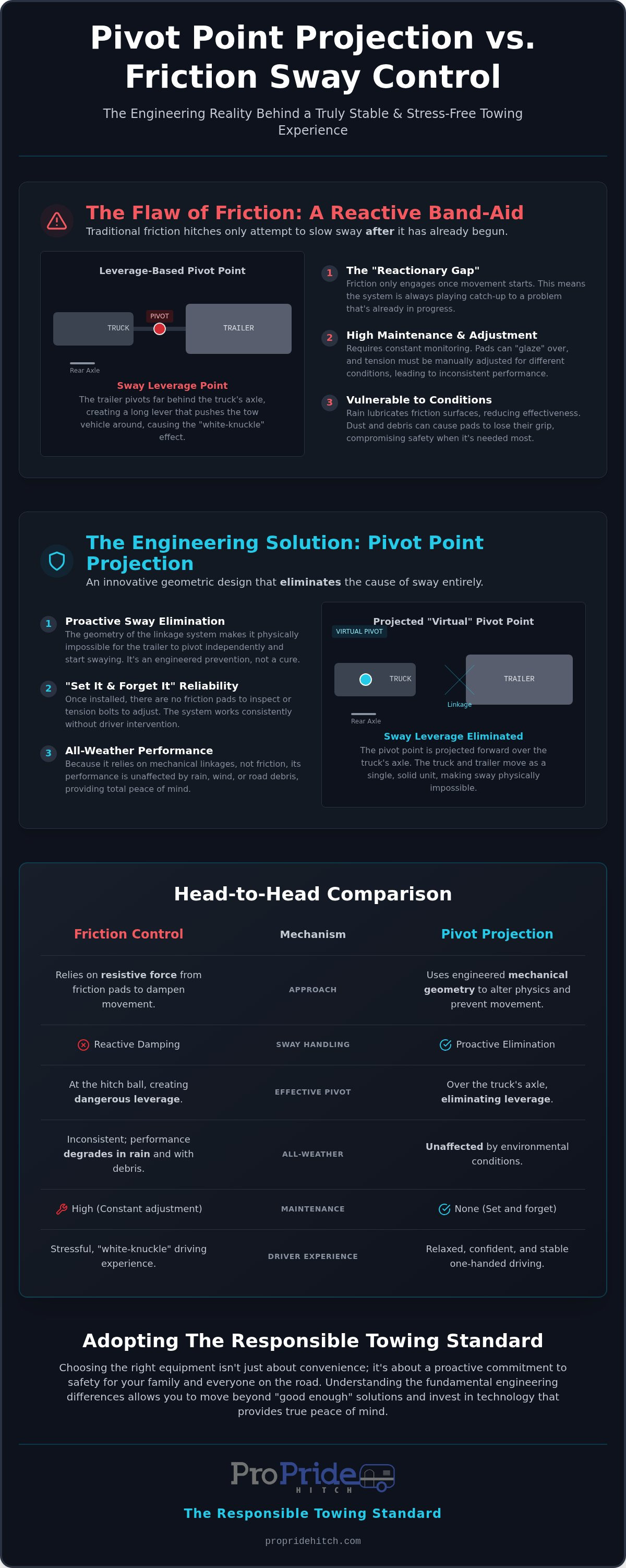
The fundamental flaw in this design is the "Reactionary Gap." Because these systems rely on friction to resist motion, they only begin to work after the trailer has already started to sway. If there is no movement, there is no friction. This means the driver is always in a reactive state, waiting for the hitch to catch up to a problem that's already in progress. For those who value safety, this delay is unacceptable. We believe in "The Responsible Towing Standard," which dictates that safety should be proactive, not a response to a dangerous situation.
Environmental factors also compromise these systems. Friction pads are highly sensitive to the world around them. Rain can lubricate the surfaces, significantly reducing the resistive force exactly when you need it most. Conversely, road dust and debris can cause the pads to glaze over, losing their grip entirely. This inconsistency forces the driver to constantly compensate for changing road conditions.
How Friction Hitches Fight Physics
A friction-based system creates a physical bind between the truck and trailer. While this might feel more stable in a parking lot, it creates a mechanical struggle on the highway. These hitches often require manual adjustment via a handle or bolt to increase tension. If you tighten it too much, your truck may struggle to complete sharp turns; too little, and the sway remains unchecked. This constant need for monitoring is a hallmark of "good enough" equipment that fails to reach the level of engineering found in the ProPride 3P Hitch.
Actionable Tip: Before every trip, inspect your friction pads for "glazing," which looks like a shiny, glass-like finish. If you see this, scuff the pads with heavy-grit sandpaper to restore the friction surface, as glazed pads will slide much too easily under pressure.
The Limits of Resistance in High-Stress Scenarios
In high-stress scenarios, such as a sudden crosswind or the "bow wave" of air pushed by a passing semi-truck, the external force often exceeds the threshold of the friction pads. When this happens, the friction "breaks," and the trailer is free to swing. This leads to the exhausting white-knuckle effect where the driver must constantly steer against the trailer's momentum. There is a profound difference between managing a problem with friction and eliminating the cause of the problem through superior geometry. The goal of a responsible researcher isn't just to slow down the sway, but to ensure it never starts.
Understanding Pivot Point Projection: The Jim Hensley Innovation
Jim Hensley changed the world of towing when he realized that friction was an inadequate solution for trailer safety. His legacy lives on through the ProPride 3P, which represents the ultimate evolution of his original engineering breakthroughs. When evaluating pivot point projection vs friction sway control, it's vital to recognize that the 3P is a proactive engineering solution rather than a reactive friction-based dampener. This technology creates what engineers call a "Virtual Pivot Point."
In a standard setup, the trailer pivots on the hitch ball, which sits several feet behind your truck's rear axle. This creates a long lever that the trailer uses to push your tow vehicle around. By utilizing a series of heavy-duty links, the ProPride 3P projects that pivot point forward, effectively placing it over the rear axle of the truck. This is similar to the physics of tongue weight and stability management found in heavy-duty commercial semi-trucks, ensuring the trailer cannot gain leverage over the tow vehicle.
The Geometry of Convergence
The 3P uses a trapezoidal linkage system to achieve this projection. When the trailer tries to move sideways due to wind or road conditions, these links converge to a single point ahead of the bumper. This geometry forces the trailer to move only when the truck moves, creating a single, stable unit. It mirrors the inherent stability of a 5th-wheel setup without requiring a hole in your truck bed. As we often say, "Pivot Point Projection doesn't fight sway with friction; it makes sway physically impossible through geometry."
Why Locking the Ball is Critical
For this geometry to work, the hitch ball must be "locked out." In a ProPride system, the ball and coupler are held rigid within the hitch head. This eliminates the trailer's ability to act as a lever against the truck. It's a fundamental part of The Responsible Towing Standard, ensuring that external forces like wind or passing traffic can't initiate a sway event. If you're ready to move beyond "good enough" equipment, you can explore the engineering details of the 3P Hitch to see why it's considered The Best Hitch on the Planet.
Actionable Tip: Because the ball is locked and doesn't rotate within the coupler on a 3P system, you should never grease the ball. Greasing it can actually interfere with the rigid connection required for the linkage to function correctly; instead, keep the connection clean and dry to maintain maximum stability.
Head-to-Head: Friction Bars vs. The ProPride 3P Hitch
When you compare pivot point projection vs friction sway control, the most immediate difference is the level of effort required before you even leave your driveway. Friction bars are a maintenance chore. They require precise manual tensioning every time you hitch up. If you don't get the tension exactly right, the system either fails to dampen sway or makes your truck groan and pop during every turn. The ProPride 3P Hitch is a "set it and forget it" system. Once it is properly installed, the geometry handles the work for you, maintaining absolute stability without constant manual intervention.
One of the most dangerous moments on the open road is the "Bow Wave." This is the massive wall of air pushed aside by a semi-truck passing you at high speed. Friction hitches often succumb to this sudden pressure, allowing the trailer to wiggle and pull the truck's rear end toward the passing vehicle. Because the 3P projects the pivot point forward, your truck and trailer act as a single, rigid unit. This keeps your steering precise and your braking performance predictable, even in high winds or heavy traffic. Choosing the 3P is the only way to truly meet The Responsible Towing Standard.
Performance in Emergency Maneuvers
In a crisis, you need your equipment to be fluid and responsive. Friction hitches can "bind" during sharp corrective steering or emergency swerves. This binding makes it harder to pull the vehicle back into alignment and can lead to a loss of control. The 3P linkage moves with total fluidity, allowing for tight turns and easy backing up without the need to ever remove sway bars. You can find more detail on how these systems behave under pressure in our deep dive on The Science and Safety of Stable Towing.
Long-Term Value and Durability
Friction pads are consumable items. They wear down, glaze over, and eventually require replacement to maintain even a baseline level of effectiveness. In contrast, the ProPride 3P is constructed from heavy-duty steel designed to last the life of your trailer. While the physical durability of "The Best Hitch on the Planet" is clear, the real return on investment is the peace of mind it provides. Knowing your family is protected by the Jim Hensley design legacy is a value that can't be measured in simple dollars. It is the difference between hoping your hitch holds and knowing it will.
Actionable Tip: To keep your 3P in peak condition, perform a quick pre-trip inspection of the linkage arms. Check that all bolts are secure and apply a small amount of grease to the zerk fittings on the main hitch head. This ensures the pivot points move freely and the system remains the ultimate safeguard for your journey.
Transitioning to The Responsible Towing Standard
Adopting The Responsible Towing Standard is more than a purchase; it is a commitment to safety and engineering excellence. For the informed researcher, the journey begins by asking a critical question: "Is my equipment designed to prevent a crisis, or merely to react to one?" When you evaluate pivot point projection vs friction sway control, you are choosing between a proactive solution and a reactive compromise. This decision impacts not only your equipment's performance but also your physical and mental well-being during long-distance travel.
Towing stress is a real factor that many drivers dismiss as "part of the experience." The constant micro-corrections required by friction-based systems lead to significant driver fatigue. This white-knuckle driving drains your energy and reduces your reaction time. By choosing a system that provides total stability, you arrive at your destination refreshed rather than exhausted. This peace of mind is the true return on investment for those who prioritize their family's safety.
Assessing Your Risk Profile
Every trailer has a unique risk profile based on its length, weight, and "sail area." The sail area is the side profile of your trailer; the larger it is, the more it acts like a giant sail in crosswinds. A 30-foot trailer provides a massive surface for wind and passing semi-trucks to push against. If you're using "good enough" equipment, you're gambling that these external forces won't exceed your hitch's friction threshold. Even the most experienced drivers cannot overcome the immutable laws of physics when a trailer begins to act as a lever against the truck. Many travel trailer towing mistakes occur because drivers underestimate how these forces scale with trailer size.
The Role of Education in Safe Towing
We encourage every trailer owner to look past marketing buzzwords and study the actual mechanics of their setup. Understanding how weight distribution works in tandem with sway elimination is essential. While weight distribution levels the load, only pivot point projection addresses the geometric cause of sway. If you value precision and durability, you can experience the ProPride 3P Hitch and see why it remains the only logical conclusion for the responsible tower.
Actionable Tip: As part of your commitment to The Responsible Towing Standard, use a dedicated tongue weight scale to verify your loaded trailer's stats. Aim for a tongue weight between 10% and 15% of the total loaded trailer weight. Proper tongue weight ensures your linkage system and weight distribution bars have the necessary downward force to operate at peak engineering efficiency.
Why the ProPride 3P Hitch is the Only Logical Conclusion
The debate surrounding pivot point projection vs friction sway control usually ends the moment a driver experiences the difference on the open road. While friction hitches offer a budget-friendly entry point, they cannot bridge the mechanical gap between dampening a problem and eliminating it entirely. The ProPride 3P Hitch stands as the ultimate engineering evolution of the Jim Hensley design legacy. It is the only system that utilizes advanced geometry to ensure sway never has the chance to begin. For the researcher who has analyzed the physics, the 3P isn't just an option; it's the only logical conclusion for a secure journey.
Some see the initial investment in a 3P system as a hurdle. However, responsible towers view this as a vital insurance policy for their most valuable assets. When you consider the combined cost of your tow vehicle, your trailer, and the lives of those inside, the price of engineering excellence becomes a clear priority. Paying for safety upfront prevents the devastating physical and financial costs of a sway-induced accident later. You're investing in a lifetime of stress-free travel and total control.
The ProPride Advantage: More Than Just a Hitch
Choosing the 3P means joining a community of like-minded individuals who refuse to settle for "good enough." You gain access to a team of experts who understand the nuances of your specific setup. Because of its heavy-duty construction, this is likely the last hitch you will ever need to buy. It is a durable partner in your lifestyle, designed to withstand thousands of miles across diverse terrains and harsh weather conditions without losing its effectiveness.
Actionable Tip: If you're unsure about which model fits your trailer's weight profile, don't guess. Reach out to our ProPride specialists for a personalized setup consultation. We can help you analyze your tongue weight and frame requirements to ensure your system meets the highest safety standards from the very first mile.
Final Commitment to Safety
At the end of the day, towing is about more than just moving a trailer from one destination to another. It's about protecting the memories you're making and the people you're making them with. We believe that every family deserves the peace of mind that comes from superior engineering. By choosing the 3P, you're adopting The Responsible Towing Standard and ensuring that you have the most stable connection possible. Don't leave your safety to chance or inadequate friction. Experience the Best Hitch on the Planet and reclaim your confidence on the highway.
Secure Your Family's Future on the Road
You've now seen the fundamental engineering differences of pivot point projection vs friction sway control. While traditional friction bars attempt to manage sway after it starts, the ProPride 3P uses Jim Hensley's patented technology to project the pivot point forward, making sway physically impossible. This isn't just about a smoother ride; it's about the safety of your family and the protection of your investment.
With over 15 years of proven sway elimination, we provide the ultimate solution for those who refuse to settle for "good enough" equipment. Our team offers direct engineering support for every customer, ensuring your setup is optimized for peak performance. Choosing the 3P means you're no longer fighting the road; you're commanding it with the quiet confidence of a master engineer. It's time to stop reacting to the wind and start enjoying the journey again.
Upgrade to The Responsible Towing Standard with the ProPride 3P
We're here to help you move forward with absolute peace of mind. Your next adventure deserves the stability and precision that only the best engineering can provide.
Frequently Asked Questions
Is Pivot Point Projection the same as a friction sway bar?
No, these two technologies are fundamentally different. Friction sway bars rely on resistive force to dampen movement that's already started. In contrast, pivot point projection vs friction sway control represents a shift from reactive to proactive engineering. The ProPride 3P uses a linkage system to move the trailer's rotation axis forward over the truck's rear axle. This geometric change ensures the trailer can't pivot independently, meeting The Responsible Towing Standard.
Can I use a friction hitch and a ProPride 3P together?
You shouldn't use both, as they are incompatible and redundant. The ProPride 3P is designed to completely eliminate sway through its patented linkage system, making friction bars unnecessary. Adding friction to a system that already prevents independent trailer movement would be counterproductive and could interfere with the fluidity of the 3P's geometry. Our system is a standalone solution that replaces traditional friction-based equipment with a superior mechanical connection you can rely on.
Does Pivot Point Projection work better in high winds than friction hitches?
Yes, pivot point projection provides significantly better stability in high winds. When comparing pivot point projection vs friction sway control, friction hitches have a physical limit; once wind force exceeds the friction threshold, the trailer will sway. The ProPride 3P doesn't have a "break" point because it relies on solid steel linkages rather than friction pads. It creates a rigid connection that keeps your truck and trailer aligned as a single unit, providing total peace of mind.
Why is Pivot Point Projection more expensive than traditional sway control?
The cost reflects the complex engineering and premium materials required to eliminate sway rather than just manage it. Traditional sway control kits are simple resistive bars, while the ProPride 3P is a sophisticated mechanical system featuring heavy-duty steel and the Jim Hensley design legacy. When you invest in the 3P, you're paying for a lifetime of safety and the total elimination of risk, making it the most responsible choice for protecting your family and investment.
Do I need to turn off friction sway control when backing up my trailer?
With traditional friction bars, you often have to remove or loosen them before backing up to prevent the equipment from binding or snapping. One of the primary benefits of the ProPride 3P is that you never have to adjust or remove anything to reverse. The linkage system remains fluid and responsive during tight maneuvers, allowing you to back into campsites with total ease while maintaining The Responsible Towing Standard for both convenience and safety.
Is the ProPride 3P Hitch compatible with my specific trailer brand?
The ProPride 3P is designed to be compatible with almost every travel trailer that uses a standard A-frame chassis. Whether you own an Airstream, Grand Design, Jayco, or another major brand, our hitch can be integrated into your setup. We offer different model capacities to match your specific loaded hitch weight. If you have a unique frame configuration, our specialists provide direct engineering support to ensure a perfect, secure fit for your specific towing needs.
How does Pivot Point Projection affect my vehicle's fuel economy compared to friction hitches?
While no hitch can magically increase fuel economy, the stability provided by pivot point projection can help. Friction hitches allow for constant micro-sway, which increases aerodynamic drag and forces your engine to work harder to maintain speed. By keeping the trailer perfectly aligned behind your truck, the ProPride 3P creates a more streamlined profile. This reduction in lateral movement leads to a smoother ride and more efficient power delivery from your tow vehicle during long trips. For drivers seeking to further optimize their engine's performance for heavy loads, Naked Frog Vehicle Tuning provides specialist remapping services that enhance torque and efficiency for a more capable tow vehicle.
Yes, the 3P is specifically engineered to eliminate the "bow wave" effect from passing semi-trucks. Traditional hitches allow the air pressure to push the trailer's tail, which then pivots and pushes the truck's rear end. The ProPride 3P locks out the hitch ball and uses its linkage system to project the pivot point forward. This ensures the air pressure cannot initiate a pivot, keeping your entire rig straight and stable as large vehicles pass on the highway.

