That friction sway control bar you're relying on wasn't actually designed to stop trailer sway. It was designed to resist it after it has already started, and there is a massive difference between those two concepts. Most owners who value safety start with these traditional setups because they are the industry default. However, you've likely already noticed the loud groaning noises during tight turns or the unsettling wagging when a semi-truck passes you at highway speeds. These common friction sway control problems are more than just a nuisance. They are clear evidence of a reactive system reaching its mechanical limit.
We know you take your role as a driver seriously and want to uphold The Responsible Towing Standard for your family. You deserve a towing experience that doesn't require you to pull over and disconnect greasy equipment just to reverse into a campsite. In this guide, you'll discover the inherent flaws in friction-based designs and learn how to upgrade your safety to a professional engineering standard. We will explore how a concept called Pivot Point Projection can provide total stability. This shift in technology offers the confidence to enjoy the journey without the constant stress of unpredictable movement.
Key Takeaways
- Understand why friction hitches are a reactive solution that only attempts to dampen sway after your trailer has already begun to move out of alignment.
- Identify common friction sway control problems, such as unsettling groaning noises and the mechanical risk of damage if you fail to disconnect the equipment before reversing.
- Evaluate the performance ceiling of traditional hitches to see how high winds and emergency maneuvers can easily overwhelm the resistance of abrasive friction pads.
- Learn how Pivot Point Projection technology offers a proactive engineering solution that eliminates trailer sway by changing the geometric relationship between your vehicles.
- Discover how to align your towing setup with The Responsible Towing Standard to ensure a predictable and stress-free driving experience for your family.
What is Friction Sway Control and How Does It Actually Work?
To understand why so many trailers struggle on the highway, we first need to look at the mechanics of the traditional setup. Friction sway control is a system that uses abrasive pads to create physical resistance against the lateral movement of a trailer. These are often referred to as "sway bars" or friction bars. They typically attach to the side of the hitch ball and provide a clamping force designed to keep the trailer from swinging freely. Their low cost and simple installation make them the default choice for many weekend towers.
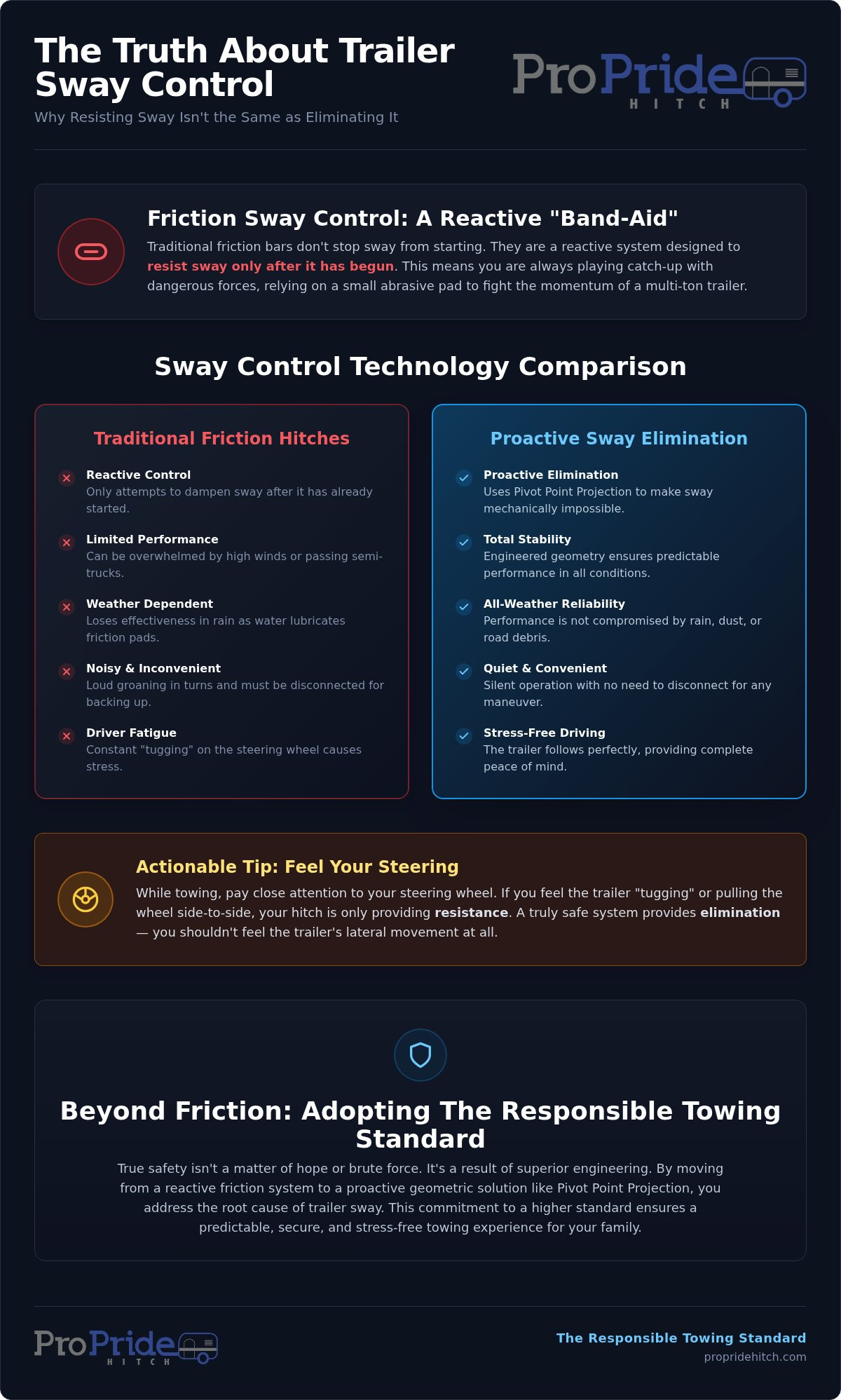
However, these systems are essentially a "Band-Aid" for a mechanical problem. They don't stop sway from starting; they only attempt to dampen it after the laws of physics have already set the trailer in motion. This reactive nature is the primary reason for most friction sway control problems. Relying on friction means hoping a small pad can overcome the massive kinetic energy of a multi-ton trailer caught in a crosswind or the vacuum of a passing semi-truck.
The Difference Between Sway Resistance and Sway Elimination
There's a critical distinction between resisting a force and eliminating the possibility of that force entirely. Friction-based systems rely on brute force, using material-on-material resistance to try and hold a moving object still. If the external force is greater than the friction provided, the trailer will sway. When you research What is a Tow Hitch?, you'll see that a standard ball and coupler creates a pivot point. Friction hitches try to "stiffen" that pivot, but they can't change the underlying geometry of the connection. Sway elimination uses engineering to ensure the trailer cannot physically pivot independently of the tow vehicle.
Actionable Tip: Pay close attention to your steering wheel while towing. If you can feel the trailer "tugging" or pulling the wheel back and forth, your hitch is only providing resistance. Real safety means you shouldn't feel the trailer's lateral movement at all.
Why 'The Responsible Towing Standard' Demands More
Informed RVers recognize that safety shouldn't depend on the tightness of a single bolt or the wear of an abrasive pad. Upholding The Responsible Towing Standard means looking for a system that addresses the root cause of instability rather than just the symptoms. Relying on friction means your family's safety is at the mercy of a reactive component that loses effectiveness as it wears down or gets wet. The ProPride 3P Hitch utilizes Pivot Point Projection to move the effective pivot point forward. This proactive design makes it mechanically impossible for the trailer to sway on its own, providing the peace of mind every responsible owner deserves.
Mechanical Limitations and Common Friction Sway Control Problems
Traditional friction hitches operate on a principle of resistance that has a definite performance ceiling. No matter how much you tighten a manual sway bar, it can only counteract a finite amount of lateral force. This is one of the most significant friction sway control problems because it creates a false sense of security. When a large semi-truck passes you, the "bow wave" of air pressure it pushes can easily exceed the holding power of those abrasive pads. Because the system is reactive, the trailer must actually begin to move out of alignment before the friction even starts to work. This means you're always playing catch-up with physics.
Excessive reliance on friction also introduces structural stress. To gain more control, many drivers overtighten their equipment, which transfers immense strain to the trailer frame and the hitch head. This brute-force approach ignores the elegant laws of geometry in favor of friction, which can lead to premature wear or even structural failure over time. If you find yourself constantly fighting the steering wheel to keep your trailer centered, it's a sign that your equipment has reached its mechanical limit.
How Weather and Road Conditions Compromise Friction
The environment is a constant enemy of friction-based systems. Rain is perhaps the most dangerous factor; water acts as a lubricant on the friction pads, drastically reducing the resistance they provide. Similarly, road dust, grease, or even small amounts of debris can cause the pads to slip. If your safety depends on the coefficient of friction between two surfaces, any change in weather can compromise your control when you need it most.
Actionable Tip: Before every trip, inspect your friction pads for "glazing," which is a smooth, shiny surface caused by heat and wear. If they look like glass, they won't provide the resistance you need. Clean them with a stiff brush to maintain what little performance they offer.
The Unreliability of Manual Adjustments
There is no scientific way to measure if a friction bar is tightened "enough" for a specific set of conditions. It's pure guesswork. On a calm day, your setting might feel fine, but a sudden 30 mph crosswind can instantly reveal the limitations of that guess. Overtightening creates its own risks. If the connection is too stiff, the trailer may struggle to straighten out after a turn, leading to a "jackknife" sensation that is difficult to correct. Educated towers realize that guessing isn't part of The Responsible Towing Standard. Instead of fighting friction, you can choose a system designed to eliminate the possibility of sway through superior engineering.
Real-World Operational Issues: Noise, Maintenance, and Backing Up
If you've ever spent time in a crowded campground, you've likely heard the sound. It's that loud, metallic groaning and popping noise that echoes when a trailer makes a sharp turn at low speeds. While some might dismiss this as a minor annoyance, these sounds are actually symptoms of significant friction sway control problems. They represent the immense physical stress being placed on your hitch components as abrasive pads struggle to maintain their grip under tension. For the driver, it's an unsettling reminder that their equipment is constantly fighting against the natural movement of the vehicle.
Beyond the noise, there's the constant issue of reversing. Most traditional friction bars must be manually loosened or completely disconnected before you can back into a campsite. If you forget this step, the rigid nature of the bar can cause it to bend or even snap its mounting brackets. This turns the simple act of parking into a multi-step chore. It often requires you to step out into the mud or rain just to prepare your equipment for a basic maneuver. This level of inconvenience is exactly why many owners eventually look for a more sophisticated solution that doesn't hinder their mobility.
Why Friction Bars Are a Liability in Tight Spaces
Operating a trailer in tight environments requires maximum articulation and flexibility. Unfortunately, friction bars limit that freedom by design. If you leave them connected during a sharp turn, you significantly increase your jackknife risk. Jackknife risk is the mechanical interference between a friction bar and the trailer frame during tight articulation. This interference can result in permanent damage to your trailer's A-frame or the hitch assembly itself. The frustration of having to stop in the middle of a busy road to pull pins and stow bars is a common experience for those who haven't yet moved to a more advanced system.
Actionable Tip: If you're still using a friction-based system, make it a habit to remove the bars as soon as you enter a campground or fuel station. It's better to deal with a little extra sway at 5 mph than to risk bending your frame during a tight turn.
Maintenance Costs Over the Life of the Hitch
While the initial price of a friction setup is low, the long-term maintenance is a hidden burden that many don't consider. These systems rely on wear-and-tear components that degrade with every mile you travel. You'll find yourself frequently replacing worn pads and cleaning rusted sliders to keep the system functional. Over time, the cost of these replacement parts and the value of your own time add up. Choosing the ProPride 3P Hitch allows you to step away from this cycle of constant adjustment. It's an investment in a system that respects The Responsible Towing Standard by providing durability and ease of use without the need for frequent part swaps.
Assessing Your Towing Risk: Is Friction 'Good Enough' for Your Family?
When you're traveling at highway speeds with your family in the vehicle, "good enough" is a dangerous standard to accept. Many owners assume their traditional setup is sufficient until they face a 30 mph crosswind or a sudden gust. At that point, the inherent friction sway control problems become a matter of physical safety rather than mere inconvenience. A strong lateral force can easily overcome the resistance provided by an abrasive pad, leaving you struggling to maintain lane position while the trailer begins its own independent movement. This is the moment when the mechanical limitations of a reactive system become undeniable.
Emergency maneuvers reveal the true failure point of these systems. If you have to swerve suddenly to avoid a road hazard, a friction hitch cannot react fast enough to keep the trailer in line. Instead, the trailer's momentum can actually push the rear of your tow vehicle, leading to a loss of control. This constant threat creates a psychological toll known as "white-knuckle" fatigue. You arrive at your destination mentally and physically exhausted from hours of two-handed vigilance. Upholding The Responsible Towing Standard means moving from a state of hoping your equipment works to knowing it will.
A Responsible RVer's Safety Evaluation Framework
To determine if your current setup truly protects your investment, you should perform a structured safety evaluation. This helps you identify if you are operating within a safe margin or if you are one gust of wind away from a crisis. Consider these three steps:
- Step 1: Evaluate your trailer's length and weight relative to your tow vehicle. A longer trailer acts like a giant sail in the wind, which can easily overwhelm basic friction bars.
- Step 2: Consider your typical travel environment. If you frequently drive through mountain passes, open plains, or high-traffic corridors, the risk of unpredictable sway is significantly higher.
- Step 3: Perform the steering test. Does your current hitch allow you to drive with one hand comfortably, or does every passing truck require a two-handed grip on the wheel?
The Price of Safety vs. The Cost of an Accident
It's easy to focus on the initial price of a hitch, but a responsible owner looks at the long-term value of protection. A high-quality hitch is an investment in your family's safety and the longevity of your trailer. When you choose a system based on engineering excellence rather than the lowest price point, you are buying peace of mind. You can Learn why the ProPride 3P is the Ultimate Sway Control System and how it eliminates the risks associated with traditional designs. Don't wait for a close call on the highway to realize that your family deserves better than a reactive "Band-Aid" solution. If you're ready to eliminate sway forever, you can upgrade to the ProPride 3P Hitch today.
Beyond Friction: Adopting The Responsible Towing Standard
Moving past the limitations of traditional equipment requires a shift from dampening force to utilizing geometry. While we've discussed how friction sway control problems stem from a reactive design, the ProPride 3P Hitch offers a proactive solution through Pivot Point Projection. This technology, rooted in the Jim Hensley design legacy, effectively moves the trailer's pivot point from the hitch ball to the rear axle of your tow vehicle. By changing this fundamental relationship, the system makes it mechanically impossible for the trailer to pivot on its own, ensuring it follows your truck with absolute precision.
This engineering evolution also eliminates the operational frustrations found in lesser systems. Because the 3P doesn't rely on abrasive pads, you'll enjoy silent operation without the unsettling groans or pops that echo through a campground. Perhaps most importantly, you can reverse your trailer into any spot without ever touching your hitch. There's no need to step out into the elements to pull pins or loosen bars. This seamless experience is the hallmark of The Responsible Towing Standard, providing a level of convenience that matches its superior safety profile.
How the ProPride 3P Eliminates Sway Through Geometry
The secret to this stability lies in a trapezoid link system. This linkage design allows the tow vehicle to turn the trailer easily, but prevents the trailer from being able to turn the tow vehicle. When a lateral force like a crosswind hits your trailer, the geometry of the links forces the truck and trailer to move as a single, solid unit. Instead of the trailer wagging independently, the entire rig remains stable and composed. This isn't about applying more brute force; it's about using physics to ensure sway never starts in the first place.
Actionable Tip: When evaluating your next upgrade, look for hitches that utilize mechanical linkage rather than friction pads. True sway elimination is found in geometry, not in the resistance of wearing components.
Making the Switch: Your Journey to Confident Towing
Transitioning from a friction setup to a ProPride 3P is a straightforward process that yields immediate results. On your very first highway drive, the "white-knuckle" tension disappears. You'll notice that passing semi-trucks no longer cause that unsettling pull on your steering wheel. To see how this technology stands up against the equipment you're currently using, you can Compare the ProPride 3P to common friction hitches. Investing in a professional engineering standard isn't just about a better product; it's about the confidence and peace of mind you feel every time you hit the open road with your family.
Take Command of Your Towing Experience
Relying on a reactive system means you're always one wind gust away from an unsettling driving experience. We've explored how traditional hitches reach a performance ceiling and why those loud, metallic groans are signs of a system under immense stress. These friction sway control problems don't have to be part of your journey. You deserve a setup that aligns with The Responsible Towing Standard, providing stability through geometry rather than brute force.
The ProPride 3P Hitch utilizes patented Pivot Point Projection technology to move the pivot point forward, making it mechanically impossible for your trailer to sway. Backed by a lifetime warranty and thousands of 5-star reviews from owners who prioritize safety, it truly is the Best Hitch on the Planet. You've done the hard work of educating yourself on the physics of towing. Now, it's time to invest in the peace of mind that only professional engineering can provide.
Stop managing sway and start eliminating it with the ProPride 3P Hitch. Your family is worth the extra margin of safety, and your next trip should be defined by confidence rather than white-knuckle fatigue. Enjoy the open road the way it was meant to be experienced.
Frequently Asked Questions
Do I have to remove my friction sway bar to back up?
Yes, most manufacturers require you to disconnect friction bars before backing into a campsite or making tight maneuvers. Because these bars are rigid, they cannot accommodate the extreme articulation angles created during reversing. If you leave them connected, the physical interference can bend the bar or snap the mounting brackets off your trailer frame. This inconvenience is a primary reason many owners switch to the ProPride 3P, which allows for full reversing without any equipment adjustments.
Why does my friction sway control make so much noise when I turn?
That loud groaning or popping noise is the sound of the abrasive pads creating resistance against the sliding metal bar. As you turn, the hitch must overcome the clamping force you've applied to the system. The noise is a physical manifestation of the stress being placed on your hitch and trailer frame. While common, these unsettling sounds are a constant reminder that your safety is dependent on brute force friction rather than an elegant engineering solution.
Can I use friction sway control in the rain or snow?
You can use them, but their performance will be significantly degraded. Water and snow act as lubricants on the friction pads, which drastically reduces the coefficient of friction required to hold your trailer steady. This means your sway control is least reliable when road conditions are at their worst. Upholding The Responsible Towing Standard requires a system that maintains 100% effectiveness regardless of weather, which is why non-friction systems are the preferred choice for serious travelers.
How tight should I tighten the handle on my friction sway bar?
Tightening a friction handle is unfortunately a matter of guesswork. There is no precise gauge to tell you if you've reached the optimal tension for today's wind or road conditions. If you overtighten it, your vehicle may feel "locked" and struggle to straighten out after a curve. If it's too loose, it won't provide enough resistance to dampen sway. This lack of precision is a major drawback compared to engineered linkage systems that provide consistent stability.
Does friction sway control stop 100% of trailer sway?
No, friction sway control cannot stop all sway because it is a reactive technology. For the friction pads to work, the trailer must first begin to move out of alignment. This means the system is always reacting to a problem that has already started. It can dampen the movement, but it cannot prevent the initial pivot. Only a system that utilizes Pivot Point Projection can claim to eliminate sway by changing the mechanical relationship between vehicles.
Is there a weight limit for friction-based sway control systems?
Yes, every friction system has a finite performance ceiling. While manufacturers provide weight ratings, these are often based on ideal conditions. In the real world, a heavy trailer caught in a 30 mph crosswind can generate lateral forces that easily overcome the holding power of a friction pad. As trailers get longer and heavier, the effectiveness of friction decreases, often leading to significant friction sway control problems that a simple sliding bar cannot solve with brute force alone.
What is the best alternative to a traditional friction sway hitch?
The premier alternative is the ProPride 3P Hitch, which is widely considered the Best Hitch on the Planet. It replaces unreliable friction pads with a patented linkage system that projects the pivot point forward to the truck's rear axle. This geometric shift ensures the trailer cannot move independently of the tow vehicle. It provides a silent, maintenance-free experience that allows you to reverse without disconnecting any equipment, offering the ultimate peace of mind for your family.
Why is my trailer still swaying even with a friction bar installed?
Sway occurs because friction is a dampening agent, not an elimination tool. If your trailer is still wagging, it means the external forces, such as wind or the vacuum of a passing vehicle, are greater than the resistance your friction bar can provide. This is a fundamental limitation of reactive physics. If you want to stop the swaying entirely, you must move beyond "good enough" equipment and adopt a proactive engineering solution that addresses the root cause of the pivot.