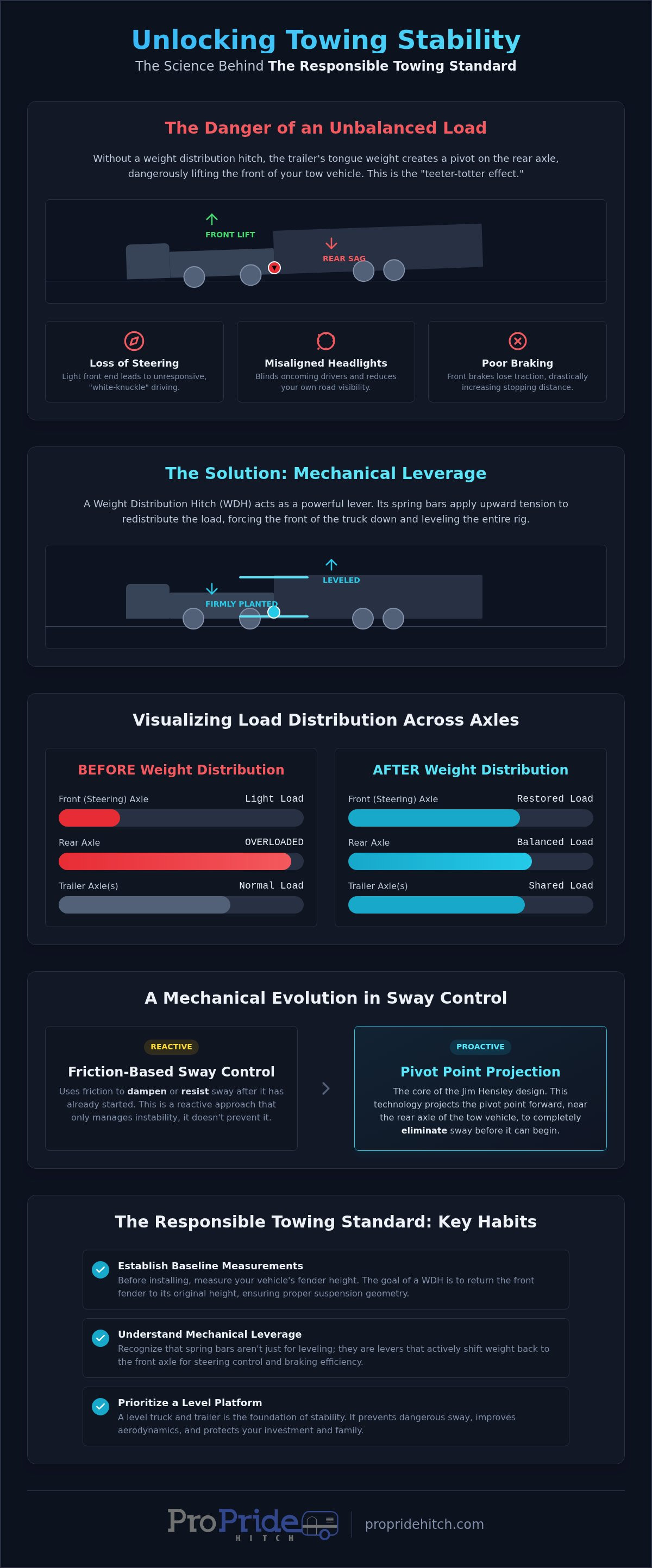
A weight distribution hitch doesn't actually remove an ounce of weight from your trailer; it is a mechanical lever that tricks your truck into thinking the load is perfectly balanced. You likely know the white-knuckle feeling when your steering feels light and the trailer starts to dictate where the vehicle goes. This happens because the tongue weight acts as a pivot, lifting the front end and causing dangerous rear-end sag. Learning how to install a weight distribution hitch correctly is the first step in reclaiming control over your setup and ensuring your tires stay firmly planted on the asphalt.
We are going to unlock the engineering secrets that transform your towing experience into The Responsible Towing Standard. By understanding the physics of spring bars and the legacy of Jim Hensley's Pivot Point Projection technology, you can eliminate unpredictable sway for good. This article provides a clear look at how these systems shift weight back to the front axle to create a level, unified platform. You will gain the technical knowledge needed to protect your family and your investment with total confidence. We'll break down the mechanics of leverage and stability so you can move beyond "good enough" equipment and embrace true precision on the road.
Key Takeaways
- Understand how weight distribution uses mechanical leverage to redistribute tongue weight across all axles, preventing front-end lift and loss of steering control.
- Learn the essential baseline measurements required for how to install a weight distribution hitch to achieve a perfectly level towing platform.
- Discover why a properly balanced load is the critical foundation for eliminating dangerous trailer sway and maintaining stability in high winds.
- Explore the engineering shift from reactive friction hitches to proactive Pivot Point Projection technology, the core of the Jim Hensley design legacy.
- Master the practical habits that define The Responsible Towing Standard, ensuring your family and investment are protected on every journey.
The Science of Leverage: Why Your Tow Vehicle Needs a Weight Distribution Hitch
Towing a heavy trailer changes the fundamental physics of your vehicle the moment the coupler drops onto the ball. A standard connection creates a pivot point that forces the rear of the truck down and the front up, a phenomenon known as the teeter-totter effect. When the front tires lose contact pressure, steering becomes light and unpredictable. Knowing how to install a weight distribution hitch is not just a weekend project; it's a safety requirement for anyone moving heavy loads. This system uses mechanical leverage to redistribute tongue weight across all axles, ensuring the vehicle remains level and stable.
A properly tuned setup restores the balance that the trailer's weight has stripped away. By using a weight-distributing hitch, you apply tension that forces the front of the tow vehicle back toward the pavement. This is the foundation of a controlled ride, as it keeps the steering geometry intact and prevents the dangerous "floaty" feeling that leads to loss of control at highway speeds.
To better understand this concept, watch this helpful video:
Braking efficiency is also deeply tied to this distribution of force. Most of a vehicle's stopping power resides in the front brakes. If the front tires are lifted even slightly, they cannot maintain the traction required for an emergency stop. Learning how to install a weight distribution hitch correctly ensures that your front tires stay firmly planted, allowing your truck's braking system to perform as the manufacturer intended.
Understanding Tongue Weight and Axle Load
Tongue weight is the downward force exerted by the trailer coupler onto the hitch ball. In a standard hitch setup, the rear axle serves as a fulcrum, which causes the truck's weight to shift away from the steering axle. Axle load is the total weight supported by a single axle, and it must never exceed the manufacturer's Gross Axle Weight Rating (GAWR) to avoid mechanical failure or tire blowouts.
The Dangers of Rear-End Sag
Visual cues like a "squatting" truck or a "nose-up" trailer are clear indicators of a compromised setup. This sag misaligns your headlights, pointing them into the eyes of oncoming drivers and reducing your own visibility. Furthermore, an unlevel trailer creates a poor aerodynamic profile, which increases wind resistance and significantly lowers fuel efficiency. Adhering to The Responsible Towing Standard means achieving a level ride height, which can be accomplished through the precision of the ProPride 3P Hitch.
Mechanics of the Spring Bar: How Weight is Actually Distributed
The spring bars are the primary mechanical components that perform the heavy lifting in your towing setup. While the hitch head acts as the central command center, the bars function as flexible levers that bridge the gap between the tow vehicle and the trailer. When you apply tension to these bars, you store potential energy that lifts the rear of the truck and pushes the front end down. This mechanical transfer moves weight away from the rear axle and redistributes it toward the front steering axle and the trailer's own wheels.
Understanding How Weight Distribution Systems Work is vital for anyone who values safety over convenience. In most systems, the upward force is generated by tensioning components like frame-mounted jacks or L-brackets. These parts pull the ends of the spring bars upward, creating the leverage necessary to level the entire rig. If you are researching how to install a weight distribution hitch, remember that the goal is not just to "level the look" but to restore the original geometry of your vehicle's suspension. As you master how to install a weight distribution hitch, you'll notice that the spring bars' flex is what maintains constant pressure even as you drive over dips in the road.
Round Bar vs. Trunnion Bar Designs
The two primary styles of spring bars differ mainly in how they connect to the hitch head. Round bars enter the head from the bottom. This can sometimes limit ground clearance on uneven terrain or steep driveways. Trunnion bars, by contrast, seat into the face of the hitch head assembly. This design is often preferred for heavy-duty trailers because it allows for higher weight capacities and provides a cleaner profile. Choosing the right bar style is a key part of maintaining The Responsible Towing Standard for your specific equipment.
The Importance of Proper Tensioning
Tensioning is a precise science, not a guessing game. You must measure the distance from the ground to the top of your front wheel wells before and after hitching. A common industry guideline is the 50 percent return rule. This rule states that you should tension the bars until the front wheel well height is halfway between its uncoupled height and its height when the trailer is fully loaded without distribution. Don't assume that more tension is always better. Over-tensioning is dangerous; it can lift the rear wheels enough to lose traction or even damage the trailer frame. If you're looking for a setup that moves beyond these traditional limitations, the ProPride 3P Hitch provides a superior engineering solution for total control.
The Critical Link: Weight Distribution and Sway Control
Many drivers mistakenly view weight distribution and sway control as two separate, unrelated features. In reality, they are physically inseparable components of a safe towing experience. If your front tires aren't firmly planted because of rear-end sag, your truck lacks the lateral grip necessary to resist the side-to-side force of a swaying trailer. This is why adopting The Responsible Towing Standard requires you to look at your setup as a single, unified machine. When you learn how to install a weight distribution hitch, you aren't just leveling your ride; you are building the physical foundation for total trailer stability.
A light front end makes your vehicle vulnerable to every gust of wind and every passing semi-truck. Without proper weight distribution, the trailer's tongue weight acts as a lever that unweights your steering axle, making the entire rig feel "floaty" and disconnected. If you are researching how to install a weight distribution hitch to solve a sway problem, remember that restoring that front-end weight is the first step in regaining control. A balanced truck is naturally more resistant to the lateral forces that try to push you out of your lane.
What Causes Trailer Sway?
Sway is often triggered by external forces like crosswinds or the air pressure bow-wave from a passing semi-truck. However, internal factors like improper cargo loading or a high center of gravity often make these triggers much worse. The industry standard for safe towing requires a tongue weight of 10 to 15 percent of the Gross Trailer Weight. If your weight distribution isn't set up to handle this load, the trailer yaw, or side-to-side movement, becomes much harder to manage. Proper distribution mitigates these triggers by effectively "stiffening" the connection between the truck and trailer, making them move as one unit rather than two competing masses.
Integrated vs. Add-on Sway Control
Traditional towing setups often rely on separate friction sway bars. These are reactive tools that attempt to stop sway only after it has already started by creating physical resistance in a friction joint. These bars are limited in their effectiveness, often produce loud groaning noises, and typically must be removed before you can back up your trailer. For families who prioritize safety, a more reliable solution is necessary. Integrated sway control, which is built directly into the hitch head, provides a proactive defense that doesn't require constant adjustment. You can see how these different designs measure up in this Sway Control Hitch Comparison. Choosing a system that eliminates sway before it begins is the only logical conclusion for the discerning traveler.
Friction vs. Pivot Point Projection: A Mechanical Evolution
Traditional weight distribution hitches rely on friction to manage trailer sway. These systems use friction pads or sliding bars to create resistance at the connection point, essentially trying to "stiffen" the joint between the truck and trailer. This is a reactive approach; the system only begins to work after the trailer has already started to swing. If a gust of wind or a passing semi-truck exerts enough force to overcome that friction, the trailer will sway. For many, this "good enough" solution isn't sufficient when the safety of their family is on the line. As you research how to install a weight distribution hitch, you'll find that traditional designs focus on managing a problem rather than solving it.
The Jim Hensley design legacy represents a complete departure from these reactive methods. Instead of fighting movement with friction, the ProPride 3P utilizes Pivot Point Projection to change the fundamental geometry of the tow setup. The process of how to install a weight distribution hitch with 3P technology is slightly different because it replaces the standard ball-and-coupler connection with a mechanical linkage. This design ensures that the trailer cannot move independently of the truck, effectively eliminating sway before it can even begin. It's the difference between trying to catch a falling object and preventing it from falling in the first place.
How Pivot Point Projection Works
The heart of the 3P system is a trapezoidal linkage that mechanically locks out trailer sway. This geometry allows the tow vehicle to turn the trailer easily, but it prevents the trailer from exerting any side-to-side force on the truck. In a 3P system, the convergence of lines projected by the linkage creates a virtual pivot point located over the rear axle of the tow vehicle. This mimics the stability of a fifth-wheel or gooseneck hitch while maintaining the convenience of a bumper-pull setup. By projecting the pivot point forward, the trailer's lateral forces are directed into the truck's frame in a way that promotes stability rather than chaos.
Why The Responsible Towing Standard Matters
Adopting The Responsible Towing Standard is about more than just hardware; it's about achieving total peace of mind. A stable, stress-free tow allows you to arrive at your destination refreshed rather than exhausted from hours of white-knuckle driving. Beyond the psychological benefits, a properly engineered setup protects your investment by reducing unnecessary wear on your vehicle's transmission, brakes, and suspension. If you are ready to move beyond basic friction and embrace a proactive safety solution, you can explore The ProPride 3P Hitch Engineering Solution for a deeper look at the physics of stability.
Experience the confidence that comes with the only hitch designed to eliminate sway entirely. Upgrade to the ProPride 3P Hitch and secure your towing future today.
Practical Tips for The Responsible Towing Standard
Understanding the physics of leverage is one thing, but applying those principles in the driveway is where safety becomes reality. To achieve a setup that meets The Responsible Towing Standard, you must approach the process with a methodical mindset. Before you even touch a wrench, ensure your trailer is on a perfectly flat, level surface. If you attempt to set up your hitch on an incline or uneven ground, your measurements will be skewed, and your weight distribution will be fundamentally flawed from the start.
The first active step in how to install a weight distribution hitch is establishing your baseline. Measure the distance from the ground to the top of your tow vehicle's front wheel well arch while the truck is uncoupled. This number represents your "zero" point. Once you have this, drop the trailer onto the hitch and engage the weight distribution bars. Re-measure that same front wheel well. Your goal is to return that measurement as close to the original baseline as possible, typically aiming for the 50 percent return rule discussed earlier. Precision here is what ensures your steering remains responsive and your front brakes maintain traction.
Finalizing the setup requires a road test. A short drive at various speeds will reveal if the rig feels unified or if there is still a hint of "float" in the steering. Small, incremental adjustments to the bar tension can make a world of difference in how the vehicle handles. If you find the ride is still unsettled, you may need to re-evaluate your tongue weight or the angle of the hitch head itself.
Common Installation Mistakes to Avoid
One of the most frequent errors is ignoring the Gross Combined Weight Rating (GCWR) of the tow vehicle. This is the maximum allowable weight of your truck, trailer, and all cargo combined; exceeding it renders even the best hitch ineffective. Another common pitfall is setting the hitch ball height incorrectly. If the ball is too high or too low, the trailer won't sit level, which ruins the leverage the spring bars are trying to create. You can find more detail on avoiding these setbacks in our Travel Trailer Towing Mistakes Guide.
Maintenance for Longevity
A high-performance system requires regular attention to remain safe. You should grease all pivot points and check the torque on every bolt before every long trip. Steel-on-steel friction is an enemy of precision, so keeping components lubricated is vital. Additionally, inspect your spring bars for any signs of stress, fatigue, or hairline cracks that could lead to failure under load. For those using our specific hardware, refer to these ProPride 3P Troubleshooting Tips to keep your equipment in peak condition. Proper maintenance is a core part of how to install a weight distribution hitch and keep it functioning as a life-saving tool for years to come.
Take Command of Your Towing Future
Understanding the science of leverage is the first step toward a safer journey. You've learned how weight distribution restores steering authority and why relying on friction is a reactive compromise. While mastering how to install a weight distribution hitch provides the necessary foundation, true stability is found in proactive engineering. Adopting The Responsible Towing Standard means moving beyond traditional limitations and choosing a system that prioritizes the immutable laws of physics over simple friction pads.
Your family and your investment deserve the protection of Jim Hensley's original design. With a 100% Sway Elimination Guarantee and a Lifetime Warranty, you can leave the stress of unpredictable trailer movement behind forever. Upgrade to the ProPride 3P-The Best Hitch on the Planet and experience the ultimate in road-tested stability. Safe travels are no longer a matter of luck; they are the result of superior engineering. See you on the road with total confidence.
Frequently Asked Questions
Do I really need a weight distribution hitch if my truck has a high towing capacity?
You should use a weight distribution hitch whenever your trailer weight exceeds 50 percent of your vehicle's weight. High towing capacity refers to power and structural strength, but it does not change the physics of tongue weight. Without distribution, even the strongest truck will suffer from front-end lift, which compromises your steering control and braking safety.
Can a weight distribution hitch increase my vehicle's maximum towing capacity?
A weight distribution hitch does not increase your vehicle's maximum towing capacity. It simply allows you to use your existing capacity more safely by balancing the load across all axles. You must always adhere to the Gross Combined Weight Rating (GCWR) set by your vehicle's manufacturer to avoid damaging your transmission or engine.
Is it safe to use a weight distribution hitch with a surge brake system?
Using a weight distribution hitch with surge brakes is only safe if the hitch design doesn't interfere with the brake actuator. Some systems can bind the sliding mechanism that triggers the surge brakes, potentially leaving you without trailer stopping power. Always verify that your specific hitch model is rated for use with surge brake assemblies.
How do I know if my weight distribution hitch is set up correctly?
You will know the setup is correct when the front wheel well height is returned to within a fraction of its original uncoupled measurement. If the truck and trailer are perfectly level and the steering feels responsive, you have mastered how to install a weight distribution hitch. This precision ensures your tires maintain the grip required for safe maneuvering.
Do I need to remove my weight distribution bars when backing up my trailer?
Most traditional friction-based hitches require you to remove the sway control bars before backing up to prevent them from binding or bending. This is a significant inconvenience during a long day of travel. Advanced systems like the ProPride 3P are engineered to stay connected at all times, providing the freedom to maneuver in reverse without manual intervention.
What happens if I over-tighten my weight distribution spring bars?
Over-tightening the spring bars can lift the rear tires of your tow vehicle, which reduces the traction needed for emergency braking and acceleration. This excessive tension also puts unnecessary strain on the trailer's A-frame and the hitch itself. Achieving the correct balance is essential for long-term durability and the safety of your family.
Will a weight distribution hitch stop all trailer sway?
A standard weight distribution hitch is designed for leveling, not for stopping side-to-side movement. While leveling is the first step in how to install a weight distribution hitch, you must use a system with integrated sway elimination to stop yaw. True stability requires a proactive engineering solution that locks out sway before it can start.
Can I use a weight distribution hitch with an aluminum trailer frame?
You can use a weight distribution hitch with an aluminum frame, but you must be careful with the mounting brackets. Aluminum is less dense than steel and can be crushed if brackets are over-tightened. Always consult your trailer manufacturer to ensure the frame is reinforced to handle the localized stress of a weight distribution system.