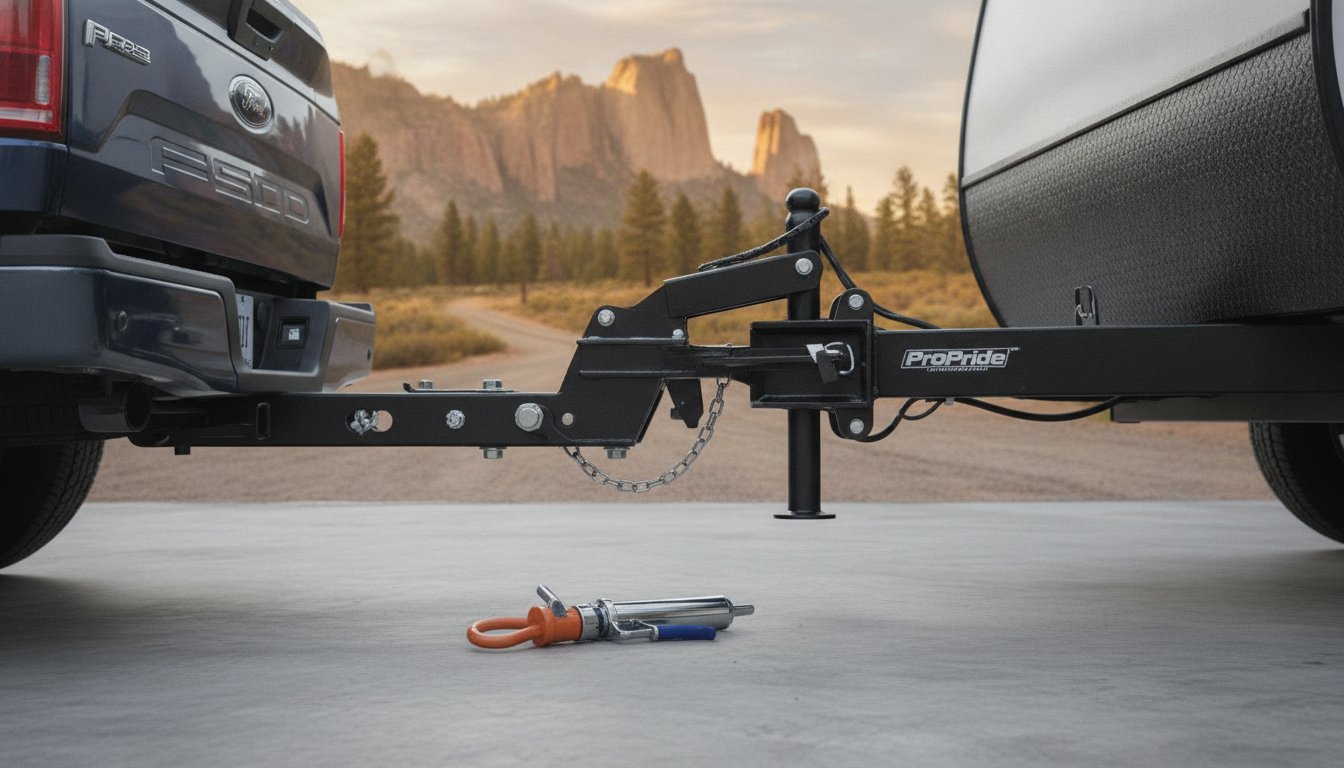
Imagine you've pulled into a beautiful, remote campsite, but as you try to unhitch on a steep, uneven slope, the stinger refuses to budge. It's a frustrating moment that can make even the most experienced traveler feel a bit of hitch anxiety, which is why mastering ProPride 3P hitch troubleshooting is essential for any owner who values precision. You likely chose this system because you refuse to settle for "good enough" when it comes to your family's safety. We agree that a premium investment should deliver a premium experience, even when the terrain or road conditions aren't perfect.
This guide will help you fine-tune your Jim Hensley designed hitch so you can regain total confidence in your equipment's reliability and performance. We're here to help you achieve the effortless hitching and total sway elimination that defines The Responsible Towing Standard. From solving alignment issues on difficult terrain to understanding the mechanics of Pivot Point Projection, this article provides the actionable steps you need to ensure your trailer remains rock-solid at any speed. You'll learn how to maintain your system for the long haul, ensuring every trip is defined by stability rather than stress.
Key Takeaways
- Approach propride 3p hitch troubleshooting as a precision tuning exercise to ensure your trailer remains rock-solid on any terrain or road condition.
- Discover the "Yoke secret" for keeping frame brackets perfectly centered and preventing weight distribution jacks from shifting during travel.
- Master the art of the perfect hitch-up by achieving one-inch precision with your stinger and implementing a responsible grease management routine.
- Fine-tune your road performance by understanding the critical link between jack height and front-axle weight distribution for heavier travel loads.
- Implement a proactive 2026 safety checklist that includes proper lubrication of Zerk fittings to protect your long-term investment and uphold The Responsible Towing Standard.
Troubleshooting Your ProPride 3P: Upholding The Responsible Towing Standard
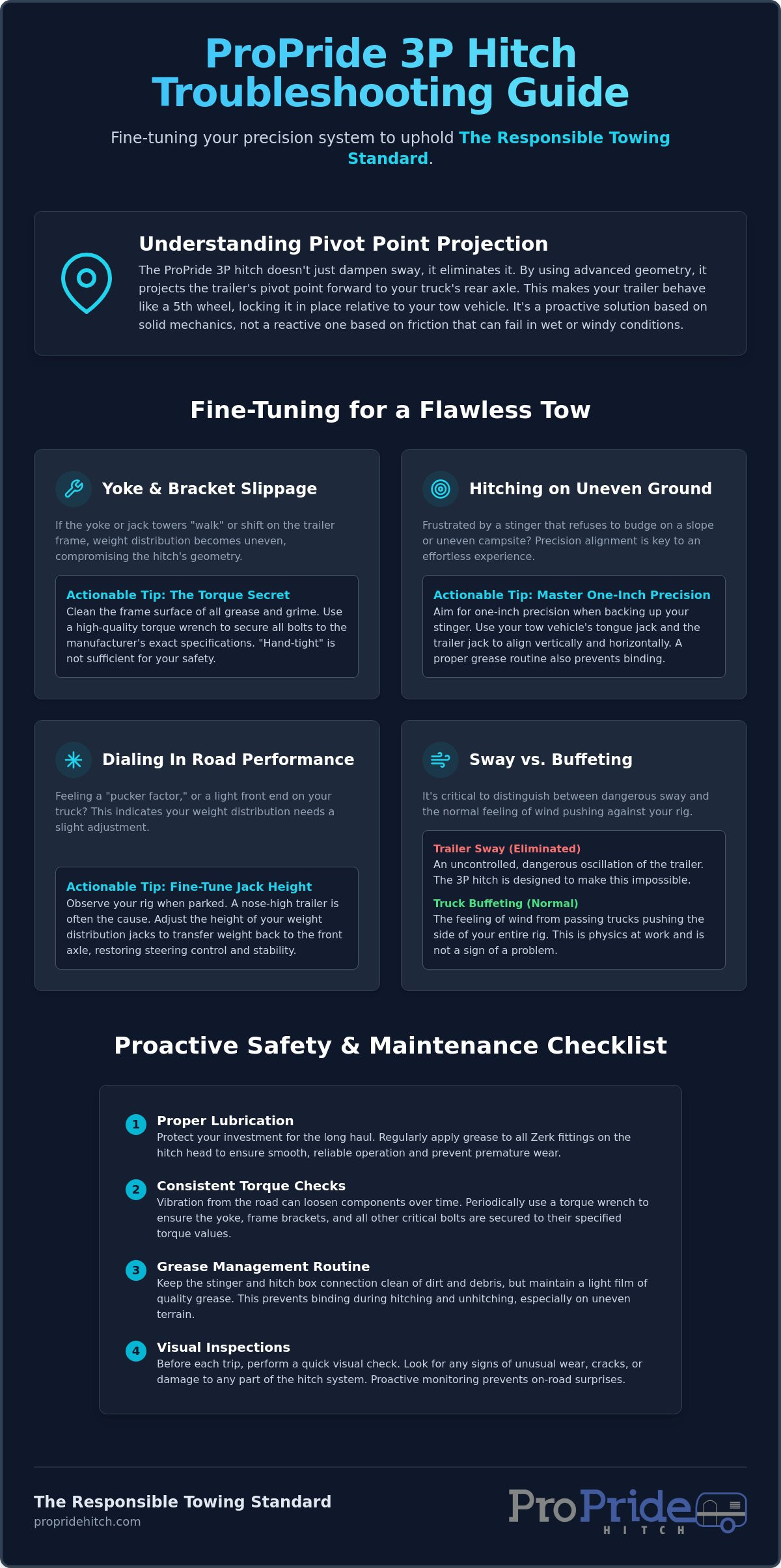
The ProPride 3P isn't just a piece of hardware you bolt onto a trailer. It represents a commitment to safety and engineering excellence, rooted in the Jim Hensley design legacy. When you begin propride 3p hitch troubleshooting, you're not just fixing a problem; you're fine-tuning a precision system to ensure it meets The Responsible Towing Standard. Unlike traditional equipment, the 3P uses Pivot Point Projection to physically move the trailer's pivot point forward to the rear axle of your truck. This mechanical advantage eliminates the possibility of sway before it even starts.
To better understand how this alignment impacts your towing experience, watch this helpful video from our team:
Understanding the difference between trailer sway and truck buffeting is the first step for any responsible owner. Sway is an uncontrolled oscillation of the trailer that can lead to disaster. Buffeting, however, is the feeling of wind or passing semi-trucks pushing against the side of your vehicle. While the 3P eliminates sway, you'll still feel the laws of physics at work as air moves around your rig. Distinguishing between these two sensations allows you to remain calm and in control during your journey.
The Logic of the 3P System
The ProPride 3P Hitch is engineered to make your travel trailer behave like a 5th wheel. While standard towing hitches rely on friction to manage sway after it begins, the 3P uses a series of links to lock the trailer in place relative to the tow vehicle. Friction bars often fail during rain or high winds because they depend on surface contact that can slip. The 3P excels because it relies on solid geometry. The adjustable hitch bar is the heart of this setup, allowing you to maintain a perfectly level profile regardless of your load.
Signs Your System Needs Adjustment
Even the best equipment requires occasional monitoring. If you feel a "pucker factor" during a drive, it's usually a sign that your weight distribution needs a slight tweak. Look for visual cues when you're parked. Is the trailer nose-high or nose-low? A nose-high trailer is a common culprit for a front-end light feeling in the truck. Being an educated tower means you don't wait for a close call to check your settings. Proactive monitoring ensures your equipment performs as intended, providing the peace of mind that comes with knowing you've done everything to protect your family and your investment.
Correcting Installation Misalignments and Yoke Slippage
Precision is the difference between a stressful drive and a confident journey. When you are dealing with propride 3p hitch troubleshooting, many owners overlook the physical stability of the components attached to the trailer frame. The yoke, which connects the main hitch unit to the trailer's A-frame, must stay perfectly centered. If the yoke or the jack towers shift even slightly, the forces required for weight distribution become uneven. This "walking" effect usually happens because the brackets haven't bitten into the frame properly. It's a mechanical issue that compromises the geometry of Pivot Point Projection.
A high-quality torque wrench is your most important tool for maintaining this system. You cannot rely on "hand-tight" or a standard wrench when your family's safety is on the line. The bolts securing the yoke and the jack towers require specific force to remain stationary under the thousands of pounds of pressure they endure on the road. Without the correct torque, the vibration of travel will eventually cause components to slip, leading to a loss of weight distribution and a decrease in steering control. This proactive maintenance is a hallmark of The Responsible Towing Standard.
Securing the Frame Brackets
Start by cleaning the frame surface to remove grease, road grime, or loose paint. These contaminants act as lubricants that encourage bracket slippage. Once the surface is clean, seat the set screws so they "dimple" the metal of the frame. This creates a permanent mechanical lock. Always re-check your torque settings after the first 100 miles of a trip. Metal can settle and paint can compress, so that second check ensures your setup remains rock-solid for the duration of your travels.
Addressing the 'Un-Square' Hitch Box
If your hitch head isn't square with the trailer tongue, your sway elimination won't be symmetrical. You should measure the distance from the hitch box to a fixed point on each side of the trailer frame to ensure it's perfectly centered. You can adjust the tilt of the main unit to correct for an un-level trailer profile. A trailer that nose-dives or sits too high will struggle to project the pivot point correctly, which directly impacts how the rig handles at highway speeds.
Finally, verify the vertical alignment of your jack towers. They must be perfectly perpendicular to the trailer frame to ensure an optimal force transfer from the spring bars. If the towers lean forward or backward, the weight distribution jacks will work against the system rather than with it. Precision is the core of propride 3p hitch troubleshooting. If you're upgrading your setup, the ProPride 3P Hitch provides the engineering foundation needed for a truly stable, sway-free experience.
Mastering the Stinger: Solving Hitching and Unhitching Challenges
The stinger is the physical link that enables the Jim Hensley design to function. Achieving a successful connection requires more than just backing up; it demands a level of precision that separates the casual traveler from those who uphold The Responsible Towing Standard. You should aim for one-inch precision when aligning your truck. While modern backup cameras make this easier, a spotter or alignment rods can provide the extra data needed for a perfect match. This focus on detail ensures that the Pivot Point Projection technology can do its job the moment you hit the road.
Uneven ground is where many owners encounter their biggest hurdles. If your truck is on a different plane than the trailer, the stinger won't slide into the hitch box smoothly because the angles don't match. You can solve this by using your weight distribution jacks to tilt the hitch head. By adjusting the jacks, you can angle the box to mirror the stinger's approach. This technique is a vital part of propride 3p hitch troubleshooting when you're camping on soft or sloped terrain where a perfectly level surface is a luxury.
Troubleshooting a 'Stuck' Hitch Bar
A stinger that refuses to slide out during unhitching is almost always the result of residual tension. If the truck and trailer are binding against each other, the locking latches won't release easily. To fix this, use the truck's creep method. Shift into neutral and let the vehicle settle, or move it an inch forward or backward to find the neutral pressure point. Once the tension is relieved, the stinger should slide out freely. For the final seating when hitching up, a slight bump with the truck ensures the latches are fully engaged. Always remember the responsible disconnect: you must relieve all spring bar tension via the jacks before you attempt to pull the pins.
Maintenance is equally important for a smooth experience. Keep the O-rings clean and apply a light coat of all-purpose grease to the stinger. This isn't just about making things slide; it's about protecting the metal from friction and corrosion. A responsible habit is to wipe down the stinger after every trip to prevent road grit from acting like sandpaper inside the hitch box. This simple step preserves the tight tolerances that make this The Best Hitch on the Planet.
Hitching at Difficult Angles
When you're forced to hitch at an angle, depth perception becomes your biggest challenge. Look for visual cues on the stinger to know when you've reached the correct depth for the latches to clear. If you're operating solo, magnetic alignment rods can help you track your progress without constantly hopping out of the cab. For a more detailed look at these maneuvers, you can read our guide on How to use the ProPride hitch. Mastering these nuances ensures that your ProPride 3P Hitch remains the most reliable tool in your towing arsenal, providing total confidence regardless of the campsite conditions.
Eliminating Residual Movement and Dialing in Road Performance
A perfectly installed hitch is only the beginning of a stable journey. If you are engaging in propride 3p hitch troubleshooting because your rig feels "loose" at highway speeds, the culprit is often the specific height of your weight distribution jacks. While the Pivot Point Projection design physically prevents the trailer from swinging independently, improper weight distribution can make the entire rig feel sensitive to road ruts or wind. You aren't managing sway in these moments; you're managing the balance of your vehicle's footprint on the pavement. Achieving the right balance is a core requirement for those who uphold The Responsible Towing Standard.
When you prepare for "heavy" trips with full water tanks or extra gear, your previous jack settings may no longer be sufficient. A heavier trailer tongue naturally pushes the rear of the truck down, which lifts the front wheels and reduces steering traction. In these cases, adding an extra half-inch of jack tension can restore the necessary load to your front axle. You'll know you've found the sweet spot when the truck feels planted and responsive, even when large semi-trucks pass you at high speeds. The 3P system is designed to handle these pressure changes by forcing the truck and trailer to move as a single, unified unit.
Fine-Tuning Weight Distribution
Precision measurement is the only way to ensure your setup is optimized. You should use a tape measure to check the height of your truck's front wheel well before and after coupling the trailer. Your objective is to return the front fender of your tow vehicle as close as possible to its original uncoupled height without going below it. If the fender remains too high, you haven't applied enough tension to the spring bars. For a deeper look at the physics involved, see our guide on Mastering ProPride weight distribution adjustment.
Managing Tongue Weight and Cargo Loads
How you pack your trailer directly impacts how the hitch performs. Industry standards recommend placing 60% of your cargo weight in the front half of the trailer to maintain proper tongue weight. A shift in this cargo can change your hitching angle and the tension required on your jacks. However, you must remember that "more tension" isn't a universal fix for every handling issue. Over-adjusting the spring bars can actually lift too much weight off the rear tires, compromising traction. Trust the engineering of your ProPride 3P Hitch and let the geometry do the work. If you've dialed in your measurements correctly, the rig will remain stable through wind gusts without needing constant steering corrections.
If you want to ensure your setup is truly optimized for your specific tow vehicle, check our weight rating options to match your rig's requirements perfectly.
Long-Term Maintenance: The 2026 Safety Checklist
A precision-engineered system like the ProPride 3P requires more than just an initial setup; it demands a disciplined approach to maintenance. If you've spent time on propride 3p hitch troubleshooting to solve a handling quirk, you likely realized that many issues stem from simple neglect. Maintaining your equipment is the only way to ensure that the Jim Hensley design legacy continues to provide the stability you expect. By following a structured schedule, you uphold The Responsible Towing Standard and protect your family's investment for years to come.
For frequent travelers, a 5-point monthly safety inspection is essential. This routine ensures that the mechanical advantages of Pivot Point Projection remain intact. Your monthly checklist should include:
- Verifying the torque on all frame brackets and yoke set screws.
- Inspecting the stinger for any burrs or unusual wear patterns.
- Testing the weight distribution jacks for smooth, vertical operation.
- Checking the integrity of the safety chains and electrical umbilical.
- Clearing any road debris from the main hitch unit opening.
Lubrication is where many owners struggle to find the "sweet spot." You should apply a high-quality marine-grade grease to your spring bars every 1,000 miles of travel. This frequency prevents the metal-on-metal friction that can lead to premature wear. When greasing the Zerk fittings, which are the small lubrication ports on the main unit, add grease until you see a small amount of old grease being pushed out. This ensures the internal components are fully coated without creating a messy over-accumulation that attracts road grit.
Protecting the finish of your ProPride 3P Hitch is a year-round job. Road salt and moisture are the primary causes of surface rust, which can eventually seize moving parts. A quick rinse after driving on salted roads and an occasional application of a protective coating will keep the unit looking and performing like new. This attention to detail is what defines a truly responsible owner.
Annual 3P Inspection Points
Once a year, or every 12 to 18 months, you need to perform a deeper dive into the system's health. This includes lubricating the hitch ball and inspecting the internal bearings for any play or rough rotation. If you notice the spring bars showing significant wear at the pivot points, it's time to consider replacement parts. You can find everything you need in our guide to ProPride hitch parts and accessories. Remember that a bearing inspection is recommended every 4 years or 50,000 miles to ensure the system remains The Best Hitch on the Planet.
Off-Season Storage Tips
When your trailer is parked for the winter, don't leave the main unit exposed to the elements. Remove the stinger and apply a thin, protective coating of grease or a corrosion inhibitor to prevent it from seizing. Covering the main unit with a weather-resistant hitch cover will prevent water from pooling in the hitch box. These simple steps ensure that your rig is ready for the next "Responsible Towing" adventure the moment the season begins. Taking the time for propride 3p hitch troubleshooting and maintenance during the off-season provides the ultimate peace of mind when you finally hit the open road again.
Master Your Journey with Precision and Confidence
Mastering propride 3p hitch troubleshooting is the final step in ensuring your rig is as safe as it is stable. You've learned that precision in your stinger alignment and consistency in your maintenance routine are what separate a stressful trip from a relaxing adventure. By understanding the geometry of your setup, you can eliminate residual movement and drive with total peace of mind. These small adjustments empower you to uphold The Responsible Towing Standard every time you hitch up.
The ProPride 3P isn't just a parts upgrade; it's a specialized safety partner for your lifestyle. It's the only system that utilizes patented Pivot Point Projection technology to eliminate sway through the laws of physics rather than unreliable friction. With a Lifetime Warranty on all 3P systems, you're investing in a permanent solution for your family's protection. If you're ready to experience the stability of The Best Hitch on the Planet, Upgrade to the ProPride 3P Trailer Sway Control Hitch today. Your commitment to preparation makes the road safer for everyone. We'll see you out there.
Frequently Asked Questions
How often should I grease my ProPride 3P hitch Zerk fittings?
You should apply marine-grade grease to the spring bars every 1,000 miles of travel to ensure smooth operation. For the main unit, add grease through the Zerk fittings until you see a small amount of old grease being expelled from the unit. This routine maintenance is a critical part of propride 3p hitch troubleshooting because it prevents friction-related wear and keeps the internal bearings rotating freely during tight maneuvers.
What should I do if my stinger is stuck in the hitch head?
A stuck stinger is almost always caused by residual tension between the truck and the trailer binding the locking latches. To free it, shift your truck into neutral to let the rig settle or use the "creep" method by moving the vehicle an inch forward or backward. Once you find the neutral pressure point and relieve the tension, the stinger should slide out of the hitch box without resistance.
Can I use the ProPride 3P hitch with a backup camera?
Yes, using a backup camera is highly recommended to achieve the one-inch precision required for a seamless connection. While the 3P system is incredibly robust, precise alignment reduces unnecessary wear on the stinger and the hitch box opening. Utilizing your vehicle's technology to ensure a perfect hitch-up is a hallmark of an owner who follows The Responsible Towing Standard for every trip.
How do I know if my weight distribution jacks are at the correct height?
You know your weight distribution jacks are at the correct height when your tow vehicle's front fender returns to its original uncoupled height. Use a tape measure to compare the distance from the ground to the center of the wheel well before and after hitching. If the front end remains high, you must increase the jack tension to restore steering control and essential front-axle traction.
Why does my trailer feel like it is 'banging' during tight turns?
A "banging" sound during tight turns is often the mechanical sound of the link arms shifting as the Pivot Point Projection technology transitions through its range of motion. If the sound becomes excessive, it may indicate that the spring bars or the hitch ball require fresh lubrication. Ensure all pivot points are adequately greased to minimize noise and maintain the mechanical efficiency of your system.
Is the ProPride 3P compatible with my Airstream or Jayco frame?
The ProPride 3P is fully compatible with Airstream, Jayco, and most other trailers that utilize a standard A-frame design. Because the system mounts directly to the frame rather than the coupler, it provides a universal solution for high-end trailers. You should always verify your specific frame width and propane tank clearance during the initial setup to ensure a perfect, unobstructed fit for the yoke.
Can I install the ProPride 3P hitch myself as a responsible owner?
Yes, a responsible owner can certainly install the ProPride 3P hitch themselves because it is a completely bolt-on system that requires no welding. The process typically takes three to five hours and requires basic tools like a high-quality torque wrench. Performing your own installation is an excellent way to deeply understand the system's mechanics, which makes future propride 3p hitch troubleshooting much more intuitive.
What is the 'Responsible Towing Standard' for pre-trip inspections?
The Responsible Towing Standard for pre-trip inspections involves a disciplined 5-point check of your equipment before every departure. You must verify the torque on all frame brackets, inspect the stinger for wear, ensure the jacks are vertical, check safety chains, and clear any debris from the hitch box. This proactive approach ensures that your Pivot Point Projection system performs flawlessly and keeps your family safe on the open road.