The difference between a stressful, white-knuckle drive and a perfectly controlled journey lies in a few precise inches of tension and the immutable laws of physics. You likely chose the ProPride 3P because you understand that traditional equipment is a compromise your family's safety shouldn't have to make. It's a common frustration to stare at your weight distribution jacks and wonder if another half-inch of height is the key to restoring your steering authority, especially when you feel that unsettling floating sensation on the front axle.
This guide is designed to eliminate that guesswork by providing the precise engineering steps required for a perfect ProPride weight distribution adjustment. We'll move beyond "good enough" to help you achieve the absolute stability that only Pivot Point Projection can provide. You'll learn how to leverage the Jim Hensley design legacy to restore front-axle weight and dial in your patented weight distribution jacks with mathematical certainty. We will walk through the specific measurements and mechanical principles needed to transform your towing experience into one of total, unshakeable confidence, ensuring the best hitch on the planet performs at its theoretical limit.
Key Insights for Mastering Towing Stability:
- Master the physics of weight transfer to restore steering authority and eliminate the dangerous "floating" sensation on your tow vehicle's front axle.
- Learn how to perform a precise ProPride weight distribution adjustment using the three-pass weigh method at a CAT Scale for data-driven stability.
- Understand the mechanical interaction between the vertical screw-jack system and the heavy-duty links to maximize the Jim Hensley design legacy.
- Identify and resolve common towing issues like porpoising and trailer bounce through methodical fine-tuning of your spring bar tension.
- Implement a routine maintenance schedule for your jacks and spring bars to ensure the Best Hitch on the Planet remains in peak condition for years of travel.
The Critical Role of Weight Distribution in Towing Stability
Towing a heavy trailer is an exercise in managing forces that are constantly trying to disrupt your vehicle's equilibrium. When you lower a trailer onto a standard hitch, the rear axle acts as a fulcrum, lifting weight off the front steering axle. This loss of front-end mass is the primary cause of floating steering and reduced braking performance. The fundamental goal of a weight-distributing hitch is to leverage the trailer's tongue weight, shifting it forward to restore the tow vehicle's original suspension geometry. Achieving a perfect propride weight distribution adjustment ensures that every tire on your rig is doing its fair share of the work, providing the stability required for long distance travel.
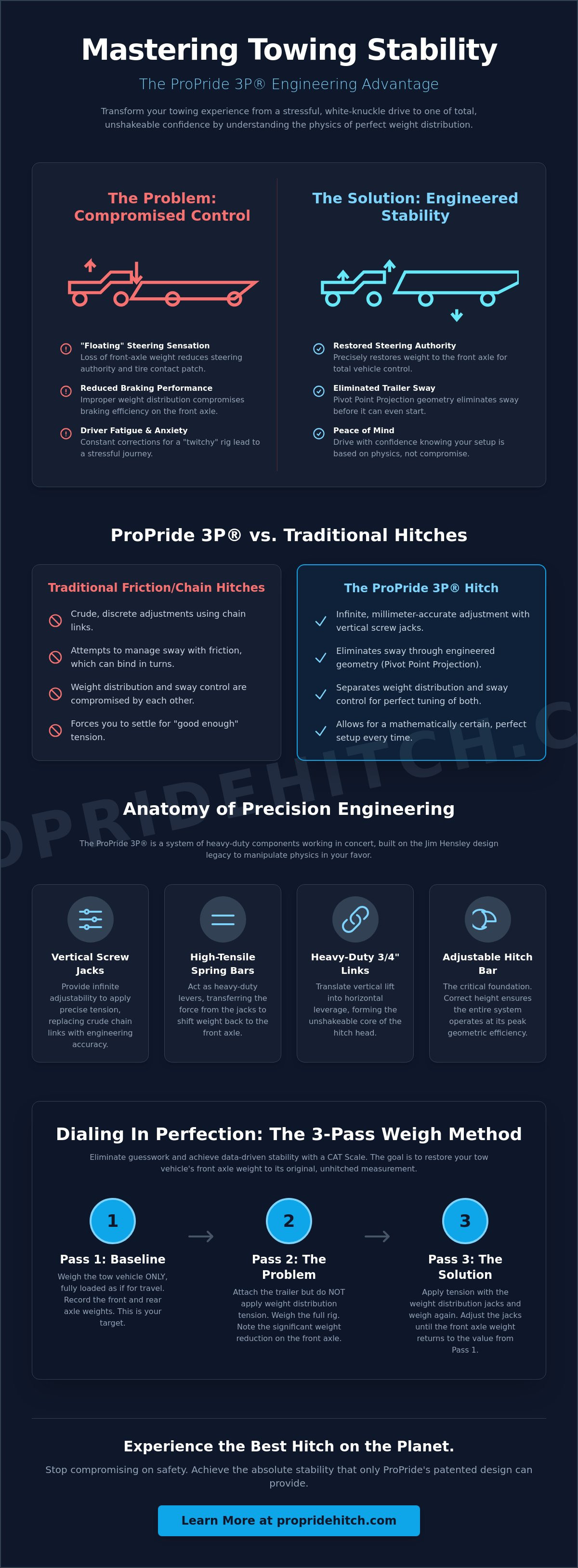
Traditional friction hitches often fail because they attempt to manage sway and weight distribution through the same mechanical resistance. In a turn, these systems can bind or lose tension, leading to inconsistent handling. The ProPride 3P® Hitch is different. It separates these two critical functions entirely. Sway is eliminated through the geometry of Pivot Point Projection, while weight distribution is handled independently by the heavy duty jacks. This separation allows you to dial in the exact tension needed without affecting the hitch's ability to eliminate sway. It's a calculated approach to safety that respects the immutable laws of physics.
The Problem with Rear-Axle Overload
When your truck squats under a heavy load, it isn't just an aesthetic issue. This change in stance alters your front end alignment, reducing the contact patch of your steering tires. Excessive weight on the rear axle creates a pivot point that makes the entire rig more susceptible to dangerous lateral forces. Beyond the mechanical risk, there's a significant psychological toll. Driving a twitchy rig that reacts unpredictably to every gust of wind or passing semi-truck leads to driver fatigue and anxiety. By restoring weight to the front axle, you reclaim steering authority and the peace of mind that comes with total control.
ProPride vs. Traditional Weight Distribution
Most systems rely on chains and brackets, which limit you to discrete increments of tension. You're often forced to choose between a setting that's slightly too loose or one that's too tight. The ProPride system, built on the Jim Hensley design legacy, replaces this good enough approach with engineering precision. Our 3P weight distribution jacks utilize a vertical screw mechanism, allowing for a propride weight distribution adjustment that is accurate to the millimeter. This level of infinite adjustability ensures your rig remains level and stable, regardless of how your cargo is loaded. We don't settle for traditional compromises because your family's safety depends on physics, not luck. This commitment to precision is why the ProPride 3P is recognized as the Best Hitch on the Planet.
Mechanics of the ProPride 3P Weight Distribution Jacks
The ProPride 3P® is a precision instrument designed to manipulate the laws of physics in your favor. At the heart of this system are the weight distribution jacks, which utilize a vertical screw-jack mechanism. Unlike traditional chain-and-bracket systems that rely on crude increments, our jacks provide infinite adjustability. This mechanical advantage allows you to apply precise tension to the spring bars, which are crafted from high-tensile steel to ensure they can withstand the immense forces required for effective weight transfer. The 3/4" thick links in the main unit act as the critical connection point, translating the vertical lift of the jacks into the horizontal leverage needed to shift tongue weight forward. A proper propride weight distribution adjustment starts here, where engineering excellence replaces guesswork.
The adjustable hitch bar serves as the baseline for this entire mechanical process. If the hitch bar height is not correctly set for your specific truck and trailer combination, the jacks cannot perform their intended function. The Jim Hensley design legacy dictates that the system requires a specific amount of tension to "lock" the geometry of the hitch head. This tension is what stabilizes the main unit, ensuring that the Pivot Point Projection remains consistent even at highway speeds. Without this calculated tension, the mechanical links would have too much play, degrading the hitch's ability to eliminate sway before it begins. Following the principles of Towing Your Trailer Safely requires understanding that weight distribution is not just about leveling the rig; it is about maintaining the structural integrity of the towing connection.
Anatomy of the V2 Weight Distribution Jacks
The V2 design features a square-drive mechanism that significantly simplifies the adjustment process. This allows you to use a standard socket or drill to raise and lower the jacks with minimal physical effort. Understanding the height-to-tension ratio is vital. Every inch of jack travel represents a specific amount of weight being shifted from the rear axle to the front. Because we use premium materials, these jacks are rated for 2,000 lbs, providing the durability needed for heavy-duty towing. If you are looking to upgrade your current setup, the ProPride 3P Hitch offers the most robust jack system available today.
The Synergy of Pivot Point Projection and Tension
Pivot Point Projection is the signature technological differentiator of the ProPride 3P®. This effect relies on the hitch head remaining in a fixed relationship with the trailer frame. Proper propride weight distribution adjustment provides the necessary downward force on the spring bars to stabilize the hitch head against the main unit links. This synergy ensures the "virtual" pivot point is projected forward over the rear axle of the tow vehicle, where sway cannot physically manifest. The relationship between hitch head tilt and jack height is a balancing act of engineering. When these forces are correctly aligned, the result is a towing experience defined by total, unshakeable confidence.
Dialing in Precision: Using CAT Scales for Perfect Adjustment
Visual estimation is the enemy of engineering precision. While many owners attempt to judge their setup by looking at the "levelness" of the truck and trailer, this is an unreliable metric that ignores the actual distribution of mass across your axles. A rig that looks perfectly level can still suffer from a dangerously light front end or an overloaded rear axle. To achieve the absolute stability promised by the Jim Hensley design legacy, you must move beyond aesthetics and utilize a CAT scale. This data driven approach provides the only objective proof that your propride weight distribution adjustment has successfully restored steering authority and braking efficiency.
The goal is mathematical. We are looking for specific weight values that confirm the trailer's tongue weight is being distributed forward to the front axle and backward to the trailer axles, rather than simply pushing down on the rear of the tow vehicle. Once the scale confirms your balance is perfect, you can record your jack height measurement. This number becomes your permanent reference point, allowing you to return to the same level of safety every time you hitch up without needing to return to the scale.
The Three-Pass Weighing Process
To get an accurate picture of your setup, you must perform three distinct weighings. This methodical approach identifies exactly how much weight is being moved by your ProPride 3P® system.
- Step 1: The Baseline. Weigh your tow vehicle alone, with a full tank of fuel and all passengers inside. This establishes your factory front axle weight.
- Step 2: The Unloaded Rig. Attach your trailer but leave the weight distribution jacks at zero tension. This weigh shows you exactly how much weight the trailer removes from your front steering axle.
- Step 3: The Calibrated Rig. Apply tension to the jacks and weigh the entire setup again. This final pass confirms if your propride weight distribution adjustment has successfully pushed the weight back where it belongs.
Interpreting the Numbers
Your CAT scale ticket will provide three key numbers: the Front Axle, Rear Axle, and Trailer Axle weights. When you compare Step 3 to your baseline in Step 1, you are looking for Front Axle Load Restoration (FALR). FALR is the percentage of weight returned to the front wheels compared to the weight lost when hitching. Most vehicle manufacturers recommend a restoration of 50% to 100%. If your front axle weight in Step 3 is still significantly lower than in Step 1, you need more tension on your jacks. Conversely, you must ensure you aren't overloading the trailer axles beyond their rated capacity. Finding this "sweet spot" ensures the Best Hitch on the Planet is functioning at its theoretical limit, providing you with total, unshakeable confidence on the open road.
Troubleshooting and Fine-Tuning Your Towing Experience
The road is a dynamic environment where the physics we calculated at the scale are put to the test. Even with a baseline setting, you might encounter "porpoising," a rhythmic bouncing that follows a bump or dip in the asphalt. This oscillation indicates that the spring bars aren't under enough tension to control the vertical movement of the hitch assembly. If your rig feels like it's on a trampoline, a small propride weight distribution adjustment is required to increase the dampening force. By raising the jacks in small increments, you unify the truck and trailer into a single, cohesive unit that resists these vertical forces.
Floating steering is another signal that your setup needs fine-tuning. If the front end feels light or disconnected from the road, your front axle is still under-weighted. Conversely, you must avoid the "over-adjusted" trap. Applying too much tension can lift the rear wheels of the tow vehicle, leading to a loss of traction and an unnecessarily harsh ride. This state is dangerous because it compromises the stability of the tow vehicle's rear end, especially during emergency maneuvers. You're seeking a balance where the truck and trailer move as one, providing a smooth, level ride without the twitchy feedback that causes driver fatigue.
Load management is equally vital for maintaining this equilibrium. A full fresh water tank can add over 400 lbs to your trailer, often shifting the center of gravity and increasing tongue weight. If you're hauling a full load of water, you'll need more jack tension than when your tanks are empty. Marking your jacks for "Heavy Load" versus "Light Load" scenarios allows you to adapt to these changes instantly. To maintain this level of control in every environment, the ProPride 3P Hitch provides the infinite adjustability required for total safety.
Symptom-Based Adjustment Framework
- Steering feels light or "darty": Your front axle needs more weight. Increase jack height by 1/2 inch increments until the steering feels firm and responsive.
- Harsh ride or loss of rear-wheel traction: You've likely over-tensioned the system. Decrease jack height slightly to return weight to the rear tires.
- Trailer nose-high or nose-low: This is rarely a jack issue. You may need to re-evaluate the baseline height of your adjustable hitch bar to ensure the trailer frame is level.
Environmental Adjustments
External conditions often dictate a change in your propride weight distribution adjustment strategy. When towing in high winds, a slightly tighter setup can improve your confidence by making the connection between vehicle and trailer more rigid. This stiffness helps the Pivot Point Projection system maintain its virtual pivot point more effectively against lateral gusts. Similarly, mountain driving requires maximum front-axle weight to ensure braking stability on steep downgrades. Keeping your steering tires planted is the only way to maintain control when gravity is working against you. These subtle refinements are what separate a standard tow from a ProPride experience.
Maintaining Peak Performance and Towing Confidence
Total confidence on the open road isn't a one-time achievement but a continuous state maintained through methodical care. Once you've mastered your initial propride weight distribution adjustment, your focus must shift to preserving the mechanical integrity of the system. The ProPride 3P® is an investment in your family's safety. Like any high-performance engineering solution, it requires routine attention to perform at its theoretical limit. Neglecting basic upkeep can lead to increased friction or debris buildup, which might subtly alter the tension required for perfect weight transfer. Because our system utilizes a patented heavy-duty jack mechanism (US Patent 12,311,711 B2), keeping these components clean is essential for long-term precision.
Regularly re-verifying your settings at the start of every towing season is a critical safety protocol. Over time, trailer loads shift and tow vehicle suspensions can settle. A setting that provided perfect steering authority last year might require a slight refinement today. By returning to the CAT scale or checking your recorded jack heights, you ensure the Jim Hensley design legacy continues to protect your investment with mathematical certainty. We stand behind this engineering excellence with a lifetime warranty for the original purchaser, solidifying our position as the provider of the Best Hitch on the Planet. This warranty is our promise that your equipment is built to endure the rigors of the road indefinitely.
The ProPride Maintenance Checklist
Maintaining the silent, smooth operation of your 195 lb hitch assembly is straightforward if you follow a disciplined schedule. Discipline ensures that the Pivot Point Projection geometry remains unhindered by mechanical resistance.
- Lubrication: Grease the main unit and spring bar bushings every 1,000 to 2,000 miles to eliminate noise and prevent binding.
- Torque Verification: Inspect the frame brackets and U-bolts for proper torque after your first 1,000 miles of travel to account for initial settling.
- Jack Care: Clean the vertical jack screws to remove road salt and debris, ensuring the 2,000 lb rated mechanism moves freely in all weather conditions.
- Spring Bar Inspection: Examine the high-tensile steel spring bars for any signs of unusual wear or stress fractures, especially after thousands of miles of heavy use.
Long-Term Towing Success
A perfectly maintained propride weight distribution adjustment does more than just eliminate sway. It extends the operational life of your tow vehicle by preventing premature wear on rear shocks and tires. When weight is distributed correctly, your vehicle's suspension geometry remains within factory specifications, reducing the mechanical stress of hauling heavy loads. This synergy between the ProPride 3P® and your truck creates a stress-free travel experience that allows you to focus on the journey rather than the hardware. Safety is a serious matter that deserves the time it takes to fully understand and maintain. Achieve total towing confidence with the ProPride 3P® Hitch and experience the difference that Pivot Point Projection makes over the long haul.
Reclaiming the Road with Engineering Precision
Achieving the perfect towing setup isn't a matter of luck; it's a matter of physics. By transitioning from visual guesswork to data-driven CAT scale measurements, you ensure your front axle retains the steering authority required for safe travel. A precise propride weight distribution adjustment does more than level your rig. It stabilizes the entire towing connection by leveraging the Jim Hensley design legacy to unify your truck and trailer. This methodical approach transforms a "good enough" setup into a precision instrument that responds predictably to every road condition.
You've invested in your family's safety and your vehicle's longevity. It's now your responsibility to ensure that investment performs at its theoretical limit through consistent calibration. As the only system that completely eliminates trailer sway through patented Pivot Point Projection technology, the ProPride 3P® is backed by a Lifetime Warranty for your total peace of mind. Experience the ultimate in towing safety with the ProPride 3P® Hitch. Safe travels begin with the unshakeable confidence that comes from knowing your equipment is dialed in perfectly.
Frequently Asked Questions
How high should I crank my ProPride weight distribution jacks?
You should typically adjust your weight distribution jacks to a height between 5 and 7 inches of travel, though the exact measurement depends on your specific vehicle and trailer load. The only way to confirm this setting is through a CAT scale weigh-in to ensure your front axle weight is restored. Once you find the correct height for a balanced rig, you can record that measurement for future trips.
Can I over-tighten the weight distribution jacks on a ProPride 3P?
It's possible to apply too much tension to the spring bars, which results in transferring excessive weight away from the tow vehicle's rear axle. This condition can lift the rear tires enough to reduce traction and create a harsh, unstable ride. If your truck's rear end feels light or you experience a loss of traction on wet surfaces, you should decrease the jack tension slightly to restore equilibrium.
Do I need to adjust my weight distribution every time I tow?
You don't need to perform a new propride weight distribution adjustment every time you hitch up if your cargo and water levels remain consistent. However, significant changes in loading, such as towing with a full fresh water tank versus an empty one, will alter your tongue weight. It's a best practice to re-verify your baseline at the start of every season or when your payload changes significantly.
What happens if my trailer is not level after adjusting the jacks?
If your trailer remains nose-high or nose-low after you've achieved the correct weight distribution, the issue lies with your adjustable hitch bar height rather than the jacks. The jacks are designed to distribute mass across the axles, not to compensate for an incorrectly set baseline height. You'll need to adjust the hitch bar on the tow vehicle side to ensure the trailer frame is parallel to the road.
How do I know if I have enough weight on my front axle?
The most reliable method is to calculate your Front Axle Load Restoration (FALR) at a CAT scale. You've achieved proper distribution when 50% to 100% of the weight lost during hitching is returned to the front steering axle. Without these numbers, you're relying on visual guesswork rather than the engineering precision the ProPride 3P® provides for ultimate safety.
Should I remove the weight distribution tension when backing up?
You don't need to remove the tension from your weight distribution jacks when backing into a campsite or driveway. Unlike traditional friction-based hitches that can bind or snap during tight maneuvers, the ProPride 3P® design handles reverse movement without issue. This capability is a hallmark of the Best Hitch on the Planet, allowing for a seamless transition from the highway to your destination.
Does the ProPride 3P work with electronic sway control on my truck?
The ProPride 3P® is fully compatible with your truck's factory electronic sway control systems. Because our Pivot Point Projection technology eliminates sway at the source, your vehicle's electronic sensors will rarely, if ever, need to intervene. The hitch handles the physics of sway elimination, while the truck's systems remain as a secondary, dormant safety layer that doesn't interfere with the propride weight distribution adjustment.
How often should I grease my ProPride weight distribution components?
You should grease the main unit and spring bar bushings every 1,000 to 2,000 miles to ensure silent and efficient operation. Regular lubrication prevents metal-on-metal friction and ensures your mechanical links move freely. Maintaining these components is vital for preserving the lifetime value and safety of your Jim Hensley design legacy, ensuring the system performs at its theoretical limit.