
Towing a 30-foot travel trailer with traditional friction sway control asks basic brake-pad material to fight massive aerodynamic leverage. When you're searching for the best WDH for 30 ft travel trailer setups, you don't want a noisy band-aid that merely reacts to trailer movement; you want complete, uncompromising stability.
If you've ever endured that white-knuckle pull when a commercial semi-truck blows past on the interstate, you know how exhausting highway driving can become. Proper weight distribution isn't just about leveling your truck's stance. It's about restoring crucial front-axle grip, managing real-world loaded tongue weight, and protecting your family and investment on every journey.
In this 2026 towing guide, you'll discover how to choose the right weight distribution hitch to eliminate sway entirely rather than just dampening it after it starts. We'll examine the engineering behind front-axle load restoration, compare friction bars against advanced pivot point geometry, and help you implement The Responsible Towing Standard for effortless highway travel.
Key Takeaways
- Understand how a 30-foot travel trailer acts like a massive sail in crosswinds and how its extended frame multiplies leverage against your tow vehicle.
- Learn why finding the best WDH for 30 ft travel trailer towing requires calculating your true loaded tongue weight instead of relying on brochure dry weight numbers.
- Discover the mechanical difference between friction-based sway control that reacts after sway begins and geometric systems that eliminate trailer sway at the source.
- Master practical wheel-well measurement techniques to dial in your front-axle load restoration and regain complete steering control.
- Explore how advanced Pivot Point Projection technology and variable adjustment jacks uphold The Responsible Towing Standard for ultimate peace of mind.
Why a 30-Foot Travel Trailer Demands Advanced Weight Distribution and Sway Control
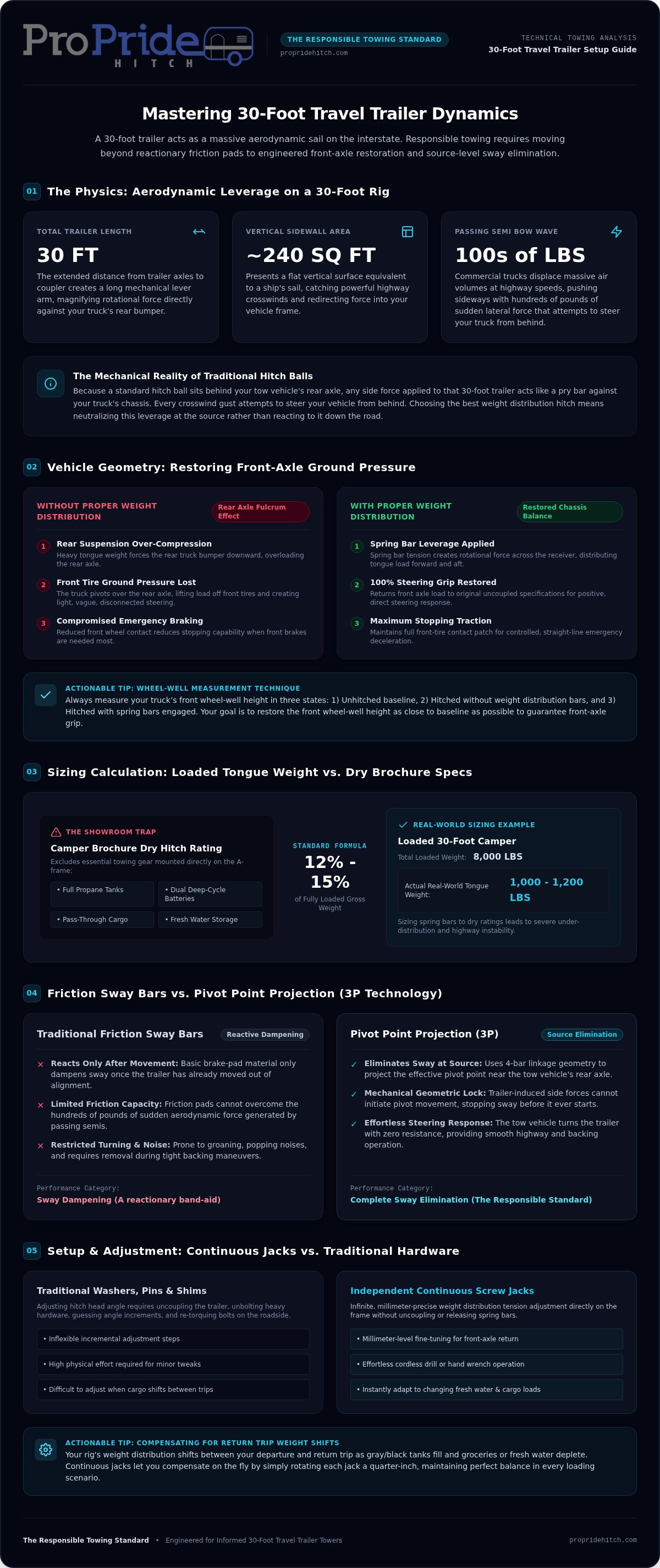
Towing a 30-foot camper involves far more than simply pulling weight. At this length, your trailer presents roughly 240 square feet of flat vertical sidewall to the open road. That large surface area acts just like a ship's sail against highway crosswinds. When a commercial semi-truck passes you at interstate speeds, its aerodynamic bow wave pushes that massive wall sideways with hundreds of pounds of sudden lateral force. Choosing the best WDH for 30 ft travel trailer setups requires recognizing that ordinary equipment cannot overcome this level of aerodynamic pressure.
To see how different hitch designs handle real-world highway loads and compare their towing characteristics, take a look at this detailed review:
The Physics of Trailer Length and Aerodynamic Side Force
Trailer instability increases rapidly as overall box length grows. The distance from your trailer's axles to the coupler creates a long mechanical lever. When side winds slam the rear of a 30-foot rig, that lever magnifies rotational force around your rear bumper. Because traditional hitch balls sit behind the rear axle, every side gust attempts to steer your tow vehicle from behind. Setting The Responsible Towing Standard means neutralizing this mechanical advantage before crosswinds can steer your truck for you.
Restoring Tow Vehicle Geometry and Front Axle Load
Heavy tongue weight naturally compresses your truck's rear suspension. That downward drop creates a fulcrum effect over the rear axle, lifting weight directly off your front tires. When your front wheels lose ground pressure, your steering feels light, vague, and disconnected. A properly adjusted weight-distributing hitch uses spring bar tension to transfer that lost load forward across the chassis. Restoring that front-axle ground pressure brings back full steering control and ensures your front brakes deliver maximum stopping grip during emergency stops.
Key Buying Criteria: How to Evaluate the Best WDH for 30-Foot Campers
Selecting the best WDH for 30 ft travel trailer setups means looking past basic showroom specs and focusing on mechanical leverage. Long trailers place unique stresses on your connection point. Evaluating equipment based on real engineering and physical capacity helps you protect your passengers, your vehicle, and your camper.
Calculating Loaded Tongue Weight Versus Dry Hitch Ratings
Never size your hitch based on the dry hitch weight printed in the camper brochure. That manufacturer number excludes full propane tanks, heavy tongue-mounted batteries, front pass-through cargo, and fresh water. Here is an actionable tip: always calculate your hitch requirements using 12% to 15% of your trailer's fully loaded gross weight. A 30-foot camper weighing 8,000 pounds loaded easily generates 1,000 to 1,200 pounds of tongue weight. Sizing your spring bars to dry ratings leads to severe under-distribution and poor handling.
Fine-Tuning Capabilities and Independent Weight Adjustment
Traditional hitches often rely on washers, pins, or angled shims to adjust head tilt. Changing tilt on the side of the road requires uncoupling the trailer, unbolting heavy hardware, and guessing the right angle. Continuous screw jacks solve this limitation. Independent weight distribution jacks let you dial in front-axle restoration down to the millimeter without unhooking spring bars. Because cargo weight shifts between your departure and your return trip, this fine-tuning flexibility keeps your rig balanced in every situation.
Durability, Frame Compatibility, and Safety Standards
The extended frame of a 30-foot trailer generates significant twisting forces across your hitch assembly. When evaluating hitch frames, look closely at structural steel shank thickness, solid bracket engineering, and clearance around propane tank covers. Thorough research is essential for long-term travel trailer towing safety. Choosing an engineered mechanical system like the ProPride 3P Hitch upholds The Responsible Towing Standard, eliminating sway through geometry rather than temporary friction.
Friction Sway Bars vs. Pivot Point Projection: Comparing 30-Foot Trailer Hitches
Most drivers assume that all sway control hitches function the same way. When evaluating the best WDH for 30 ft travel trailer setups, the fundamental difference lies between dampening sway after it begins and eliminating it at the mechanical source. Understanding this engineering distinction will completely change how you approach highway safety.
The Limitations of Friction-Based Weight Distribution Hitches
Traditional designs rely on steel-on-steel friction bars, cams, or brake-pad style brackets clamped to the trailer frame. By definition, friction requires movement to create resistance. Your trailer must physically begin to swing out of alignment before these components can generate opposing force. In addition to loud groaning noises during low-speed turns, friction pads suffer when driving in rain or on cold roads. Highway spray acts like a lubricant on friction brackets, drastically reducing holding power exactly when adverse weather demands maximum grip.
How Pivot Point Projection Mechanically Eliminates Trailer Sway
Pivot Point Projection replaces friction pads with a heavy-duty four-bar geometric linkage. Originally developed by Jim Hensley, this system projects the effective pivot point forward directly over your tow vehicle's rear axle, mirroring the natural stability of a commercial semi or fifth wheel. Your truck can turn freely, but side forces pushing against the trailer cannot pivot the hitch head laterally. You can explore how these mechanical differences stack up in this sway control hitch comparison.
Long-Distance Towing Fatigue and Highway Stability Performance
Eliminating trailer wander directly transforms your physical driving experience. Instead of spending hours with white knuckles, fighting constant steering corrections as commercial trucks blow past, you enjoy steady, predictable tracking in direct crosswinds. Preventing trailer yaw also spares your vehicle's transmission from micro-hunting and reduces uneven tire tread wear. Upgrading to a geometric linkage design represents The Responsible Towing Standard, ensuring long trips remain safe, smooth, and relaxing for everyone on board.
Sizing, Setting Up, and Dialing in Your 30-Foot Rig for Maximum Stability
Dialing in the best WDH for 30 ft travel trailer setups requires replacing guesswork with measurable data. Even the most advanced mechanical hitch cannot perform at its peak if your front axle load is improperly restored. Taking the time to dial in your equipment creates predictable braking, tight steering response, and a level ride height across both vehicles.
Accurate Wheel-Well Measurements and Initial Setup
Start by parking your tow vehicle and trailer on level pavement with normal cargo aboard. Measure the vertical distance from the ground through the center of your truck's front wheel wells to the fender lip, then record this baseline number. Once you lower the trailer tongue onto the hitch without spring tension, measure the front lift caused by suspension squat. Jack up your weight distribution bars until the front wheel-well height returns to your original baseline measurement.
CAT Scale Verification: Confirming Proper Weight Distribution
A certified public CAT scale offers documented proof of your actual weight transfer. Follow a three-pass weighing routine: scale your truck alone, scale your truck hitched without distribution engaged, and scale your rig with the hitch fully tensioned. Comparing the front-axle load across these three scale tickets shows exactly how much weight transferred back onto your steering tires. This data ensures your front and rear axles remain well within their factory gross axle weight ratings.
Routine Maintenance and Hitch Inspection Protocol
Before pulling out of your driveway, perform a methodical pre-trip walkaround. Check that hitch shank bolts meet torque specifications, verify safety chains are properly crossed, and inspect your emergency breakaway switch. Grease pivot points on schedule and ensure your adjustment jacks turn smoothly under load. For practical advice on diagnosing handling quirks on the road, review our towing troubleshooting guide. Ready to eliminate trailer wander for good? Equip your camper with the ProPride 3P Hitch and bring The Responsible Towing Standard to every mile of your route.
The ProPride 3P Hitch: Setting The Responsible Towing Standard for 30-Foot Trailers
When pulling an 8,000-pound camper down a busy interstate, "good enough" sway control simply isn't an option. The ProPride 3P Hitch establishes itself as the best WDH for 30 ft travel trailer towing by solving instability through advanced geometry rather than basic surface friction. It delivers total sway elimination, transforming a stressful highway drive into a calm, controlled journey.
Engineering Excellence: The Jim Hensley Design Evolution
Jim Hensley revolutionized trailer stability by creating Pivot Point Projection, moving the trailer's effective pivot point forward over the tow vehicle's rear axle. While traditional friction hitches merely slow down trailer movement after wind or passing semi-trucks shove the frame, the ProPride 3P mechanically locks out trailer sway before it can begin. You can explore the mechanics behind this geometry in our detailed breakdown of the ProPride 3P engineering solution.
Seamless Everyday Hookup and Effortless Towing
Living with your hitch system shouldn't involve fighting heavy, greasy hardware at every campsite. The ProPride hitch head stays permanently attached to your trailer A-frame. You simply guide your truck's hitch bar into the receiver box and lock the over-center latches. Continuous screw jacks allow infinite height adjustments, letting you fine-tune weight distribution with a cordless drill. When your fresh water tank empties or your gear shifts between outings, you can adjust front-axle load restoration in seconds without ever touching a heavy pry bar.
Choosing Your Ideal Configuration and Ordering Direct
Equipping your rig with the best WDH for 30 ft travel trailer stability means matching your hardware directly to your setup:
- Spring Bar Sizing: Select 1,000-pound bars for lighter setups, or step up to 1,400-pound bars for tongue weights exceeding 1,000 pounds.
- Receiver Shank: Choose between standard 2-inch and heavy-duty 2.5-inch receiver shanks to eliminate sloppy hitch slop in factory truck receivers.
Investing in precision engineering safeguards your family and preserves your vehicle's mechanical components across hundreds of thousands of miles. Take control of your towing experience with the ProPride 3P Trailer Sway Control Hitch and uphold The Responsible Towing Standard on every road you travel.
Upgrade to Sway-Free Highway Confidence
Pulling a long camper through gusty crosswinds and heavy interstate traffic shouldn't be an exercise in endurance. Dialing in your true loaded tongue weight and restoring front-axle geometry are critical steps toward protecting your investment. When choosing the best WDH for 30 ft travel trailer towing, settling for traditional friction pads that merely dampen movement after it begins leaves your safety to chance.
True peace of mind comes from mechanical sway elimination. Engineered specifically for heavy travel trailers and built with durable American manufacturing, our patented Pivot Point Projection technology eliminates trailer sway entirely. You don't have to dread passing commercial trucks or unexpected road ruts ever again. Backed by dedicated technical customer support, our team ensures your rig tracks true from day one. Order the ProPride 3P Hitch and Experience The Responsible Towing Standard on every adventure ahead.
Frequently Asked Questions
Do I really need a weight distribution hitch for a 30-foot travel trailer?
Yes, towing a 30-foot travel trailer absolutely requires a weight distribution hitch. Most 30-foot trailers weigh well over 5,000 pounds, crossing vehicle manufacturer guidelines for mandatory weight distribution. The extended frame exerts heavy leverage on your rear axle, lifting weight from the front tires and compromising steering and braking. Using the best WDH for 30 ft travel trailer stability restores balance and keeps you fully compliant with vehicle safety limits.
How much tongue weight should a 30-foot travel trailer have?
A 30-foot travel trailer should maintain a tongue weight between 10% and 15% of its total loaded weight. If your camper weighs 8,000 pounds when packed for camping, your loaded tongue weight needs to sit between 800 and 1,200 pounds. Towing below 10% drastically encourages dangerous fish-tailing, while exceeding 15% can overload your tow vehicle's rear axle. Always weigh your rig fully loaded with gear, water, and propane to verify proper loading balance.
What is the main difference between friction sway bars and the ProPride 3P Hitch?
Friction sway bars merely resist trailer movement after sway begins, whereas the ProPride 3P Hitch mechanically eliminates sway before it can start. Friction systems rely on brake pads clamped against steel, losing stopping power in wet weather and requiring constant friction wear. In contrast, the ProPride 3P utilizes Jim Hensley's patented Pivot Point Projection geometry. This four-bar linkage projects the pivot point over your truck's rear axle, locking out lateral trailer forces completely.
Can a half-ton truck safely tow a 30-foot travel trailer with the right WDH?
Yes, a half-ton truck can safely tow a 30-foot trailer if the loaded weight falls within your truck's payload and axle ratings. The true limiting factor is almost always payload capacity, not towing capacity. A 30-foot trailer creates substantial tongue weight and intense wind leverage. Pairing your half-ton with the best WDH for 30 ft travel trailer towing projects the pivot point forward, eliminating sway and preventing that light, floating steering feel on the highway.
Will a weight distribution hitch increase the maximum towing capacity of my truck?
No, a weight distribution hitch cannot increase your truck manufacturer's maximum towing or payload limits. Your vehicle's frame, brakes, engine, and drivetrain determine its factory gross vehicle weight rating and gross combined weight rating. A weight distribution hitch simply restores front-axle steering geometry and distributes tongue weight evenly across all vehicle and trailer axles. Adhering to these established factory boundaries represents The Responsible Towing Standard.
Why does my 30-foot camper sway violently when passing semi-trucks on the highway?
Violent sway happens because a semi-truck pushes a high-pressure air wave off its front bumper, followed immediately by a low-pressure vacuum along its sides. As the commercial truck passes, that pressure wave slams into your 30-foot trailer's large flat side, pushing it sideways. Because conventional hitch balls pivot behind your rear axle, that lateral force steers your tow vehicle from behind. Geometric linkage hitches neutralize this mechanical leverage so the air blast pushes the entire combination uniformly.
How do I know if my weight distribution spring bars are adjusted properly?
You know your spring bars are adjusted properly when your tow vehicle's front wheel-well height returns to its original unhitched baseline measurement. Measure from the ground to the fender lip before hooking up. If your front end stays higher than baseline after tensioning the bars, you have not restored enough weight to the front steering axle. For ultimate precision, visit a public CAT scale to verify that your front axle weight matches or slightly exceeds its unhitched weight.