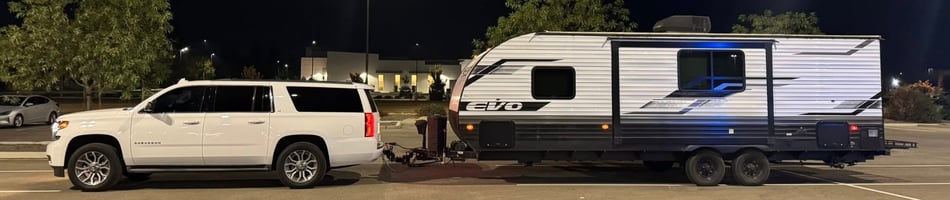
If you’ve ever noticed that trailer sway feels far more stressful late in the day than it did during the first few hours of towing, you’re not imagining it. Even mild instability becomes harder to tolerate the longer you drive. This isn’t just discomfort—it’s trailer sway fatigue, and it’s one of the most overlooked safety risks during long towing days.
Understanding why sway feels worse over time reveals why eliminating sway entirely is safer than trying to manage it mile after mile.
Trailer Sway and Driver Fatigue Are Directly Connected
Trailer sway doesn’t just move your rig—it demands constant mental and physical input from the driver.
Every time the trailer shifts, the driver subconsciously:
Makes micro steering corrections
Adjusts throttle input
Anticipates wind, traffic, or road changes
Tenses muscles to stay “ready”
Over hours of towing, these constant corrections accumulate into significant fatigue, even if sway never becomes extreme.
Why Long Towing Days Amplify the Problem
1. Mental Load Increases Over Time
Early in the day, drivers are alert and focused. As the hours pass:
Reaction times slow
Situational awareness declines
Decision-making becomes less precise
Trailer sway demands attention when the brain is already taxed, making it feel more intense and harder to manage.
2. Physical Fatigue Reduces Fine Control
Towing requires small, precise steering inputs. As fatigue sets in:
Grip strength weakens
Steering corrections become delayed
Overcorrections become more likely
What felt like “manageable” sway in the morning can feel alarming late in the day.
3. Environmental Stressors Stack Up
Long towing days often include:
Changing wind conditions
Heavy traffic
Heat, glare, or rain
Uneven or deteriorating road surfaces
Each factor alone might be tolerable—but combined with fatigue, they amplify the perception and danger of sway.
Why Trailer Sway Feels Worse—Even If It’s the Same Amount
Here’s the key insight:
Trailer sway often doesn’t increase—but your tolerance for it decreases.
As fatigue builds:
Your margin for error shrinks
Small movements feel larger
Stress responses trigger faster
This creates a feedback loop where:
Sway causes fatigue
Fatigue makes sway feel worse
Increased stress accelerates exhaustion
This is why drivers often describe the last hour of towing as the most exhausting—even on familiar routes.
Why Slowing Down Isn’t a Real Solution
Many drivers respond to fatigue by:
Reducing speed
Taking longer breaks
White-knuckling through the final miles
While these help marginally, they don’t solve the root cause. As long as the trailer can pivot and sway, the driver must stay constantly engaged—no matter the speed.
How ProPride Eliminates Trailer Sway Fatigue
The ProPride 3P® Hitch removes the cause of fatigue by eliminating sway at its source.
Using Pivot Point Projection™, the trailer’s effective pivot point is moved forward near the rear axle of the tow vehicle. This creates a fundamentally different towing experience:
No side-to-side oscillation
No constant micro-corrections
No anticipation of sudden sway events
Instead of fighting the trailer, the driver simply drives.
Why Sway Elimination Preserves Energy
With sway eliminated:
Steering inputs are calm and predictable
Muscle tension drops
Mental load is dramatically reduced
Drivers often report arriving after 500–600 mile days feeling:
Alert instead of drained
Confident instead of stressed
Ready to enjoy the destination
This is the difference between managing sway and removing it entirely.
Long-Term Safety Implications
Fatigue isn’t just uncomfortable—it’s dangerous. As driver fatigue increases:
Reaction time slows
Judgment suffers
Emergency response capability declines
By eliminating trailer sway, ProPride helps keep drivers sharp when it matters most, especially late in the day when risks are highest.
Final Takeaway
Trailer sway feels worse at the end of a long travel day because:
It compounds mental and physical fatigue
It demands constant attention
It reduces safety margins over time
The safest solution isn’t better endurance—it’s eliminating sway entirely.
With the ProPride 3P® Hitch, long towing days become calmer, less exhausting, and far more enjoyable—allowing drivers to arrive confident, rested, and ready for what comes next.