
A semi’s air wake is a cue to stay composed, not fight the trailer. If you’re wondering what to do when a semi passes your trailer, keep your steering steady and avoid sudden braking or acceleration. The passing truck can push air toward your trailer, then pull it back as it moves ahead, creating a brief nudge that may feel unsettling from the driver’s seat.
It’s reasonable to feel concerned when your trailer moves unexpectedly. The key is to notice whether it settles after the semi passes or continues swaying. This article explains what passing-air movement can feel like, how to respond without overcorrecting, and when continued sway is a reason to slow down safely, pull over, and reassess your setup. You’ll also learn what to check if the movement keeps returning. Careful preparation and calm decisions matter throughout a towing trip.
Key Takeaways
- Learn what to do when a semi passes your trailer, using calm, deliberate steps instead of reflexive steering corrections.
- Notice whether movement is brief and settles or keeps returning. One sensation alone isn’t enough to identify the cause.
- If the trailer continues moving or you don’t feel in control, stop in a safe place away from live traffic before reassessing.
- Review your vehicle, trailer, loading, tires, and hitch, and consult manufacturer guidance for questions about your specific setup.
- Consider how towing equipment and preparation can address sway risk before a pass, rather than relying on split-second corrections.
What Happens When a Semi Passes Your Trailer?
A sudden nudge from your trailer can feel alarming, especially if you’re new to towing. If you’re asking what to do when a semi passes your trailer, start by understanding that changing air pressure around the truck and trailer can cause brief movement. You may feel a push, followed by a pull as the semi moves past, but the sensation varies with the vehicles and road conditions.
A semi traveling in the same direction and one approaching from the opposite direction create different passing situations, but neither guarantees a particular reaction. Airflow changes as the vehicles draw near and move apart, and the movement you feel can depend on the vehicles and conditions around you. A single nudge doesn’t, by itself, prove that sustained sway has started.
For a visual explanation of trailer sway and common responses, watch this video:
For broader background on towing safety, remember that stability depends on the entire towing setup, not just what happens when a large vehicle passes. The key distinction is whether the movement settles or continues.
Why can a passing semi make a trailer move?
As the truck passes, airflow and pressure around both vehicles change. That shift can briefly nudge the trailer, then seem to draw it back toward the truck. Drivers sometimes describe this as a push-pull sensation. It’s one possible response to a passing vehicle, not a guaranteed outcome or a reliable measure of the stability of the full setup.
Is a brief push the same as trailer sway?
Trailer sway involves continuing side-to-side movement, rather than one momentary nudge. Notice whether the trailer settles after the pass or keeps moving. Don’t diagnose a problem from one sensation alone. If the motion persists or repeats, take it seriously and reassess when it’s safe. For more on causes and prevention, read our trailer sway solutions guide.
What to Do While a Semi Passes Your Trailer: A Calm Response
A trailer can shift as a semi draws alongside, and your instinct may be to steer away or change speed quickly. Resist that reflex. Knowing what to do when a semi passes your trailer means keeping your attention on the road and making smooth, measured decisions, not trying to counter every brief movement.
What should you do as the truck draws alongside?
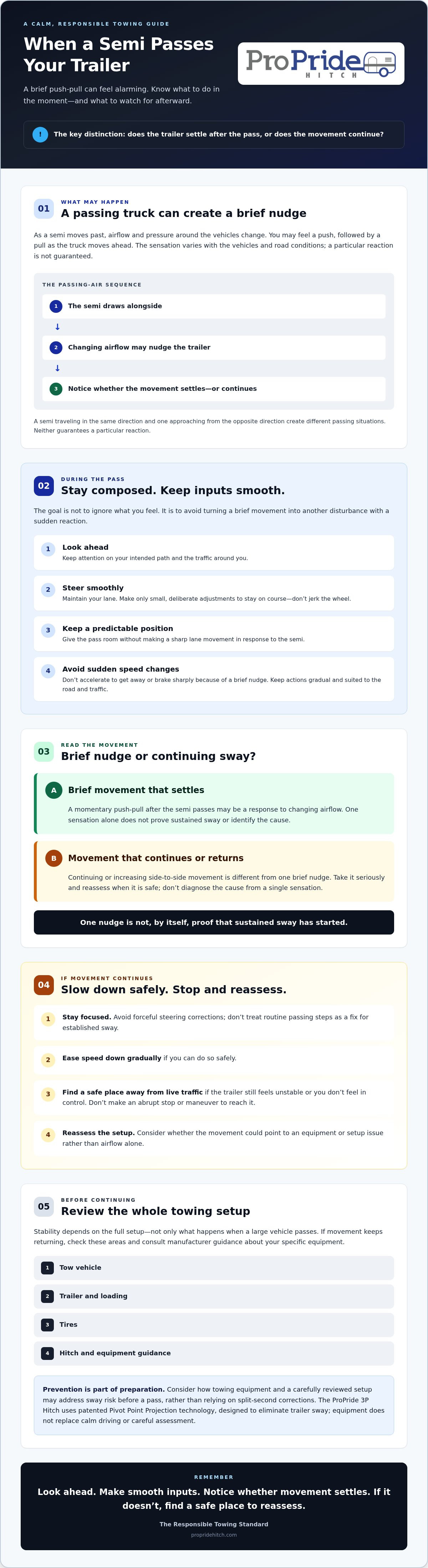
Use this simple sequence during a routine pass:
- Look ahead. Keep your attention on your intended path and the traffic around you.
- Steer smoothly. Maintain your lane and make only the small, deliberate adjustments needed to stay on course. Don’t jerk the wheel in response to a brief trailer movement.
- Give the pass room. Keep a safe, predictable position in your lane. Don’t make a sharp lane movement in response to the semi.
- Avoid sudden changes in speed. Don’t accelerate to get away from the truck or brake sharply because you feel a nudge. Abrupt inputs can make it harder to keep the tow vehicle and trailer settled.
The aim isn’t to ignore what you feel. It’s to avoid turning a brief movement into another disturbance with a sudden reaction. Follow the road and traffic conditions, and keep your actions gradual.
What if the trailer keeps moving after the pass?
Continuing or increasing side-to-side movement is different from a brief response to a passing vehicle. Stay focused, avoid forceful steering corrections, and don’t treat the steps above as a fix for established sway. If you can do so safely, ease your speed down gradually. If the trailer still feels unstable or you don’t feel in control, look for a safe place away from live traffic to stop and reassess. Don’t make an abrupt stop or maneuver to reach a stopping place.
Once parked safely, consider whether the movement could point to a setup or equipment issue rather than airflow alone. The ProPride 3P Hitch uses patented Pivot Point Projection technology, designed to eliminate trailer sway. Learning how a travel-trailer sway-control hitch works can help you evaluate prevention options, but equipment doesn’t replace calm driving or careful assessment when movement continues.
Passing-Air Movement or Trailer Sway? Know What to Watch For
A trailer’s movement after a semi passes can be unsettling, but one sensation alone can’t tell you exactly what’s happening. To judge whether the trailer appears to settle or continues moving, pay attention to how long the movement lasts, whether it repeats, and whether it grows. These are practical observations, not a diagnosis of your towing setup.
| What you observe | What it may suggest | What to do |
|---|---|---|
| A brief nudge that fades after the pass | A short-lived response to changing airflow is possible | Keep watching the trailer and maintain a steady path |
| Side-to-side movement that repeats or continues | The trailer may be experiencing ongoing sway | Prioritize safe control and look for a safe place to stop if needed |
| Movement that becomes stronger or leaves you no longer feeling in control | The situation needs prompt attention | Avoid roadside checks in an unsafe spot; stop somewhere safe to reassess |
Which signs suggest the movement is settling?
A single nudge as the semi goes by, followed by the trailer returning to a steady path, is different from repeated side-to-side motion. Keep observing rather than changing hitch or sway-control settings while driving. For example, one brief shift that fades is not the same pattern as the trailer swinging one way, then back, and continuing to oscillate. That distinction can help you decide whether to keep monitoring or treat the movement as a more serious concern.
Which signs mean you should stop and reassess?
If the trailer keeps moving, the motion worsens, or you don’t feel in control, focus on reaching a safe place away from live traffic. Don’t pull over somewhere hazardous just to inspect the hitch or make roadside adjustments. Once safely stopped, reassess before continuing and consult the vehicle, trailer, and hitch manufacturers’ guidance for setup-specific questions. An online article can offer general information, but it can’t inspect your equipment or diagnose why your particular trailer is moving.
When considering what to do when a semi passes your trailer, use the movement’s duration and pattern as clues, not proof of a cause. For broader preparation guidance, see common travel trailer towing mistakes.
After a Semi Passes: How to Reassess Before Continuing
If the trailer keeps moving after the semi has passed, or you don’t feel in control, don’t assume the motion will settle on its own. Find a safe place away from live traffic and stop before inspecting anything. A shoulder or other exposed spot may not be safe for getting out or checking the hitch, so choose a location that gives you room to assess the situation without standing near moving vehicles.
What should you check during a safe stop?
Once parked safely, look over the setup without attempting a repair you’re unsure about. This is a basic visual check, not a diagnosis. Follow the vehicle and trailer manufacturers’ guidance, and check for:
- Shifted cargo: Look for items that appear to have moved and review the trailer’s loading guidance before rearranging or securing anything.
- Visible hitch concerns: Check for anything that looks out of place or different from the way the hitch is normally connected. Don’t adjust settings based only on one encounter with a passing truck.
- Obvious tire issues: Look for visible damage or a tire that appears abnormal. Don’t put yourself in an unsafe position to inspect it, and don’t attempt a repair beside live traffic.
If you can’t identify the cause, notice a concern, or the movement returns, don’t treat a quick visual check as proof that everything is safe. Consult the relevant manufacturer guidance and seek qualified assistance before continuing. An online article can’t inspect your particular vehicle, trailer, hitch, or loading setup.
When is it sensible to continue the trip?
Continue only if you feel in control and have no unresolved safety concern. If you do proceed, choose a cautious pace suited to the road, traffic, weather, and your setup. There isn’t one universal speed that fits every towing situation. If the movement happens again, note the conditions, such as whether it followed a pass or occurred at a particular point in the trip. Those observations can help you explain the issue to a qualified towing professional.
Understanding what to do when a semi passes your trailer includes knowing when not to continue. Preparation matters too: the ProPride 3P Hitch uses patented Pivot Point Projection technology, designed to eliminate trailer sway. No hitch replaces a safe inspection or removes every towing risk. To learn more about its design and role in a travel-trailer setup, explore the ProPride 3P Hitch.
Reduce Repeat Movement with Responsible Towing Preparation
Calm decisions during a pass matter, but preventing recurring instability starts before you set out. The tow vehicle, trailer, load, tires, and hitch work together as one towing system. If movement keeps happening, don’t assume a single adjustment will solve it. Check your setup against the guidance for your specific vehicle and trailer, and ask a qualified towing professional when you’re unsure.
What should you review before your next trip?
Use your normal pre-trip routine to look at the whole setup, not just the hitch. Confirm that your loading and towing arrangement follow the vehicle and trailer manufacturers’ guidance. Check that cargo is secure, look over the tires for visible concerns, and make sure hitch connections appear properly engaged according to the hitch instructions. These checks can help you spot issues, but they can’t guarantee that the trailer won’t move in changing road or wind conditions.
If you’re comparing equipment, consider how each hitch is designed to address sway and whether it’s appropriate for your towing combination. A sway control hitch comparison can help you understand the questions to ask. For fitment or setup-specific concerns, rely on manufacturer instructions or qualified help rather than guessing at a change.
How does hitch design fit into sway-control planning?
Hitch choice is part of prevention planning, not a maneuver to make while a semi is passing. The ProPride 3P Hitch uses patented Pivot Point Projection technology, designed to eliminate trailer sway. The system’s design manages the trailer’s pivot point in relation to the tow vehicle. A hitch doesn’t replace correct loading, compatible equipment, or careful driving, so consider it as one part of your towing setup.
If you’re researching what to do when a semi passes your trailer because movement has raised questions about your equipment, take time to understand your full setup before making changes. Reviewing the ProPride 3P trailer sway control hitch is a practical next step as you compare options. Preparation and informed decisions are central to responsible towing.
Tow with Calm, Prepare with Confidence
A semi’s passing airflow can give your trailer a brief nudge, but movement that continues or worsens deserves attention. Keep your steering smooth during the pass, watch whether the trailer settles, and pull over somewhere safe to reassess if you don’t feel in control. Before your next trip, review your loading, tires, hitch connections, and the guidance for your vehicle and trailer.
Knowing what to do when a semi passes your trailer is about more than reacting in the moment. Thoughtful preparation matters too. The ProPride 3P Hitch uses patented Pivot Point Projection technology to provide advanced sway control and stability. No hitch removes every towing risk, but learning how its design fits your setup can help you make a more informed choice.
Explore the ProPride 3P trailer sway control hitch to see how it may fit your towing needs. Review your setup and the manufacturer guidance before choosing equipment.
Frequently Asked Questions
Why does my trailer move when a semi passes?
A passing semi changes the airflow and air pressure around your tow vehicle and trailer. That shift can create a brief push-pull sensation as the truck approaches and moves past. The amount of movement varies with the vehicles and conditions, so not every pass feels the same. Watch whether the trailer settles afterward. A momentary nudge alone doesn’t confirm that sustained sway has started or identify a problem with your setup.
What should I do when a semi passes my trailer?
Keep your attention on the road, steer smoothly, and maintain your intended path. Give the semi room to pass without making a sharp lane move, and don’t accelerate or brake abruptly in response to a brief shift. Then observe whether the trailer settles or continues moving. If it keeps swaying or you don’t feel in control, find a safe place away from traffic to stop and reassess.
Should I brake when a semi makes my trailer sway?
Don’t slam on the tow vehicle’s brakes because you feel a brief nudge as a semi passes. A sudden input can make it harder to keep the combination steady. If movement continues, prioritize maintaining control and look for a safe place to stop. For any sustained sway response involving braking or trailer-brake controls, follow the instructions for your specific vehicle, trailer, and equipment rather than relying on a one-size-fits-all maneuver.
Is it normal for a semi to push or pull my trailer?
A brief push-pull feeling can happen as air pressure changes while a semi passes, but the sensation and its strength vary. One short movement that fades is different from repeated side-to-side swinging. Don’t assume a single sensation is harmless or diagnose a hitch problem from it alone. Keep watching the trailer’s movement; if it persists, increases, or leaves you feeling out of control, stop safely and reassess.
What should I do if my trailer keeps swaying after the semi passes?
If the trailer continues swaying, focus on a smooth, controlled response and avoid abrupt steering or braking. Reduce speed gradually only if conditions allow, then find a safe stopping place away from live traffic if the movement persists or you don’t feel in control. Once parked, check for visible concerns and consult your vehicle and trailer manufacturers’ guidance. If you can’t identify the cause or sway returns, seek qualified assistance before continuing.
Should I adjust my sway-control hitch after a semi passes?
Don’t change hitch settings based only on one passing-truck encounter. First distinguish a brief movement that settles from repeated or continuing sway. If the trailer keeps moving, stop somewhere safe before inspecting the setup. Review the hitch manufacturer’s instructions and the guidance for your vehicle and trailer. If you’re unsure whether an adjustment is appropriate, ask a qualified towing professional instead of experimenting while on the road.
Can a sway-control hitch stop all movement when a semi passes?
No hitch can guarantee that you’ll feel no movement or remove every towing risk. A hitch is one part of a towing system that also includes the tow vehicle, trailer, loading, tires, and driving conditions. The ProPride 3P Hitch uses patented Pivot Point Projection technology, designed to eliminate trailer sway by managing the trailer’s pivot point in relation to the tow vehicle. Consider how a hitch fits your setup, and follow its instructions alongside your vehicle and trailer guidance.