
You have probably been told that wind gusts and passing semi-trucks are the main reasons your trailer starts to dance behind you. While those environmental factors play a role, they aren't the root of the problem. Understanding what causes trailer sway requires looking at the physics of the connection between your truck and your trailer. Most drivers experience a deep sense of anxiety when the steering wheel begins to jerk, fearing a high-speed jackknife accident that could jeopardize their family and their investment.
It's frustrating to deal with conflicting advice about tongue weight and weight distribution when all you want is absolute confidence behind the wheel. We agree that you shouldn't have to fight your equipment just to stay in your lane. In this article, you'll discover the mechanical triggers of instability and learn how to reach The Responsible Towing Standard. We will explore the science of hitch geometry and provide a clear path to eliminating sway for good, ensuring your next trip is defined by stability rather than stress. By the end of this guide, you'll have a scientific understanding of towing safety that replaces fear with engineering facts.
Key Takeaways
- Learn how the "lever effect" turns small movements into dangerous oscillations and why understanding the physics of your rig is the first step toward safety.
- Identify the primary mechanical and environmental triggers, including improper weight distribution and aerodynamic interference, to fully understand what causes trailer sway.
- Understand the inherent limitations of traditional friction-based equipment and why these systems often fail to manage the forces that lead to a jackknife.
- Master a comprehensive pre-trip checklist for tire pressure and weight balance to ensure your family travels according to The Responsible Towing Standard.
- Discover how moving the trailer’s virtual pivot point to the truck's rear axle through Pivot Point Projection creates a towing experience with absolute stability.
The Science of Instability: What Exactly is Trailer Sway?
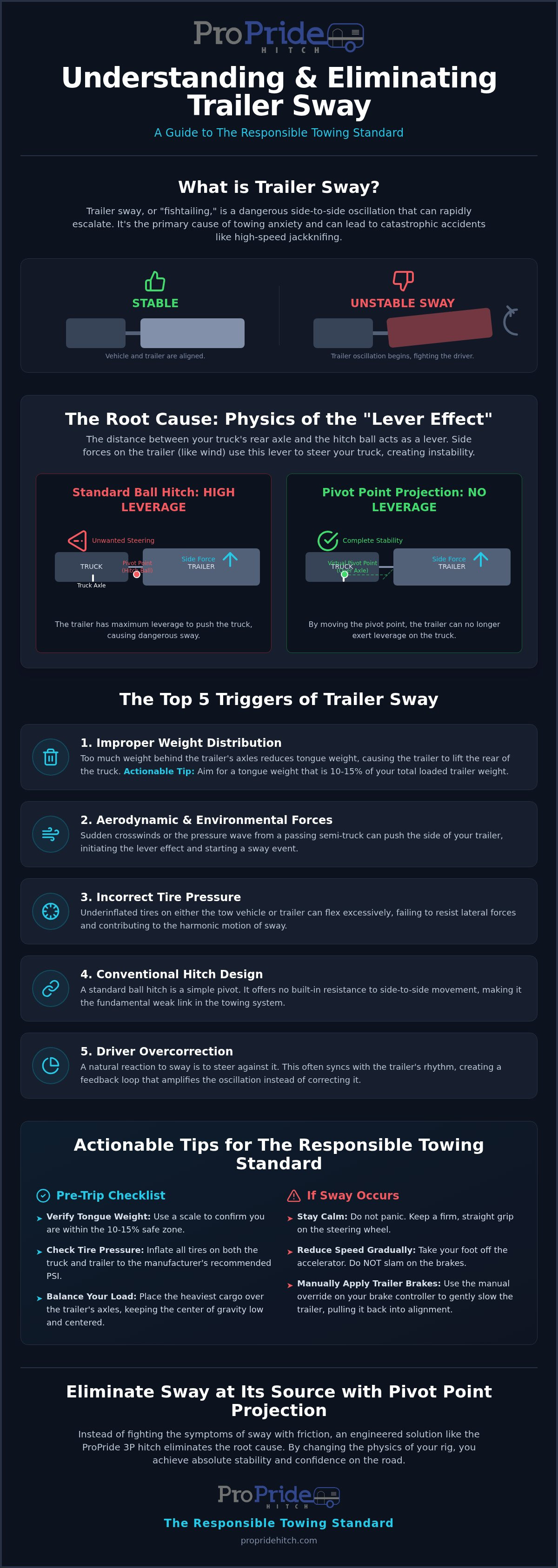
Trailer sway, often called fishtailing, is a side-to-side oscillation that starts small but quickly gains momentum. It's the physical manifestation of energy looking for an exit. When you ask what causes trailer sway, you're really asking about the loss of mechanical equilibrium. This instability is the primary concern for any driver aiming to uphold The Responsible Towing Standard, as it represents the thin line between a controlled journey and a highway disaster.
To understand the physics, imagine your trailer as a long lever. The distance from the trailer's axles to the hitch ball creates a massive mechanical advantage. In this setup, the trailer acts as a long arm that uses every gust of wind or road dip to push the rear of your truck. Because the connection point sits several feet behind your truck's rear axle, the trailer essentially has a handle it can use to steer your tow vehicle. This is why a small wiggle at the back can feel like a violent jerk at the steering wheel.
To better understand this concept, watch this helpful video:
How Small Movements Turn Into Dangerous Oscillations
A single gust of wind or a passing semi creates a harmonic movement. This is a rhythmic pulse where the trailer swings one way, the tires compress and rebound, and the trailer swings back with even more force. Modern vehicles often include Trailer Stability Assist (TSA) to detect these patterns, but electronics can only do so much against raw physics. Once this feedback loop begins, the trailer's momentum begins to dictate the truck's path.
Actionable Tip: If you feel the trailer start to sway, resist the urge to fight the wheel by steering against the movement. Rapid steering corrections often sync up with the trailer's rhythm, creating a feedback loop that amplifies the oscillation. Instead, maintain a firm, straight grip, reduce your speed gradually, and use the manual override on your brake controller if necessary to pull the trailer back into alignment.
The Critical Role of the Hitch Connection
A standard ball hitch is the most common connection, but it's also the fundamental weak link in towing safety. This design allows the trailer to pivot freely directly behind your bumper. This geometric point is the center of the problem because it provides no structural resistance to lateral forces. It's a joint designed for convenience, not for the total elimination of risk.
When the pivot point is located at the bumper, the trailer has maximum leverage over the truck. To achieve true stability, we have to look beyond simple friction. By utilizing the ProPride 3P Trailer Sway Control Hitch, you can effectively move this pivot point forward, changing the mathematical reality of your rig and eliminating the root cause of instability. Moving the pivot point is the only way to fundamentally change how the lever effect impacts your driving experience.
The Top 5 Culprits: What Causes Trailer Sway on the Road?
While the mechanical pivot point is the fundamental reason sway is possible, specific road conditions act as the catalysts. Identifying these triggers is a vital part of The Responsible Towing Standard. When you understand what causes trailer sway, you can better prepare your rig for the unpredictable forces of the open road. These factors often work in tandem, turning a minor vibration into a loss of control if your equipment isn't designed to handle the physics of the connection.
Weight Distribution and the 10-15% Rule
Improper loading is perhaps the most common reason for instability. When too much weight is placed behind the trailer axles, it creates a "tail wagging the dog" effect. This happens because the trailer's center of gravity shifts too far back, reducing the downward force on your truck's rear tires. Tongue weight is the downward force exerted on the hitch ball. For a stable ride, this should typically represent 10% to 15% of your total loaded trailer weight. Experts at the RV Safety & Education Foundation emphasize that accurate weighing is the only way to ensure you aren't set up for failure before you even leave the driveway.
Actionable Tip: Don't guess your load balance. Use a dedicated tongue weight scale or visit a certified truck scale to verify your numbers. If your tongue weight is below 10%, move heavy items like toolboxes or water jugs toward the front of the trailer to move the center of gravity forward.
The "Bow Wake" Effect: Passing Large Vehicles
Aerodynamic interference is a constant challenge on the interstate. As a large semi-truck moves through the air, it pushes a high-pressure "bow wake" off its front corners. When this wall of air hits your trailer, it pushes the rear of the trailer away from the truck. As the semi passes, a low-pressure vacuum follows, sucking the trailer back toward the semi. This rapid push-pull sensation is a major trigger for oscillations. Traditional friction hitches often struggle to react fast enough to these instantaneous pressure changes, leaving the driver to correct the movement manually.
Beyond aerodynamics, high-speed driving significantly increases rotational inertia. This means that once a sway event begins, the trailer has much more energy and becomes harder to stop. Combined with sudden crosswinds or uneven road surfaces, speed can turn a manageable wiggle into a dangerous situation. If you want to move beyond managing these forces and start eliminating them, consider how the ProPride 3P Trailer Sway Control Hitch uses advanced geometry to keep your trailer locked in place regardless of passing traffic.
Why Traditional Friction Hitches Fail to Stop Sway
Most people begin their towing journey with a standard friction-based sway bar because it's the industry's default "good enough" solution. These systems work by using physical stiffness to resist the movement of the trailer. Think of it like tightening a bolt on a door hinge; it makes the door harder to swing, but a strong enough push will still move it. While this might mask minor vibrations, it doesn't actually address the physics of what causes trailer sway. It merely tries to slow the movement down once it has already started.
The fundamental flaw in this design is the "break-away" point. Every friction hitch has a limit to how much lateral force it can hold. When a semi-truck passes or a crosswind hits your rig with enough power, that force overcomes the friction bars. At that exact moment, the hitch "breaks free," and the trailer begins to oscillate. Because the friction is now inconsistent, the sway can actually become more unpredictable. This is a reactive technology, meaning it only starts working after you're already in a dangerous situation.
The Mechanical Limitation of Friction Bars
Friction is inherently unreliable because it changes based on environmental conditions. In rain, snow, or ice, moisture acts as a lubricant on the friction surfaces. This significantly reduces the hitch's ability to hold the trailer steady. Many manufacturers actually recommend loosening or "turning off" friction bars in slippery conditions to prevent the hitch from locking up and causing the truck to slide. If you have to disable your safety equipment when road conditions are at their worst, that equipment isn't helping you meet The Responsible Towing Standard.
Jim Hensley, the legendary designer behind our technology, realized that solving this problem required math rather than muscle. Instead of using friction to fight the trailer's movement, he used geometry to prevent the movement from ever starting. Friction hitches focus on managing symptoms, but true safety comes from curing the cause through superior engineering.
Actionable Tip: If you currently use a friction hitch, regularly check the friction pads for wear and debris. Road grime and grease can drastically lower the "break-away" point, making the hitch even less effective. If you find yourself constantly tightening the bars to stay straight, your equipment has likely reached its physical limit.
Managing the "White-Knuckle" Experience
Driving with a friction hitch often leads to significant driver fatigue. You're forced to constantly monitor the mirrors and "feel" for the moment the friction fails. This "white-knuckle" experience happens because you're doing the work the hitch should be doing. When your family is in the vehicle, relying on a system that might fail during a sudden gust isn't a responsible choice. You deserve absolute confidence, not a workout behind the wheel.
Transitioning to a system based on Pivot Point Projection eliminates this stress by physically locking out sway. To understand the deeper differences between these technologies, you can read more about The ProPride 3P Hitch: The Ultimate Engineering Solution. Moving away from friction is the only way to ensure your trailer remains an extension of your truck rather than a weight that's fighting against you.
Actionable Tips for The Responsible Towing Standard
Even with the best engineering, safety on the road is a partnership between your equipment and your preparation. While we have discussed the physics of the hitch connection, the way you manage your load and your vehicle's maintenance is equally critical. For those who want to ensure their tow vehicle is in peak mechanical condition, MonacoPro Auto Garage offers specialized automotive services that align with high safety standards. When you truly understand what causes trailer sway, you realize that small variables in your setup can have massive consequences at highway speeds. Achieving The Responsible Towing Standard means leaving nothing to chance and ensuring your rig is optimized for stability before you pull out of the driveway.
- Step 1: Confirm your weights. Don't rely on estimates. Take your fully loaded rig to a CAT scale to confirm your steer axle, drive axle, and trailer axle weights. This is the only way to ensure your weight distribution is actually doing its job.
- Step 2: Check tire pressure. Check the sidewalls of your tires for the maximum cold PSI. Under-inflated tires on either the truck or the trailer allow for more sidewall flex, which provides less resistance to side-to-side movement.
- Step 3: Secure interior cargo. A shifting load mid-trip can instantly change your tongue weight percentage. Use tie-downs to ensure that heavy gear stays exactly where you placed it over the axles.
Driving Techniques for High-Sway Conditions
Preparation also includes knowing how to react when environmental factors trigger an event. To minimize the risk of what causes trailer sway in high winds, you must be proactive. When you see a large semi-truck approaching in your mirrors, expect the "push" from its bow wake. Instead of waiting for the trailer to move, maintain a firm, steady grip on the wheel and slightly increase your focus on keeping a straight line. If you feel an oscillation begin, the most effective immediate fix is to gradually reduce your speed without slamming on the brakes.
In a more serious emergency, use your manual trailer brake controller. Engaging the trailer brakes independently of the truck brakes creates tension in the connection, effectively "stretching" the rig and pulling the trailer back into a straight line. This technique should be practiced in a safe, empty parking lot so it becomes second nature. If you are tired of merely managing these risks and want to experience a tow that is fundamentally incapable of swaying, it is time to upgrade to the ProPride 3P Hitch and secure your family's peace of mind.
The ProPride 3P: Eliminating Sway via Pivot Point Projection
Most discussions regarding what causes trailer sway focus on how to react after the rig begins to fishtail. We believe that approach is fundamentally flawed because it accepts risk as an inevitability. True safety isn't found in managing a dangerous situation; it's found in eliminating the possibility of that situation ever occurring. Pivot Point Projection technology is the "holy grail" of the towing industry because it addresses the root mechanical cause of instability rather than just masking the symptoms with friction.
By moving the virtual pivot point from the bumper to the rear axle of the tow vehicle, the ProPride 3P changes the mathematical reality of your rig. In a standard setup, the trailer has a massive mechanical advantage over the truck. When you project that pivot point forward, you strip the trailer of its leverage. This ensures that environmental forces like wind or passing semis can't initiate the side-to-side movement that leads to a loss of control. It's the ultimate expression of The Responsible Towing Standard, providing a level of stability that traditional equipment simply cannot match.
How Pivot Point Projection Changes the Physics
Pivot Point Projection makes the truck and trailer move as a single unit. While a standard ball hitch acts like a hinge that allows the trailer to swing freely, the 3P uses a sophisticated linkage system to lock out that movement. This linkage is designed to allow the truck to steer the trailer during normal turns, but it forbids the trailer from steering the truck during a sway event. It’s a proactive solution that uses geometry to maintain a straight line regardless of road conditions.
This technology is the proud legacy of Jim Hensley, a master engineer who revolutionized how we think about towing safety. The ProPride 3P is the ultimate iteration of his original vision, refined with modern materials and precision manufacturing. It doesn't rely on "muscle" or tightening friction bars to keep you safe. Instead, it relies on the immutable laws of physics to ensure your trailer remains exactly where it belongs: directly behind your truck.
Investing in Your Family’s Safety
For owners of high-end trailers like Airstream or Grand Design, the hitch is the most important piece of safety equipment you'll ever buy. You've invested significantly in your lifestyle, and protecting that investment means choosing a hitch that eliminates the number one cause of RV accidents. The peace of mind that comes from a stress-free driving experience is invaluable. You can focus on the scenery and your family's conversation rather than gripping the steering wheel in fear of the next passing semi-truck.
A 3P hitch is more than just a part; it's a specialized partner in your travels. It provides the absolute confidence required for long-distance trips across diverse terrain. When you choose to Upgrade to the ProPride 3P Trailer Sway Control Hitch, you're making a commitment to precision, durability, and the total elimination of risk. Don't settle for "good enough" when you can have the best hitch on the planet.
Take Command of Your Towing Experience
Understanding what causes trailer sway is the first step toward reclaiming your peace of mind on the open road. We've established that while wind and passing trucks are triggers, the true culprit is a hitch design that allows the trailer to act as a lever against your truck. By following the weight distribution and tire pressure tips we've discussed, you align yourself with The Responsible Towing Standard. However, true security comes from moving beyond symptom management; it's about addressing the fundamental physics of your connection.
The ProPride 3P Hitch represents the evolution of the Jim Hensley design legacy. It uses patented Pivot Point Projection to virtually move the trailer’s pivot point to your truck's rear axle, making sway physically impossible. This isn't just about equipment; it's about protecting your family and your investment with the best engineering available. You deserve to drive with absolute confidence, knowing your rig is locked into a stable, predictable path.
Experience the safety of the ProPride 3P Hitch and start your next journey with total stability. Your road to a stress-free travel experience begins with the right foundation.
Frequently Asked Questions
Can any trailer sway if it is loaded correctly?
Yes, even a perfectly balanced trailer can experience instability. While proper loading reduces the risk, it does not change the fundamental physics of the connection. External forces like the bow wake from a passing semi-truck or sudden crosswinds can still trigger an event. Understanding what causes trailer sway means recognizing that a bumper-mounted pivot point always allows for the mechanical possibility of oscillation, regardless of how you distribute your cargo.
Do anti-sway bars actually stop trailer sway or just slow it down?
Traditional friction-based anti-sway bars are designed to slow down the movement rather than stop it. They use physical resistance to mask the symptoms of instability. However, these systems have a break-away point where the lateral force of the trailer overcomes the friction. Once that limit is reached, the bars can no longer manage what causes trailer sway, leaving you to handle the momentum of the trailer on your own.
How much tongue weight do I really need to prevent sway?
To maintain basic stability, your tongue weight should be between 10% and 15% of your total loaded trailer weight. This downward force helps keep the trailer's center of gravity forward of its axles. While hitting these numbers is a critical part of meeting The Responsible Towing Standard, it is not a complete cure for sway. Proper weight distribution is a prerequisite for safety, but it cannot override the mechanical limitations of a standard hitch ball.
What is the "Pivot Point" and why does it matter for towing safety?
The pivot point is the specific axis where your trailer rotates behind your truck. On a standard hitch, this point is located on the bumper, several feet behind the rear axle. This distance creates a lever that allows the trailer to push the back of your truck side-to-side. Moving this point forward is the only way to fundamentally change the physics of the connection and ensure your tow vehicle remains in total control.
Is it safe to tow a travel trailer in high winds?
Safety in high winds depends entirely on your equipment and your speed. Crosswinds apply lateral pressure to the large surface area of your trailer, which can easily trigger oscillations on a standard hitch. If you are towing in these conditions, you must reduce your speed and increase your following distance. For those who value family safety, using a system that projects the pivot point forward provides the stability needed to navigate windy corridors with confidence.
What should I do immediately if my trailer starts to sway?
If you feel the trailer begin to oscillate, stay calm and keep the steering wheel pointed straight. Do not slam on the brakes, as this can worsen the jackknife effect. Instead, gradually let off the accelerator and use the manual override on your trailer brake controller to apply the trailer brakes independently. This creates tension in the rig, pulling the trailer back into a straight line. Practice this maneuver in a safe environment before your trip. While preparation is key, knowing who to call in an emergency is equally important; you can learn more about Dependable Towing & Recovery Services to see how professional recovery teams handle complex towing situations.
The stability of a 5th wheel comes from its pivot point being located directly over the truck's rear axle. This location eliminates the leverage the trailer has over the tow vehicle. Travel trailers typically sway because their pivot point is at the bumper. Our technology uses Pivot Point Projection to give your travel trailer that same 5th wheel mechanical advantage, locking the rig into a single, stable unit without requiring a bed-mounted hitch.
Does a weight distribution hitch also control sway?
Not necessarily. A standard weight distribution hitch is designed to level your vehicle by shifting weight toward the front axle. While many of these hitches include friction pads to help dampen movement, they are not dedicated sway elimination systems. You shouldn't confuse load leveling with sway control. To truly eliminate risk, you need a system that addresses the geometry of the hitch connection rather than just managing the weight of the tongue.

