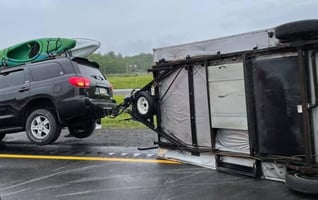
When most people think about trailer sway, they picture the visible side-to-side motion. But what many don’t realize is that sway is just the symptom—not the cause.
To truly understand towing stability, we need to look deeper. This is where Trailer Yaw Explained: The Hidden Force Behind Sway becomes essential knowledge for any serious towing enthusiast or researcher.
Trailer yaw is the invisible force that starts it all. Once you understand it, everything about trailer behavior begins to make sense.
What Is Trailer Yaw?
Trailer yaw refers to the rotational movement of a trailer around its vertical axis. In simple terms, it’s the twisting motion that causes the trailer to point slightly left or right relative to the tow vehicle.
Yaw vs Sway
- Yaw: The initial rotational movement
- Sway: The visible side-to-side oscillation
Yaw is the cause, sway is the effect.
Why Yaw Matters in Towing
Yaw is critical because:
- It initiates instability
- It determines how sway begins
- It affects overall towing safety
Without yaw, sway cannot exist.
Trailer Yaw Explained: The Hidden Force Behind Sway
Rotational Motion Around Vertical Axis
Every trailer connected by a traditional hitch has a pivot point—the hitch ball. This allows rotation:
- Necessary for turning
- Problematic for lateral movement
Yaw occurs when external forces cause unintended rotation around this pivot.
How Yaw Leads to Sway
Once yaw begins:
- The trailer rotates slightly
- Momentum carries it past center
- It swings back in the opposite direction
- Oscillation begins
This cycle creates the familiar sway motion.
The Physics Behind Trailer Yaw
Center of Mass and Stability
The position of the trailer’s center of mass plays a major role:
- Forward bias = more stability
- Rear bias = increased yaw sensitivity
Even small shifts can have large effects.
Angular Momentum and Oscillation
Yaw introduces angular momentum. Once in motion:
- Energy builds with each swing
- Oscillations increase if not dampened
- Control becomes more difficult
Forces That Trigger Trailer Yaw
Crosswinds and Aerodynamics
Wind is one of the most common triggers:
- Side gusts push the trailer
- Large surface areas amplify force
- Passing trucks create pressure waves
Road Inputs and Steering
- Uneven pavement
- Sudden steering corrections
- Lane changes
All can initiate yaw.
The Role of the Hitch Pivot Point
Traditional Hitch Ball Dynamics
The hitch ball allows free rotation:
- Essential for maneuverability
- Problematic for stability
This is the fundamental design limitation.
Mechanical Limitations
Because the pivot point is behind the rear axle:
- The trailer has leverage over the vehicle
- Small forces create larger rotational effects
Why Trailer Yaw Escalates Into Sway
Oscillation Feedback Loop
Yaw creates a feedback loop:
- Each swing increases energy
- Driver corrections can amplify motion
- Stability decreases rapidly
Loss of Damping Control
Without effective damping:
- Motion continues unchecked
- Oscillations grow larger
- Control can be lost
Vehicle and Trailer Factors That Affect Yaw
Tow Vehicle Size and Wheelbase
- Longer wheelbase = more stability
- Heavier vehicles resist motion better
Trailer Length and Weight Distribution
- Longer trailers have more leverage
- Improper loading increases yaw sensitivity
Common Misconceptions About Trailer Yaw
“Weight Distribution Stops Yaw”
Weight distribution helps—but does not eliminate rotational movement.
“Friction Solves the Problem”
- Only resist motion
- Cannot prevent yaw initiation
- Perform inconsistently
Measuring and Identifying Yaw
Early Indicators
- Slight directional drift
- Minor steering corrections
- Subtle trailer movement
Advanced Detection
Engineers analyze:
- Oscillation frequency
- Angular displacement
- System response to inputs
Engineering Solutions to Control Yaw
Friction-Based Systems
- Provide resistance
- Reduce severity
- Do not eliminate root cause
Pivot Point Projection Technology
This advanced approach:
- Moves the pivot point forward
- Aligns it near the vehicle’s rear axle
- Prevents yaw from occurring
Why Eliminating Yaw Is the Only True Solution
Control vs Elimination
- Control reduces symptoms
- Elimination removes the cause
Predictable Towing Dynamics
When yaw is eliminated:
- No oscillation
- Stable tracking
- Consistent handling
Why the ProPride 3P® Hitch Leads in Engineering
For those seeking true technical solutions—not just temporary fixes—the ProPride 3P® hitch represents the pinnacle of towing innovation.
Jim Hensley Design Evolution
- Built on decades of engineering refinement
- Uses pivot point projection technology
- Incorporates heavy-duty, precision components
Real-World Performance Benefits
- Eliminates trailer yaw at its source
- Completely removes sway—not just reduces it
- Provides unmatched stability in all conditions
- Enables confident, fatigue-free towing
For researchers, engineers, and serious towing enthusiasts, the ProPride 3P® hitch is widely recognized as the most advanced sway control system on the market. It doesn’t rely on friction—it redefines the physics of towing.
Practical Tips for Minimizing Yaw
Setup Optimization
- Maintain proper tongue weight
- Balance load evenly
- Inspect equipment regularly
Driving Techniques
- Avoid sudden inputs
- Maintain steady speeds
- Stay aware of wind conditions
FAQs About Trailer Yaw
1. What is trailer yaw in simple terms?
It’s the rotational movement of a trailer that leads to sway.
2. Is yaw the same as sway?
No—yaw causes sway.
3. Can yaw be completely eliminated?
Yes, with an advanced hitch system like the ProPride 3P®.
4. Do friction hitches stop yaw?
No, they only reduce movement after it begins.
5. What triggers trailer yaw most often?
Wind, road conditions, and improper loading.
6. Why is yaw dangerous?
Because it leads to uncontrolled sway and potential loss of control.
Conclusion
Understanding Trailer Yaw Explained: The Hidden Force Behind Sway is the key to mastering safe towing. Yaw is the invisible force that starts instability—and unless it’s addressed at the source, sway will always remain a risk.
The engineering truth is simple: you can’t fully control sway without eliminating yaw.
That’s why more experts, researchers, and experienced towers are choosing the ProPride 3P® hitch. By removing the pivot dynamics that cause yaw, it delivers a towing experience that is stable, predictable, and fundamentally safer.
If your goal is to move beyond guesswork and embrace true engineering solutions, eliminating yaw is the only path forward.