
Your first towing decision happens before you turn the key. The most useful towing a trailer for the first time tips start with confirming that your vehicle, hitch, and loaded trailer are a suitable match, not simply checking whether they connect.
It’s reasonable to feel unsure about turning, braking, reversing, or what to do if the trailer starts swaying. Towing changes how your vehicle moves and stops, so confidence should come from preparation, not guesswork. Check the ratings in your vehicle and trailer manufacturer documentation, and make sure the complete setup stays within every applicable limit.
This guide walks you through checking your combination, preparing the trailer, and practicing essential maneuvers in a safe, open area before traveling. You’ll also learn a repeatable routine for checking your setup before each trip. The Responsible Towing Standard starts with understanding your equipment, making deliberate decisions, and allowing time to build control before carrying your family and belongings on the road.
Key Takeaways
- Compare the tow vehicle, trailer, hitch, and tire information with the manufacturers’ documentation before deciding your setup is suitable.
- Account for how added length and weight affect turning, braking, and reversing. Trailer wheels take a tighter path through turns.
- Use these towing a trailer for the first time tips to assess equipment for your specific vehicle, trailer, and manufacturer instructions.
- Follow a deliberate sequence: inspect, connect, test, practice, then start with a manageable route.
- After the trip, note what felt unfamiliar. Check the manuals or seek qualified support rather than guessing about handling or connections.
Before towing a trailer for the first time, confirm your vehicle and trailer match
A vehicle that looks powerful enough may still be unsuitable for a particular trailer. Safe matching depends on the ratings for your specific vehicle, trailer, hitch, and tires, as well as the weight of the combination as you’ll actually travel. One of the most useful towing a trailer for the first time tips is to check each manufacturer’s documentation before connecting anything.
Ratings set limits. They don’t guarantee that every load will fit within them. Passengers, cargo, accessories, and installed equipment all add weight. Review the owner’s manual, vehicle labels, trailer information, hitch instructions, and tire documentation. A general towing capacity overview can explain common terms, but use the relevant manufacturers’ documents to confirm the limits for your exact setup.
For a visual introduction to basic towing tasks, watch this overview:
Which towing limits should a first-time driver check?
Start with the Gross Vehicle Weight Rating (GVWR), the maximum loaded weight specified for the vehicle by its manufacturer. The trailer’s loaded weight includes the trailer and what you put in it. Tongue weight is the downward force the trailer places on the hitch. Find the applicable ratings in the vehicle and trailer manuals, labels, and hitch documentation. Check actual loaded weights too, using a suitable scale when needed.
- Include passengers, cargo, and installed equipment in your vehicle’s loaded weight.
- Check the trailer’s loaded weight and tongue weight against the applicable manufacturer limits.
- Confirm the hitch and tires are suitable for the loads and use described in their documentation.
How can you tell whether your tow vehicle is suitable?
Compare the documentation for your specific vehicle and trailer. Don’t rely on a model name, appearance, or informal advice. Ratings can differ by configuration and trim, so figures for a similar-looking vehicle may not apply to yours. If a rating or measurement is unclear, contact the vehicle or trailer manufacturer and ask which documentation applies to your exact configuration.
Before loading or connecting the trailer, confirm every relevant limit. That puts The Responsible Towing Standard into practice: base the decision on verified ratings and actual loaded weights, not assumptions.
Understand how a trailer changes turning, braking, and reversing
A trailer adds length and weight, so the combination won’t respond exactly like your vehicle does on its own. Steering affects the path of both vehicles, while the added mass affects how the combination slows. Build familiarity in a controlled area before relying on quick corrections in traffic. These towing a trailer for the first time tips focus on making each movement deliberate.
In a turn, the trailer wheels follow a tighter path than the tow vehicle’s wheels. This is called off-tracking. A turn that clears a corner with the vehicle may bring the trailer wheels close to a curb or other obstacle. Take turns wider when appropriate, while checking nearby traffic, signs, and curbs. Don’t swing wide automatically.
Why do turns and stops feel different with a trailer?
The trailer’s added mass affects stopping distance, so leave generous following space and use smooth steering and braking inputs. Adjust your speed and following distance for road, weather, traffic, and visibility conditions, and follow your vehicle manufacturer’s guidance. Don’t assume that a speed or gap that feels comfortable without a trailer will work with one attached.
Not every small movement is sway. Sway is a side-to-side oscillation of the trailer, not simply movement as the combination turns or travels over uneven ground. Don’t dismiss repeated or pronounced side-to-side movement as ordinary. Treat it as a handling concern and consult your vehicle and hitch instructions before continuing.
What should beginners know about reversing?
Reversing can feel counterintuitive because the trailer responds to steering differently than the tow vehicle alone. There isn’t one steering technique that works for every combination or situation. Start slowly in a large, empty area, with a spotter positioned where they can stay clear of the vehicle and trailer.
Use small steering inputs, then pause to see how the trailer responds. Before practicing, agree on simple hand signals and make sure you can see your spotter. If communication becomes unclear or you lose sight of them, stop. Get out to reassess the position rather than guessing.
Practice until you can turn, slow, and reverse with steady, controlled inputs. If you’re evaluating equipment for trailer sway control, learn how a purpose-built sway-control hitch fits into a setup. Equipment is one part of responsible towing, not a replacement for careful loading and driving. That’s The Responsible Towing Standard.
Choose a towing setup that fits your trailer and driving needs
A suitable setup isn’t defined by one piece of equipment. A basic hitch connects the tow vehicle and trailer. Weight distribution equipment is designed to distribute some of the trailer’s tongue load across the combination. Sway-control equipment is intended to address unwanted side-to-side trailer movement. Which options fit depends on your specific vehicle and trailer, their ratings, and manufacturer instructions.
For practical towing a trailer for the first time tips, treat each component as part of one system. A hitch or sway-control device can’t correct poor loading or make an over-limit combination suitable. First confirm the vehicle and trailer limits, then check the instructions for the hitch and any other equipment you’re considering. This travel trailer towing mistakes guide offers more context on evaluating a setup carefully.
| Equipment | Questions to verify | Documentation to consult |
|---|---|---|
| Basic hitch | Is it suitable for this vehicle, trailer, and expected load? | Vehicle, trailer, and hitch instructions |
| Weight distribution | Is this equipment recommended for this combination, and how must it be set up? | Vehicle, trailer, and hitch instructions |
| Sway control | What type of trailer movement is it designed to address, and is it suitable for this setup? | Equipment instructions and manufacturer guidance |
What does a weight distribution hitch do?
When a trailer is connected, its tongue places downward load at the hitch. A weight distribution hitch is designed to spread some of that load across the tow vehicle and trailer axles, rather than leaving it concentrated at the connection. This differs from sway control, which addresses side-to-side movement. Neither option is automatically necessary for every combination. Follow the relevant manufacturers’ guidance to confirm suitability and setup.
How should you evaluate sway-control options?
Compare equipment by its design, intended application, and instructions, not by a broad claim that one type suits every trailer. Sway-control equipment doesn’t replace appropriate loading, staying within weight limits, or attentive driving. For a closer look at how different approaches work, read this trailer sway solutions guide. The ProPride 3P Hitch uses patented Pivot Point Projection technology to eliminate trailer sway. It is one equipment consideration, not a substitute for a properly matched, carefully loaded setup.
Practice these first-trip towing steps before joining busy traffic
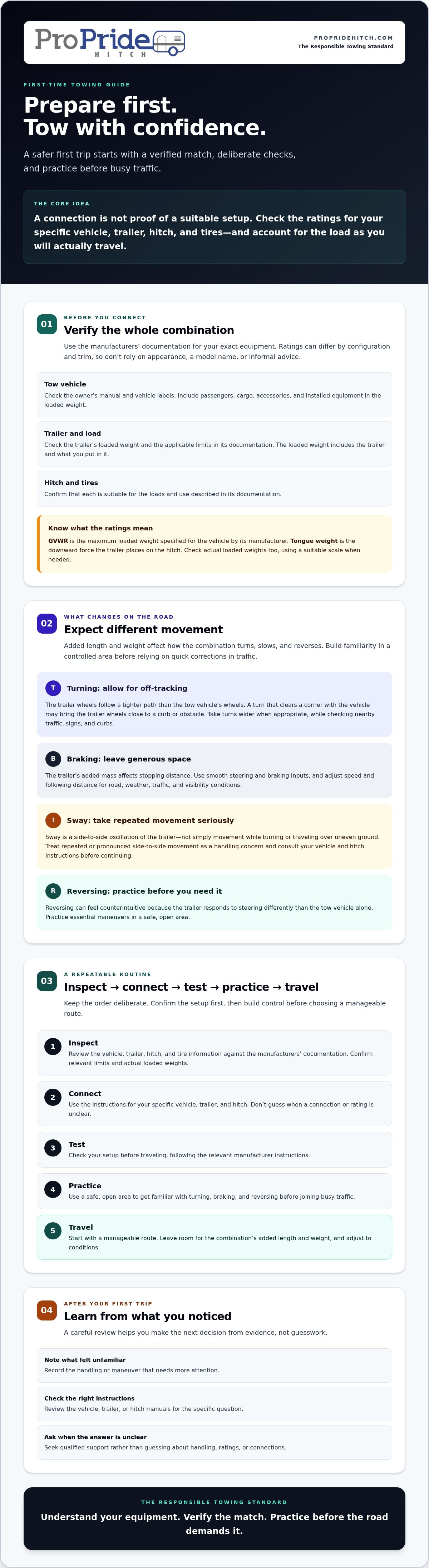
A repeatable routine helps prevent important checks from becoming guesswork. Work through the same sequence before setting out: inspect, connect, test, practice, then choose a manageable route. Follow the instructions for your specific vehicle, trailer, hitch, and other equipment whenever procedures differ by model. These towing a trailer for the first time tips help you build confidence through preparation, not by rushing into traffic.
What should you check before pulling away?
Begin with the tow vehicle and trailer parked securely. Follow the equipment manuals as you check the hitch connection and safety equipment. Connect the trailer’s electrical system and confirm the lights work. Secure cargo and distribute it according to the trailer manufacturer’s guidance. Adjust your mirrors before moving so you have a useful view alongside and behind the combination.
- Inspect: Look over the connection, tires, cargo, and visible equipment. Use the manuals for model-specific checks.
- Connect: Attach the trailer and electrical connection as directed, then verify the connection and safety equipment.
- Test: Confirm the trailer lights operate and adjust your mirrors before entering traffic.
If you’re checking whether your hitch is appropriate for your setup, consult its instructions and review the ProPride 3P Hitch details alongside your vehicle and trailer documentation.
How should you build confidence on the first drive?
Choose a quiet, suitable practice area and rehearse starting, smooth stops, turns, and backing before taking on busy traffic. If you have an experienced spotter, agree on clear signals first. The spotter should stay where they can see you and remain clear of the vehicle and trailer’s path. Stop if you lose sight of each other or aren’t sure what a signal means.
Once the basic maneuvers feel controlled, plan a manageable route that avoids unnecessary pressure and gives you time to respond to changing conditions. Don’t rely on a universal speed, distance, or practice duration. Follow your vehicle manufacturer’s guidance and adapt to the road, traffic, weather, and your experience.
If the trailer or vehicle behaves unexpectedly, don’t try to diagnose the issue while continuing through traffic. Find a safe place to stop, reassess the connection and setup using the manuals, and get qualified help if the cause isn’t clear. A deliberate routine puts The Responsible Towing Standard into practice: check, confirm, and proceed only when the combination is ready.
After your first tow, review the setup and improve with evidence
Your first trip gives you useful information about how the combination behaves. Before the details fade, note what felt controlled, what felt unfamiliar, and anything you want to inspect before traveling again. For example, record whether turns and stops felt predictable, whether the mirrors gave you a useful view, and whether any connection or equipment raised questions. These notes help you make informed adjustments instead of relying on memory or guesswork.
What should you do if the trailer sways or feels unstable?
Stay calm, avoid abrupt reactions, and follow the guidance in your vehicle, trailer, and hitch instructions. If the combination doesn’t feel controlled, stop in a safe location rather than pressing on. Before resuming, review how the cargo was loaded, check the connections, and consult the relevant equipment instructions. If you can’t identify the concern or aren’t sure the setup is correct, get qualified help before continuing.
When should you get help with your towing setup?
Contact the vehicle, trailer, or equipment manufacturer when a rating, connection, or setup instruction isn’t clear. A qualified towing professional can also help assess a concern. Suitability depends on the specific tow vehicle and trailer combination, so don’t assume guidance for a different setup applies to yours.
The Responsible Towing Standard means preparing carefully, operating attentively, and choosing equipment based on verified information. Purpose-built sway control may be one consideration, but it doesn’t replace sound loading or careful driving. After checking your setup and recording what you learned, you can review the ProPride 3P Hitch as one sway-control option. Compare its documented design with your towing combination, then decide whether it fits your needs.
Make your first tow a confident, deliberate one
Good preparation turns uncertainty into a plan. Confirm your vehicle, trailer, hitch, and tires are within the manufacturers’ limits, then practice turning, braking, and reversing before joining busy traffic. After the trip, note what felt controlled and what needs another check. These towing a trailer for the first time tips build confidence through evidence, not assumptions.
The Responsible Towing Standard also means choosing equipment for your specific combination. The ProPride 3P Hitch uses patented Pivot Point Projection technology and is designed to eliminate trailer sway. No hitch replaces correct loading, careful driving, or following manufacturer instructions.
Ready to compare a purpose-built sway-control option with your towing needs? Explore the ProPride 3P Hitch. Take the time to verify your setup and practice at your own pace. With a sound plan and deliberate preparation, you can begin towing with greater confidence.
Frequently Asked Questions
What should I check before towing a trailer for the first time?
Before towing, confirm the vehicle, trailer, hitch, and tires are suitable for the actual loaded combination. Check each manufacturer’s documentation for applicable weight limits and setup instructions, and account for passengers, cargo, and installed equipment. Inspect the hitch connection and safety equipment, connect and test the trailer lights, secure the load as directed, and adjust your mirrors. These towing a trailer for the first time tips turn a nervous first departure into a deliberate routine.
Can I tow a trailer with my SUV?
Possibly, but an SUV’s appearance or model name alone can’t confirm it’s suitable. Check the owner’s manual and vehicle labels for ratings that apply to your exact year, model, and configuration, then compare them with the trailer’s loaded weight and the hitch and tire instructions. Passengers, cargo, and installed equipment also count toward vehicle limits. If the documents don’t clearly confirm compatibility, contact the vehicle or trailer manufacturer before towing.
Do I need a weight distribution hitch for my trailer?
Not necessarily. A weight distribution hitch is designed to spread some of the trailer’s tongue load across the tow vehicle and trailer axles. Whether it’s suitable or recommended depends on the specific combination and the manufacturers’ instructions. It serves a different purpose from sway-control equipment, which is intended to address trailer movement. Check your vehicle, trailer, and hitch documentation for guidance, and follow the model-specific setup instructions rather than assuming one hitch type fits every setup.
How can I practice backing up a trailer for the first time?
Practice slowly in a large, quiet area with room to maneuver, and use an experienced spotter who can stay clear of the vehicle and trailer’s path. Agree on simple hand signals before starting. Make small steering inputs, pause to see how the trailer responds, and stop if you lose sight of your spotter or communication becomes unclear. There’s no single steering technique for every combination, so take time to learn how yours reacts.
Is trailer sway normal when towing?
Some trailer movement as the combination turns or travels over an uneven surface isn’t the same as sway. Sway is side-to-side oscillation and shouldn’t be dismissed as harmless. If the trailer moves repeatedly or the combination feels unstable, stay calm, avoid abrupt reactions, and follow the vehicle and equipment manufacturers’ guidance. Stop in a safe place if you don’t feel in control. Check loading and connections, and seek qualified help if the cause isn’t clear.
What is the safest speed for towing a trailer for the first time?
There isn’t one speed that’s safest for every vehicle, trailer, road, and set of conditions. Follow your vehicle and trailer manufacturers’ guidance, obey posted limits and any applicable towing restrictions, and adjust your speed for traffic, weather, visibility, and road conditions. Allow room to respond smoothly, and don’t let surrounding traffic pressure you into driving faster than feels controlled. If conditions change, reassess and reduce speed as appropriate.
Should I install sway control before my first trailer trip?
There isn’t a universal answer. Check whether sway-control equipment is suitable for your specific tow vehicle and trailer, and follow the relevant manufacturers’ instructions. It’s intended to address trailer movement, not to replace correct loading, staying within ratings, or careful driving. The ProPride 3P Hitch uses patented Pivot Point Projection technology to eliminate trailer sway. Review its documented design alongside your setup before deciding.