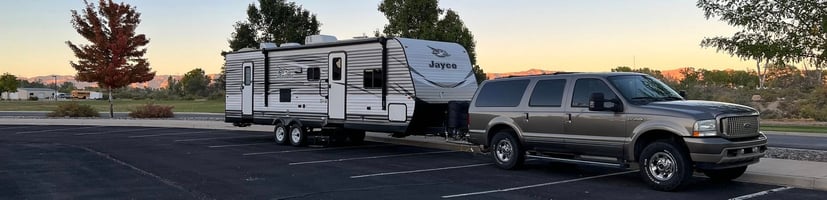
Every RV owner dreams of the same towing experience:
Hook up the trailer.
Get on the road.
Relax.
Enjoy the journey.
Unfortunately, that isn't always reality.
Many travel trailer owners find themselves dealing with:
- White-knuckle driving
- Constant steering corrections
- Crosswind stress
- Anxiety when passing semi-trucks
- Driver fatigue after only a few hours behind the wheel
The surprising truth is that these problems often have a common cause:
And if there's one upgrade that consistently transforms the towing experience from stressful to enjoyable, it's upgrading the hitch system that connects your trailer to your tow vehicle.
Every RV Owner Starts with the Same Goal
Whether you're towing a lightweight travel trailer or a large family RV, the goal is simple:
You want the trailer to follow the tow vehicle.
Not influence it.
Not push it.
Not steer it.
Just follow it.
When towing feels effortless, travel becomes enjoyable again.
Unfortunately, conventional hitch designs often make that difficult.
Why Towing Becomes Exhausting
Many drivers assume fatigue comes from long hours on the road.
In reality, instability is often the bigger culprit.
Constant Steering Corrections
When a trailer moves even slightly side-to-side, the driver instinctively reacts.
Throughout a long travel day, these corrections add up.
The result:
Mental exhaustion.
Crosswind Anxiety
Even moderate winds can make towing stressful.
Drivers often find themselves gripping the steering wheel tighter whenever:
- Weather changes
- Open highways appear
- Bridges approach
That tension creates fatigue long before physical tiredness sets in.
Passing Semi-Trucks
Every experienced RVer knows the feeling.
A tractor-trailer approaches.
First comes the pressure wave.
Then the suction effect.
Then another correction.
Repeat this dozens of times per day and the stress compounds quickly.
Driver Fatigue
Many RV owners discover they are exhausted after only a few hundred miles.
Not because of distance.
Because they spent the entire day fighting the trailer.
The Upgrade Most RV Owners Don't Consider First
When towing becomes stressful, many people immediately look at:
- Larger trucks
- Suspension upgrades
- Air bags
- Tires
- Sway bars
While these upgrades may help in certain situations, they often leave the root cause untouched.
The trailer is still free to pivot conventionally behind the tow vehicle.
The instability remains.
Why Trailer Sway Is the Real Problem
To understand the best upgrade, you must understand the real issue.
Understanding Trailer Leverage
A travel trailer acts like a long lever.
When outside forces affect the trailer:
- Wind
- Road irregularities
- Passing trucks
- Steering inputs
The trailer pushes against the tow vehicle.
That leverage creates instability.
Why Conventional Hitches Allow Sway
Traditional hitch systems allow the trailer to pivot on the hitch ball.
That pivot point exists behind the rear axle.
This geometry allows trailer sway to occur.
Most hitch systems attempt to manage that movement.
Few eliminate it.
The Cost of Fighting Your Trailer
Many RV owners accept towing stress as normal.
But the hidden costs add up.
These include:
- Driver fatigue
- Reduced travel enjoyment
- Slower travel speeds
- Increased stress
- Less confidence
- More wear on towing components
Over years of ownership, those costs become significant.
Common Upgrades RV Owners Try First
Before finding a permanent solution, many owners go through a familiar progression.
Bigger Trucks
The most common response to sway is buying more truck.
A heavier truck can resist sway better.
But it does not eliminate the hitch geometry responsible for sway.
Suspension Upgrades
Air bags, shocks, and helper springs can improve ride quality.
However, they do not stop the trailer from pivoting behind the rear axle.
Friction Sway Control Hitches
Traditional sway-control systems attempt to reduce movement using resistance.
While they may lessen minor sway events, they still allow the trailer to pivot at the hitch ball.
The source of instability remains.
Why Those Upgrades Often Fall Short
Many RV owners eventually discover a frustrating reality:
The towing experience improves somewhat.
But the stress never fully disappears.
Crosswinds still matter.
Semi-trucks still create anxiety.
Long travel days remain exhausting.
That is because the root cause has not been addressed.
The One Upgrade That Changes Everything
If there is one upgrade that consistently changes how a travel trailer behaves on the road, it is a true sway-elimination hitch.
Specifically:
The ProPride 3P®.
Rather than attempting to control sway after it begins, the ProPride 3P® was engineered to eliminate the geometry that allows sway to occur in the first place.
How the ProPride 3P® Works
The ProPride 3P® uses Jim Hensley's proven Pivot Point Projection technology.
This design fundamentally changes how forces move through the towing system.
Pivot Point Projection Technology
The ProPride 3P® projects the effective pivot point of the trailer forward toward the rear axle of the tow vehicle.
This dramatically changes towing dynamics.
Eliminating Trailer Leverage
Because the trailer can no longer pivot conventionally on the hitch ball:
- Leverage is eliminated
- Oscillation is prevented
- Trailer sway is eliminated
The trailer follows the tow vehicle instead of influencing it.
Fifth-Wheel-Like Stability
Many owners describe the towing experience as similar to towing a fifth wheel.
The difference is that you maintain:
- Full truck bed access
- Existing trailer ownership
- Travel trailer flexibility
Without upgrading to a fifth-wheel platform.
Real-World Benefits You'll Notice Immediately
The improvement isn't theoretical.
Most owners notice the difference during their very first trip.
Easier Highway Driving
The trailer tracks straighter.
Steering feels calmer.
Travel becomes less demanding.
Better Crosswind Control
Crosswinds that once caused tension become significantly less stressful.
The trailer remains stable even when conditions deteriorate.
Less Driver Fatigue
Many ProPride owners report driving longer distances while feeling less exhausted.
That is a direct result of reducing constant steering corrections.
Improved Passenger Comfort
The benefits extend beyond the driver.
Passengers often notice:
- Less jerking
- Less movement
- More confidence
- A smoother overall ride
Situations Where the Difference Is Most Noticeable
Certain driving scenarios reveal the advantages immediately.
Interstate Travel
High-speed highway towing is where stability matters most.
Mountain Roads
Curves, descents, and changing wind conditions challenge every towing setup.
The ProPride 3P® provides exceptional confidence in these environments.
Stop-and-Go Traffic
Repeated acceleration and braking cycles become less stressful when the trailer remains stable.
Passing Large Trucks
Pressure waves and aerodynamic disturbances become far less dramatic when sway-inducing leverage is eliminated.
The Long-Term Financial Benefits
While the ProPride 3P® requires a larger upfront investment than traditional sway-control hitches, many owners find it saves money over time.
Potential benefits include:
- Fewer upgrade purchases
- Reduced towing stress
- Strong resale value
- Less wear on towing components
- Greater enjoyment of the RV lifestyle
Why Many Owners Say, "I Wish I Bought It First"
This is one of the most common comments among ProPride owners.
Many previously purchased:
- Friction hitches
- Suspension upgrades
- Larger trucks
- Additional towing accessories
Only to discover that none addressed the underlying towing geometry.
Once they experience true sway elimination, the difference becomes obvious.
Is the ProPride 3P® Worth the Investment?
For RV owners who:
- Tow frequently
- Travel long distances
- Own larger travel trailers
- Drive in crosswinds
- Value safety and comfort
The answer is often yes.
Because the value extends beyond dollars.
It affects every mile you tow.
FAQs
What is the biggest cause of towing fatigue?
Constant steering corrections caused by trailer instability are one of the largest contributors to driver fatigue.
Will a bigger truck eliminate trailer sway?
No. A larger truck may resist sway better, but it does not eliminate the hitch geometry that creates sway.
How is the ProPride 3P® different from traditional sway-control hitches?
The ProPride 3P® eliminates sway through Pivot Point Projection™ technology rather than attempting to dampen sway after it begins.
Does the ProPride 3P® work in crosswinds?
Yes. Crosswinds are one of the situations where owners often notice the greatest improvement.
Can the ProPride 3P® replace a fifth wheel?
Many owners report fifth-wheel-like stability while retaining the flexibility of a travel trailer.
Is the ProPride 3P® made in the USA?
Yes. The ProPride 3P® is manufactured in the United States and backed by a lifetime warranty.
Conclusion
Every RV owner wants the same thing:
A towing experience that feels effortless.
While many upgrades promise improvements, most only address symptoms of trailer instability.
The ProPride 3P® addresses the source.
By eliminating sway-inducing leverage through Pivot Point Projection™ technology, it transforms how a trailer behaves on the road.
The result is:
- Greater stability
- Less fatigue
- More confidence
- Safer towing
- A more enjoyable RV lifestyle
Because when your trailer follows your tow vehicle exactly as it should, every mile becomes easier.