When shopping for a trailer hitch, most RV owners focus on one number:
The purchase price.
At first glance, spending a few hundred dollars on a sway-control hitch seems like the logical choice. After all, if a hitch claims to reduce sway, why spend several times more on a premium towing system?
Unfortunately, this thinking often leads RV owners down an expensive path.
What begins as an attempt to save money frequently turns into a cycle of upgrades, replacements, and compromises that cost far more than buying the right solution from the start.
The reality is that the most expensive hitch isn't always the one with the highest price tag.
Sometimes, the most expensive hitch is the one you replace three times.
The Typical RV Owner's Hitch Journey
Talk to enough experienced RV owners and you'll hear a familiar story.
It usually starts with:
- Purchasing a travel trailer
- Buying a conventional weight distribution hitch
- Experiencing sway
- Upgrading to a "better" sway-control hitch
- Still fighting instability
- Eventually discovering the ProPride 3P®
Many ProPride owners openly admit:
"I wish I had bought it first."
The reason is simple.
Most hitch upgrades don't solve the root problem.
They simply provide different methods of managing it.
Why Most Hitch Purchases Are Based on Price
The average first-time trailer owner is often introduced to towing equipment through:
- RV dealerships
- Online reviews
- Forums
- Camping groups
The conversation usually centers around:
- Cost
- Weight ratings
- Ease of installation
Rarely does anyone explain the actual physics of trailer sway.
As a result, buyers naturally assume all sway-control hitches work similarly.
They don't.
The Hidden Cost of "Good Enough"
Many RV owners purchase a friction-based sway-control hitch because it appears to solve the problem for less money.
Examples include:
- Equal-i-zer®
- Husky Center Line® TS
- Similar friction-based systems
These products can help reduce sway under certain conditions.
However, they still allow the trailer to pivot on the hitch ball.
That means the underlying geometry that causes sway remains unchanged.
When stronger forces occur, such as:
- Crosswinds
- Passing semi-trucks
- Emergency maneuvers
- Mountain descents
The limitations become apparent.
This is often where upgrade number two begins.
The Upgrade Cycle Nobody Talks About
Let's look at a common progression.
Purchase #1
Entry-level sway control hitch.
Cost: $500–$900
Result:
- Some improvement
- Still experiences sway
- White-knuckle driving remains
Purchase #2
Premium friction or passive sway-control system.
Cost: $800–$1,500
Result:
- Better performance
- Sway still possible
- Driver still compensating
Purchase #3
Tow vehicle upgrade.
Cost: $15,000–$40,000+
Result:
- Heavier vehicle
- Less noticeable sway
- Same hitch geometry
Purchase #4
ProPride 3P®
Result:
- Problem finally solved
The irony?
The hitch that often gets purchased last is frequently the only one that fundamentally changes the towing dynamics.
The Big Truck Myth Costs Thousands
One of the most expensive mistakes RV owners make is assuming a bigger truck will eliminate trailer sway.
It won't.
A trailer can sway behind:
- Half-ton trucks
- Three-quarter-ton trucks
- One-ton trucks
Why?
Because the pivot point remains the same.
The trailer still rotates around the hitch ball.
A larger truck may mask the sensation.
It does not eliminate the leverage causing the instability.
Many RV owners spend tens of thousands upgrading trucks when the real issue is hitch geometry.
What Makes the ProPride 3P® Different?
Most hitch systems focus on controlling sway.
The ProPride 3P® focuses on eliminating it.
That distinction matters.
Traditional systems rely on:
- Friction
- Resistance
- Spring tension
- Chain capture
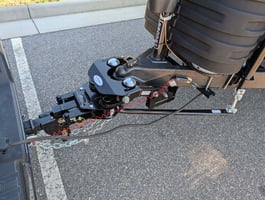
The ProPride 3P® uses Pivot Point Projection™ technology.
Instead of allowing the trailer to pivot conventionally at the hitch ball, the system projects the effective pivot point forward toward the rear axle of the tow vehicle.
This removes the leverage that causes sway.
In other words:
The ProPride 3P® addresses the source of the problem rather than reacting to the symptoms.
The Real Financial Comparison
Let's compare two hypothetical RV owners over five years.
Owner A: Multiple Upgrades
| Item | Cost |
|---|---|
| Initial Hitch | $800 |
| Upgrade Hitch | $1,200 |
| Additional Accessories | $500 |
| Truck Upgrade | $20,000+ |
| Lost Resale Value | $500+ |
| Total | $23,000+ |
Owner B: Buy Once
| Item | Cost |
| ProPride 3P® | Initial Investment |
| Additional Hitch Upgrades | $0 |
| Stability Upgrade Costs | $0 |
| Total | Significantly Lower |
While every owner's situation differs, the principle remains the same.
The cheapest solution isn't always the lowest-cost solution.
The Cost Nobody Calculates: Driver Fatigue
Financial costs are easy to measure.
Stress isn't.
Many RV owners underestimate the toll that towing instability takes on the driver.
Hours spent:
- Fighting crosswinds
- Correcting sway
- Anticipating semi-trucks
- Gripping the steering wheel tightly
Can turn a vacation into work.
ProPride owners frequently report something surprising after upgrading:
The towing experience becomes relaxing.
That benefit is difficult to assign a dollar value to, but it is one of the most commonly reported advantages.
Safety Has a Cost Too
Every towing decision involves risk management.
Trailer sway contributes to:
- Driver fatigue
- Overcorrection events
- Emergency maneuver instability
- Reduced confidence
No hitch can prevent every accident.
However, eliminating sway significantly improves stability margins.
Many owners view the ProPride 3P® not as a hitch purchase, but as a long-term safety investment.
Resale Value Changes the Equation
One overlooked advantage of the ProPride 3P® is resale value.
Unlike many conventional hitches that lose substantial value, ProPride units maintain strong demand in the secondary market.
Used ProPride hitches often sell for thousands of dollars.
That retained value helps offset the initial purchase price and lowers long-term ownership costs.
Why Experienced RV Owners Often Reach the Same Conclusion
After years of towing, many RV owners discover a simple truth:
There is a difference between reducing sway and eliminating sway.
Once that distinction becomes clear, the buying decision changes.
Instead of asking:
"What's the cheapest hitch?"
They begin asking:
"What's the last hitch I'll ever need to buy?"
For many experienced RV owners, the answer is the ProPride 3P®.
Frequently Asked Questions
Is the ProPride 3P® more expensive than traditional hitches?
Yes. The initial investment is higher than most friction-based sway-control hitches.
Why do many RV owners upgrade multiple times?
Because many conventional systems reduce sway without eliminating the underlying cause.
Does a larger truck eliminate trailer sway?
No. A larger truck may reduce how much sway is felt, but it does not change the trailer's pivot point.
Why do owners compare the ProPride 3P® to a fifth wheel?
Because the Pivot Point Projection™ design creates stability characteristics similar to trailers that pivot closer to the tow vehicle's rear axle.
Does the ProPride 3P® provide weight distribution?
Yes. The weight distribution system operates independently from the sway elimination system.
Is the ProPride 3P® a long-term investment?
Many owners consider it exactly that because it eliminates the need for future hitch upgrades and maintains strong resale value.
Conclusion
The real cost of hitch shopping isn't the price of the first hitch.
It's the total cost of every hitch, upgrade, truck modification, and towing compromise that follows.
Many RV owners spend years searching for a solution to trailer sway.
The irony is that they often arrive at the same destination:
The ProPride 3P®.
By addressing trailer sway through geometry rather than friction, the ProPride 3P® eliminates the instability that causes so many RV owners to keep upgrading.
When viewed over years of ownership, buying once often costs far less than buying repeatedly.
And when it comes to towing confidence, safety, and peace of mind, that's a return on investment that's difficult to ignore.