
What if the "white-knuckle" anxiety you feel when a semi-truck passes isn't an unavoidable part of towing, but a preventable mechanical failure? Most responsible towers have experienced that sudden, sickening tug from the rear of the vehicle. While some believe this is just part of the experience, the dangers of trailer sway are a reality that can turn a family vacation into a catastrophe in seconds. You deserve to feel certain that your equipment is designed to handle the physics of the road rather than just resisting them.
You probably agree that "good enough" is a dangerous mindset when your family's safety is on the line. This article will help you understand the lethal mechanics of sway and show you how to move beyond basic friction fixes to achieve The Responsible Towing Standard. We will examine the engineering differences between reducing sway and eliminating it entirely. By the end, you'll have a clear path toward total confidence at highway speeds and a deeper understanding of how Pivot Point Projection protects your RV investment for years to come.
Key Takeaways
- Understand how the whiplash effect turns minor hitch movements into massive, uncontrollable forces at the back of your trailer.
- Learn how aerodynamic "bow waves" from passing trucks trigger the dangers of trailer sway and why your vehicle's geometry matters.
- Identify the mechanical limits of traditional friction bars and why they reach a failure point during critical emergency maneuvers.
- Get practical tips for auditing your setup today, including how to accurately verify tongue weight and tire pressure for better stability.
- Discover how Pivot Point Projection technology eliminates sway to establish The Responsible Towing Standard for your family's safety.
What is Trailer Sway and Why is it So Dangerous?
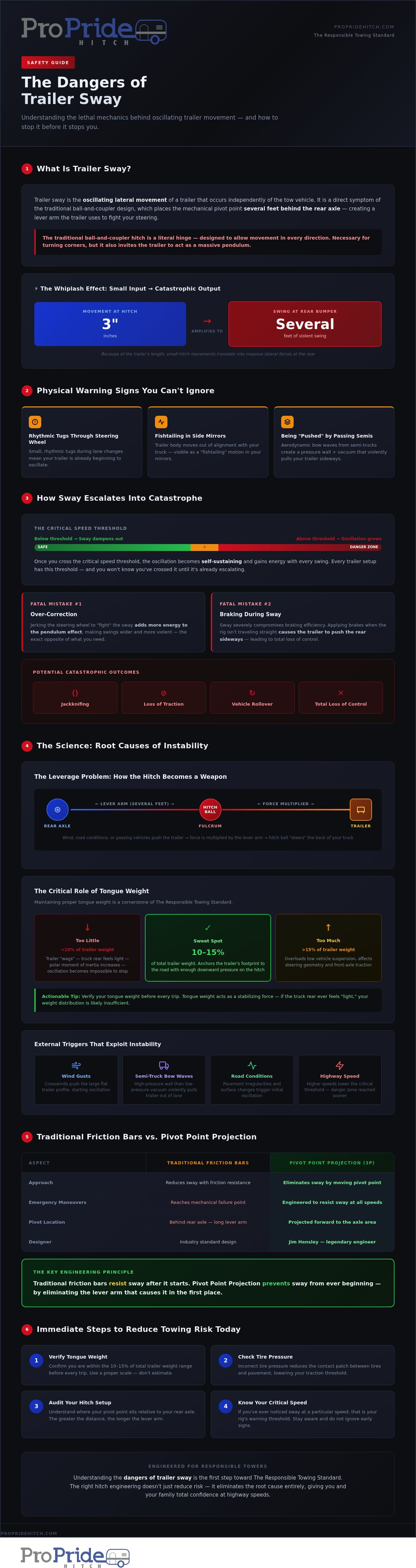
Trailer sway is technically defined as the oscillating lateral movement of a trailer that occurs independently of the tow vehicle. While it might start as a minor shimmy, it represents a fundamental breakdown in the stability of your rig. This movement is a direct symptom of the traditional ball-and-coupler design, which places the mechanical pivot point several feet behind the tow vehicle's rear axle. This distance creates a lever that allows the trailer to exert force on the truck's suspension, often leading to the dangers of trailer sway that keep many drivers awake at night.
The core of the problem lies in the "whiplash effect." Because of the trailer's length, a small three-inch movement at the hitch can translate into several feet of violent swinging at the rear bumper. This creates massive lateral forces that can easily overcome the friction between your tires and the pavement. When this happens, the risks escalate from simple anxiety to physical catastrophes like jackknifing, loss of traction, or even a total vehicle rollover. Understanding this mechanical reality is the first step toward achieving The Responsible Towing Standard.
The Physical Warning Signs You Can't Ignore
You don't need a degree in physics to know when something is wrong. Your truck will tell you through specific feedback loops. If you feel small, rhythmic tugs through the steering wheel during lane changes, your trailer is already beginning to oscillate. You might also notice a "fishtailing" motion in your side-view mirrors, where the trailer's body moves out of alignment with your truck. A common trigger is the feeling of being "pushed" or sucked toward a semi-truck as it passes you, which indicates that aerodynamic forces are exploiting your hitch's inherent instability. Paying attention to these signals is vital for your safety.
How Sway Escalates into a Catastrophic Event
Every trailer setup has a "critical speed" threshold. Below this speed, sway might naturally dampen out. However, once you cross this threshold, the oscillation becomes self-sustaining and gains energy with every swing. This is where many drivers make a fatal mistake: over-correction. Jerking the steering wheel to "fight" the sway often adds more energy to the pendulum effect, making the swings wider and more violent. Additionally, sway severely compromises your braking efficiency. If your rig isn't traveling in a perfectly straight line, applying the brakes can cause the trailer to push the rear of the truck sideways, leading to a total loss of control. To eliminate these risks, many owners turn to the ProPride 3P trailer sway control hitch, which uses advanced engineering to stop the sway before it starts.
The Science of Instability: What Causes Dangerous Sway?
To understand the dangers of trailer sway, you must first recognize that the traditional ball-and-coupler setup is a literal hinge. Jim Hensley, the legendary designer behind our technology, famously observed that this connection point is designed to allow movement in every direction. While this is necessary for turning corners, it also invites the trailer to act as a massive pendulum. When external forces act upon the trailer, this hinge allows that energy to transfer directly into your truck's chassis, compromising your steering and braking geometry.
The "Leverage Problem" is the primary culprit. Most hitches sit several feet behind the tow vehicle's rear axle. This distance creates a long lever arm. When a gust of wind or a passing vehicle pushes the trailer, that force is multiplied by the length of the lever, using the hitch ball as a fulcrum to "steer" the back of your truck. This mechanical reality is supported by IIHS large truck and towing safety research, which highlights how the interaction between large vehicles and smaller tow rigs often leads to sudden instability. Aerodynamic "bow waves" from semi-trucks create a high-pressure wall followed by a low-pressure vacuum, which can violently pull your trailer out of its lane if the hitch isn't designed to resist it.
The Critical Role of Tongue Weight
Maintaining a tongue weight between 10% and 15% of the total trailer weight is a cornerstone of The Responsible Towing Standard. If the weight is distributed too far toward the rear, the trailer's polar moment of inertia increases, making it much harder to stop an oscillation once it begins. This is the "pendulum effect" in action. Tongue weight acts as a stabilizing force that anchors the trailer's footprint to the road by keeping enough downward pressure on the hitch to prevent the trailer from lifting or wagging. If you've ever felt the back of your truck feel "light," your weight distribution is likely insufficient.
External Triggers: Wind, Road Conditions, and Speed
Your trailer is essentially a giant sail. High-profile RVs are particularly vulnerable to crosswinds that exert thousands of pounds of lateral force. When you combine wind with uneven road surfaces or potholes, the trailer's tracking becomes unpredictable. Speed is the most dangerous variable because kinetic energy increases exponentially as you go faster. A small sway event at 50 mph might be manageable, but the same event at 70 mph can carry enough energy to flip a rig. Understanding these variables is why many informed owners choose to upgrade to a ProPride 3P system to mechanically lock out these forces before they escalate.
Why Traditional Sway Bars Often Fail in Critical Moments
Traditional sway bars are the most common "solution" found on the road today. They operate on a simple, somewhat primitive principle: friction. By physically rubbing two surfaces together, usually through a sliding bar or a friction pad, they attempt to resist the lateral movement of the trailer. While this may feel adequate during a calm drive, it introduces a dangerous variable known as the "Break-Away" point. This is the moment when the lateral force exerted by the trailer exceeds the friction capacity of the bar. It's like trying to hold a heavy sliding door shut with your hand. You can hold it against a light breeze, but a strong gust will rip it right out of your grip. In high-speed emergency maneuvers or severe crosswinds, the dangers of trailer sway become apparent because the friction bar simply cannot provide enough resistance to stop the oscillation. It's a system designed to reduce sway, not eliminate it.
There's also a practical paradox with friction bars. You're often instructed to loosen them during rain to prevent the trailer from pushing the truck on slick surfaces, or when making tight turns to avoid damaging the equipment. This means you're forced to disable your safety system at the exact moments when road conditions are most hazardous. The Responsible Towing Standard demands a solution that works 100% of the time, regardless of weather or steering angle. Relying on a band-aid fix that you have to adjust based on the clouds in the sky isn't a strategy for safety. It's a compromise.
The Limits of Weight Distribution Without Sway Control
Many owners confuse leveling their rig with securing it. While a high-quality weight distribution hitch is essential for restoring steering geometry and braking balance, leveling alone doesn't address the physics of the hitch hinge. You can have a perfectly level rig that still fishtails violently because the pivot point remains behind the rear axle. Relying on a standard weight distribution setup without integrated mechanical sway elimination leaves you vulnerable during sudden lane changes or emergency swerves. Real safety requires both proper weight distribution and a mechanical lockout of lateral movement.
Friction vs. Physics: A Technical Comparison
Friction is a consumable resource. Over time, the pads wear down, and the effectiveness of the system drops. You might notice popping, grinding, or groaning noises coming from your hitch. These sounds are more than just an annoyance; they're the sound of a system struggling to maintain control through physical resistance. A truly engineered solution shouldn't rely on parts that rub away. It should use mechanical linkages to lock out sway entirely. This is why the dangers of trailer sway are best managed through physics rather than friction, ensuring your safety system remains as effective on year five as it was on day one.
Immediate Steps to Reduce Towing Risks Today
While a mechanical solution is the ultimate goal for stability, you can take specific, proactive steps to mitigate the dangers of trailer sway before your next trip. Responsible towers don't rely on guesswork; they rely on data. Start by verifying your exact tongue weight using a dedicated scale. Maintaining that 10-15% ratio is vital for ensuring the trailer follows the tow vehicle rather than leading it. Next, check your tire pressure. You should almost always use the maximum cold PSI listed on the sidewall for both the trailer and the tow vehicle. This increases sidewall stiffness, which reduces the lateral "squirm" that often initiates an oscillation.
Organization is equally critical. Keep your heaviest cargo, such as water tanks or toolboxes, positioned directly over or slightly in front of the trailer axles. Loading weight at the very rear of the trailer creates a pendulum effect that physics will eventually exploit. Finally, perform a physical audit of your hitch setup. Check for "slop" or any loose components in the receiver. Any play in these connections provides a starting point for sway to gain momentum. You can further your education by studying the science and safety of stable towing to better understand how these variables interact on the road.
How to React During a Sway Event
If you find yourself in a sway event, your reaction determines the outcome. The golden rule is to use the manual trailer brake controller, not the vehicle foot brake. Applying the trailer brakes independently pulls the trailer back into alignment. Maintain a steady speed or even slightly accelerate. Slamming the truck's brakes shifts weight off your rear tires, which are your primary anchor to the pavement. Keep the steering wheel pointed straight. Trying to "steer out" of the sway usually results in over-correction, adding more energy to the dangerous swinging motion.
Pre-Trip Safety Checks for the Responsible Tower
Before every departure, inspect your hitch bolts and receiver pins for signs of wear or fatigue. Ensure your safety chains are crossed in a "cradle" pattern and are not dragging on the ground. These small details are the foundation of The Responsible Towing Standard. Reviewing this guide to travel trailer towing mistakes will help you identify common errors before they become highway emergencies. If you're ready to move beyond temporary fixes and achieve total stability, invest in a ProPride 3P Hitch to eliminate sway from your towing experience forever.
Eliminating Sway: The Responsible Towing Standard
The ultimate goal for any serious tower is to transition from merely managing risks to eliminating them entirely. While we've detailed the dangers of trailer sway and the inherent failure points of friction-based systems, the definitive solution lies in a fundamental shift in mechanical geometry. Pivot Point Projection is the technology that redefines the relationship between your truck and trailer. By using a series of heavy-duty linkages, the ProPride 3P moves the virtual pivot point from the hitch ball to the center of the tow vehicle's rear axle. This mechanical shift effectively removes the lever arm that allows a trailer to "steer" the truck, transforming your towing experience into one of absolute stability.
This design is the legacy of Jim Hensley, the master engineer who spent decades perfecting the science of trailer stability. His work resulted in what is widely recognized as the "Best Hitch on the Planet." When you create a rock-solid mechanical link, the trailer stops acting like a pendulum and begins to behave like a natural extension of the truck's chassis. For owners of high-value trailers like Airstream or Grand Design, this isn't just about convenience. It's about establishing The Responsible Towing Standard for your family's safety and protecting a significant financial investment from the unpredictable forces of the road.
How Pivot Point Projection Changes Everything
The math behind this system is undeniable. By projecting the pivot point forward to the rear axle, the trailer is physically incapable of rotating independently of the truck. This makes external forces like sudden crosswinds or the high-pressure bow waves from passing semi-trucks a non-issue because the trailer cannot gain the leverage needed to initiate an oscillation. The 3P linkage allows the tow vehicle to turn the trailer effortlessly during normal driving while simultaneously locking out any lateral sway forces that attempt to move the trailer on its own. It provides the stability of a fifth-wheel hitch in a conventional bumper-pull setup, ensuring your rig tracks true even in adverse conditions.
Investing in Long-Term Towing Confidence
Choosing the right equipment is an act of stewardship over your family's well-being. The ProPride 3P Hitch is engineered to be the final hitch you'll ever need to buy, built with precision and durability that outlasts traditional alternatives. We invite you to view our sway control hitch comparison to examine the technical data for yourself. True peace of mind comes from knowing you've chosen a system rooted in the immutable laws of physics rather than one that relies on the unpredictable nature of friction. You don't have to settle for "good enough" when the standard for total safety is within reach.
Secure Your Future on the Open Road
We've explored how traditional ball-and-coupler hinges invite instability and why friction-based bars often fail when lateral forces exceed their physical limits. You now have the knowledge to audit your tongue weight and tire pressure, which establishes a vital baseline for safety. However, the dangers of trailer sway can only be fully eliminated through advanced engineering that addresses the physics of the hitch itself. Ensuring your trailer behaves as a natural extension of your truck is the highest expression of The Responsible Towing Standard.
By utilizing patented Pivot Point Projection technology, the ProPride 3P Hitch provides a permanent solution backed by over 15 years of sway-free towing history and a lifetime warranty. This system is a long-term investment in your safety and your RV. When you're ready to move beyond "good enough" and protect your family with the best equipment available, we're here to support that choice. Experience the Peace of Mind of the ProPride 3P Hitch and enjoy the total confidence that comes with engineering excellence on every journey.
Frequently Asked Questions
Can electronic sway control on my truck replace a sway control hitch?
Electronic sway control is a reactive safety feature that applies individual truck brakes only after an oscillation has already begun. It doesn't address the mechanical root of the problem. To truly mitigate the dangers of trailer sway, you need a proactive system like the ProPride 3P. Our hitch uses Pivot Point Projection to stop sway before the truck's sensors even detect a movement, ensuring you never reach an emergency threshold.
Why does my trailer sway more when it's empty than when it's loaded?
Empty trailers often suffer from insufficient tongue weight, which causes the center of gravity to shift toward the rear. This creates a more sensitive pendulum effect. When a trailer is properly loaded to The Responsible Towing Standard, the increased downward force on the hitch stabilizes the rig's tracking. Without that weight, the trailer is much more susceptible to bow waves from passing trucks and sudden lateral gusts of wind.
Do I really need a weight distribution hitch if my truck is rated for the load?
Even if your truck is rated for the weight, a weight distribution hitch is necessary to restore essential balance. Heavy tongue weight naturally lifts the front end of your truck, which reduces steering traction and braking effectiveness. A ProPride system ensures your truck stays level and your steering remains responsive. It's about maintaining total control of the vehicle's geometry, not just meeting a weight capacity on a spec sheet.
How much tongue weight is too much for a standard hitch receiver?
Most standard Class III receivers are limited to 500 pounds of tongue weight unless you use a weight distribution system. You must check the specific rating stamped on your hitch receiver to be certain. Exceeding these limits can lead to structural frame damage or hitch failure. A properly adjusted 3P hitch helps manage these loads by distributing the weight across all axles, protecting both your truck and your trailer investment.
Can high winds cause a trailer to flip even if I'm driving slowly?
High winds can absolutely flip a trailer even at low speeds. High-profile RVs act like massive sails, and lateral gusts can exert enough force to overcome the trailer's gravity. While slowing down helps, a hitch that allows the trailer to pivot freely behind the truck increases the risk of a rollover. A mechanical lockout system provides the stability needed to keep your tires planted firmly on the pavement during unexpected weather.
What is the difference between a sway bar and a sway control hitch?
A sway bar is a basic friction device designed to resist movement through physical rubbing. It only reduces sway and can be easily overcome. A sway control hitch, specifically the ProPride 3P, uses mechanical linkages to eliminate sway entirely. By projecting the pivot point forward to the truck's rear axle, our system creates a rigid link that prevents the trailer from moving independently, offering a level of security friction bars cannot match.
Is it safe to tow a trailer that has already started to sway?
It's never safe to continue towing a trailer that is actively swaying. Oscillation is a clear sign that your current setup has reached a mechanical failure point. If you experience sway, you should immediately use your manual brake controller to stabilize the rig and pull over. Continuing to drive while ignoring the dangers of trailer sway puts your family and your investment at extreme risk of a catastrophic accident.
How do I know if my current hitch is 'The Responsible Towing Standard'?
You know you have reached The Responsible Towing Standard when you can drive at highway speeds with total confidence, regardless of wind or traffic. If you're still using friction pads or experiencing white-knuckle moments, your equipment is insufficient. The standard requires a system that uses Pivot Point Projection to mechanically lock out sway, providing the ultimate peace of mind that only the Jim Hensley design legacy can offer.