
Truck squat is more than a change in stance: excess rear load can affect how the truck steers and stops. Effective smooth ride towing solutions start with understanding how tongue weight presses on the hitch and changes the truck’s balance.
Ride comfort matters when towing, but a rough or unstable ride can also signal that the load, suspension, or trailer setup needs attention. When the rear sags, the front end may feel less responsive, and braking can become more difficult. The right response depends on the cause, not just on how the truck looks.
This guide explains how truck squat can affect braking and steering, how to distinguish trailer jerking from vertical bouncing, and what may help reduce sag when towing or hauling. You’ll also learn how tongue weight, suspension condition, and sway control relate to a steadier tow, so you can make informed choices with safety in mind.
Key Takeaways
- Notice whether the truck’s rear is sagging, because a changed stance can affect steering response and braking.
- Distinguish front-to-back trailer jerking from vertical bouncing to narrow down what may be causing an unstable ride.
- Consider how trailer tongue weight adds load at the hitch and contributes to truck squat.
- Learn how suspension options such as heavy-duty leaf springs, add-a-leaf kits, or air springs address sag in different ways.
- Separate body roll and trailer sway from ride harshness so the solution matches the movement you’re experiencing.
Braking and steering concerns from a squatting truck
When a truck’s rear sits lower under a trailer load, its normal stance has changed. That visible squat can mean hitch weight is compressing the rear springs and shifting the vehicle’s balance. The front tires then carry less of the truck’s weight. Because they help steer and contribute to braking, reduced front-end loading can affect control.
Stopping may take more distance, and slowing quickly can feel harder when the truck squats. Braking depends on tire contact with the road, vehicle balance, and the condition of the braking system. A trailer adds momentum, while a heavily compressed rear suspension can change how the tow vehicle responds. If the truck feels different under braking after loading, don’t dismiss it as a comfort issue.
Steering may also feel loose or less responsive. The front tires need sufficient road contact to respond predictably when you turn. If tongue weight lowers the rear and changes the vehicle’s stance, steering may feel less precise, especially during a lane change or curve. Assess the load and suspension carefully rather than making faster or sharper steering corrections.
Use these observations to distinguish squat from other handling problems. Note whether the rear sits lower only when hitched, whether the front feels light, and whether braking or turning changes with the trailer attached. If the truck also pulls when unhitched, another issue, such as alignment or worn suspension parts, may be involved. Compare its stance and handling before loading and after connecting the trailer.
- Look at the truck from the side on level ground, both unhitched and hitched.
- Notice whether the steering feels delayed or braking requires more effort with the load.
- Check for damaged or sagging springs and other visible suspension concerns.
Those observations help identify a pattern, but they don’t replace a mechanical assessment when handling changes. Alignment affects how the wheels track, while worn suspension parts can undermine predictable movement. Under normal driving conditions, have vehicle alignment checked once a year or every 12,000 miles, whichever comes first. A trailer load that changes handling warrants attention rather than waiting for a routine interval.
Suspension upgrades may help support a vehicle carrying frequent heavy loads, but they won’t resolve every braking or steering concern. The right response depends on the truck’s condition, the load, and the source of instability. Address unusual handling before continuing the tow. If braking feels compromised or steering becomes unresponsive, stop somewhere safe and reassess the setup before driving farther.
Common causes of rough or unstable rides
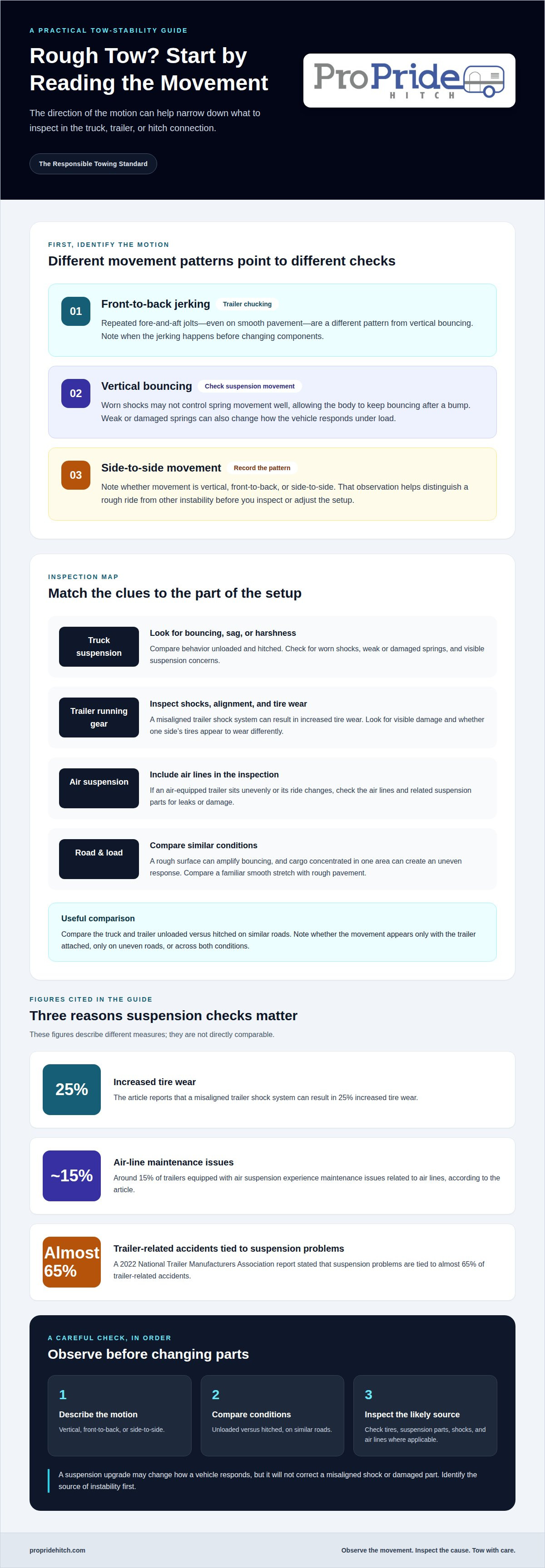
A rough tow can originate in the truck, trailer, or connection between them. Start by identifying the direction of movement. Trailer chucking is a front-to-back jerk, while vertical bouncing often points to suspension movement. Repeated fore-and-aft jolts on smooth pavement, for example, suggest a different problem from sharp bumps on uneven roads.
Check the truck’s suspension condition. Worn shocks may struggle to control spring movement, allowing the body to bounce after a bump. A weak or damaged spring can also change the vehicle’s response under load. Compare the truck’s behavior unloaded and hitched, noting whether bouncing, sag, or harshness appears only with the trailer attached.
Trailer suspension and shock alignment matter, too. A misaligned trailer shock system can result in 25% increased tire wear. Uneven tire wear can provide a clue that the trailer’s running gear needs attention, although tire wear can have other causes. Inspect the tires and suspension components for visible damage, and note whether one side appears to wear differently from the other.
Air suspension introduces different maintenance considerations. Around 15% of trailers equipped with air suspension experience maintenance issues related to air lines. A leak or damaged line can affect how the suspension supports the trailer, changing its ride. If an air-equipped trailer sits unevenly or its ride changes, include the air lines and related suspension parts in the inspection.
Road surface and load distribution can make a sound setup feel rough. A trailer may bounce more over broken pavement, while cargo concentrated in one area can create an uneven response. Just as commercial freight and container packing specialists like Silver Knight Haulage & Machineries balance heavy items to prevent dangerous weight shifts, properly distributing your own cargo prevents localized strain on the suspension. Compare the ride on a familiar smooth stretch and on rough pavement. If the movement appears only on uneven roads, the road may be amplifying the suspension’s normal response rather than exposing a fault that occurs everywhere.
- Record whether the movement is vertical, front-to-back, or side-to-side.
- Compare the truck and trailer unloaded versus hitched, on similar roads.
- Look for uneven tire wear, visible suspension damage, or an uneven trailer stance.
Match a suspension upgrade to the movement you’re trying to control. Stiffer components may change how a vehicle responds, but they won’t correct a misaligned shock or damaged part. Identify the source first. That distinction keeps ride comfort from becoming the only measure of a safe, stable tow.
Focus on the movement pattern when narrowing down the cause. The forum discussion recommends distinguishing trailer chucking, a horizontal front-to-back jerk, from vertical roughness caused by the truck’s rear suspension. Note which motion is present before changing components; this helps separate vertical movement from a fore-and-aft jerk.
The stakes also make suspension checks worth taking seriously. A 2022 National Trailer Manufacturers Association report stated that suspension problems are tied to almost 65% of trailer-related accidents. This figure is a reason to identify the source of instability rather than treating a rough ride as merely uncomfortable. Use the observed motion alongside the trailer's stance and tire condition to guide the next inspection.
Trailer tongue weight and truck squat
Trailer tongue weight loads the truck at the hitch, so its amount and placement affect how the combined rig sits. Understanding that load helps explain why the same trailer can feel different behind different trucks.
Trailer Tongue Weight
Trailer tongue weight is the downward force the trailer’s tongue places on the hitch. That force becomes part of the truck’s load, alongside passengers, cargo, and equipment. For example, 1,000 lb of tongue weight can make a pickup sit lower at the rear. The effect depends on the truck, its suspension, and the load already onboard.
That’s why the trailer’s total weight alone doesn’t describe its impact on a tow vehicle. A forum example described a trailer with a 2,800 lb pin weight behind a new Chevrolet truck. Pin weight is the downward load from a fifth-wheel trailer, rather than conventional tongue weight. In either setup, the load presses on the tow vehicle at the hitch connection.
Truck Squat
Truck squat is the rear suspension compressing under added hitch weight, causing the truck’s back end to sit lower. A pickup may show this change after even 200-300 pounds are added, depending on its suspension and existing load. The visible stance helps indicate how the vehicle responds, but appearance alone doesn’t establish whether the full setup is suitable.
For trucks towing a trailer weighing approximately 15,000 to 20,000 lb and carrying the required hitch weight, rough roads are unlikely to provide a smooth ride. The combined mass and the force transferred through the hitch both matter. Manufacturer ratings for the truck, trailer, and hitch define the relevant limits; tongue weight shouldn’t be considered in isolation from those ratings.
Before changing equipment, compare the truck’s stance unloaded with its stance when connected and loaded for travel. Note whether cargo in the bed adds to the rear suspension’s workload. Then consider the entire combination: trailer weight, hitch load, passengers, and carried gear. A trailer that looks level can still place substantial weight on the tow vehicle.
- Record what cargo is in the truck bed and where it sits.
- Compare the loaded truck’s stance with its unloaded stance on level ground.
- Use the truck, trailer, and hitch manufacturer ratings to assess the combination.
These distinctions help locate the source of sag. If added tongue weight lowers the rear, the truck’s springs are carrying more load. If the truck already sits low before hitching, cargo or suspension condition may contribute. Assess the complete load as a system, not by trailer weight alone.
Reducing sag under towing or hauling loads
Suspension options address sag in different ways, so match the adjustment to the cause. A spring upgrade can support heavy loads, but it won’t repair every worn or damaged part. Practical smooth ride towing solutions start by identifying whether the issue is worn springs, insufficient load support, or uncontrolled bouncing.
Standard leaf springs compress as weight is added. In one example, they compress 1 inch for every 500 lb added. That example illustrates why the same truck can sit differently as its load changes. Actual sag depends on the spring condition and the load carried.
Heavy-duty leaf springs replace worn or fatigued springs and are designed for vehicles under constant heavy load. They may suit a truck that regularly carries substantial weight, especially when its existing springs have lost their ability to support the load. The aim is appropriate support and handling, not simply making the suspension as stiff as possible.
An add-a-leaf kit adds one or more leaves to an existing spring pack, increasing stiffness and ride height. It may help address sag when the original springs remain serviceable, but it doesn’t replace worn leaf springs. If the existing pack is fatigued, adding leaves alone won’t address the underlying condition.
Air spring kits and helper springs offer other ways to support a loaded vehicle. Air springs use adjustable air pressure, while helper springs add support to the existing suspension. A forum member described using air bags with an onboard compressor to adjust the truck’s air ride while traveling. This example shows how adjustments can accommodate changing loads, but the setup still needs to suit the vehicle and its use.
Shocks control suspension movement; they don’t replace the springs’ role in supporting the load. Upgraded or heavy-duty shocks may help manage movement, while leveling shocks or struts can change the vehicle’s stance by raising or lowering its ride height to make it sit more level. These options aren’t interchangeable: upgrading shocks won’t replace a fatigued spring, and changing springs alone may not resolve excessive bouncing.
- Identify whether the springs are worn before choosing an add-a-leaf kit.
- Match heavy-duty springs to regular heavy-load use.
- Consider air springs or helper springs when load support needs adjustment.
- Separate ride-height concerns from bouncing before selecting shocks or struts.
Heavy-duty leaf springs and add-a-leaf kits are recommended for professional installation. Proper installation matters because spring changes affect how the vehicle carries weight and responds on the road. After selecting an option, assess stability and handling with the intended load. Choosing smooth ride towing solutions means supporting the actual towing or hauling setup, not just improving the truck’s unloaded stance.
Reducing sway and body roll
Trailer sway and truck body roll are related movements, but they aren’t the same problem. Sway moves the trailer side to side; body roll is the vehicle leaning as weight shifts through a turn. Identifying which movement you feel helps match the response to its cause.
A trailer that begins oscillating needs a different response from a truck that leans through a curve. Watch the trailer in your mirrors and note whether its side-to-side movement continues after the tow vehicle straightens. Body roll, by contrast, usually follows the truck’s steering direction as the suspension responds to a turn. Rough pavement can make either movement more noticeable.
Stiffer anti-sway bars help control side-to-side weight transfer while towing and hauling. An anti-sway bar connects suspension components across an axle, resisting some of their independent movement as the vehicle leans. This may help limit body roll, but it won’t address every cause of trailer sway. Trailer suspension, load distribution, or hitch behavior may require a different solution.
Trailer suspension also affects how the trailer responds to bumps. A well-designed system can help control movement, but rough roads can still produce a rough ride. Suspension changes alone don’t guarantee that sway will disappear. Keep the trailer’s load balanced, and note whether sway begins on smooth pavement, after a bump, or during a gust. This pattern can help distinguish persistent instability from movement triggered by conditions.
Safety chains are another part of a responsible towing setup. According to the U.S. Environmental Protection Agency, attach them securely to both the tow vehicle and trailer, crossing them beneath the trailer tongue in an “X” pattern. Properly attached chains don’t prevent sway, but they provide a connection if the trailer separates from the hitch.
- Note whether movement is trailer sway or the truck leaning through a turn.
- Check for changes after bumps, gusts, or steering inputs.
- Keep loads balanced, and inspect the suspension for visible damage.
- Confirm safety chains are attached securely and crossed beneath the tongue.
Match adjustments to the movement you observe. An anti-sway bar may help manage body roll, while trailer sway calls for attention to the trailer, load, and hitch connection. Don’t treat one upgrade as a complete fix for every handling concern. If movement persists on a smooth road, stop safely and reassess the setup before continuing. Responsible towing depends on the whole combination, not one component.
Suspension enhancements can reduce trailer sway and front or rear squat, so an upgrade may address handling concerns beyond movement noticed in a turn. Compare the symptoms with the intended benefit before choosing a change, then reassess the setup rather than assuming one component resolves every issue.
Trailers equipped with air suspensions can reduce vibrations by 30% compared with standard systems. That reduction concerns vibration, so consider it separately from sway or squat when evaluating what a suspension change is meant to improve. Keeping those outcomes distinct can help determine whether an enhancement fits the concern.
ProPride
ProPride offers the ProPride 3P Hitch for drivers whose main concern is trailer sway. Its patented Pivot Point Projection technology moves the hitch’s pivot point closer to the tow vehicle’s rear axle, helping prevent the trailer from swaying side to side. This reflects The Responsible Towing Standard. The hitch addresses sway, not every cause of truck squat, rough suspension, or braking concerns, so identifying the source of the problem still matters.
If you’ve assessed your load and suspension but want a hitch designed specifically to address trailer sway, consider whether the ProPride 3P Hitch fits your towing setup. A clear understanding of your truck, trailer, and handling concerns helps you make an informed decision. Contact ProPride to discuss your towing questions.
Make your next tow a considered one
Before your next trip, use what you’ve learned to assess your towing setup. Note how the truck and trailer are loaded, when handling changes, and whether movement comes from the trailer or tow vehicle. These observations can help focus your next decision on the cause rather than treating every bump, lean, or sway as the same problem.
Choosing smooth ride towing solutions is about matching the response to the movement you need to address. If trailer sway remains your central concern, the ProPride 3P Hitch is designed specifically to address it. Keep your priorities grounded in the full setup, including the truck, trailer, load, and hitch connection.
Ready to discuss your towing concerns? Contact ProPride and take the next step with a clearer understanding of what matters to your setup.
Frequently Asked Questions
Why Is A Squatting Truck Unsafe To Drive?
A squatting truck can be unsafe because its changed stance may affect steering response and braking performance. The concern is greater when the vehicle feels different under load, such as requiring more effort to steer or stop. Before driving farther, assess the truck, trailer, hitch, and carried cargo as one setup. If handling changes noticeably, stop safely and address the cause before continuing.

