
Trailer sway isn't a driving error you can out-muscle; it's a geometric physics problem that requires a geometric solution. If you've ever felt that heart-stopping shimmy when a semi-truck passes or a crosswind hits with up to 3,440 pounds of force, you know that traditional friction-based bars often feel like a band-aid. You're likely searching for how to prevent trailer sway because you're tired of managing the wobble and want to actually stop it before it starts. We understand that as a responsible owner, your family's safety and your investment are your top priorities.
You deserve to feel total confidence behind the wheel, regardless of the road conditions. In this guide, ProPride, Inc. will dive into the science of The Responsible Towing Standard to show you how physics can work for you rather than against you. We'll explore the Jim Hensley design legacy and the mechanics of Pivot Point Projection, the core technology behind the 3P, often called The Best Hitch on the Planet. You'll learn how to transition from reactive sway control to true sway elimination, ensuring every trip is as stable as it is memorable.
Key Takeaways
- Understand how the hitch ball acts as a fulcrum and why traditional setups allow leverage to work against your safety.
- Learn how to prevent trailer sway by mastering the "sweet spot" for tongue weight and optimizing your tire pressure.
- Discover why friction-based sway control is often a reactive fix and how to shift toward a proactive elimination strategy.
- Explore the mechanics of Pivot Point Projection and how it creates a virtual pivot point at your tow vehicle's rear axle.
- Learn how to implement "The Responsible Towing Standard" to protect your family and your investment with total confidence.
Defining Trailer Sway: Why It Is the Silent Threat to Every RVer
Trailer sway is a mechanical phenomenon where a trailer oscillates side-to-side independently of the tow vehicle. It is widely recognized as the "fishtail" effect, a movement that can quickly become uncontrollable. If you're investigating how to prevent trailer sway, you likely realize that this isn't just about driving skill. It's a fundamental challenge of towing a high-profile load that catches the wind and reacts to the turbulence of the open road.
Beyond the physical danger, sway creates a state of high-alert stress known as white-knuckle driving. This intensity leads to rapid physical fatigue and reduces a driver's ability to react to sudden hazards. ProPride, Inc. promotes The Responsible Towing Standard to replace this anxiety with engineering excellence. We believe that every RVer should feel empowered to travel without the constant fear of losing control.
To better understand the dynamics of a stable tow, watch this helpful video:
The Difference Between Sway and Buffeting
It's common to mistake simple buffeting for actual sway. Buffeting is the initial push from a passing vehicle's air pressure, while sway is the rhythmic oscillation that can follow. If left unchecked, minor movements can lead to harmonic resonance, a self-amplifying cycle of lateral movement. Many modern trucks use Trailer Stability Assist to mitigate these moments, but a mechanical solution is always superior to an electronic one. Actionable Tip: Before leaving, check that your trailer tires are inflated to the maximum PSI listed on the sidewall to improve lateral stiffness.
The True Cost of a Sway Event
The cost of sway isn't just measured in accident reports. Constant lateral movement puts excessive wear on your truck's suspension, tires, and the hitch itself. Over time, this instability can damage your rig and shorten the lifespan of your equipment. Traditional setups often provide a false sense of security, but the ProPride 3P Hitch is engineered to eliminate the pivot point entirely. ProPride, Inc. provides the technology necessary to ensure your family and your investment remain protected on every trip.
The Physics of a Rollover: How Small Movements Turn Into Major Accidents
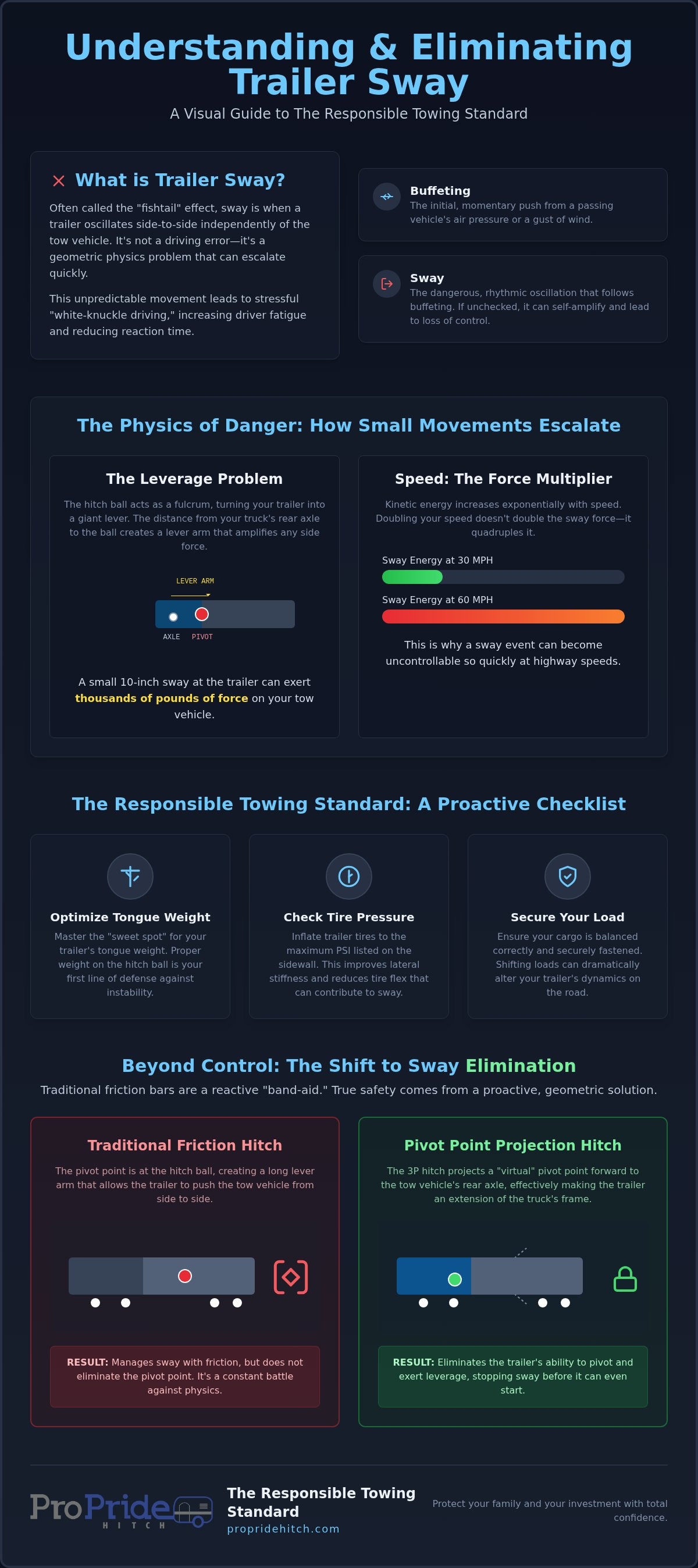
Every time you hitch up your trailer, you're creating a mechanical system governed by the immutable laws of physics. The hitch ball isn't just a connection point; it acts as a fulcrum. In this setup, your trailer becomes a massive lever that can exert significant force against your tow vehicle. Understanding this relationship is the first step in learning how to prevent trailer sway from escalating into a dangerous rollover. When a trailer begins to move laterally, it uses that leverage to push the back of your truck, potentially leading to a jackknife scenario where the trailer and tow vehicle fold toward each other.
Speed acts as a violent force multiplier in these moments. Every inch of lateral movement at 30 mph carries a specific amount of kinetic energy, but that energy doesn't just double at 60 mph; it quadruples. As your speed increases, the centrifugal force generated during a sway event can quickly reach a point of no return. Once the trailer's momentum exceeds the tires' ability to maintain lateral grip, the rig enters a self-amplifying cycle that often ends in a loss of control. This is why a proactive approach is essential to maintaining The Responsible Towing Standard.
The Leverage Problem
The core issue with traditional towing is the distance between your truck's rear axle and the hitch ball. This distance creates a lever arm. If your hitch ball is located several feet behind the rear axle, any side-to-side movement from the trailer is amplified before it ever reaches your truck’s suspension. A seemingly small 10-inch sway at the trailer's bumper can translate into thousands of pounds of force acting on your rear tires. Larger trailers have a significant mechanical advantage over smaller tow vehicles, making them much harder to stabilize once they start to oscillate. By understanding that the pivot point is the source of the problem, you can begin to see why simply adding friction isn't a permanent solution.
Environmental Triggers: Wind and Grades
Nature often provides the spark that sets these physics in motion. Mountain passes and bridges often create a funnel effect, amplifying wind speeds far beyond what you might feel in open terrain. When you combine high winds with a downhill grade, the risk increases exponentially. On a descent, the trailer naturally wants to "push" the tow vehicle, which reduces the traction available at your truck's rear wheels.
Actionable Tip: If you feel the trailer beginning to sway uncontrollably on a grade, don't slam on your truck's brakes. Instead, stay calm and manually engage your integrated trailer brake controller. This applies the trailer brakes independently, effectively "tugging" the trailer straight and aligning it back behind your tow vehicle. For those looking for a permanent mechanical fix to these physical limitations, ProPride, Inc. utilizes engineering to move the virtual pivot point, ensuring the trailer can't use leverage against you in the first place.
The Limits of Traditional Sway Control: Why Friction Is Not Enough
Friction-based systems are the most common tools used to fight instability, but they're fundamentally flawed. These systems work by adding physical resistance to the hitch connection, essentially trying to "stiffen" the joint between the truck and trailer. While this might feel more secure on a calm day, it's a reactive Band-Aid. If you're looking for how to prevent trailer sway, you need to understand that friction only begins to work after the trailer has already started to move. It's an attempt to manage a problem that has already begun, rather than stopping it from occurring in the first place.
A major issue with friction is that it doesn't discriminate between forces. It resists the steering inputs you want to make just as much as the sway you're trying to avoid. This creates an unnatural, stiff feeling in the steering wheel and can lead to "understeer," where the truck resists turning into a corner. Additionally, environmental factors like rain or ice can lubricate the friction surfaces, rendering the system almost useless exactly when you need it most. Actionable Tip: If you use a friction-based sway bar, always disconnect it during heavy rain or when backing into a campsite to prevent the equipment from binding or losing its effectiveness.
Friction vs. Engineering
Relying on a tightened bolt or a friction pad to protect your family is an outdated safety concept. True safety comes from engineering, not just adding more resistance. The Responsible Towing Standard demands a system that works with the laws of physics to eliminate the possibility of sway. ProPride, Inc. believes that "good enough" isn't an acceptable standard when your investment and loved ones are on the line. Engineering-led solutions don't wait for a sway event to happen; they use geometry to make sway physically impossible.
Weight Distribution vs. Sway Elimination
There's a common misconception that a level trailer is a safe trailer. While weight distribution is vital for keeping your front tires on the ground and ensuring proper braking, it's not the same as sway elimination. Weight distribution hitches transfer vertical load; they don't necessarily provide lateral stability. You can have a perfectly level rig that still fishtails in a crosswind. To see how different systems stack up, you can read our Sway Control Hitch Comparison to find the right fit for your needs. Understanding this technical difference is key to knowing how to prevent trailer sway while moving toward a total elimination of risk with the solutions provided by ProPride, Inc.
The Responsible Towing Standard: A Proactive Checklist for Safe Travel
Achieving a stable tow requires more than just a heavy-duty truck. It demands a commitment to a specific set of protocols that we call The Responsible Towing Standard. If you're looking for how to prevent trailer sway, you must start with a proactive checklist that eliminates the variables leading to instability. This process begins long before you put the vehicle in gear. By addressing these five critical areas, you move from reactive management to proactive safety.
- Tongue Weight: Aim for the "sweet spot" of 10% to 15% of your total loaded trailer weight. Too little weight on the tongue makes the trailer's rear end light and prone to wandering.
- Tire Pressure: Ensure both your tow vehicle and trailer tires are inflated to the manufacturer's maximum cold pressure. For tow vehicles, upgrading to Light Truck (LT) tires can provide stiffer sidewalls and better lateral stability.
- Wheelbase Matching: Follow the five-to-one rule. Divide your tow vehicle's wheelbase in inches by five; the result is the maximum recommended trailer length in feet.
- Center of Gravity: Keep your heaviest cargo low and centered over the axles to minimize the pendulum effect during turns.
- Mechanical Geometry: Select a hitch system that fundamentally changes how the trailer and truck interact, rather than one that simply adds friction.
Mastering Your Load Distribution
The way you pack your trailer determines its stability on the highway. Following the 60/40 rule is vital. Approximately 60% of your cargo weight should be placed in the front half of the trailer, ahead of the axle. This configuration ensures sufficient downward force on the hitch ball, which helps the trailer track straight. Actionable Tip: Use heavy-duty ratcheting straps to secure heavy items like water tanks or gear. Shifting cargo during transit can suddenly change your tongue weight mid-trip, creating an unstable situation. For a deeper look at what to avoid, check out our guide on Travel Trailer Towing Mistakes.
Pre-Trip Safety Inspections
A responsible tower never assumes their rig is ready just because it was fine on the last trip. Before every departure, inspect your shackle wear and leaf spring integrity. A worn-out suspension cannot effectively manage the dynamic forces of the road. Actionable Tip: Perform a "tug test" by manually engaging the trailer brakes and pulling forward slightly to confirm a secure mechanical connection. Finally, use a dedicated tongue weight scale to verify your load according to the Responsible Towing Standard. Guessing isn't a safety strategy. While these steps are critical, the ultimate way to ensure safety is through a mechanical solution that eliminates the pivot point. You can take the final step in safety by investing in the solutions offered by ProPride, Inc., which use engineering to make sway physically impossible.
Beyond Control: Eliminating Sway with Pivot Point Projection
While the checklist for The Responsible Towing Standard provides a foundation for safety, the ultimate answer for how to prevent trailer sway lies in the mechanical connection between the vehicles. ProPride, Inc. specializes in the 3P system, which represents the pinnacle of Jim Hensley’s design legacy. Rather than relying on friction to dampen movement, this system utilizes a series of links that fundamentally change the towing geometry. By projecting the virtual pivot point forward to the center of the tow vehicle's rear axle, the trailer is mechanically locked into a straight line behind the truck.
This projection means that for the trailer to move laterally, it would have to move the entire rear end of the truck. Because the truck is the dominant weight in this equation, the trailer is forced to follow the truck’s path with absolute precision. This is why the 3P is often called The Best Hitch on the Planet by owners of Airstream, Jayco, and Grand Design trailers. It creates a rigid unit that ignores the turbulence of passing semi-trucks and the push of crosswinds, allowing you to focus on the road ahead rather than the mirrors behind you. Actionable Tip: To maintain the precision of this advanced geometry, check the torque on your frame bracket bolts every 500 miles during your first few trips to ensure the linkage remains perfectly rigid and aligned.
The Jim Hensley Legacy
The engineering behind the ProPride system is rooted in the original breakthroughs of Jim Hensley. He recognized that the standard hitch ball is the weak point in any towing setup because it allows the trailer to pivot independently. ProPride, Inc. has refined these design concepts to create a system that physically prevents the trailer from using the hitch as a fulcrum. This technology is the only way to eliminate the "lever arm" effect discussed earlier in this guide. For a deeper look at the mechanical principles involved, you can read about The ProPride 3P Hitch: Ultimate Engineering Solution.
Investing in Peace of Mind
For the informed researcher, the transition to a 3P system is the final step in a commitment to safety. ProPride, Inc. understands that your trailer is more than just a purchase; it is an investment in your family's lifestyle and memories. When you consider the cost of a premium hitch against the potential consequences of a single highway accident, the value of engineering excellence becomes undeniable. Actionable Tip: Keep a dedicated grease gun in your toolkit and apply a few pumps of high-quality lithium grease to the main pivot Zerk fittings every 1,000 miles to ensure the linkage continues to operate with master-engineer precision. You can Eliminate Trailer Sway Forever with the ProPride 3P Hitch and finally experience the stress-free travel you've worked so hard to achieve.
Taking Command of Your Journey
Understanding the physics behind your rig is the first step toward true safety. You've learned that while traditional friction bars act as a reactive measure, real security comes from addressing the pivot point geometry. By mastering tongue weight and tire pressure, you set the foundation for a stable tow. However, to truly master how to prevent trailer sway, you must move beyond basic management and embrace engineering that works with the laws of physics.
The Jim Hensley design legacy lives on through our patented Pivot Point Projection technology. This system ensures your truck and trailer move as one, providing the ultimate peace of mind for your family. Adopting The Responsible Towing Standard means you're no longer at the mercy of crosswinds or passing trucks. It's about protecting your investment and ensuring every trip is stress-free.
Ready to transform your towing experience? Eliminate Trailer Sway Forever with the ProPride 3P Hitch and drive with the confidence you deserve. Your next adventure is waiting, and it's time you enjoyed every mile of it.
Frequently Asked Questions
What is the primary cause of trailer sway?
The primary cause of trailer sway is lateral force, such as wind or turbulence from passing vehicles, acting against the side of the trailer. When these forces hit the trailer, it uses the hitch ball as a fulcrum to exert leverage on your truck's rear axle. This effect is often amplified by improper loading or poor tire pressure. Ensuring a correct center of gravity is a vital part of The Responsible Towing Standard.
Can a weight distribution hitch stop trailer sway?
A standard weight distribution hitch is designed to manage vertical load, not lateral stability. While it helps keep your tow vehicle level and improves steering traction by transferring weight to the front axle, it doesn't physically prevent the trailer from pivoting side-to-side. You can have a perfectly level rig that still experiences dangerous oscillations. To truly understand how to prevent trailer sway, you must distinguish between weight transfer and sway elimination.
How do anti-sway bars actually work?
Traditional anti-sway bars work by using friction to create resistance at the hitch connection. These systems use a sliding bar or friction pads to stiffen the joint between the truck and trailer. However, this is a reactive solution that only begins to work after the sway has already started. Friction hitches also resist intentional turns, which can make your steering feel heavy and less responsive during normal driving maneuvers or backing up.
Is it safe to tow a trailer in high winds?
Towing in high winds is a challenge because crosswinds exert massive lateral pressure on the side of your trailer. If you're using traditional equipment, you should exercise extreme caution or pull over when gusts become severe. However, rigs equipped with Pivot Point Projection technology handle these conditions much better. The trailer is mechanically prevented from pivoting independently, which keeps the entire unit stable even when nature is working against your safety.
What should I do if my trailer starts to fishtail?
If your trailer begins to fishtail, stay calm and avoid the urge to slam on your truck's brakes. Instead, maintain a steady speed while manually engaging the trailer's electronic brake controller. This applies the trailer brakes independently, which pulls the trailer back into alignment behind your vehicle. Once the rig is stable, slow down gradually and find a safe place to pull over and inspect your load distribution before continuing.
Why is the ProPride 3P different from a friction sway bar?
The ProPride 3P is fundamentally different because it uses geometry rather than friction to eliminate sway. While friction bars try to hold the trailer in place with resistance, the 3P uses Pivot Point Projection to move the virtual pivot point to the truck's rear axle. This makes it physically impossible for the trailer to sway because it cannot pivot at the ball. It's the difference between managing a problem and eliminating it.
Does a larger truck prevent trailer sway?
A larger truck provides a heavier anchor, but it doesn't eliminate the physics of the pivot point. Even a heavy-duty dually can be pushed around by a large travel trailer if the hitch allows the trailer to use leverage against the rear axle. While a heavy tow vehicle improves your margin for error, the most responsible approach is to follow The Responsible Towing Standard by fixing the mechanical flaw at the hitch connection.
Can I use a sway control hitch with an Airstream?
Yes, and many Airstream owners consider a high-quality hitch an essential investment to protect their trailers. Because Airstreams are premium investments, owners often look for the best how to prevent trailer sway solutions available. The ProPride 3P is a popular choice for Airstream enthusiasts because it provides the stability required for long-distance travel without the noise or stiffness associated with traditional friction hitches. It's truly The Best Hitch on the Planet.