Most drivers believe they can steer their way out of a trailer oscillation, but the reality is that physics always wins. Trailer sway isn't a driving error you can out-muscle; it's a geometric problem that requires a geometric solution. If you've ever felt your heart race as a semi-truck passes or white-knuckled your way through a crosswind, you know that traditional friction bars often fall short. Learning how to prevent trailer sway starts with moving past "good enough" equipment and embracing The Responsible Towing Standard. This approach focuses on engineering excellence to protect your family and your investment on every journey.
We agree that the anxiety of losing control is the greatest barrier to a peaceful trip. That's why we'll show you how to transition from simply managing a wobble to eliminating the risk entirely. You'll learn the hidden physics of Pivot Point Projection and gain actionable tips on load distribution, such as the 60/40 cargo rule and maintaining a 10% to 15% tongue weight. We're going to preview the mechanical principles that make The Best Hitch on the Planet a necessity for the informed traveler, ensuring you have total confidence behind the wheel and a deep understanding of the science of towing safety.
Key Takeaways
- Understand why your trailer acts as a lever against your vehicle, turning small wobbles into dangerous jackknife scenarios.
- Discover the precise 10-15% tongue weight sweet spot and tire optimization techniques that form the foundation of safe travel.
- Learn how to prevent trailer sway by addressing the root geometric causes rather than just masking the symptoms with traditional friction bars.
- Explore how Pivot Point Projection technology shifts the virtual pivot point to your rear axle, effectively making the truck and trailer move as one.
- Adopt The Responsible Towing Standard to transition from a reactive driving experience to total confidence on the open road.
Defining Trailer Sway: Why It Is the Silent Threat to Every RVer
Trailer sway is the unintended side-to-side movement of a trailer behind its tow vehicle. While some industry voices suggest a small amount of sway is normal, we reject that premise entirely. Any oscillation is a sign of a compromised mechanical connection. It often starts as a subtle fishtail, but left unchecked, it can quickly overpower a driver's ability to maintain a straight line. Understanding how to prevent trailer sway is the first step toward reclaiming your peace of mind. For the responsible traveler, safety isn't a matter of luck; it's a commitment to The Responsible Towing Standard.
The psychological impact of sway is just as dangerous as the physical movement. White-knuckle driving, where you are constantly fighting the steering wheel to stay centered, leads to rapid mental and physical fatigue. This exhaustion creates a dangerous window for operator error. Even the most experienced towers are vulnerable to sudden environmental changes like high-altitude crosswinds or the vacuum created by passing traffic. Hope is not a safety strategy. This is why professionals transporting sensitive gear, such as the professional DJ setups found at proxdirect.com, understand that a truly stable towing setup relies on engineering, not just driver reflexes.
To better understand why this phenomenon occurs and how it impacts your journey, watch this helpful video:
The Difference Between Sway and Buffeting
Many drivers confuse air buffeting with true trailer sway. Buffeting is the sudden "push" you feel when a large semi-truck passes you at highway speeds, often referred to as the bow wave effect. While buffeting is an external force, it acts as a primary trigger for sway. If your hitch setup is unstable, that initial push can lead to a self-amplifying cycle of lateral movement. Harmonic resonance is a self-amplifying cycle of lateral movement. Modern tow vehicles often include Trailer Stability Assist (TSA) to help manage these moments. However, these electronic systems are reactive, meaning they only intervene after the danger has already begun. Proactive safety means stopping the movement before the sensors even detect it.
The True Cost of a Sway Event
The damage from a sway event isn't always as obvious as a rollover in a ditch. Frequent minor oscillations put immense stress on your vehicle's suspension, tire sidewalls, and hitch components. Over time, this mechanical wear leads to costly repairs and premature equipment failure. Beyond the hardware, there is the long-term anxiety that prevents families from fully enjoying the RV lifestyle. Many people stop traveling altogether because the stress of the drive outweighs the joy of the destination. Traditional friction-based equipment often provides a false sense of security until a critical situation occurs. To truly protect your family and your investment, you must look toward a solution that eliminates the pivot point at the ball, such as the ProPride 3P Hitch.
- Actionable Tip: Check your side mirrors frequently to identify the "bow wave" of an approaching truck before you feel the push. This allows you to prepare mentally and maintain a firm, but not rigid, grip on the wheel to avoid overcorrecting.
- Actionable Tip: If you feel the trailer beginning to oscillate, avoid the urge to slam on the vehicle brakes. Instead, maintain your speed and use the manual override on your trailer brake controller to gently slow the trailer down, which helps pull it back into alignment.
The Physics of a Rollover: How Small Movements Turn Into Major Accidents
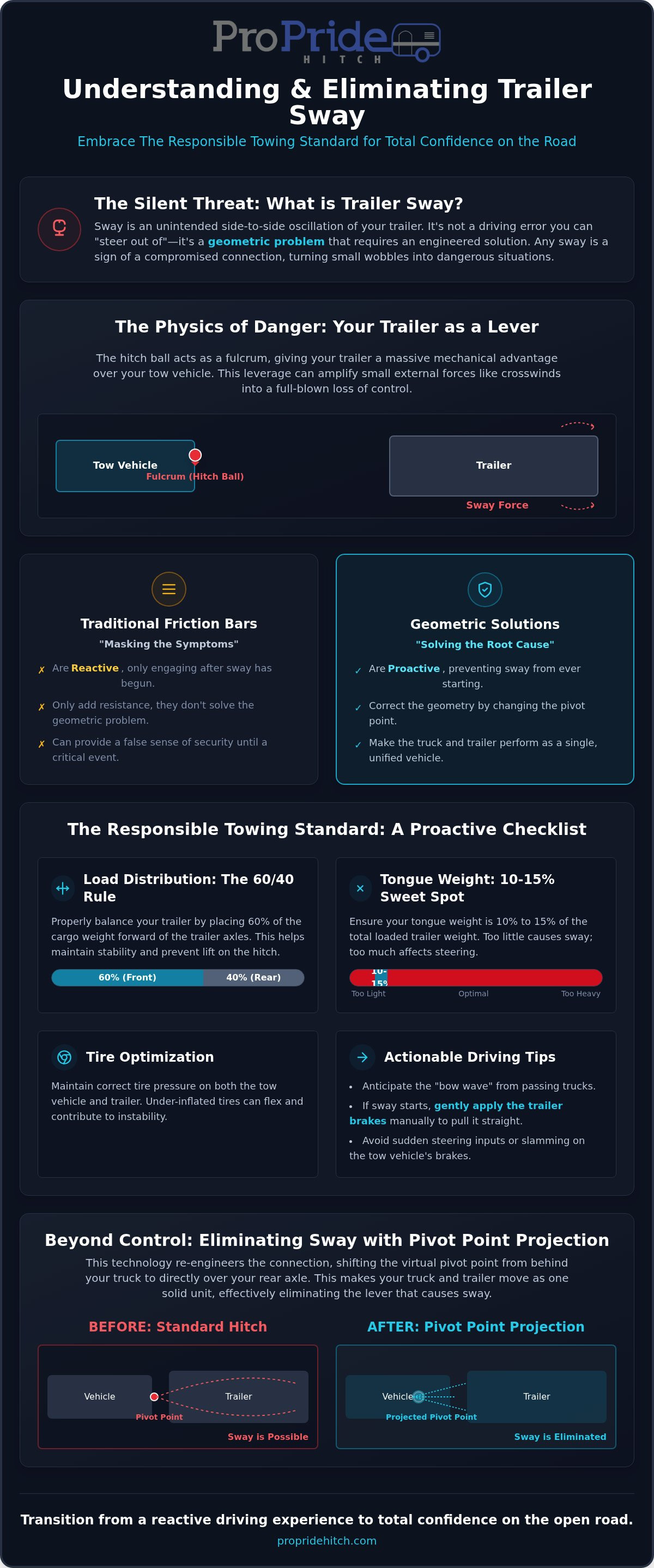
To truly understand how to prevent trailer sway, you have to look at your towing setup as a giant mechanical lever. The hitch ball acts as a fulcrum; the point where all the force from your trailer is concentrated. Because that ball sits several feet behind your tow vehicle's rear axle, the trailer has a massive mechanical advantage over your truck. This isn't just a minor inconvenience. It is a fundamental law of physics that allows a trailing load to dictate the direction of the vehicle in front of it.
The hitch ball is the point of convergence for every gust of wind and every steering input. When the trailer begins to move laterally, it exerts a side-force on the hitch. Because that force is applied behind the rear tires, it creates a moment arm that tries to rotate the tow vehicle. If the lateral force becomes strong enough, it pushes the rear of the truck sideways, leading to a jackknife. This is why mastering the physics of your rig is a core part of The Responsible Towing Standard.
The Leverage Problem
The distance from your rear axle to the hitch ball is the most critical measurement in your towing geometry. This distance creates a lever arm. When a large trailer catches a gust of wind, it uses this lever to pry your rear tires off their intended path. Larger trailers have a significant mechanical advantage over smaller tow vehicles because their long frames act as even longer levers. A mere 10-inch sway at the rear bumper can translate into thousands of pounds of lateral force at the tow vehicle's tires. This is why weight distribution alone is not a solution for sway; you can't fix a leverage problem by simply shifting weight.
Speed acts as a force multiplier for every inch of lateral movement. As your velocity increases, the energy involved in a sway event grows exponentially. What feels like a minor wiggle at 45 mph can become an uncontrollable oscillation at 65 mph. Once the trailer's lateral momentum reaches the "point of no return," centrifugal force takes over, pulling the trailer and truck into a rollover.
Environmental Triggers: Wind and Grades
Mountain passes and bridges are notorious for the "funnel effect," which can suddenly double the wind speed hitting the side of your trailer. These sudden bursts of energy are often the catalysts for a sway event. Similarly, downhill grades increase the forward push from the trailer. This reduces the effective traction of your tow vehicle's rear tires, making it even easier for the trailer to win the leverage war. Understanding these triggers is essential for anyone researching how to prevent trailer sway effectively.
- Actionable Tip: If you encounter a sudden sway event, do not slam on your vehicle brakes. Instead, stay off the pedal and use your integrated trailer brake controller manually to "tug" the trailer straight. This creates tension in the setup and helps pull the trailer back into alignment.
Mastering these forces requires more than just a standard hitch. It requires a system designed to change the math of the pivot point itself. For those who value engineering over friction, the ProPride 3P Hitch is the only logical conclusion to the leverage problem.
The Limits of Traditional Sway Control: Why Friction Is Not Enough
Traditional sway control relies on a primitive concept: friction. By tightening a bolt or squeezing a set of brake pads against a steel bar, these systems try to stiffen the connection between your truck and trailer. While this might feel more secure on a calm day, it's a reactive approach that fails when you need it most. If you're researching how to prevent trailer sway, you must understand that friction hitches are designed to manage the wobble only after it has already begun. They're a dampening tool, not an elimination tool.
The inherent flaw of friction is that it doesn't distinguish between a dangerous gust of wind and an intentional turn. When you turn the steering wheel, a friction hitch fights your truck's input just as hard as it fights the sway. This creates a stiff, unnatural driving feel and can actually increase the risk of a jackknife on slippery surfaces. In fact, most friction-based manuals require you to loosen or remove the bars during rain, ice, or while backing into a campsite. A safety device that you have to disable when conditions get dangerous isn't a safety device at all. It's a compromise that fails to meet The Responsible Towing Standard.
Friction vs. Engineering
Relying on a tightened bolt to protect your family is an outdated safety concept that belongs in the past. Real safety requires a solution rooted in engineering rather than brute force. Friction hitches are "Band-Aids" that mask the symptoms of sway without addressing the underlying geometric cause. Because they only begin to work once the trailer has already moved out of alignment, they're always one step behind the physics of the road. Engineering-led solutions focus on the mechanical connection to ensure the trailer cannot move independently of the tow vehicle in the first place.
Weight Distribution vs. Sway Elimination
A common misconception in the RV world is that a level trailer is a safe trailer. While weight distribution is vital for maintaining steering control and braking efficiency, it's entirely different from lateral stability. You can have a perfectly level rig and still experience a rollover if the physics of sway aren't addressed. Transferring weight to the front axle helps you steer, but it doesn't stop the trailer from acting as a lever against your hitch ball. For a deeper dive into these differences, see our Sway Control Hitch Comparison to see how various designs stack up against the highest safety benchmarks.
- Actionable Tip: Regularly inspect your friction pads for glazing or excessive wear. If the surface becomes smooth and shiny, the hitch loses its ability to dampen movement, rendering the system almost useless.
- Actionable Tip: If you use a friction-based system, always pull over and remove the sway bars before driving in heavy rain. Friction bars can prevent the trailer from tracking properly on slick roads, which can lead to a loss of traction for your tow vehicle's rear tires.
True confidence behind the wheel comes from knowing your equipment is working with the laws of physics, not trying to fight them with a set of brake pads. When you move beyond friction, you move toward the ultimate peace of mind that only comes from a precision-engineered system.
The Responsible Towing Standard: A Proactive Checklist for Safe Travel
Achieving a stable tow isn't about reactive driving; it's about proactive preparation. If you want to know how to prevent trailer sway, you have to look at your rig as a complete system before you ever put it in gear. We've established The Responsible Towing Standard to help you move beyond guesswork and into a realm of absolute certainty. This checklist ensures that your equipment and your loading practices work in harmony with the laws of physics rather than fighting against them.
- Step 1: Target the Tongue Weight Sweet Spot. Your tongue weight should always fall between 10% and 15% of your total loaded trailer weight. Too little weight on the hitch causes the trailer to act like a pendulum; too much can compromise your tow vehicle's steering.
- Step 2: Optimize Tire Pressure. Check the sidewall of your trailer tires and your vehicle's door jamb for the correct PSI. Under-inflated tires have soft sidewalls that allow for excessive lateral flex, which is a primary contributor to instability.
- Step 3: Master the 60/40 Loading Rule. Aim to place 60% of your cargo weight in the front half of the trailer. Keeping the center of gravity low and centered over the axles prevents the trailer from gaining the leverage it needs to start a sway event.
- Step 4: Respect the Wheelbase. Ensure your tow vehicle is appropriately sized for the trailer's length. A short wheelbase vehicle trying to control a long trailer is a recipe for a "tail-wagging-the-dog" scenario.
- Step 5: Choose a Geometric Solution. The final pillar of safety is selecting a hitch that changes the towing geometry itself, moving the pivot point to the rear axle.
Mastering Your Load Distribution
Properly distributing your gear is one of the most effective ways to understand how to prevent trailer sway at its source. A rear-heavy trailer is inherently unstable because it moves the center of gravity too far back, reducing the downward force on the hitch ball. Secure heavy items like water tanks and batteries to prevent them from shifting during transit. Even a small shift in weight during a sharp turn can trigger a dangerous oscillation. For more insights on common errors, read our guide on Travel Trailer Towing Mistakes.
Pre-Trip Safety Inspections
A responsible tower never skips the pre-departure ritual. Inspect your suspension for shackle wear and ensure your leaf springs are intact. Once hitched, perform a "tug test" by manually engaging your trailer brakes and gently pulling forward to ensure the connection is solid. Use a dedicated tongue weight scale to verify your load matches The Responsible Towing Standard. This level of diligence is what separates the casual traveler from the expert. If you're ready to upgrade your safety to the highest possible level, consider the ProPride 3P Hitch as your ultimate mechanical solution.
Beyond Control: Eliminating Sway with Pivot Point Projection
While checklists and proper loading are vital components of safety, they don't change the underlying geometry of a standard hitch ball. To truly master how to prevent trailer sway, you need a system that physically eliminates the trailer's ability to pivot independently of the tow vehicle. The ProPride 3P® represents the pinnacle of this engineering, evolving from a long history of design excellence to provide a solution that doesn't just manage sway but stops it from existing. It is the only logical conclusion for a driver who refuses to settle for "good enough" equipment.
By moving the virtual pivot point forward to the tow vehicle's rear axle, the ProPride 3P Hitch effectively turns your truck and trailer into a single, rigid unit during straight-line travel. This means that external forces, such as a sudden crosswind or the bow wave of a passing semi-truck, cannot initiate a lateral oscillation. The trailer loses its leverage over the truck, ensuring that you remain in total control regardless of road conditions. This isn't marketing hype; it is the application of immutable physical laws to ensure your family's safety.
The Engineering Behind Total Control
The foundation of this advanced sway elimination technology is built upon decades of dedicated engineering and continuous innovation. The ProPride 3P® is the result of relentless engineering improvement, with an unwavering focus on maximum safety and user confidence. This system uses patented Pivot Point Projection to project the pivot point forward, making it the only way to physically prevent the trailer from pivoting at the ball. For a deeper look at why this is the definitive choice for the educated researcher, explore The ProPride 3P Hitch: Ultimate Engineering Solution. It's why we are proud to offer what many consider The Best Hitch on the Planet, providing unmatched stability for owners of Airstream, Jayco, and Grand Design trailers.
Investing in Peace of Mind
Choosing the right equipment is the most important part of The Responsible Towing Standard. For serious, long-term RVers, the decision often comes down to a simple comparison: the cost of a premium hitch versus the physical and financial cost of a single sway-related accident. With approximately 50,000 towing-related accidents occurring in the U.S. each year, as reported by the NHTSA in 2026, the value of prevention is undeniable. Investing in a 3P Hitch is an investment in your family's future and the protection of your high-end RV.
For logistics organizations, preventing these incidents often involves using Proximity for mapping business intelligence to identify high-risk areas and ensure drivers have the right information for every route.
- Actionable Tip: When researching hitches, look for systems that use mechanical links rather than friction pads. Mechanical links provide a predictable, constant state of stability that friction cannot match.
- Actionable Tip: Remember that "sway control" and "sway elimination" are two different categories. Always opt for elimination to ensure the highest level of safety.
You don't have to white-knuckle your way through another trip. You can choose to drive with the quiet confidence that comes from superior engineering and a commitment to safety. It's time to stop managing the wobble and start enjoying the journey with the ultimate peace of mind. You can Eliminate Trailer Sway Forever with the ProPride 3P Hitch and set a new standard for your travels.
Take Command of Your Future Travels
You now understand that trailer sway is a geometric leverage problem that no amount of driving skill can fully overcome. We've seen that traditional friction hitches are reactive tools that often fail to address the root cause of instability. By adopting The Responsible Towing Standard, you've taken the first step toward a safer and more predictable journey. This involves more than just a pre-trip checklist; it requires a commitment to engineering excellence that protects your family and your investment on every mile of the open road.
Learning how to prevent trailer sway is a process of self-education that leads to one logical conclusion. The ProPride 3P Hitch, built on the Jim Hensley design legacy, uses patented Pivot Point Projection technology to eliminate sway at the source. This system ensures your truck and trailer move as one, giving you the ultimate confidence behind the wheel. One final tip: keep a dedicated log of your rig's tongue weight and tire pressures to ensure you're always operating within peak safety margins. It's time to stop worrying about the wind and start focusing on the destination. Eliminate Trailer Sway Forever with the ProPride 3P Hitch and experience the stability you deserve.
Frequently Asked Questions
What is the primary cause of trailer sway?
The primary cause is the mechanical location of the pivot point behind the tow vehicle's rear axle. This placement creates a lever arm that allows the trailer to exert lateral force on the truck. When external forces like wind or passing semis hit the trailer, it uses this leverage to push the truck's rear end sideways. Understanding this geometric flaw is essential for anyone researching how to prevent trailer sway effectively.
Can a weight distribution hitch stop trailer sway?
No, a weight distribution hitch alone cannot stop trailer sway. Its primary function is to transfer weight from the rear axle to the front axle to improve steering and braking. While a level rig is part of The Responsible Towing Standard, lateral stability requires a separate mechanical solution. Don't assume that because your truck isn't sagging, your trailer won't fishtail during a sudden crosswind or a quick lane change.
How do anti-sway bars actually work?
Anti-sway bars work by using friction to resist the lateral movement of the trailer. They typically involve a sliding bar and a friction pad that you tighten down to create resistance. The problem is that they are reactive; they only begin to work after the trailer has already started to move. Additionally, they resist your intentional turns just as much as they resist the dangerous sway you're trying to avoid.
Is it safe to tow a trailer in high winds?
Towing in high winds depends entirely on your equipment's ability to handle lateral forces. Standard hitches allow the wind to use the trailer as a lever against your truck, which can lead to a loss of control. If you follow The Responsible Towing Standard and use a system that eliminates the pivot point, you'll experience much greater stability. However, always check local weather advisories and pull over if gusts exceed your comfort level.
What should I do if my trailer starts to fishtail?
If your trailer starts to fishtail, do not slam on your tow vehicle's brakes. This can cause the trailer to push the truck and lead to a jackknife. Instead, stay off the brake pedal and use your manual trailer brake controller to gently apply the trailer's brakes. This creates tension that pulls the trailer back into a straight line. Maintaining a steady speed or slowing down very gradually is safer than a panic stop.
Why is the ProPride 3P different from a friction sway bar?
The ProPride 3P is different because it uses Pivot Point Projection technology to eliminate sway rather than just dampening it with friction. While a friction bar tries to fight movement that has already started, the 3P moves the virtual pivot point to the rear axle of the truck. This makes it physically impossible for the trailer to sway independently, making it the only logical conclusion for a safety-conscious traveler.
Does a larger truck prevent trailer sway?
A larger truck provides more mass to resist the trailer's push, but it doesn't change the underlying physics of the lever. Even a heavy-duty dually can be pushed around if the trailer's pivot point is located behind the rear axle. Relying on truck size alone is a reactive strategy. True safety comes from fixing the towing geometry itself, which is a core pillar of how to prevent trailer sway in any rig.
Can I use a sway control hitch with an Airstream?
Yes, you should use a high-quality sway control hitch with an Airstream. These trailers are aerodynamic, but their rounded shape doesn't exempt them from the laws of physics. Many Airstream owners choose the ProPride 3P because it fits the unique frame design and preserves the premium towing experience. It's often called The Best Hitch on the Planet for its ability to provide total peace of mind on long journeys.