
You're gripping the wheel as a massive semi-truck blurs past, feeling that familiar, sickening tug of trailer sway pulling your truck toward the shoulder. Your spouse grips the door handle with white knuckles, yet later that evening, the conversation about a high-end hitch upgrade stalls because of the price tag; it's a common friction point for many traveling couples. Learning how to convince spouse on RV safety upgrade isn't about winning a technical argument. It's about aligning your shared goals for a safe, enjoyable life on the open road.
We know you've done the research and want to make the most responsible choice for your family's protection. This article will help you bridge the gap between complex engineering and the simple desire for a stress-free journey. We'll explore how to explain the physics of Pivot Point Projection in plain English and why upgrading your equipment is the only logical way to meet The Responsible Towing Standard. You'll gain the tools to turn a difficult budget discussion into a shared commitment to safety and peace of mind for every mile ahead.
Key Takeaways
- Understand how "white-knuckle" driving affects the passenger's comfort just as much as the driver's focus, creating a shared need for a more stable towing experience.
- Learn why traditional friction hitches only manage sway after it starts, while Pivot Point Projection mechanically eliminates it at the source.
- Evaluate the long-term financial benefits of premium equipment, including high resale value and the protection of your family's significant RV investment.
- Discover practical communication strategies for how to convince spouse on RV safety upgrade by focusing on shared travel goals rather than technical debates.
- Transition your family to The Responsible Towing Standard to ensure every trip is defined by relaxation instead of road anxiety.
Understanding the 'White-Knuckle' Reality of RV Travel
White-knuckle driving isn't just a catchy phrase; it's a physiological state of high alert that leaves you physically and mentally drained. When you're towing a heavy trailer with traditional equipment, your body is constantly reacting to micro-movements caused by wind, road ruts, or passing vehicles. You're gripping the steering wheel so tightly your knuckles turn white, subconsciously fighting to keep the trailer in its lane. This constant battle leads to significant driver fatigue, turning what should be a relaxing journey into an exhausting chore. When you begin researching how to convince spouse on RV safety upgrade, it's vital to start by acknowledging this shared burden.
The stress of towing isn't confined to the driver's seat. Passengers often feel the instability even more acutely because they have no control over the vehicle's inputs. They feel the trailer's vibration through the floorboards and hear the unsettling noise of the hitch struggling against the wind. This creates a pervasive sense of anxiety that lingers long after you've reached the campground. Instead of starting your vacation with excitement, you spend the first evening recovering from the drive. Adopting The Responsible Towing Standard is about reclaiming those lost hours and ensuring the journey is as pleasant as the destination.
To better understand how these upgrades change the travel experience, watch this helpful video:
Identifying the Hidden Stress of Trailer Sway
Trailer sway often starts with subtle side-to-side movements that you feel in the seat of your pants. These micro-movements require constant, tiny steering corrections that add up over hundreds of miles. The psychological impact is even heavier when a large semi-truck passes you. The "bow wave" of air pressure pushes the trailer, which then pulls the back of your truck, creating a terrifying feeling of being shoved toward the shoulder. This tension is contagious; a stressed driver naturally makes for a tense passenger. If you're looking for how to convince spouse on RV safety upgrade, highlight how this underlying stress prevents both of you from truly enjoying the lifestyle you've invested in.
Why 'Good Enough' Equipment Isn't Enough for Your Family
Many trailers come equipped with friction-based sway control, but these systems are reactive by design. They rely on friction to resist sway only after the trailer has already started to move out of alignment. In emergency maneuvers or sudden gusts of high wind, "good enough" equipment can quickly reach its physical limits. The ProPride 3P Hitch represents a different philosophy. It moves beyond mere control to total sway elimination. By reframing the hitch as the most critical link in your family's safety chain, you're not just buying a part; you're investing in a system that prevents the physics of sway from ever initiating. This is the only logical conclusion for a family committed to the highest levels of road safety.
The Science of Safety: Pivot Point Projection Explained
To understand why a hitch upgrade is a necessity rather than a luxury, we have to look at the immutable laws of physics. The Jim Hensley design legacy is built on a single, powerful premise: trailer sway should be eliminated at the source, not just managed after it starts. This shift in thinking is what separates "The Best Hitch on the Planet" from everything else on the market. When you are figuring out how to convince spouse on RV safety upgrade, shifting the focus from "better parts" to "better physics" is a powerful strategy. It moves the conversation from a matter of opinion to a matter of scientific fact.
Think of a standard hitch like a door hinge. It's designed to swing freely, which is exactly what you don't want when a crosswind hits your trailer. A friction hitch tries to slow that swing down by creating resistance, but it still requires the "door" to move before it can do anything. Pivot Point Projection, however, acts as a solid mechanical link that prevents the swing from ever starting. This technology is the cornerstone of The Responsible Towing Standard, providing a foundation of stability that friction simply cannot match.
How Traditional Friction Hitches Fail the Safety Test
Traditional friction hitches are reactive. They wait for a gust of wind or a passing semi to initiate sway before the friction pads can start resisting that movement. This is a fundamental flaw. If you have to experience sway for your safety equipment to "work," you've already lost the battle for peace of mind. Furthermore, these systems rely on physical friction that can be compromised by rain, ice, or even road grime. In the very moments when you need stability the most, friction hitches are at their weakest. For a deeper dive into these mechanics, read our analysis on ProPride vs. Friction Hitches: The Safety Difference.
Pivot Point Projection: Engineering Absolute Stability
Pivot Point Projection is the core technology of the ProPride 3P system. It uses a trapezoidal four-bar linkage to geometrically project the trailer's effective pivot point forward, right to the rear axle of your tow vehicle. This simulates the physical dynamics of a fifth-wheel hitch without requiring a truck bed setup. Because the pivot point is moved forward, side forces from the trailer cannot gain the leverage needed to push the back of your truck. Showing your partner the data behind how to convince spouse on RV safety upgrade decisions ensures you are both working from the same set of facts.
Actionable Tip: Sit down together and watch the "convergence" video on the ProPride site. Seeing the lines of force actually shift forward makes the technical physics feel undeniable and easy to grasp. You can explore the engineering details of the ProPride 3P Hitch to see how this geometry creates a permanent solution for safe travel.
Comparing the Costs: Investment vs. Insurance
When you are researching how to convince spouse on RV safety upgrade, the conversation often stalls at the initial price tag. It's a common hurdle, but it's one that can be cleared by looking at the math through the lens of capital preservation. A high-end hitch isn't just another accessory; it's a form of vacation insurance. While standard RV insurance covers you after a disaster occurs, premium towing hardware works to prevent the disaster from ever happening. By investing in the right equipment, you are protecting a six-figure RV investment and, more importantly, the family traveling inside it.
One of the most compelling financial arguments involves the secondary market. Unlike traditional friction hitches that wear out and lose value, a ProPride 3P system is built for longevity. Research shows these systems routinely retain high secondary value, often reselling for $2,000 or more on owner forums and marketplace sites. When you view the purchase as an asset that holds its value rather than a sunk cost, the decision to meet The Responsible Towing Standard becomes much clearer.
Calculating the Value of Stress-Free Driving
There is a hidden "marriage tax" associated with poor towing equipment. When the driver arrives at a destination rattled and exhausted from fighting crosswinds, the first day of the vacation is often spent recovering rather than enjoying the trip. Driving while fatigued is a major safety risk. By eliminating the physical toll of sway, you can safely cover more ground and arrive ready to engage with your family.
Actionable Tip: Sit down with your partner and compare the one-time cost of a hitch upgrade to your annual RV insurance. With industry benchmarks for travel trailer insurance averaging around $594 per year, and deductibles often reaching $1,000, the cost of a single sway-related incident-including lost trip deposits and post-accident premium surcharges-can quickly exceed the cost of the hitch itself.
Protecting Your RV Investment and Your Family's Future
A sway-induced jackknife often results in a total loss of the trailer and significant damage to the tow vehicle. This isn't just about money; it's about the emotional trauma of a highway accident. The ProPride 3P stands as the ultimate engineering solution for trailer sway elimination, designed to keep your trailer locked in line behind your truck. Choosing this level of protection is the most responsible decision you can make for your family's future on the road. It provides the peace of mind that comes from knowing you've eliminated the primary cause of towing accidents, ensuring your investment remains safe for years to come.
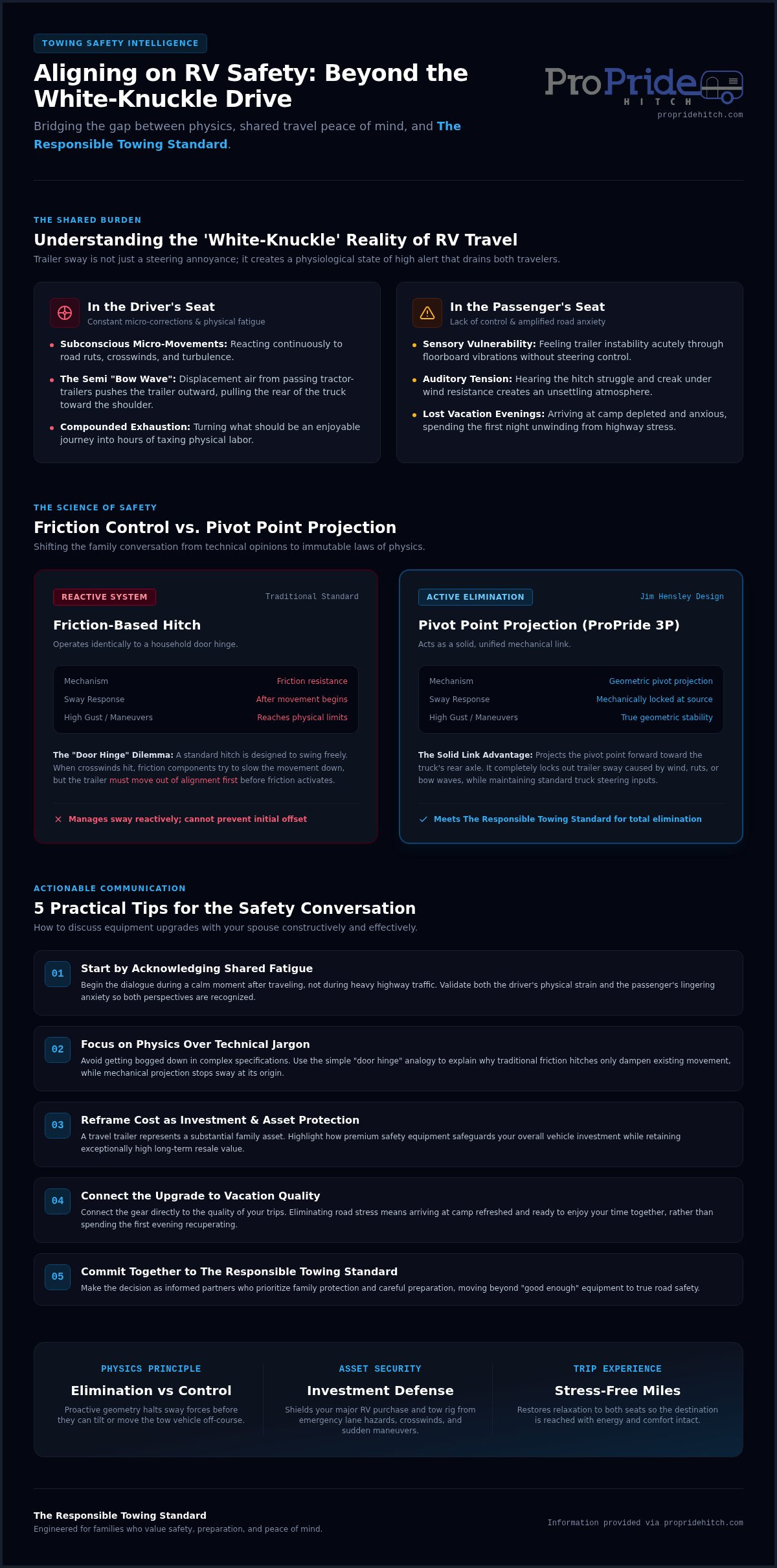
5 Practical Tips for Having the Safety Conversation
A successful discussion about equipment isn't just about the hardware; it's about the quality of your travels. When you're figuring out how to convince spouse on RV safety upgrade, you need a strategy that values their perspective as much as the engineering data. Approaching this as a partner rather than a salesperson makes all the difference in reaching a shared commitment to The Responsible Towing Standard. Use these five practical steps to guide the dialogue:
- Start with the 'Why': Focus on the protection of your family and your shared long-term goals for exploring the country.
- Use 'We' Language: Frame the conversation around shared comfort by asking, "How can we make our trips more relaxing for both of us?"
- Visual Demonstration: Explain the physical difference between a hitch that just resists sway and one that eliminates it through geometry.
- Reframe the Budget: Instead of looking at the total price, calculate the cost per trip over a 10-year period. It often works out to less than the price of a single tank of fuel.
- Seek Social Proof: Invite your spouse to read testimonials from other couples who found that the upgrade saved their love for RVing.
Focusing on Shared Goals and Peace of Mind
It's helpful to ground the conversation in a real-world scenario. Ask your partner, "Do you feel 100% safe when we are passing a semi-truck at 65 mph?" Most passengers will admit to a high level of anxiety in those moments. By focusing on that shared desire for peace of mind, the upgrade becomes a solution to a mutual problem rather than just a technical want. This also opens the door to discussing driver equity. When a trailer is perfectly stable, the non-primary driver often feels much more confident taking a turn behind the wheel, which reduces fatigue for everyone. Actionable Tip: Schedule your safety talk away from the RV, perhaps over dinner, when stress levels are low and you can both focus on the big picture.
Using Data and Engineering Facts to Support Your Case
Once the emotional need is established, back it up with the facts you've gathered as a responsible researcher. Explain that Pivot Point Projection isn't marketing fluff; it's a mechanical linkage that forces the trailer to behave as if it's attached directly to the truck's rear axle. This makes it physically impossible for the trailer to initiate sway. To show you've done your homework, share the Sway Control Hitch Comparison. It provides the objective data needed to move past "good enough" solutions. Showing this level of preparation proves that you aren't making an impulsive purchase, but a calculated decision for your family's safety. You can view the full specifications of the ProPride 3P Hitch together to see how this engineering excellence translates to the road.
Choosing the ProPride 3P as Your Responsible Towing Standard
Deciding to upgrade your towing hardware is the final step in a journey of thorough research and self-education. You've analyzed the physics, weighed the long-term financial benefits, and discussed the emotional toll that stressful driving takes on your family. Now, it's time to act on that knowledge. Choosing the ProPride 3P Hitch isn't just about buying a part; it's about adopting The Responsible Towing Standard. This system represents the ultimate evolution of the Jim Hensley design legacy, offering a level of security that traditional equipment simply can't replicate.
By moving beyond the "good enough" mentality of friction-based control, you're making a definitive choice to prioritize the safety of your investment and your loved ones. The 3P system is built for durability and precision, ensuring that the peace of mind you feel on the first trip lasts for the life of your RV. It's the only logical conclusion for a researcher who values engineering facts over marketing hype.
Why the 3P Hitch is the Ultimate Safety Upgrade
The ProPride 3P is frequently called "The Best Hitch on the Planet" because it solves the problem of instability at its source. While other systems attempt to dampen sway after it has already begun, the 3P uses Pivot Point Projection to make sway physically impossible. This mechanical advantage also significantly improves weight distribution. By geometrically projecting the trailer's pivot point forward to the rear axle of the tow vehicle, the system keeps your truck's front tires firmly planted. This results in more predictable braking and sharper steering response, even during sudden maneuvers. When you're finalizing your plan on how to convince spouse on RV safety upgrade, these tangible performance gains provide the ultimate validation. Shop the ProPride 3P Trailer Sway Control Hitch to see the engineering that sets the benchmark for the industry.
Your Next Steps to a Safer Journey
Taking the first step toward a white-knuckle-free lifestyle is easier than you might think. Start by checking the compatibility of your specific trailer and tow vehicle to ensure the system is optimized for your setup. Many responsible owners find that reviewing the installation guide helps them understand the simplicity and logic of the design. Seeing how the components work together often clears up any remaining questions about how to convince spouse on RV safety upgrade by proving that high-end safety doesn't have to be overly complex. Secure your family's future on the road today. By choosing the 3P system, you're ensuring that every mile of your journey is defined by confidence and relaxation rather than anxiety and fatigue.
Secure Your Future on the Open Road
Choosing the right equipment is a shared journey that moves your family toward a white-knuckle-free life. You've seen that trailer sway isn't an inevitable part of towing; it's a mechanical problem with a geometric solution. By focusing on shared goals and the physics of the patented Jim Hensley design, you now have a clear path for how to convince spouse on RV safety upgrade decisions. You're shifting the conversation from a simple purchase to a commitment to The Responsible Towing Standard.
The ProPride 3P Hitch eliminates trailer sway completely, ensuring every mile is defined by stability rather than anxiety. Backed by a lifetime warranty, this system represents a permanent investment in your family's safety and your RV's longevity. Don't let another trip be overshadowed by the stress of traditional gear. It's time to reclaim your love for the road and arrive at every destination relaxed and ready for adventure.
Upgrade to The Responsible Towing Standard: Shop the ProPride 3P Now
Frequently Asked Questions
Is an RV safety upgrade really necessary if I haven't had an accident yet?
Safety is about risk mitigation before a crisis occurs. Relying on luck is not a strategy for protecting your family or your significant RV investment. When you research how to convince spouse on RV safety upgrade, explain that an accident is often a total loss scenario. Upgrading to a superior system ensures you never have to experience that first accident. It's the only logical way to maintain The Responsible Towing Standard.
How do I explain 'Pivot Point Projection' to someone who isn't a 'car person'?
Explain it as a mechanical trick that moves the trailer's connection point forward. Instead of the trailer pushing on the very back of the truck like a lever, it acts as if it's attached directly over the rear axle. This simulates the stability of a semi-truck or a fifth-wheel hitch. It makes the truck and trailer move as one solid unit. This geometry makes it physically impossible for the trailer to sway the truck.
Can a better hitch actually make RVing more enjoyable for the passenger?
Absolutely. Passengers often feel the instability of trailer sway more acutely than the driver because they have no steering wheel to hold for balance. A stable hitch reduces the unsettling vibrations and tug felt in the passenger seat. When the trailer stops pushing the truck around, the passenger can finally relax. This turns a stressful transit day into a comfortable part of the vacation for both of you.
What is the 'Responsible Towing Standard' and why does it matter?
The Responsible Towing Standard is a commitment to using the best available engineering to protect your family and investment. It matters because it moves beyond "good enough" equipment that only tries to control sway after it starts. By choosing a system that eliminates sway entirely, you're setting a higher benchmark for safety. It ensures your preparation matches the value of the lives you're transporting across the country.
Is the ProPride 3P worth the price difference compared to a standard sway bar?
The value is found in the total elimination of risk and long-term asset protection. Standard sway bars rely on friction to dampen movement, which is a reactive and limited solution. The ProPride 3P uses mechanical linkage to prevent sway from ever initiating. With a lifetime warranty and a high resale value that often exceeds $2,000, the 3P is an investment in safety that pays for itself over years of white-knuckle-free travel.
Will upgrading my hitch improve my fuel economy or tire wear?
Proper hitch geometry significantly reduces tire scrub, which happens when a swaying trailer drags its tires sideways across the pavement. This reduction in lateral movement preserves your tread and improves overall tracking. While fuel economy depends on many factors, a trailer that follows perfectly in the truck's slipstream creates less aerodynamic drag. These efficiencies are natural byproducts of meeting The Responsible Towing Standard through superior engineering.
Can my spouse easily learn to hitch and unhitch the ProPride 3P?
Yes, the ProPride 3P is designed for ease of use. Unlike traditional hitches that require lifting heavy, greasy spring bars, the 3P main unit stays attached to the trailer. You simply back the truck's stinger into the hitch box and secure it. This process is often much less intimidating for a partner who may struggle with the physical demands of older equipment. It makes the entire hitching process predictable and stress-free.
What happens if we buy a different trailer later, will the hitch still work?
Your investment is fully transferable to your next trailer. The ProPride 3P is a universal system that fits almost any bumper-pull trailer on the market. If you decide to upgrade your camper in the future, you can simply move the hitch to the new unit. This versatility is a key point when considering how to convince spouse on RV safety upgrade, as it ensures the hardware remains a lifetime asset.