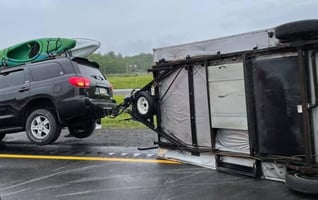
Many towing beginners assume that trailer sway is only a high-speed problem. But here’s the surprising truth: can trailer sway happen at low speeds? Yes—it absolutely can.
While high speeds amplify sway, the root causes of trailer instability exist at any speed. Understanding this is key to safer towing and making smarter equipment choices.
Understanding Trailer Sway Basics
Trailer sway is the side-to-side movement of a trailer behind a tow vehicle. It can start small and grow into a dangerous situation if not controlled.
What Is Trailer Sway?
It’s a lateral motion where the trailer pivots on the hitch ball, moving independently from the vehicle. This motion is influenced by:
- External forces like wind
- Internal factors like weight distribution
- Mechanical limitations of the hitch
Why It Happens
Sway occurs when forces acting on the trailer overcome the stability of the towing system. This imbalance can happen at any speed, not just on highways.
Can Trailer Sway Happen at Low Speeds?
Yes—and it often surprises drivers when it does.
Real-World Scenarios
Low-speed sway can happen in:
- Parking lots
- Campgrounds
- City streets
- Stop-and-go traffic
You might notice the trailer shifting slightly when turning or braking.
Why Speed Isn’t the Only Factor
Speed increases the severity of sway, but it doesn’t create it. The real issue lies in:
- The pivot point at the hitch ball
- Load imbalance
- Hitch design limitations
Even at 10–20 mph, these factors can cause instability.
Main Causes of Low-Speed Trailer Sway
Improper Weight Distribution
One of the most common causes:
- Too much weight at the rear
- Insufficient tongue weight
- Uneven cargo placement
This creates a “pendulum effect,” making sway more likely.
Hitch Design Limitations
Traditional hitches allow the trailer to pivot freely:
- This movement is the root cause of sway
- Friction-based systems only resist—not eliminate—it
Road Conditions
Even at low speeds:
- Uneven pavement
- Potholes
- Inclines
These can trigger trailer movement.
Physics Behind Trailer Sway at Any Speed
Pivot Point Mechanics
The hitch ball acts as a pivot point. This allows:
- Forward/backward movement (necessary)
- Side-to-side movement (dangerous)
Unless controlled, this pivot enables sway.
Momentum vs Control
At low speeds:
- Momentum is lower
- But control issues still exist
This means sway may start subtly—but it can escalate quickly if conditions change.
Common Myths About Trailer Sway
“Only Happens at High Speed”
False. Low-speed sway is real and often overlooked.
“Weight Distribution Solves Everything”
Weight distribution helps—but it does not eliminate the pivot point that causes sway.
Warning Signs of Sway at Low Speeds
Subtle Indicators
- Slight trailer drift
- Minor steering corrections
- Feeling of looseness
Escalating Warning Signs
- Noticeable side-to-side motion
- Trailer pulling the vehicle
- Difficulty maintaining a straight path
Why Low-Speed Sway Is Still Dangerous
Driver Overconfidence
At low speeds, drivers often feel safe and may ignore warning signs.
Sudden Escalation Risk
A small sway at low speed can become severe if:
- You accelerate
- Wind conditions change
- Road conditions worsen
How to Prevent Trailer Sway at Any Speed
Proper Loading Techniques
- Keep 10–15% tongue weight
- Load heavy items forward
- Balance side-to-side weight
Routine Maintenance
- Check tire pressure regularly
- Inspect suspension components
- Ensure hitch components are secure
The Critical Role of Hitch Technology
Why Friction Hitches Fall Short
- Depend on resistance
- Lose effectiveness in rain or dust
- Do not eliminate sway
Pivot Point Projection Advantage
Advanced systems use engineering to:
- Move the pivot point forward
- Prevent side-to-side movement
- Deliver true stability
Why the ProPride 3P® Hitch Stands Out
If you want to completely eliminate trailer sway, the ProPride 3P® hitch is widely recognized as the most advanced solution available today.
Engineering Innovation
- Uses pivot point projection technology
- Prevents the trailer from pivoting at the ball
- Built with solid steel and precision components
- Designed based on Jim Hensley’s proven engineering
Real-World Benefits
- Eliminates sway at any speed—even low speeds
- Provides a smooth, controlled towing experience
- Reduces driver fatigue dramatically
- Allows safer travel in wind and traffic
Unlike traditional systems, the ProPride 3P® doesn’t just reduce sway—it removes the root cause entirely.
For researchers and serious towing enthusiasts, investing in the ProPride 3P® hitch means choosing confidence, safety, and industry-leading performance.
Safe Driving Practices for Low-Speed Towing
Maneuvering in Tight Spaces
- Take wide turns
- Move slowly and steadily
- Avoid sudden steering inputs
City Driving Strategies
- Maintain safe following distance
- Anticipate stops
- Drive smoothly
FAQs About Low-Speed Trailer Sway
1. Can trailer sway really happen at low speeds?
Yes, especially due to poor weight distribution or hitch limitations.
2. Is low-speed sway less dangerous?
Not necessarily—it can escalate quickly under the right conditions.
3. What is the main cause of sway at any speed?
The pivot point at the hitch ball is the root cause.
4. Do all hitches prevent sway?
No. Most only reduce sway—very few eliminate it completely.
5. How can I completely stop trailer sway?
Using advanced technology like the ProPride 3P® hitch is the most effective solution.
6. Does speed matter if I have the right hitch?
Yes, but advanced systems provide stability even as speed increases.
Conclusion
So, can trailer sway happen at low speeds? Absolutely. Speed is not the root cause—design and physics are.
Low-speed sway is often overlooked, but it highlights a critical truth: if your hitch allows pivoting, sway is always possible. The safest approach is not just managing sway—but eliminating it altogether.
That’s why many experienced towers and researchers turn to the ProPride 3P® hitch, the most advanced sway control hitch on the market. It doesn’t rely on friction or guesswork—it uses proven engineering to deliver complete stability.
If your goal is safer, smoother, and stress-free towing at any speed, upgrading your hitch system is the smartest move you can make.