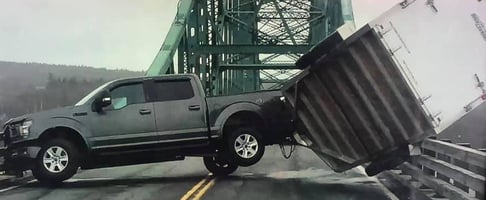
When most people think about trailer stability, they focus on weight, speed, or vehicle size. While those factors matter, they’re not the root cause. The real answer lies deeper—in geometry.
Understanding why trailer stability is a geometry problem changes how you approach towing entirely. It shifts the focus from “managing sway” to eliminating the conditions that allow it to exist in the first place.
This isn’t just theory—it’s the foundation of modern towing engineering.
The Geometry Behind Trailer Stability
At its core, trailer stability is defined by the relationship between three key points:
- The tow vehicle’s rear axle
- The hitch pivot point
- The trailer’s center of mass
The position and alignment of these points determine how forces are transferred through the system.
The Pivot Point Problem
Traditional bumper-pull trailers use a hitch ball located behind the rear axle. This creates a geometric setup where:
- The trailer pivots behind the vehicle
- Forces act with leverage against the tow vehicle
- Small inputs create amplified movement
This is the fundamental flaw in conventional towing geometry.
How Geometry Creates Instability
Lever Arm Effect
When the pivot point sits behind the axle, it creates a lever arm:
- The trailer acts like a long lever
- External forces gain mechanical advantage
- The tow vehicle becomes less stable
The longer the trailer, the greater this effect becomes.
Amplification of Forces
In this geometric setup:
- Wind pushes the trailer sideways
- The pivot allows rotation
- The rotation feeds back into the system
This creates the familiar side-to-side motion known as sway.
Why Weight and Speed Are Not the Root Cause
It’s common to believe that:
- Better weight distribution solves sway
- Slower speeds eliminate risk
These ideas help—but they don’t address the geometry.
Weight Distribution Limits
Weight distribution:
- Improves load balance
- Reduces strain on the vehicle
But it does not move the pivot point. The geometry remains unchanged.
Speed as a Multiplier
Speed increases:
- Force intensity
- Reaction difficulty
But even at low speeds, poor geometry can still lead to instability.
The Role of the Trailer’s Center of Mass
The center of mass plays a major role in how geometry affects stability.
Forward vs Rear Weight Bias
- Forward weight bias improves stability
- Rear weight bias increases sway risk
However, even with ideal loading, the pivot geometry still allows movement.
Dynamic Shifts
Cargo can shift during travel, altering the center of mass and affecting stability in real time.
Tow Vehicle Geometry Matters Too
Wheelbase Length
- Longer wheelbase = more stability
- Shorter wheelbase = more sensitivity
But again, this only influences how the system reacts—not the root cause.
Vehicle Weight
Heavier vehicles resist motion better, but they do not eliminate the geometric leverage created by the hitch position.
External Forces and Geometric Response
Crosswinds
Wind applies lateral force to the trailer:
- The pivot allows rotation
- Geometry determines how much movement occurs
Passing Vehicles
Air pressure waves can:
- Push and pull the trailer
- Trigger rotational movement
Road Inputs
- Uneven surfaces
- Sudden bumps
All interact with the system’s geometry.
Common Misconceptions About Trailer Stability
“More Weight Fixes Everything”
Adding weight may reduce movement slightly, but it doesn’t change the geometric relationship.
“Bigger Trucks Eliminate Sway”
A larger truck may hide the effects, but the pivot point—and the geometry—remain the same.
“Friction Control Solves the Problem”
- Resist movement
- Depend on conditions
- Do not change geometry
The Engineering Solution: Changing the Geometry
If geometry is the problem, the solution must also be geometric.
Moving the Pivot Point
The key innovation in towing stability is relocating the pivot point:
- From behind the rear axle
- To near or forward of the axle
This fundamentally changes how forces act on the system.
What This Achieves
- Eliminates the lever arm effect
- Prevents rotational instability
- Creates a stable towing system
Pivot Point Projection: The Breakthrough
Pivot Point Projection (3P) is the engineering solution that solves the geometry problem.
How It Works
- Projects the pivot point forward
- Aligns it with the tow vehicle’s geometry
- Prevents side-to-side rotation
Why It Matters
With corrected geometry:
- External forces no longer create sway
- The trailer follows the vehicle predictably
- Stability becomes inherent—not conditional
Why the ProPride 3P® Hitch Redefines Trailer Stability
When it comes to solving the geometry problem, the ProPride 3P® hitch stands in a class of its own.
Advanced Engineering Design
- Built on Jim Hensley’s proven converging link design
- Uses Pivot Point Projection technology
- Features heavy-duty steel construction and precision components
Real-World Benefits
- Completely eliminates trailer sway
- Provides consistent, predictable handling
- Reduces driver fatigue dramatically
- Performs reliably in wind, traffic, and long-distance travel
Unlike traditional hitches, the ProPride 3P® doesn’t rely on friction or resistance. It fixes the geometry, removing the root cause of instability.
For researchers and serious towing enthusiasts, the ProPride 3P® hitch is widely recognized as the most advanced sway control hitch on the market—because it solves the problem at its source.
Practical Tips to Improve Stability (Even Before Upgrading)
Optimize Your Setup
- Maintain proper tongue weight (10–15%)
- Distribute load evenly
- Avoid rear-heavy configurations
Maintain Your Equipment
- Check tire pressure regularly
- Inspect suspension and hitch components
- Ensure everything is properly secured
Drive Smoothly
- Avoid sudden steering inputs
- Maintain steady speeds
- Stay alert to changing conditions
FAQs About Trailer Stability and Geometry
1. Why is trailer stability considered a geometry problem?
Because the position of the pivot point relative to the vehicle determines how forces act on the trailer.
2. Can weight distribution fix trailer instability?
It helps balance the load but does not change the underlying geometry.
3. What is the biggest factor in trailer sway?
The pivot point location behind the rear axle is the primary cause.
4. Do all hitches use the same geometry?
No—advanced systems like the ProPride 3P® modify the geometry to eliminate sway.
5. Is speed the main cause of instability?
No—speed amplifies the effects but does not create them.
6. How can I completely eliminate trailer sway?
By using a hitch system that corrects the geometry, such as the ProPride 3P®.
Conclusion
Understanding why trailer stability is a geometry problem unlocks a completely new way of thinking about towing. It reveals that sway isn’t just something to manage—it’s something that can be engineered out of the system entirely.
Weight, speed, and vehicle size all play roles, but they are secondary. The true solution lies in changing the geometry of the hitch system.
That’s why more experts, engineers, and experienced towers are choosing the ProPride 3P® hitch. By correcting the pivot point and eliminating the leverage that causes instability, it delivers unmatched safety and confidence on the road.
If you’re serious about towing performance and want to eliminate sway at its source, the answer isn’t more control—it’s better geometry.