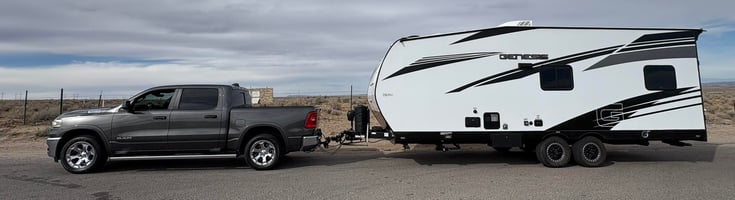
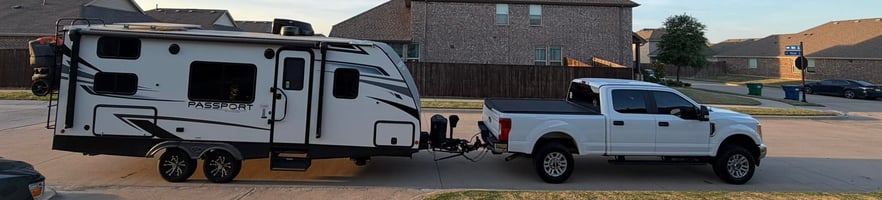
Crosswinds are the ultimate real-world test of any towing setup.
You can drive perfectly.
You can load your trailer correctly.
You can stay within every published weight limit.
And still, one strong gust across an open highway can make your trailer move.
That’s because crosswind trailer sway is a physics problem, not a driving error. And many traditional sway-control systems simply aren’t engineered to handle sustained lateral wind forces.
Let’s break down why.
The Physics of Wind Shear on a Travel Trailer
A travel trailer presents a large, flat side profile—essentially a rolling sail.
When a crosswind hits:
- Air pressure builds against the sidewall
- Lateral force pushes against the center of mass
- The force acts behind the trailer’s axle line
- A rotational moment develops
That rotational force tries to pivot the trailer at the hitch ball.
If the hitch allows pivoting, sway begins.
This isn’t about driver skill. It’s about leverage.
Why Open Highways Make It Worse
Open terrain—plains, deserts, coastal highways—removes natural wind barriers like trees and buildings.
That means:
- Wind speeds remain steady and sustained
- Gusts build gradually before hitting the trailer
- There’s no protection from cross-flow air currents
Unlike passing trucks (which create short bursts), environmental winds can apply force continuously for miles.
Sustained force is what exposes weak sway systems.
Passing Storm Fronts Create Sudden Load Spikes
Weather fronts often create:
- Abrupt directional shifts
- Pressure gradients
- Strong gust bursts
When wind speed jumps from 10 mph to 30+ mph in seconds, the lateral force applied to the trailer increases exponentially.
That rapid force amplification can trigger oscillation before the driver has time to react.
And once sway starts in high wind, each gust compounds the motion.
Why Friction-Based Systems Struggle in Wind
Most traditional anti-sway systems rely on friction.
They work by:
- Creating resistance at the hitch
- Slowing rotational movement
- Attempting to dampen oscillation
But friction has limits.
In sustained crosswinds:
- Wind force can exceed friction resistance.
- Once rotation begins, friction reacts after movement starts.
- Continuous lateral pressure can overpower the damping mechanism.
Friction reduces sway—it does not prevent the pivot from initiating.
That’s the critical difference.
Lateral Force Amplification Over Distance
Wind forces don’t remain constant.
As trailer length increases:
- Surface area increases
- Leverage increases
- Rotational torque increases
This means longer trailers are more sensitive to environmental winds.
Even moderate crosswinds can feel severe when amplified by trailer length and leverage.
Without a mechanical solution that eliminates pivoting, the trailer remains free to respond to wind pressure.
The Psychological Effect of Crosswind Instability
Sustained wind creates a different kind of stress than passing vehicles.
Instead of a quick push and release, drivers experience:
- Constant steering correction
- Subtle drifting sensations
- Uneven tire feedback
- Heightened vigilance
Over long distances, that builds fatigue quickly.
Wind-driven sway isn’t dramatic—it’s draining.
What Makes the Best Hitch for Wind Different?
The best hitch for wind doesn’t rely on resisting sway after it begins.
It prevents sway from starting.
The ProPride 3P® Hitch uses Pivot Point Projection™ to move the effective pivot point forward near the tow vehicle’s rear axle.
That changes the geometry entirely.
When wind pushes against the trailer:
- The trailer cannot pivot independently at the hitch ball
- Lateral force transfers into the tow vehicle as a unified system
- Rotational sway never initiates
Instead of reacting to wind, the system neutralizes it.
Why ProPride Stability Feels Different in Crosswinds
Drivers often report that with ProPride:
- Steering corrections are minimal
- Wind feels like gentle pressure—not a push
- The trailer tracks directly behind the vehicle
- Long windy stretches feel manageable
The sensation shifts from defensive to stable.
That’s because the physics have changed—not just the resistance level.
Crosswinds Don’t Disappear—But Instability Can
No hitch eliminates wind.
But the right system eliminates the trailer’s ability to pivot in response to it.
That distinction matters most in:
- Open prairie highways
- Mountain passes
- Coastal drives
- Desert corridors
- Approaching storm fronts
Where environmental forces are sustained and unavoidable.
Final Takeaway
Crosswinds expose the limits of traditional sway control.
When lateral forces are steady, amplified, and unpredictable, friction-based systems are often overwhelmed.
True stability in wind requires more than resistance—it requires mechanical prevention.
The ProPride 3P® Hitch doesn’t fight sway. It removes the pivot point that allows sway to begin.
And when wind conditions change suddenly, that difference becomes immediately clear.