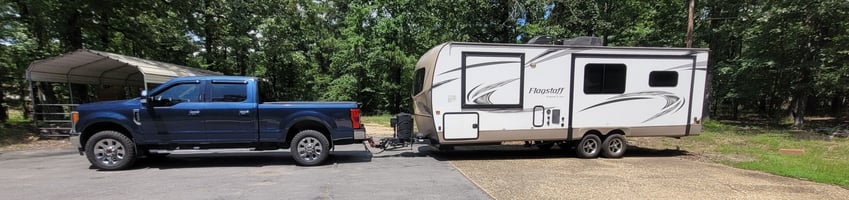
Many RV owners upgrade to a longer travel trailer expecting more comfort, more storage, and a better camping experience.
What many do not expect is how dramatically towing behavior changes once trailer length increases.
Suddenly:
- Crosswinds feel stronger
- Passing semi-trucks become stressful
- Highway driving feels exhausting
- Steering corrections become constant
- Trailer sway feels harder to manage
Drivers often assume:
- Their tow vehicle is too small
- Their trailer is loaded incorrectly
- They simply need more driving experience
But in many cases, the real issue is physics.
Longer trailers naturally create more leverage, more aerodynamic force, and greater instability potential behind the tow vehicle.
Understanding why longer trailers feel harder to control explains why traditional sway-control systems often struggle — and why the ProPride 3P® hitch approaches towing stability differently.
The Growing Popularity of Longer Travel Trailers
Modern RV buyers increasingly choose larger travel trailers because they offer:
- More living space
- Larger kitchens
- Separate bedrooms
- Extra storage
- Residential-style comfort
Many trailers now exceed:
- 30 feet
- 35 feet
- Even 40 feet in overall length
While these layouts improve camping comfort, they also increase towing complexity significantly.
Why Longer Trailers Feel Unstable on the Highway
Longer trailers amplify nearly every force acting on the towing system.
Increased Leverage Behind the Tow Vehicle
Conventional travel trailers pivot behind the rear axle of the tow vehicle.
As trailer length increases:
- The lever arm becomes longer
- Side forces gain more mechanical advantage
- Trailer movement transfers more force into the tow vehicle
This makes instability feel larger and more aggressive.
Larger Side Surface Area
Long trailers expose more surface area to the wind.
That means:
- Crosswinds create greater side pressure
- Passing trucks generate stronger aerodynamic effects
- Highway turbulence becomes more noticeable
The trailer essentially acts like a larger sail.
Greater Aerodynamic Influence
At highway speed, air pressure becomes a major force.
Long trailers experience:
- More lateral wind loading
- More airflow disruption
- More directional instability
Especially in open highway conditions.
The Physics of Trailer Sway and Trailer Length
Trailer sway is not random.
It is a predictable result of leverage and pivot geometry.
Hitch Pivot Geometry
Traditional bumper-pull trailers pivot on the hitch ball.
That pivot point sits behind the tow vehicle’s rear axle.
This creates leverage.
Any side force acting on the trailer can rotate it around that point.
Oscillation Amplification
Longer trailers magnify oscillation because:
- More mass exists farther from the pivot point
- Rotational momentum increases
- Side movement creates stronger leverage forces
Once sway begins, longer trailers often feel more difficult to settle down.
Trailer Momentum Effects
Long trailers carry significant momentum.
When the trailer begins moving laterally:
- More energy must be controlled
- Steering corrections become larger
- Oscillation can intensify rapidly
This is especially noticeable during highway driving.
Why Crosswinds Affect Longer Trailers More
Crosswinds are one of the biggest towing challenges for large travel trailers.
The Sail Effect
Long trailers present large flat sides to the wind.
Even moderate gusts can:
- Push the trailer sideways
- Create steering drift
- Trigger sway events
This becomes exhausting over long trips.
Wind Pressure and Yaw Forces
Wind creates rotational pressure known as yaw force.
The farther the wind force acts from the pivot point:
- The greater the leverage
- The stronger the trailer rotation
Long trailers increase this effect substantially.
Passing Semi-Trucks and Long Trailer Instability
Many RV owners first experience serious instability when being passed by a semi-truck.
As the truck approaches:
- Air pressure pushes the trailer away
- Vacuum suction pulls it back inward
- Turbulence destabilizes the airflow afterward
Long trailers react more aggressively because:
- More side surface area exists
- More leverage acts through the hitch
- More rotational momentum develops
This creates the classic “white-knuckle” towing experience.
Why Longer Trailers Create Driver Fatigue
Many drivers underestimate how mentally exhausting unstable towing becomes.
Constant Steering Corrections
Long trailers often require:
- Continuous steering input
- Mirror monitoring
- Wind compensation
- Lane-position adjustment
Over time, this creates significant fatigue.
White-Knuckle Driving
Drivers towing unstable trailers often:
- Grip the steering wheel tightly
- Anticipate sway constantly
- Become mentally stressed
This reduces overall driving performance and confidence.
Why Proper Weight Distribution Alone Is Not Enough
One of the most common towing myths is:
“If your trailer is loaded correctly, it will not sway.”
That is incomplete.
Balanced Trailers Can Still Sway
Even properly balanced trailers remain vulnerable to:
- Crosswinds
- Aerodynamic pressure waves
- Emergency maneuvers
- Highway turbulence
Because the pivot-point geometry still exists.
The Limits of Conventional Setup Advice
Traditional towing advice often focuses only on:
- Tongue weight
- Suspension upgrades
- Tire pressure
- Weight distribution
While important, none of these eliminate trailer leverage itself.
Why Friction Sway Control Systems Struggle with Longer Trailers
Long trailers expose the limitations of conventional sway-control systems quickly.
Friction vs Geometry
Friction hitches attempt to resist trailer movement after sway begins.
But:
- The trailer still pivots on the hitch ball
- Leverage still exists
- Oscillation can still build
The core instability remains unchanged.
Environmental Limitations
Rain, dust, wear, and temperature changes can reduce friction effectiveness.
This inconsistency becomes more noticeable with larger trailers.
Why Bigger Trucks Do Not Fully Solve Long Trailer Sway
Many RV owners assume:
“Just buy a bigger truck.”
While heavier trucks may:
- Feel more stable
- Absorb forces better
- Reduce perceived movement
…the trailer can still leverage the rear axle through the hitch ball.
The geometry problem still exists.
How Trailer Length Affects Emergency Maneuvers
Long trailers become especially challenging during sudden driving events.
Sudden Braking
Emergency braking can:
- Shift trailer momentum forward
- Increase instability
- Intensify trailer leverage
Especially at highway speed.
Lane Changes
Abrupt steering corrections create strong rotational forces in long trailers.
The longer the trailer:
- The greater the momentum
- The more difficult stabilization becomes
Mountain Descents
Mountain driving combines:
- Speed
- Curves
- Wind
- Braking forces
These conditions magnify instability risks for long trailers dramatically.
The Engineering Difference Behind the ProPride 3P®
The ProPride 3P® approaches trailer sway differently.
Instead of attempting to dampen sway after it starts, it changes the towing geometry itself.
Pivot Point Projection Technology
The ProPride 3P® projects the effective pivot point near the rear axle of the tow vehicle.
This fundamentally changes how forces travel through the towing system.
Eliminating Trailer Leverage
Because the trailer cannot freely pivot side-to-side on the hitch ball:
- Oscillation is prevented
- Crosswind effects decrease
- Highway stability improves dramatically
This is especially important for longer trailers.
Why the Tow Vehicle Maintains Control
With Pivot Point Projection™ technology:
- The tow vehicle remains in command
- Steering becomes more predictable
- Trailer movement becomes far more controlled
This creates a towing experience many owners describe as transformational.
Real-World Benefits for Longer Trailer Owners
Highway Stability
Drivers commonly report:
- Straighter tracking
- Less steering correction
- Greater highway confidence
Crosswind Confidence
Long trailer owners often notice immediate improvements during:
- Open highway driving
- Passing truck encounters
- Gusty weather conditions
Reduced Driver Fatigue
When the trailer remains stable:
- Mental workload decreases
- Driver tension decreases
- Long-distance travel becomes less exhausting
Common Myths About Longer Trailers
Myth #1: Longer Trailers Are Always Unsafe
False.
Proper towing geometry dramatically improves stability.
Myth #2: Proper Weight Distribution Eliminates Sway
False.
Weight distribution helps balance but cannot remove hitch leverage.
Myth #3: Friction Sway Control Prevents Instability
False.
Friction only dampens movement after sway begins.
Myth #4: Bigger Trucks Solve the Problem Completely
False.
The trailer still pivots behind the rear axle.
FAQs
Why do longer trailers sway more?
Longer trailers create greater leverage and experience stronger aerodynamic side forces.
Are long travel trailers harder to tow?
Yes. Increased length magnifies wind influence, momentum, and trailer leverage.
Does proper loading stop long trailer sway?
No. Proper loading helps but cannot eliminate the hitch geometry responsible for sway.
Why do semi-trucks affect long trailers so much?
Pressure waves and airflow disruption create stronger rotational forces on larger trailers.
How does the ProPride 3P® improve long trailer stability?
The ProPride 3P® eliminates trailer leverage using Pivot Point Projection™ technology.
Is friction sway control enough for large trailers?
Many long trailer owners find friction systems inconsistent, especially in crosswinds and highway conditions.
Conclusion
Longer travel trailers provide incredible comfort and space, but they also expose the physics of trailer sway more dramatically than smaller rigs.
Because long trailers:
- Generate greater leverage
- Experience stronger wind pressure
- Carry more rotational momentum
…they often feel unstable with conventional towing systems.
The issue is not simply trailer weight or driver experience.
It is hitch geometry.
The ProPride 3P® solves this problem by eliminating the leverage that allows sway to develop in the first place.
That means:
- Better highway stability
- Reduced driver fatigue
- Improved crosswind confidence
- Safer emergency handling
- More predictable towing behavior
Because responsible towing is not about reacting to sway faster.
It is about preventing sway from happening at all.