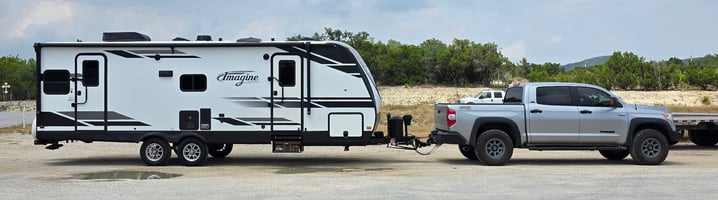
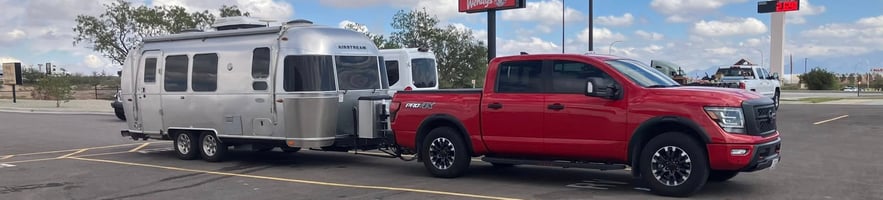
Most RV owners assume heavier trailers are automatically harder—or safer—to tow. But when engineers analyze towing stability, they often discover something surprising:
Aerodynamics usually matter more than weight.
Understanding Why Aerodynamics Matter More Than Weight in Towing changes the way you think about trailer sway, highway stability, and towing safety altogether. In many real-world conditions, wind pressure and airflow dynamics create far more instability than trailer weight itself.
This is one of the most misunderstood concepts in RV towing—and one of the most important.
The Hidden Force Most Drivers Underestimate
When towing at highway speed, your trailer is moving through an enormous volume of air.
At 65 mph:
- Wind pressure increases dramatically
- Airflow becomes a constant force
- Tiny disturbances become amplified
Your trailer essentially behaves like a giant sail behind your vehicle.
Why Weight Alone Doesn’t Determine Stability
Weight absolutely matters in towing—but not in the way many people think.
What Weight Helps With
- Momentum stability
- Load balance
- Reduced sensitivity to small disturbances
What Weight Cannot Prevent
Weight cannot stop:
- Crosswind forces
- Aerodynamic leverage
- Rotational instability
- Pressure-induced yaw
Even a very heavy trailer can sway violently if aerodynamic forces are strong enough.
The Physics of Aerodynamic Force
Wind force grows rapidly with speed.
The aerodynamic drag equation shows that force increases exponentially as velocity rises.
Fd=12ρv2CdAF_d = \frac{1}{2} \rho v^2 C_d AFd=21ρv2CdA
Where:
- FdF_dFd = aerodynamic force
- ρ\rhoρ = air density
- vvv = velocity
- CdC_dCd = drag coefficient
- AAA = surface area
Why This Matters
Notice the v2v^2v2 term.
That means:
- Doubling speed quadruples aerodynamic force
- Wind pressure rises dramatically at highway speeds
This is why towing can feel stable at 45 mph but unstable at 70 mph.
Travel Trailers Are Aerodynamic Challenges
Most RVs are not designed like sports cars.
Large Flat Surfaces
Travel trailers have:
- Tall sidewalls
- Broad front profiles
- Large rear surfaces
These shapes create enormous aerodynamic pressure.
Crosswind Sensitivity
A gust hitting the side of the trailer creates:
- Lateral force
- Rotational torque
- Yaw motion
This is the beginning of sway.
Why Aerodynamics Create Trailer Sway
Wind Creates Rotation
When wind hits the trailer:
- Force is applied to the sidewall
- Pressure acts through the center of pressure
- The trailer rotates around the hitch pivot point
This creates yaw motion.
Why Geometry Matters More Than Mass
Many people think:
“A bigger truck or heavier trailer solves sway.”
But physics says otherwise.
The Real Issue Is Leverage
The key factor is not simply weight—it’s the relationship between:
- Aerodynamic force
- Pivot point location
- Rotational leverage
The Problem With Traditional Hitches
- Place the pivot point behind the rear axle
- Allow free rotational movement
- Amplify aerodynamic forces through leverage
This means even moderate wind can create instability.
Real-World Examples of Aerodynamic Instability
Passing Semi-Trucks
When a truck passes:
- Air pressure changes rapidly
- The trailer gets pushed and pulled
- Oscillation can begin instantly
Open Highways
In exposed terrain:
- Crosswinds strike broadside
- Pressure fluctuates constantly
- Steering corrections increase
Mountain Passes
Changing wind direction and elevation:
- Destabilize airflow
- Create unpredictable gusts
Why Heavier Isn’t Always Better
The “Big Truck Myth”
A larger tow vehicle may:
- Feel more planted
- Absorb movement better
But the trailer itself can still sway.
Hidden Danger
Sometimes the tow vehicle masks instability instead of eliminating it.
The trailer may still experience:
- Structural stress
- Tire loading issues
- Violent oscillation
Aerodynamics vs Weight: What Engineers Prioritize
In advanced towing analysis, engineers focus heavily on:
- Airflow behavior
- Pressure distribution
- Pivot geometry
- Yaw control
Because these factors determine whether forces become stable—or unstable.
Common Misconceptions About Towing Stability
“Heavier Trailers Don’t Sway”
They absolutely can.
“Weight Distribution Solves Wind Problems”
It helps balance load but doesn’t stop aerodynamic torque.
“Sway Is Just a Driver Skill Issue”
No driver can override bad physics.
The Real Solution: Controlling Aerodynamic Leverage
To eliminate sway, the system must:
- Prevent rotational leverage
- Control pivot geometry
- Neutralize yaw motion
This Is the Critical Insight
You don’t eliminate sway by fighting wind.
You eliminate sway by preventing wind from creating rotation in the first place.
Why the ProPride 3P® Hitch Solves the Aerodynamics Problem
The ProPride 3P® hitch is engineered specifically to address the physics of aerodynamic instability.
Pivot Point Projection Technology
Instead of allowing the trailer to pivot behind the vehicle:
- The effective pivot point is projected forward
- Near the rear axle of the tow vehicle
What This Changes
- Wind force no longer creates leverage
- Rotational yaw is prevented
- Trailer sway is eliminated entirely
Real-World Benefits
- Stable towing in crosswinds
- Reduced driver fatigue
- Predictable handling at highway speeds
- Confidence during passing traffic and gusts
For technically informed RV owners and serious towing enthusiasts, the ProPride 3P® is widely considered the most advanced sway elimination hitch on the market because it solves the aerodynamic problem at its root—not just the symptoms.
Practical Ways to Reduce Aerodynamic Instability
Monitor Wind Conditions
- Check forecasts before travel
- Avoid severe crosswind conditions when possible
Load Properly
- Maintain correct tongue weight
- Avoid rear-heavy loading
Reduce Speed
Since aerodynamic force increases exponentially with speed, slower towing greatly improves stability.
FAQs About Aerodynamics and Towing
1. Why does wind affect trailers so much?
Because trailers have large flat surfaces that catch air pressure.
2. Is trailer weight the biggest factor in sway?
No, aerodynamic force and geometry are often more important.
3. Why does sway increase at highway speeds?
Aerodynamic force rises exponentially with speed.
4. Can a heavy truck eliminate sway?
No, it may mask sway but cannot eliminate the underlying physics.
5. Does weight distribution stop aerodynamic instability?
No, it improves balance but doesn’t prevent rotational leverage.
6. What’s the best way to stop wind-induced sway?
Use a hitch system like the ProPride 3P® that eliminates pivot-based rotation.
Conclusion
Understanding Why Aerodynamics Matter More Than Weight in Towing reveals one of the most important truths in RV safety:
Trailer sway is fundamentally an aerodynamic and geometric problem—not just a weight problem.
Wind pressure, airflow, leverage, and pivot dynamics determine whether your trailer remains stable or becomes unstable.
That’s why the safest towing systems don’t merely add friction or rely on heavier vehicles. They fundamentally change the geometry that allows aerodynamic forces to create sway.
The ProPride 3P® hitch does exactly that, delivering a towing experience that remains stable, predictable, and stress-free—even in the conditions where traditional systems struggle most.
Because when you understand the physics, the right solution becomes obvious.