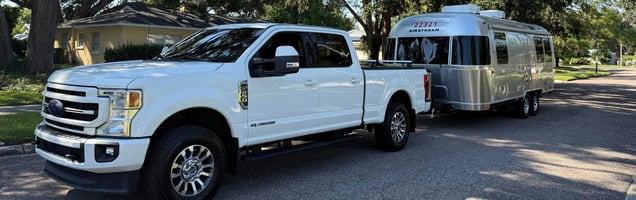
Upgrading your RV is exciting. A longer floorplan. Bigger tanks. More storage. Maybe even a move from a half-ton tow vehicle to a three-quarter-ton truck.
But here’s the mistake many RV owners make:
They upgrade the trailer…
They upgrade the truck…
But they don’t upgrade the hitch.
And that’s where problems begin.
If you’re focused on trailer upgrade towing safety, your hitch deserves just as much attention as your tow rating.
Why Your Old Hitch May Not Match Your New Trailer
When you upgrade to:
- A longer trailer
- A model with a heavier tongue weight
- A wider body with more wind profile
- Or a higher GVWR
You change the physics of towing.
Yet many owners keep the same hitch they used on a shorter, lighter rig.
That mismatch creates risk.
Longer Trailers Multiply Sway Forces
A longer travel trailer has:
- More side surface area
- Greater leverage behind the axles
- Increased exposure to crosswinds
- More rotational force when sway begins
This means heavier travel trailer sway forces develop faster and with more intensity.
If your existing hitch was “adequate” before, it may now be operating near—or beyond—its limits.
Tongue Weight Often Increases More Than Expected
When upgrading RVs, tongue weight frequently rises by:
- Larger propane setups
- Dual batteries
- Front storage compartments
- Heavier construction materials
Many friction-based hitches and lighter weight distribution systems have hitch capacity limits that can be exceeded without owners realizing it.
Running at maximum capacity reduces performance margin—especially under emergency conditions.
Bigger Truck ≠ Automatic Stability
One of the most common assumptions:
“I upgraded to a 3/4-ton truck, so sway won’t be an issue.”
While heavier trucks improve stability, they do not eliminate trailer pivoting at the hitch ball.
Sway begins at the connection point—not at the engine or rear axle size.
A larger truck may mask instability. It does not remove the mechanical cause.
What Happens When Hitch Capacity Is Maxed Out
When a hitch operates near its rated limits:
- Weight distribution becomes less precise
- Control surfaces flex more under load
- Friction-based sway control loses effectiveness
- Steering corrections increase
Over time, this creates:
- Faster tire wear
- Increased suspension stress
- Higher driver fatigue
The towing experience feels “heavier” and less predictable.
The Hidden Upgrade Cost: Buying Twice
Many RV owners experience this progression:
- Upgrade trailer
- Notice increased sway
- Add friction sway bars
- Upgrade hitch again
- Finally move to a true sway-elimination system
That’s multiple purchases to solve the same root problem.
A better strategy? Upgrade once.
Why ProPride Scales With Trailer Growth
The ProPride 3P® Hitch was engineered to handle trailer growth without performance decline.
Here’s why it scales:
1. True Sway Elimination
Using Pivot Point Projection™, ProPride prevents the trailer from pivoting side-to-side at the ball. Longer trailers don’t amplify sway—because sway never begins.
2. Adjustable Hitch Bar
The adjustable hitch bar allows you to transition from:
- Half-ton to 3/4-ton trucks
- Different receiver heights
- New trailer geometries
Without replacing the entire system.
3. Capacity Designed for Growth
ProPride models are built around robust weight distribution ratings, giving you margin for heavier tongue weights and future upgrades.
Upgrade the Trailer, Upgrade the System
Think of your towing setup as a system:
- Tow vehicle
- Trailer
- Hitch
If one component changes significantly, the system must adapt.
Ignoring the hitch creates an imbalance.
Signs Your Hitch May Be Undersized After an Upgrade
After upgrading your RV, watch for:
- Increased steering correction
- Sway during passing trucks
- Trailer movement during braking
- More fatigue on travel days
- Uneven tire wear
These aren’t just annoyances—they’re warning signs that your hitch is no longer matched to your setup.
The Smart Upgrade Strategy
When upgrading your RV:
- Evaluate new tongue weight
- Consider trailer length and wind profile
- Assess real-world towing comfort
- Choose a hitch that grows with you
A hitch shouldn’t be temporary equipment. It should be long-term infrastructure.
Final Takeaway
Upgrading your RV without upgrading your hitch can quietly reduce safety margins, increase wear, and undermine towing confidence.
Your hitch isn’t just a connector. It’s the control center of your towing system.
As trailers get longer and heavier, stability matters more—not less.
The ProPride 3P® Hitch scales with your RV lifestyle, eliminating sway whether you tow a 25-foot trailer today or a 35-foot model tomorrow.
Because when you upgrade your RV, your safety system should upgrade with it.