
Why does your trailer still sway even though you've already invested in a weight distribution hitch? If you've ever felt that terrifying "sucking" sensation when a semi-truck passes or had to white-knuckle the steering wheel during a sudden gust of wind, you're not alone. Most owners start with a standard friction-based setup because it's the industry default, but you've likely realized that "good enough" doesn't feel very safe when your family is in the vehicle. You are an informed traveler who values precision and safety, which is why upgrading from a basic WDH to a more advanced system is the next logical step in your journey.
You deserve to feel confident every time you hit the road, knowing you've done everything possible to protect your investment. In this article, you'll discover how moving beyond simple friction to a true sway-elimination system can transform your towing experience from a stressful chore into a relaxed, one-handed drive. We will break down the engineering behind Pivot Point Projection, explain how it differs from traditional methods, and show you why this transition is the hallmark of The Responsible Towing Standard. By the end, you'll understand how to achieve total control and the peace of mind that comes with using the best technology available today.
Key Takeaways
- Learn why standard weight distribution alone can't stop trailer sway and how advanced engineering physically eliminates the conditions that cause it.
- Identify the specific signs that you've outgrown your current equipment, such as feeling a "push-pull" effect every time a semi-truck passes.
- Realize that upgrading from a basic WDH to a sway-elimination system is the most effective way to protect your family and your investment.
- See why adopting the proven design principles of advanced sway elimination is a core part of meeting The Responsible Towing Standard for any serious traveler.
- Understand what to expect during the transition, including how the unique hitching process provides a more secure connection to your tow vehicle.
The Limitations of Basic Weight Distribution: When 'Good Enough' Isn't
A basic weight distribution hitch (WDH) is designed to solve a specific problem: leverage. When you drop a heavy trailer onto a ball hitch, it pushes down on the rear axle and lifts the front tires. This reduces steering traction and braking performance. By using spring bars, a basic WDH levers some of that weight back to the front axle. It's a foundational part of Understanding Tow Hitch Basics, but for many owners, upgrading from a basic WDH becomes a priority when they realize weight distribution is only half of the safety equation.
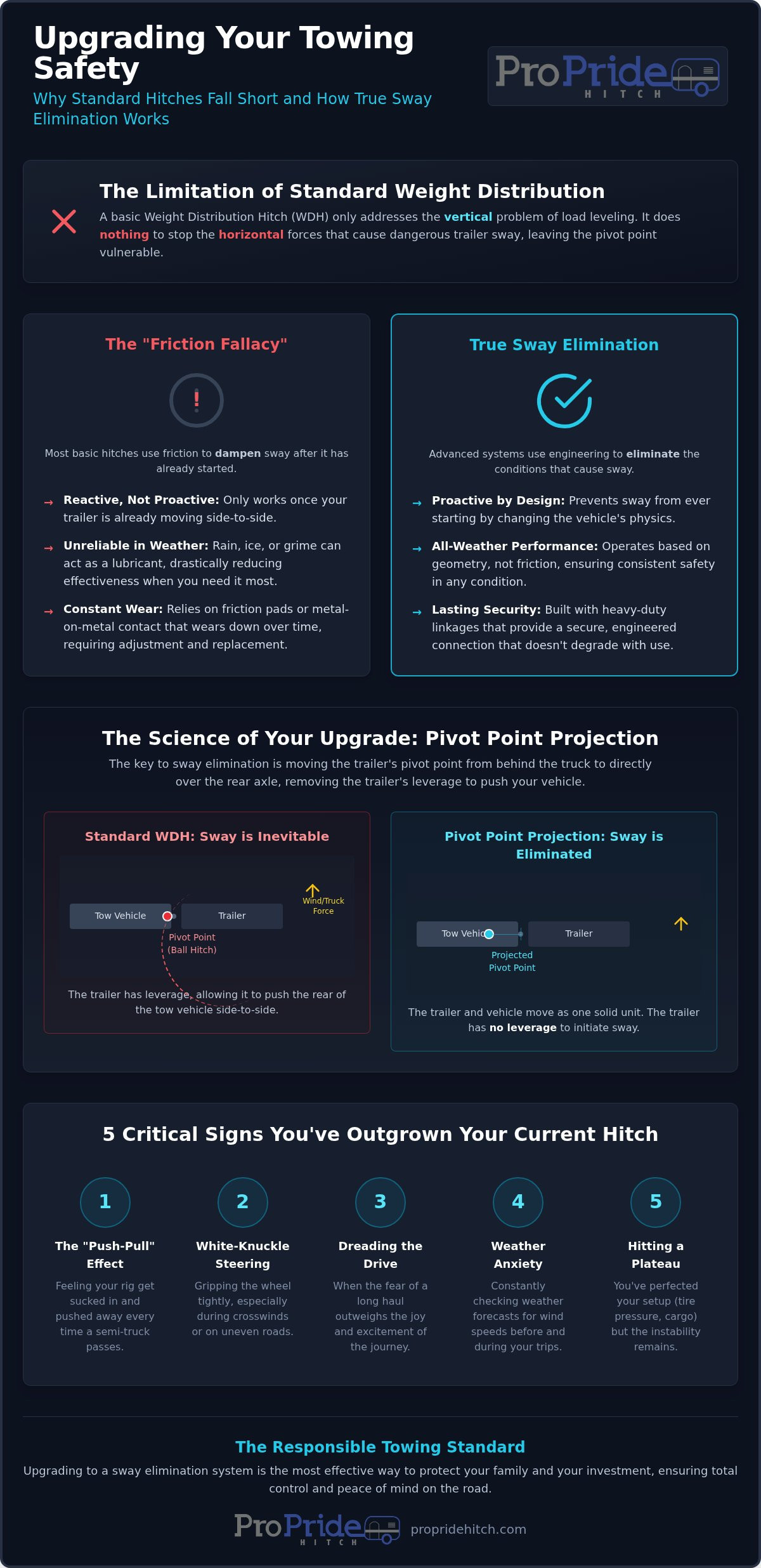
Many drivers assume that if their rig looks level, they're safe. However, weight distribution alone does nothing to stop the lateral forces that cause trailer sway. You might have your bars perfectly adjusted, yet you still feel that unsettling wiggle when a gust of wind hits. This is because basic hitches focus on vertical weight, leaving the horizontal pivot point of the ball-and-coupler completely vulnerable to side-to-side movement. This creates a situation where you are merely dampening a problem rather than eliminating it.
The Friction Fallacy: Why Bars and Bolts Aren't Enough
Most entry-level systems rely on friction to "control" sway. These designs use metal-on-metal contact or friction pads to create resistance. The problem is that friction is inherently reactive. It requires the trailer to actually start swaying before the resistance can slow it down. Engineers call this "break-out force," which is the amount of energy needed to overcome the friction and allow the trailer to move. If the wind or a passing truck provides enough force to "break" that friction, your trailer begins to oscillate.
Practical tip: If you're currently using a friction hitch, always check the friction pads for glazing or excessive wear before a trip; smooth, shiny pads have significantly less "grip" and provide even less sway control. Additionally, friction is notoriously unreliable in poor weather. Rain, road grime, or ice act as lubricants. When your hitch gets wet, the very mechanism meant to keep you stable loses its effectiveness, leaving you most vulnerable when road conditions are at their worst.
Identifying the 'Good Enough' Plateau
Responsible RVers often reach a point where they realize their current setup has hit an engineering plateau. You've checked your tire pressures, adjusted your spring bars, and carefully balanced your cargo, yet the white-knuckle driving persists. This psychological toll is a clear sign that you've outgrown "good enough" equipment. It is the moment when the fear of a passing semi-truck outweighs the joy of the journey.
When you find yourself dreading long hauls or constantly checking the weather for wind speeds, it's time to consider upgrading from a basic WDH. You aren't just looking for a better version of the same tool; you're looking for a different engineering philosophy. Shifting to a system like the ProPride 3P Hitch that eliminates sway entirely is the only way to truly meet The Responsible Towing Standard. It's about moving from a reactive mindset to a proactive one, ensuring that your family's safety is never left to the mercy of a few friction pads.
Friction vs. Pivot Point Projection: The Science of Your Upgrade
To understand why upgrading from a basic WDH is necessary, you first have to understand the physics of your tow vehicle. Think of your trailer as a massive lever and your hitch ball as the pivot point. When wind or a passing truck pushes against the side of your trailer, that force is applied to the hitch ball, which sits several feet behind your truck's rear axle. This creates a leverage advantage for the trailer, allowing it to push the back of your truck side-to-side. In a standard ball-and-coupler setup, sway isn't a glitch; it is a natural result of the mechanical design.
Jim Hensley recognized this fundamental flaw and developed a breakthrough known as Pivot Point Projection. Instead of trying to fight sway with friction after it starts, this technology uses a series of heavy-duty linkages to "project" the trailer's pivot point forward. By moving this effective pivot point to the center of the tow vehicle's rear axle, the trailer loses its leverage. It can no longer push the truck sideways because the force is directed into the axle rather than around it. This shift in physics is exactly what you gain when upgrading from a basic WDH to a superior system.
The Mechanical Advantage of Sway Elimination
The ProPride 3P utilizes a trapezoidal linkage system that essentially locks the truck and trailer into a single, rigid unit while you are driving in a straight line. Because the linkages prevent the coupler from rotating on the ball, the trailer cannot move independently of the truck. However, the moment you turn your steering wheel, the geometry of the linkage shifts, allowing the truck to lead the trailer through the turn effortlessly. It's a specialized design that distinguishes between steering input from the driver and lateral force from the wind.
Practical tip: When you first switch to this system, you might notice that the "feedback" in your steering wheel feels different. This is because the truck is no longer fighting the trailer's movements. Trust the engineering; the lack of steering corrections is a sign that the system is working perfectly. You can learn more about this by exploring the engineering of the ProPride 3P.
Why Engineering Trumps Friction Every Time
Friction hitches are high-maintenance tools. They require constant adjustment, and the pads eventually wear down or become glazed, losing their effectiveness. More importantly, friction is easily overcome by the "bow wave" of a semi-truck. That wall of air pressure hits your trailer with enough force to break the static friction of a basic hitch, leading to that familiar "sucking" feeling as the truck passes.
Pivot Point Projection doesn't rely on "grip" or resistance, so it cannot be "broken" by air pressure or wind. The trailer is mechanically prevented from swaying regardless of how hard the wind blows or how fast a truck passes you. This absolute stability is why Pivot Point Projection is the core of The Responsible Towing Standard. It replaces the unpredictable nature of friction with the immutable laws of physics, ensuring your trailer stays exactly where it belongs: directly behind you.
5 Critical Signs You’ve Outgrown Your Current Weight Distribution Setup
You’ve likely spent hours researching the perfect tow vehicle and trailer combination. However, even the best truck can feel unstable if the connection point is the weak link in your setup. Most towers start with standard equipment, but as you gain experience, you begin to notice the subtle signs that your hitch is no longer providing the security you need. Recognizing these indicators is the first step toward upgrading from a basic WDH to a system that prioritizes your family's safety.
- The Wind App Addiction: If you find yourself checking weather apps for wind speeds before every departure, you're subconsciously acknowledging that your current hitch cannot handle moderate gusts.
- The Semi-Truck Push: Feeling a noticeable "push-pull" sensation every time a large vehicle passes is a clear indicator of mechanical leverage working against you.
- Maxed Out Adjustments: If you’ve reached the maximum tension on your friction bars and still feel instability, you’ve hit the engineering ceiling of your equipment.
- Mental and Physical Exhaustion: Towing shouldn't be an isometric workout. If you need a nap after just three hours of driving due to constant steering corrections, your equipment is the problem.
- Passenger Concern: When your family expresses anxiety about the trailer "wiggling" in the rearview mirror, it’s a red flag that your setup isn't meeting the safety standards they deserve.
Diagnosing the 'Semi-Truck Suck'
When a large vehicle passes you at highway speeds, it creates a massive "bow wave" of air pressure followed by a low-pressure vacuum. A basic friction hitch is often powerless against this pressure differential. The air pushes the back of the trailer, which then uses the hitch ball as a pivot to push the front of your truck in the opposite direction.
By upgrading from a basic WDH to a ProPride 3P Hitch, you change this dynamic entirely. The Pivot Point Projection technology ensures that external air pressure cannot "break" the connection. Practical tip: Pay attention to your steering input. If you're constantly steering "against" the trailer to keep it centered in the lane, your hitch is failing you. A proper setup should allow the truck and trailer to move as a single, stable unit.
The Fatigue Factor: Safety Beyond the Mechanics
White-knuckle driving is more than just an inconvenience; it’s a safety risk. Equipment-induced stress causes the driver to focus entirely on keeping the trailer straight, which reduces the mental bandwidth available to watch for other road hazards. When you aren't fighting your steering wheel, you remain more alert and reactive to traffic changes. Making the responsible decision to upgrade your hardware today prevents a dangerous, fatigue-driven situation tomorrow. This commitment to proactive safety is the hallmark of The Responsible Towing Standard, ensuring that every mile of your journey is as calm as the destination.
Why the ProPride 3P is the Logical Conclusion of Your Research
When you reach the end of your research, you'll realize that most hitches on the market are just variations of the same reactive friction technology. ProPride stands alone because it doesn't try to improve a flawed design. Instead, it replaces it with a superior engineering solution. This is why owners of luxury brands like Airstream and Grand Design almost exclusively turn to us when they are serious about upgrading from a basic WDH. You aren't just buying a piece of hardware; you're adopting The Responsible Towing Standard.
The Jim Hensley Legacy: Authenticity in Design
Jim Hensley’s design legacy is the seal of authenticity for our system. While the rest of the industry was content with basic friction bars, Hensley looked at the trailer as a lever and solved the problem at the pivot point. Sean Woodruff and the ProPride team took that foundational genius and refined it for the modern era. The "3rd Generation" design is built for durability and precision, ensuring that "good enough" never enters the conversation. We treat every hitch as a critical piece of safety equipment, not just a commodity.
Long-Term Value vs. Initial Investment
It's helpful to view the ProPride 3P as an investment in your family's long-term safety. While the initial cost is higher than a basic friction setup, you must compare that to the total value of your tow vehicle, your trailer, and your peace of mind. Because the 3P comes with a lifetime warranty for the original purchaser, it's designed to be the last hitch you'll ever buy. If you eventually move to a different trailer, the hitch stays with you, and it maintains a remarkably high resale value among experienced RVers. You can explore the granular details of this system in our guide on The Physics of the ProPride 3P.
Practical tip: When researching resale value, check specialized RV forums. You'll find that used ProPride hitches are in high demand, which significantly lowers your total cost of ownership over time. If you're ready to experience a stress-free drive, you can secure your ProPride 3P Hitch and join the thousands of travelers who refuse to compromise on safety.
The Transition: What to Expect When Upgrading to the ProPride 3P
When you first see the ProPride 3P, you'll notice it looks nothing like the equipment you're used to. That's because it's an engineering evolution, not just a different brand of the same tool. When upgrading from a basic WDH, the most significant change is that the main hitch unit stays attached to your trailer. Instead of lifting heavy spring bars and greasy ball mounts every time you park, you simply remove the "stinger," which is the heavy-duty adjustable hitch bar that connects your truck to the hitch unit. It's a cleaner, more streamlined process that focuses on precision rather than brute force.
Hitching and unhitching is a different experience, but most owners find it far more logical once they've done it a few times. You use your truck's backup camera to line up the stinger with the hitch box on the trailer. Because the system is built with tight tolerances to ensure a stable connection, alignment is key. Unlike friction hitches, you never have to worry about disconnecting your sway control before backing into a tight campsite. The ProPride 3P remains fully engaged and functional during all maneuvers, integrating perfectly with your existing trailer brakes and electronic backup systems.
Installation and Support for the DIY Owner
Many responsible owners prefer to handle their own equipment setup to ensure they fully understand how it works. You'll be pleased to know that the ProPride 3P is a bolt-on system. This means that for the vast majority of trailers, no drilling or welding is required to achieve a secure fit. We provide exhaustive video guides and have technical support experts available to walk you through the process if you have questions about your specific frame.
Practical tip: Before you begin the installation, take several high-quality photos of your current basic WDH setup and your trailer's A-frame. Having a "before" reference helps you identify exactly where your propane tanks or battery boxes sit, making it easier to position the 3P links for the best possible clearance. Once the 3P is installed, you'll likely find that it offers more flexibility for your tongue weight adjustments than your old friction bars ever did.
The First Trip: A New Standard of Comfort
The "first drive" experience is often described by our customers as a moment of disbelief. When upgrading from a basic WDH, you've become accustomed to the constant micro-corrections required to stay centered in your lane. With the 3P, that tension simply vanishes. The trailer no longer feels like a separate entity pushing against your truck; instead, the two vehicles move as a single, solid unit. This stability is why owners frequently report a 50% reduction in travel fatigue, allowing them to arrive at their destination ready to enjoy their vacation rather than needing hours to recover from the drive.
There is a profound sense of confidence that comes from knowing you are using the "Best Hitch on the Planet." You can drive past semi-trucks and through crosswinds with one hand on the wheel, fully relaxed and in control. This is the peace of mind you've been researching, and it's the only way to truly meet The Responsible Towing Standard. Don't settle for "good enough" when you can set a new standard for your family's comfort and safety.
Secure Your Future on the Open Road
You've spent hours researching and preparing for your travels because you understand that safety isn't something to leave to chance. While a basic friction hitch might have been your starting point, your experience on the road has likely shown you its limitations. Shifting from reactive friction to a proactive engineering solution is the final step in your journey toward total control. By upgrading from a basic WDH, you are choosing to physically eliminate sway through Patented Pivot Point Projection technology rather than just dampening it.
This decision isn't just about hardware; it's about the peace of mind that comes with over 15 years of proven safety performance. You are joining thousands of RVers who have adopted The Responsible Towing Standard to protect their families and their investments. The white-knuckle drives and semi-truck pressure waves can become things of the past, replaced by a relaxed, one-handed steering experience. Trust the engineering of the Jim Hensley legacy and give your family the protection they deserve. Ready to eliminate sway forever? Shop the ProPride 3P Hitch today.
Your next journey should be defined by the scenery, not the stress of the drive. Travel with the confidence that you are using the best technology available.
Frequently Asked Questions
Is the ProPride 3P worth the price compared to a basic WDH?
The ProPride 3P is a long-term investment that provides a level of safety a basic hitch simply cannot match. While the initial cost is higher, you are purchasing the last hitch you'll ever need to buy. It maintains high resale value and includes a lifetime warranty for the original purchaser. When you consider the value of your family's safety and your trailer investment, it becomes the only logical choice for meeting The Responsible Towing Standard.
Can I install the ProPride 3P myself or do I need a professional?
Most owners install the system themselves because it's a bolt-on design requiring no drilling or welding. We provide exhaustive video guides and technical support to ensure your installation is precise. If you're comfortable with basic hand tools and following a methodical process, you'll find the setup straightforward. Taking photos of your frame before you start upgrading from a basic WDH is a practical way to ensure the perfect placement of your new hardware.
Does the ProPride 3P eliminate the need for friction sway bars?
The ProPride 3P completely eliminates the need for friction-based sway control by replacing reactive friction pads with proactive mechanical linkages. Friction hitches only work after sway has already begun, but our system uses Pivot Point Projection to ensure sway never starts in the first place. You can say goodbye to the noise and inconsistent performance of friction bars. This shift toward an engineering-based solution is a core pillar of The Responsible Towing Standard.
Will upgrading to a ProPride 3P increase my towing capacity?
No, the ProPride 3P doesn't increase the towing capacity of your vehicle or trailer. Your maximum towing limits are strictly determined by the manufacturers of your tow vehicle and trailer. Our hitch is designed to make your existing setup safer and more stable by managing the physics of the connection. It ensures you can utilize your vehicle's rated capacity with total confidence and a complete lack of trailer sway, even in challenging road conditions.
How does Pivot Point Projection actually stop sway from starting?
Pivot Point Projection stops sway by using a series of linkages to move the trailer's effective pivot point from the hitch ball to the center of your truck's rear axle. Because the trailer can no longer use the hitch ball as a leverage point, it cannot push the back of your truck sideways. This mechanical locking of the truck and trailer during straight-line travel makes sway physically impossible. It essentially transforms the two vehicles into a single unit.
Is the ProPride 3P compatible with my V-nose trailer or Airstream?
The ProPride 3P is fully compatible with Airstream trailers and most V-nose designs. We offer specialized bracket kits and extension hardware to ensure a perfect fit regardless of your trailer's frame configuration. Owners of luxury trailers often choose our system because it matches the high engineering standards of their rigs. If you have a unique frame or propane tank setup, our technical support team can help you verify the exact hardware needed for a seamless installation.
What happens if I need to back up my trailer with the ProPride 3P installed?
You can back up your trailer exactly as you normally would without making any adjustments to the hitch. Unlike friction-based systems that must be loosened or removed before backing into a tight spot, the ProPride 3P remains fully functional and secure. The system allows for a full range of movement during slow-speed maneuvers. This convenience is one of the most immediate benefits you'll notice after upgrading from a basic WDH to a more advanced engineering solution.
How do I maintain my ProPride hitch after upgrading?
Maintenance is straightforward and centers on keeping the moving parts properly lubricated. You should apply high-quality grease to the zerk fittings every 1,000 to 1,500 miles to ensure the internal bearings move smoothly. Additionally, a quick visual inspection of the bolts and linkages before each trip ensures everything remains torqued to specification. This simple routine keeps your system performing at peak efficiency for decades, fulfilling the promise of a lifetime safety investment for the responsible owner.