What if the white-knuckle driving you experience on the highway isn't actually your fault? Most travel trailer hitch problems aren't simple maintenance failures. Instead, they are often the result of inherent design flaws in traditional equipment that fails to account for the immutable laws of physics. You've likely felt that unsettling tug of trailer sway or spent too much time struggling with hitch alignment during a difficult hookup. These frustrations are common, but they shouldn't be considered a normal part of your journey.
We understand that your priority is protecting your family and your investment on the open road. In this guide, you'll discover how to identify, troubleshoot, and permanently solve the most common travel trailer hitch problems for a safer towing experience in 2026. We will examine why friction-based systems often fail and how technical solutions like pivot point projection offer a superior alternative. By embracing The Responsible Towing Standard, you can move beyond "good enough" equipment and achieve the total peace of mind that comes from true engineering excellence.
Key Takeaways
- Learn to identify the mechanical root causes behind common travel trailer hitch problems, ranging from dangerous trailer sway to persistent grinding noises.
- Discover why traditional friction-based sway control often fails to overcome the laws of physics and how engineering can solve what simple maintenance cannot.
- Master practical troubleshooting steps, such as verifying tongue weight and hitch height, to align your setup with The Responsible Towing Standard.
- Understand how Pivot Point Projection technology physically eliminates sway by moving the trailer’s effective turning point forward to your truck's rear axle.
- Transition from stressful, white-knuckle driving to total confidence by choosing equipment designed for absolute stability and long-term family safety.
The Most Common Travel Trailer Hitch Problems & Symptoms
Driving should be the most relaxing part of your vacation. However, for many owners, the reality is a "white-knuckle" experience where every passing semi-truck or gust of wind causes a heart-pounding moment of instability. These travel trailer hitch problems aren't just minor inconveniences; they are clear indicators that your connection system is struggling to manage the physical forces at play. When your trailer begins to dictate the direction of your tow vehicle, you've moved past simple maintenance issues and into the territory of mechanical failure.
A standard tow hitch relies on a ball-and-coupler design that has remained largely unchanged for decades. This design creates a natural pivot point that allows sway to begin. If you notice your trailer "hunting" behind you or feel a persistent tugging sensation, your hitch is failing to provide the stability required for modern highway speeds. Understanding these symptoms is the first step toward reclaiming your confidence on the road.
To better understand the mechanics of a proper connection and how to avoid common pitfalls, watch this helpful video:
Noise is another primary symptom of travel trailer hitch problems. Persistent pops, groans, and grinding sounds during slow turns or backing up are often dismissed as "normal" for weight distribution systems. In reality, these sounds are the result of intense metal-on-metal friction. While friction-based sway bars use this resistance to dampen movement, the noise tells you that the system is fighting against the natural movement of your vehicle. Over time, this friction leads to significant wear on the hitch ball and the internal components of the coupler.
Visual and Auditory Red Flags
Keep a close eye on your weight distribution bars. If you see uneven scoring or flat spots on the metal, your system isn't distributing weight effectively. Some drivers try greasing the ball to silence the noise, but this is usually a temporary mask. It doesn't solve the underlying mechanical friction; it just makes it quieter. True safety requires a system like the ProPride 3P Hitch, which eliminates the need for friction-based control entirely.
The Emotional Toll of Towing Problems
Hitch anxiety is a real phenomenon that affects your entire travel experience. If you arrive at the campground feeling physically exhausted and mentally drained, your equipment is the culprit. "Good enough" gear forces you to compensate for its limitations with constant steering corrections. Responsible owners prioritize education and engineering over cheap, temporary fixes. By adhering to The Responsible Towing Standard, you ensure that your focus remains on your family's safety rather than the stress of a poorly behaving trailer. Furthermore, many owners extend this commitment to safety by utilizing CCTVSecurityPros - Professional Security Cameras and Systems to protect their rig and campsite from external threats.
Mechanical Causes: Why Traditional Hitches Fail to Perform
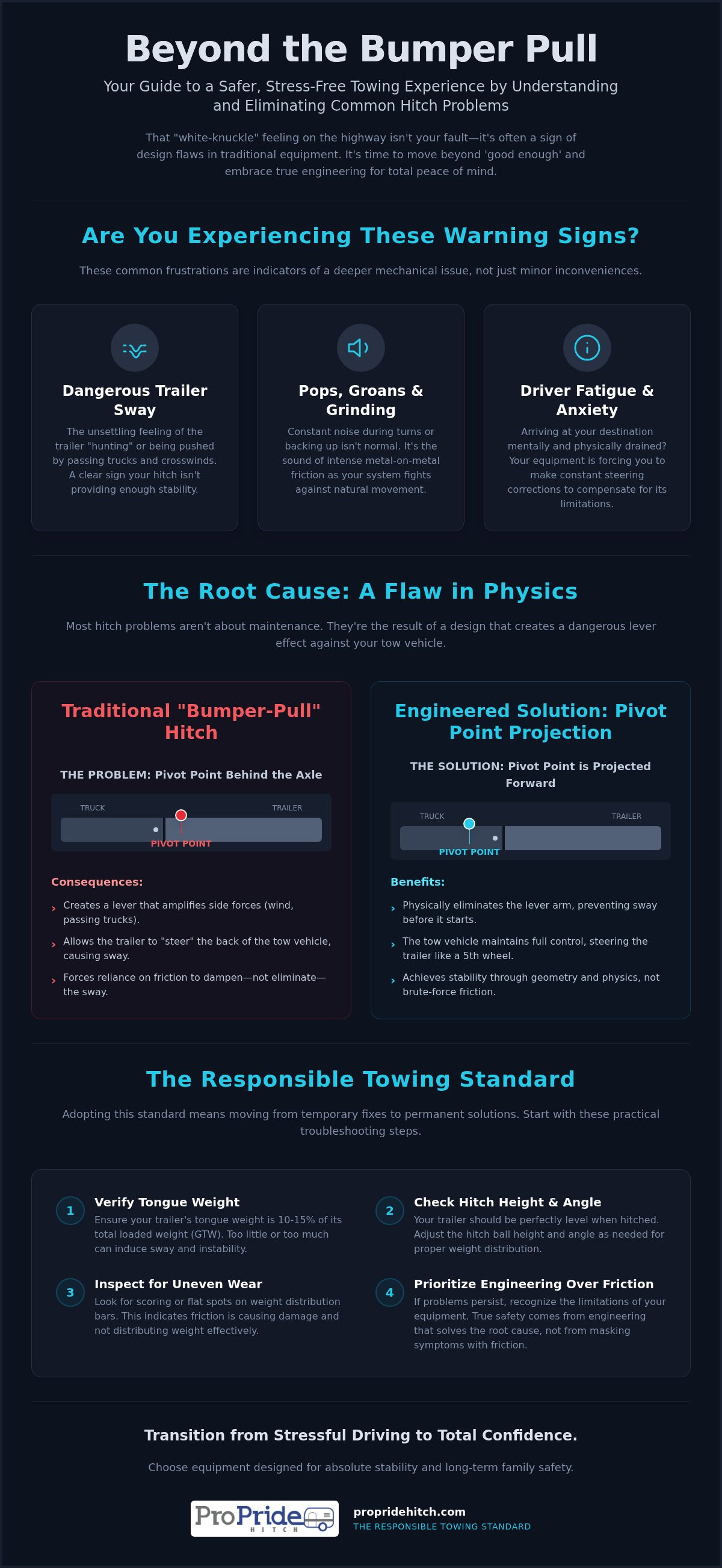
Most travel trailer hitch problems aren't the result of a missed maintenance step or a loose bolt. They are the inevitable outcome of a design that places the trailer's pivot point several feet behind the tow vehicle's rear axle. This "bumper-pull" configuration creates a natural lever. When wind or road ruts apply force to the side of the trailer, that lever amplifies the force and transfers it directly to the truck's suspension. It's a battle against geometry that a standard ball-and-coupler hitch simply isn't designed to win.
The Physics of the Pivot Point
In a traditional setup, the connection point acts as a hinge. Because this hinge sits behind your rear tires, any lateral movement from the trailer creates a steering effect on the tow vehicle. This is why you feel the trailer "pushing" the truck during a lane change or when a large vehicle passes you. Pivot point projection is the engineering alternative to bumper-pull physics that moves the effective turning point forward to the rear axle, physically preventing the trailer from acting as a lever against the truck. Without this mechanical advantage, you're forced to rely on friction to keep things straight.
Limitations of Friction Sway Bars
Traditional sway control relies on heavy-duty "friction bars" that essentially try to stiffen the hitch connection. While this might dampen minor movements, friction is a notoriously unreliable way to manage the massive kinetic energy of a multi-ton trailer. These systems fight against physics rather than working with them. One major drawback is their performance in adverse weather. Because friction depends on dry surfaces, you often have to "turn off" or loosen your sway control in rain or snow to avoid losing traction. This means you have the least amount of protection exactly when road conditions are at their most dangerous.
Over time, the pads in these friction systems wear down, leading to a steady decline in effectiveness. You might find yourself constantly tightening the bars to achieve the same level of stability you had when the equipment was new. This cycle of adjustment and wear is a hallmark of "good enough" equipment. If you're tired of equipment that loses its grip when you need it most, you might consider investigating the ProPride 3P Hitch to see how engineering can replace friction entirely.
Adhering to The Responsible Towing Standard means recognizing that weight distribution and sway control are two distinct tasks. Weight distribution is designed to level your vehicle by shifting tongue weight to the front axle; sway control is designed to keep the trailer in line. Most travel trailer hitch problems occur because owners assume a weight distribution hitch will automatically solve sway. In reality, unless the hitch uses advanced geometry to project the pivot point, it's only solving half of the safety equation.
Maintenance vs. Engineering: Solving Problems Before They Start
Many owners spend hours every season cleaning, degreasing, and reapplying lubricants to their equipment in an attempt to silence the groans of a struggling setup. While keeping your gear clean is important, it is a mistake to believe that maintenance can overcome a fundamental lack of engineering. Most travel trailer hitch problems persist because they are rooted in the mechanical design of the hitch itself. If your hitch relies on friction to provide stability, no amount of grease or adjustment will ever truly eliminate the risk of sway.
Adopting The Responsible Towing Standard means moving beyond the cycle of constant "fixing." It involves choosing equipment that is designed to perform correctly from the first mile to the last. While traditional hitches require you to manage symptoms through repetitive labor, a precision-engineered system allows you to focus on the journey ahead. High-end consumers value "set it and forget it" engineering because it provides a level of reliability that manual maintenance simply cannot match.
The Maintenance Trap
Traditional hitches often involve a tedious list of chores. You have to check the torque on your sway control bolts, clean the hitch ball to prevent abrasive wear, and monitor the thickness of your friction pads. There is a hidden danger in this process: friction pads thin out over time. As they wear down, your sway control becomes less effective, often without you noticing until a gust of wind catches you off guard. If you are using a standard setup, make it a habit to measure your friction material every 1,000 miles to ensure it still meets the manufacturer's minimum specifications.
By contrast, the ProPride 3P Hitch significantly reduces the need for the messy grease and constant adjustments associated with traditional gear. Because the system uses a series of heavy-duty links and bearings rather than a sliding ball-and-coupler connection, the primary points of wear are protected from the elements. This design ensures that your safety isn't dependent on how much grease you applied that morning.
Investing in Engineering Excellence
Engineering a solution is always safer than managing a symptom. When you invest in a superior design, you are protecting more than just your peace of mind; you are protecting your trailer and tow vehicle from unnecessary stress. A trailer that sways creates a constant "sawing" motion on your tires and suspension, leading to premature wear on expensive components. A hitch that eliminates sway entirely removes these lateral forces, allowing your vehicle to operate as the manufacturer intended.
The long-term value of a precision system is found in its durability. Friction-based hitches have a limited lifespan because their very function depends on wearing down components to create resistance. A precision-engineered system is a permanent solution. By prioritizing high-quality information and acting responsibly through your equipment choices, you ensure that your towing setup remains a specialized partner in your lifestyle for years to come.
The Responsible Towing Standard: Troubleshooting & Prevention Tips
Superior engineering provides the foundation for safety, but every owner must understand how to properly configure their rig. Troubleshooting travel trailer hitch problems begins long before you put the truck in gear. By following a methodical approach to your setup, you ensure that your equipment operates within its designed parameters. Adhering to The Responsible Towing Standard isn't just about owning the right gear; it's about the diligence you bring to every single trip.
Calculating and Managing Tongue Weight
Tongue weight is the downward force the trailer's coupler exerts on the hitch. For a stable and predictable tow, this should generally be between 10% and 15% of your total loaded trailer weight. If this weight is too low, the trailer will be inherently prone to swaying. If it's too high, it can overload your tow vehicle's rear tires and compromise your steering. To maintain balance, follow the 60/40 rule: load 60% of your cargo weight in the front half of the trailer. You can use a dedicated tongue weight scale or visit a commercial CAT scale to get precise measurements. For more detail, read our guide on How to Correctly Calculate Your Trailer Tongue Weight.
Pre-Trip Inspection Checklist
A thorough walk-around is the cornerstone of responsible ownership. Improper hitch height is a major cause of travel trailer hitch problems. A "nose-high" trailer is significantly more unstable because it shifts weight off the tongue and back onto the trailer axles. Aim for a level or slightly "nose-low" profile to keep the center of gravity stable.
- Inspect pins and clips: Look for any signs of bending, cracking, or stress in the metal.
- Check electrical connections: Clean plugs and check for corrosion to ensure your trailer brakes and lights respond instantly.
- Evaluate metal fatigue: Look for hairline cracks around the welds of a traditional coupler or hitch head.
- Verify tension: Ensure your weight distribution bars are under the correct tension to return your truck's front-end height to its uncoupled state.
Finally, evaluate your current sway control. Ask yourself if your system is merely reacting to sway after it starts or if it's physically preventing it from occurring. Traditional friction bars are reactive; they wait for a problem to happen before they start working. If you want a setup that stops sway before it ever reaches your steering wheel, it's time to move beyond traditional equipment. You can invest in the ProPride 3P Hitch to see how precision engineering redefines highway safety and family protection.
Eliminating Hitch Problems with Pivot Point Projection Technology
Most travel trailer hitch problems are simply the symptoms of an outdated ball-and-coupler design that has not changed in nearly a century. To truly solve these issues, you must change the geometry of the connection between your truck and trailer. The ProPride 3P Hitch represents the pinnacle of this shift. It utilizes a concept called Pivot Point Projection to physically prevent sway before it ever begins. If you have struggled with persistent travel trailer hitch problems, this system offers a permanent engineering fix rather than a temporary maintenance patch.
The Jim Hensley Legacy
Jim Hensley is widely recognized as the most famous name in hitch innovation. His original linkage design revolutionized the industry by acknowledging that friction is an inadequate solution for highway safety. ProPride has refined this original concept to meet the rigorous demands of 2026 travel standards. Modern trailers are larger and heavier than those of previous decades, requiring a hitch capable of managing those increased forces. For a deeper look at the mechanics behind this design, you can explore The ProPride 3P Hitch: The Ultimate Engineering Solution.
The 3P system uses a series of heavy-duty links that project the trailer's effective pivot point directly over the rear axle of your tow vehicle. In a standard setup, the trailer pivots on the bumper, which acts like a lever that can push your truck around. By moving that pivot point forward, the trailer can no longer act as a lever against your vehicle. This mimics the stability of a 5th wheel trailer while maintaining the convenience of a bumper-pull configuration. It is the only logical conclusion for an owner who values the laws of physics over marketing promises.
Making the Switch to ProPride
When you take your first tow with a 3P system, the difference is immediate. You'll notice the total absence of the "sucking" sensation when a semi-truck passes you and the lack of steering corrections usually required in heavy crosswinds. This is what it means to uphold The Responsible Towing Standard. You are no longer reacting to your trailer; you are in total control of it. This creates a stress-free environment that allows you to arrive at your destination feeling refreshed rather than exhausted.
If you are switching from a friction-based system, remember that the 3P main unit stays on the trailer. You won't have to lift heavy bars or deal with greasy hitch balls every time you hook up. Use the adjustable jacks to fine-tune your weight distribution with a simple wrench, making the process faster and more precise than traditional chain-link systems. Investing in the right equipment is the most responsible decision you can make for your family's safety. Upgrade to the ProPride 3P and experience the Responsible Towing Standard today.
Reclaim Your Confidence on the Open Road
Travel trailer hitch problems don't have to be a permanent part of your journey. You've learned that symptoms like trailer sway and grinding noises are often the result of traditional design limitations rather than simple maintenance oversights. While verifying your tongue weight and maintaining a level hitch profile can improve stability, true peace of mind comes from moving beyond reactive equipment. Embracing The Responsible Towing Standard means choosing a solution that eliminates the mechanical possibility of sway entirely.
The ProPride 3P represents the ultimate evolution of Jim Hensley’s legendary design legacy. It utilizes patented Pivot Point Projection technology to ensure your trailer remains locked in place, even in high winds and heavy traffic. Because we stand by our engineering excellence, the ProPride 3P includes a lifetime warranty for as long as you own it. It's time to stop fighting physics and start enjoying the stability you deserve. Experience The Responsible Towing Standard with the ProPride 3P® Hitch and discover the safest way to travel with your family.
Frequently Asked Questions
What are the most common signs of travel trailer hitch failure?
Common signs of travel trailer hitch problems include persistent trailer sway, groaning noises during turns, or uneven tire wear on the tow vehicle. If you feel a "sucking" sensation when trucks pass or see flat spots on your weight distribution bars, your equipment is struggling. A responsible owner inspects these components before every trip to ensure the connection remains secure and the metal isn't showing signs of fatigue.
How do I stop my trailer from swaying at high speeds?
To stop sway at high speeds, you must address the physics of the pivot point behind your bumper. While reducing speed to match state limits like California's 55 mph can help, the only permanent solution is a hitch that prevents lateral movement through mechanical design. Ensure your tongue weight is between 10% and 15% of the total trailer weight to provide a stable foundation for the journey.
Is it normal for my weight distribution hitch to make noise?
Noise is common in traditional friction-based hitches, but it indicates intense metal-on-metal friction as the bars fight to dampen movement. Those pops and squeaks tell you the system is under significant stress. While some manufacturers suggest greasing these points, doing so can actually reduce the effectiveness of friction-based sway control. Precision-engineered systems avoid this trade-off by eliminating friction requirements entirely.
Can a bad hitch cause my tow vehicle to shake?
Yes, a poorly configured or worn hitch can cause significant vibration or "bucking" in your tow vehicle. This often happens when weight isn't distributed correctly to the front axle, causing the truck to feel light or disconnected from the road. Checking your hitch height to avoid a "nose-high" trailer is a critical troubleshooting step to ensure your truck's steering and suspension perform as intended.
Do I really need a sway control hitch for a small travel trailer?
Small trailers require sway control because their shorter wheelbase can make them more reactive to wind and steering inputs. A sudden gust can whip a small trailer more violently than a heavy one, potentially leading to a loss of control. Adhering to The Responsible Towing Standard means protecting your family and your investment regardless of the trailer's size or weight.
How often should I grease my trailer hitch ball?
For a standard ball-and-coupler setup, you should apply a thin layer of specialized hitch grease before every trip. This reduces the abrasive wear that leads to travel trailer hitch problems over time. However, a major benefit of the ProPride 3P is that it uses a different mechanical connection that eliminates the need to constantly grease a hitch ball, keeping your equipment cleaner and more reliable.
What is the difference between a friction hitch and a ProPride 3P?
A friction hitch tries to slow down sway after it starts by using resistive pads. The ProPride 3P uses Pivot Point Projection to move the trailer's effective turning point forward to the truck's rear axle. This mechanical shift makes it impossible for the trailer to sway, providing a level of stability that friction-based systems simply cannot achieve through resistance alone.
Can I install a ProPride 3P hitch myself to solve these problems?
Yes, the ProPride 3P is designed for installation by the owner using common hand tools. Most responsible owners find the process straightforward because the hitch bolts directly to the trailer frame without the need for welding or specialized shop equipment. We provide detailed instructions and technical support to ensure your installation meets the highest safety standards for your upcoming travels.