
Most drivers believe that trailer sway is an unavoidable tax you pay for the freedom of the open road. You've probably felt that sudden, sickening tug on the steering wheel when a semi-truck passes or a sharp gust of wind catches your trailer. It's a terrifying moment that makes you realize how little control you actually have with a traditional setup. If you're searching for the safest weight distribution hitch, you've likely noticed that most products rely on friction to simply dampen movement. But damping a problem isn't the same as solving it. Real safety doesn't come from managing a trailer's bad behavior; it comes from using physics to ensure that behavior never starts in the first place.
We understand that as a responsible owner, you've spent hours researching how to protect your family and your investment. You want more than just a "good enough" solution; you want absolute peace of mind. In this guide, we'll explain how Pivot Point Projection technology creates a virtual hitch point near your rear axle, making your truck and trailer move as a single, stable unit. You'll discover why moving beyond friction-based systems is the only way to achieve The Responsible Towing Standard. We're going to dive deep into the engineering that eliminates sway entirely, giving you the confidence to enjoy the journey as much as the destination.
Key Takeaways
- Learn why the safest weight distribution hitch is one that physically eliminates sway through geometry rather than just trying to slow it down with friction.
- Understand the physics of Pivot Point Projection and how it creates a virtual pivot point near your rear axle for maximum stability.
- Discover how to accurately calculate your trailer's loaded tongue weight to ensure your equipment meets The Responsible Towing Standard.
- Get a practical 5-point safety checklist to use before every trip to ensure your hitch and trailer are properly secured.
- Master the art of cargo placement to maintain the ideal 10-15% tongue weight ratio, which is critical for highway control.
What Defines the Safest Weight Distribution Hitch in 2026?
Safety on the road isn't a matter of luck or driving skill alone. It's determined by the mechanical connection between your truck and your trailer. When we talk about the safest weight distribution hitch, we aren't just looking for a tool that helps level your ride. A truly safe system must address two critical forces simultaneously: the vertical load on your axles and the lateral forces that cause sway. Most equipment on the market fails because it treats these as separate issues or focuses only on one.
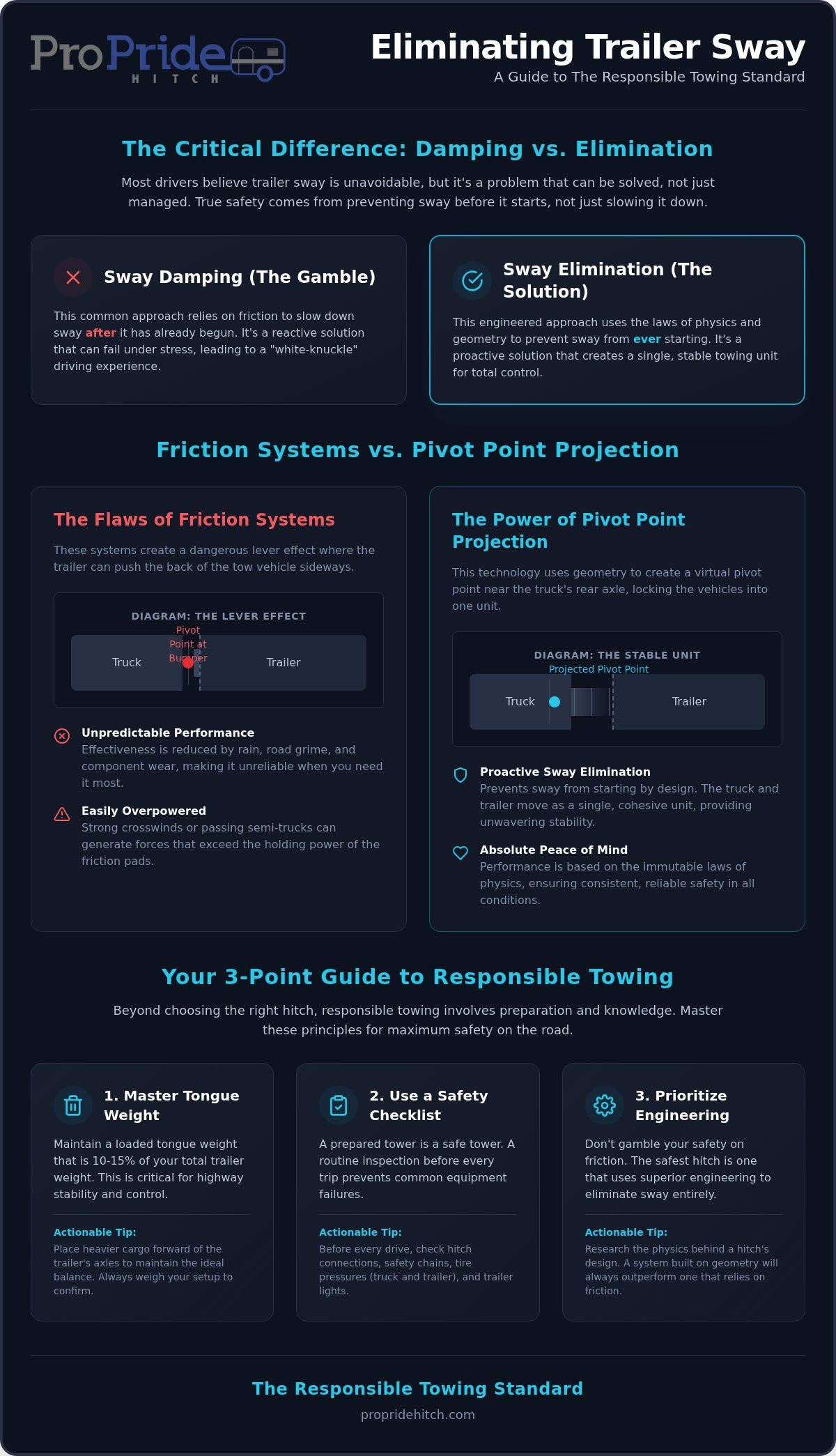
Many people confuse "sway control" with "sway elimination." Traditional systems use friction to try and slow down sway once it has already started. This is like trying to put out a fire after it's already engulfed the kitchen. A safety-first approach focuses on prevention. By using the immutable laws of physics and engineering excellence, a superior hitch ensures that the trailer simply cannot begin to sway in the first place. This commitment to preparation and using superior equipment is what we call The Responsible Towing Standard.
The Core Components of Towing Safety
A weight-distributing hitch is designed to shift tongue weight forward to the front axle of the tow vehicle. This restores steering control and braking power, which are often lost when a heavy trailer causes the truck's nose to point upward. However, weight distribution is only half the battle. Stopping the "tail wagging the dog" through total sway prevention is the primary safety priority for any driver. In an emergency maneuver, the structural integrity of the hitch head determines whether your equipment holds together or fails under extreme stress. Choosing materials that exceed standard ratings is vital for long-term peace of mind.
Why 'Good Enough' Equipment Fails the Responsible Tower
Relying on friction-based sway control is a gamble that often results in white-knuckle driving. These systems can be easily overcome by high winds, passing semis, or sudden changes in speed. Traditional hitches allow the trailer to act as a powerful lever against the rear of your truck, which can lead to a loss of control in seconds. The ProPride 3P Hitch replaces this outdated lever effect with geometry that locks the truck and trailer into a single unit. The Responsible Towing Standard is the benchmark for modern RVers who prioritize the safety of their family and the security of their investment through disciplined research and better engineering.
Friction Systems vs. Pivot Point Projection: The Physics of Safety
Understanding the mechanical forces at play during towing is the hallmark of The Responsible Towing Standard. Most traditional hitches rely on friction to manage trailer movement. Imagine these systems as a set of secondary brakes for your hitch. When the trailer begins to swing, the friction bars or pads rub together to resist that motion. While this can dampen small vibrations, it is a reactive solution. It requires the sway to actually begin before the hitch can do its job. In contrast, Pivot Point Projection (PPP) uses geometry to change the physical relationship between the tow vehicle and the trailer.
The Flaws of Friction-Based Sway Control
Friction is inherently unpredictable because it depends on environmental conditions. Rain, road grime, or even a small amount of grease can significantly reduce the effectiveness of friction-based bars. As these components wear down over time, their ability to "grip" and slow down sway diminishes. This often leads to the "white-knuckle" experience, where the driver feels every gust of wind or passing semi-truck. There is a specific threshold of failure where the lateral force of the trailer exceeds the holding power of the friction. At that point, the system is simply not enough to stop a dangerous sway event.
Actionable Tip: If you currently use a friction hitch, inspect your friction pads for glazing or excessive wear before every long trip. If the surfaces look smooth and shiny like glass, they won't provide the resistance you need in a crosswind.
How Pivot Point Projection Eliminates Sway
The ProPride 3P trailer sway control hitch utilizes the Jim Hensley design to move the trailer's pivot point forward. In a standard ball-and-coupler setup, the trailer pivots at the bumper, acting as a long lever that can easily push the back of your truck sideways. The 3P uses a series of heavy-duty linkage arms to project that pivot point over the rear axle of the tow vehicle. This geometry makes it physically impossible for the trailer to initiate a pivot on its own. Because the trailer no longer has a lever arm to work against the truck, the two vehicles move as a single, unified unit.
For a hitch to be considered the safest weight distribution hitch, it must function as a solid link during highway driving while still allowing for tight turns in the campground. The 3P achieves this by allowing the truck to dictate the direction of the trailer through the linkage arms, but refusing to let the trailer dictate the movement of the truck. This shift in physics provides a level of stability that friction systems simply cannot match. If you are ready to move beyond "good enough" equipment, you can explore the engineering of the 3P system here.
Critical Evaluation Criteria for a Safety-First Hitch
Selecting the safest weight distribution hitch requires you to look past shiny powder coatings and focus on raw mechanical integrity. Accuracy in weight ratings is your first line of defense. Many owners rely on the "dry weight" provided by trailer manufacturers; however, once you add batteries, full propane tanks, and camping gear, your tongue weight can jump by 200 pounds or more. A safety-first hitch must be rated for your actual, fully loaded weight to prevent structural failure or unpredictable handling. If your hitch is underrated, the spring bars cannot effectively move weight to the front axle, leaving your steering feeling light and disconnected.
Precision manufacturing and heavy-duty steel aren't just about how long the equipment lasts; they're about how it performs during an emergency. If a hitch is overly complex or frustrating to hook up, it invites user error. A responsible tower knows that a system that's easy to set up correctly every time is inherently safer than a complex one that might be adjusted incorrectly in a rush. Additionally, consider the "backing up" test. Some traditional systems require you to remove sway bars before reversing to avoid damaging the frame. The ProPride 3P Hitch remains fully engaged, ensuring you're never unprotected during any maneuver, whether you're cruising at 65 mph or backing into a tight campsite.
Understanding Tongue Weight and Distribution
Weight distribution is about more than just leveling your trailer. Its primary job is restoring the vertical load to the front tires of your truck. When a trailer pushes down on the bumper, it acts as a fulcrum, lifting the nose of the truck and reducing traction. This loss of grip makes steering vague and increases your emergency braking distance significantly. Proper distribution ensures your truck's safety systems, like ABS and electronic stability control, function exactly as the manufacturer intended. For a deeper look at specific trailer applications and how to calculate these loads, see our Weight Distribution Hitches: The Definitive Guide.
The Role of Engineering in Emergency Maneuvers
In a sudden swerve or lane change, a trailer acts as a massive pendulum. A hitch that eliminates sway provides the driver with vital "recovery room" by keeping the tow vehicle's rear end stable. When the trailer is locked into a single unit with the truck, you can focus on steering through the obstacle rather than fighting a jackknife. This level of control is what separates the safest weight distribution hitch from one that merely meets the minimum requirements. Adopting these high standards is the only way to truly meet The Responsible Towing Standard.
Actionable Tip: Before every departure, perform a physical "touch test" on your hitch pins and weight distribution jacks. Ensure everything is seated, pinned, and under the correct tension. This simple 60-second habit prevents the most common equipment-related accidents on the road.
Actionable Safety Tips for the Responsible Towing Standard
Hardware provides the mechanical foundation for your safety, but a diligent researcher knows that true security on the road is a continuous process. Even if you have invested in the safest weight distribution hitch, your habits and preparation determine the final outcome of every trip. The Responsible Towing Standard involves a commitment to thoroughness that starts long before you shift into drive. By following a disciplined routine, you ensure that your equipment performs exactly as the engineers intended.
Stability begins with how you pack your trailer. You should always aim for a tongue weight between 10% and 15% of your total loaded trailer weight. Placing heavy cargo over the axles or slightly forward helps maintain this critical balance. If you load too much weight in the rear of the trailer, you create a pendulum effect that forces your hitch to work much harder to maintain control. Proper loading ensures that the physics of your tow vehicle and trailer remain in your favor during high winds or sudden maneuvers.
Don't overlook the link between your hitch and the pavement: your tires. Under-inflated tires have softer sidewalls, which allow for excessive lateral flex. This flex can mimic the sensation of sway and reduce the overall effectiveness of your weight distribution system. Ensure all tires on both the truck and trailer are inflated to the manufacturer's recommended cold pressure to provide the stiffest, most stable connection to the road surface.
The Responsible Tower's Pre-Flight Checklist
Before every departure, verify that your weight distribution jacks are set to the correct tension for your current load. Because your cargo weight can change between trips, the tension required for peak performance may also vary. Check your safety chains and electrical umbilical cord to ensure they have enough slack for tight turns but aren't dragging on the ground. You can verify complete hitch engagement by pulling against the trailer's wheel chocks while the jacks are still slightly extended. This simple test confirms the mechanical connection is secure before you take on highway speeds.
Long-Term Maintenance for Peak Safety
Maintaining your safety investment ensures it lasts for the life of your trailer. Regular greasing of the main hitch head is essential to ensure smooth pivot point projection and prevent internal wear. You should also periodically inspect your weight distribution bars and u-bolts for any signs of fatigue or loosening. For specific steps on keeping your system in top condition, you can review our ProPride 3P Hitch Troubleshooting guide. If you want to ensure your setup meets the highest possible safety benchmarks, explore the ProPride 3P system today.
The ProPride 3P: Why it is the Safest Hitch on the Planet
After examining the physics of sway and the limitations of traditional equipment, it becomes clear that safety isn't a sliding scale; it's a binary choice between managing a problem or eliminating it. The ProPride 3P stands alone as the safest weight distribution hitch because it is the only system that uses advanced geometry to physically prevent the trailer from initiating sway. While other manufacturers are content with "good enough" friction-based designs, we rely on the Jim Hensley design legacy to provide a level of security that has been refined over decades of engineering excellence. This isn't just a part you add to your trailer; it's a lifetime investment in your family's protection.
Choosing the 3P means you are no longer at the mercy of passing semis or sudden crosswinds. The emotional value of this peace of mind cannot be overstated. When you know your truck and trailer are locked into a single, stable unit, the anxiety of highway driving evaporates. You can focus on the road ahead rather than constantly checking your mirrors for the first sign of a swaying trailer. This transition from a stressful chore to a relaxed journey is what happens when you adopt The Responsible Towing Standard.
The Ultimate Engineering Solution
The core differentiator of the 3P is Pivot Point Projection. By projecting the trailer's pivot point forward over the rear axle, the hitch eliminates the lever effect that causes sway. This design also offers practical benefits that friction bars simply can't match. For instance, because there are no friction pads to bind or "pop," the 3P allows for much tighter turns and smoother backing maneuvers. You don't have to get out of your truck to disconnect sway bars before you reverse into a tight campsite. We invite you to join a community of responsible towers who refuse to compromise on their safety or their equipment's performance.
Actionable Tip: Before your first long trip with a 3P, spend thirty minutes in an empty parking lot practicing low-speed turns and backing. You will immediately notice that the trailer follows the truck with much more precision than a standard ball-and-coupler setup. This practice builds the "muscle memory" needed to handle tight gas stations and campgrounds with total confidence.
Your Path to Stress-Free Towing
Investing in the 3P is a commitment to a higher level of preparation and knowledge. It is a lifestyle choice for those who value their investment and the lives of those inside their vehicle. By choosing the best technology available, you ensure that every mile you drive is backed by the laws of physics rather than the hope that your friction bars will hold. It's time to stop fighting your trailer and start enjoying the open road. Invest in the ProPride 3P Trailer Sway Control Hitch today and experience the true meaning of towing confidence.
Secure Your Future on the Open Road
You've done the research and you understand that true safety isn't found in a "good enough" friction bar. It's found in the immutable laws of physics. By choosing the safest weight distribution hitch, you're moving beyond reactive sway control and embracing the total sway elimination of the ProPride 3P. This system, built on Jim Hensley's legendary design legacy and patented Pivot Point Projection technology, transforms your towing experience. It turns a white-knuckle drive into a stable, predictable journey where your truck and trailer act as one.
Every ProPride 3P comes with a lifetime warranty, cementing its status as the Best Hitch on the Planet. It's time to stop managing risk and start eliminating it. Make the choice to protect your family and your investment with a solution that sets a new benchmark for highway stability. You've educated yourself on the mechanics of safety; now it's time to put that knowledge into practice.
Upgrade to the ProPride 3P - The Responsible Towing Standard
We look forward to seeing you out on the road, towing with the absolute confidence you and your family deserve.
Frequently Asked Questions
Is a weight distribution hitch really safer than just a sway bar?
A weight distribution hitch is significantly safer because it restores the balance of your tow vehicle while a sway bar only tries to dampen trailer movement. While a sway bar uses friction to slow down sway that has already started, a weight distribution hitch shifts weight to your truck's front axle. This restores steering and braking control. For the highest level of security, the safest weight distribution hitch will combine load leveling with total sway elimination.
Can the safest weight distribution hitch actually prevent all trailer sway?
The ProPride 3P is engineered to prevent all trailer sway by using geometry to lock the truck and trailer into a single unit. Unlike friction hitches that merely resist motion, our Pivot Point Projection technology makes it physically impossible for the trailer to pivot on the ball through lateral forces. This proactive approach ensures that wind gusts or passing semis cannot initiate a sway event. It provides the absolute peace of mind that responsible towers demand.
How much tongue weight can the ProPride 3P safely handle?
The ProPride 3P is available in several models designed to handle tongue weights ranging from 600 lbs up to 1,500 lbs. To stay within The Responsible Towing Standard, you must choose a hitch based on your actual loaded tongue weight, not the dry weight listed in your trailer's manual. Selecting the correct capacity ensures that the heavy-duty spring bars can effectively distribute the load and maintain vehicle stability throughout your journey.
Do I still need a sway bar if I have a ProPride 3P hitch?
No, you don't need an additional sway bar because the 3P system is designed to eliminate sway entirely without the help of friction devices. Traditional sway bars are reactive tools that struggle to keep up with the forces of a large trailer. The 3P uses mechanical linkage to project the pivot point forward, making external bars redundant. Adding friction bars would only complicate your setup without providing any additional safety benefit.
What happens if I have an emergency swerve with a 3P hitch?
In an emergency swerve, the 3P hitch ensures your trailer follows the truck's path exactly rather than acting as a dangerous pendulum. Because the trailer is mechanically prevented from pivoting on the hitch ball, it cannot push the rear of your truck sideways. This stability gives you the recovery room needed to steer through an obstacle safely. It transforms a potential jackknife situation into a controlled maneuver that you can manage with confidence.
Is the ProPride 3P compatible with all travel trailer frames?
The ProPride 3P is compatible with the vast majority of travel trailer frames, including standard A-frames and those with underslung couplers. The system uses adjustable brackets that can be moved to clear propane tanks or battery boxes. If you have a unique frame design, we recommend measuring your frame depth to ensure the brackets seat properly. This versatility makes it an ideal choice for the informed researcher looking for a universal safety solution.
How often should I inspect my weight distribution hitch for safety?
You should perform a visual check before every departure and a detailed mechanical inspection every 1,000 miles. Ensure all bolts are tight and the weight distribution jacks are greased and moving freely. Actionable Tip: Use a paint pen to mark your bolt heads; a quick glance will tell you if any have vibrated loose. This consistent maintenance routine is essential for ensuring your equipment performs at its peak for the life of your trailer.
Does the safest hitch improve my truck's braking performance?
Yes, the safest weight distribution hitch improves braking by restoring the vertical load to your truck's front tires. When a trailer causes your truck's nose to lift, you lose significant stopping power because your front brakes do most of the work. By leveling the rig, the hitch ensures your front tires maintain maximum traction. This allows your vehicle's anti-lock braking system to function exactly as the manufacturer intended during an emergency stop.