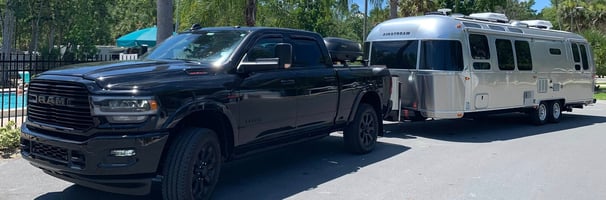
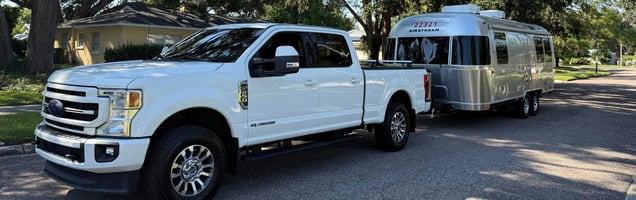
Many RV owners believe that towing experience automatically eliminates risk.
After thousands of miles on the road, experienced RVers know how to load their trailer, monitor tongue weight, and drive cautiously in wind or heavy traffic.
But even seasoned travelers can unknowingly rely on common assumptions about towing stability that simply aren’t true.
In fact, many trailer sway incidents happen to drivers who are doing everything they believe is correct.
Why?
Because stability is not just about driving skill. It’s about physics and engineering.
Understanding the most common towing mistakes—even among experienced RV owners—can dramatically improve safety, comfort, and confidence on the road.
The 3 Most Common Towing Mistakes
Three misconceptions appear again and again among experienced RV owners:
- Assuming weight distribution eliminates sway
- Believing a bigger truck will solve the instability
- Ignoring the role of hitch geometry
Each mistake is understandable. Each is widely believed. And each can lead to unnecessary towing stress.
Let’s break them down.
Mistake #1: Assuming Weight Distribution Eliminates Sway
Many RV owners install a weight distribution hitch and assume their sway problems are solved.
Weight distribution systems are important. They redistribute the downward force of the trailer tongue across the tow vehicle’s axles, helping maintain proper ride height and steering control.
But there’s a critical distinction many people miss:
Weight distribution manages vertical loads—it does not eliminate lateral sway forces.
Trailer sway is primarily caused by side-to-side rotational movement, also known as yaw.
When crosswinds, passing trucks, or road disturbances push against the trailer, they create rotational force around the hitch point.
This rotational force follows a basic mechanical relationship:
In towing:
- F represents lateral forces like wind or road disturbances
- r represents the distance from the hitch pivot to the trailer’s center of mass
- τ represents the resulting rotational torque that initiates sway
Weight distribution does not change this pivot relationship.
Even perfectly balanced trailers can still experience sway because the trailer remains free to rotate around the hitch ball.
This is why many RVers still experience instability despite properly setting up their weight distribution hitch.
Mistake #2: Believing Bigger Trucks Solve Instability
Another common belief is that upgrading to a larger truck will solve sway issues.
While moving from a half-ton pickup to a three-quarter-ton truck may improve towing capacity, the change doesn’t necessarily address the root cause of trailer sway.
Larger trucks provide:
- More engine power
- Stronger suspension components
- Higher tow ratings
But the basic connection between the trailer and tow vehicle remains the same: a ball hitch pivot point behind the rear axle.
This means the trailer can still initiate rotational motion independent of the truck.
Even powerful trucks can experience sway when towing:
- Long travel trailers
- Tall RVs with large wind profiles
- Trailers encountering crosswinds or passing trucks
Many RV owners report upgrading trucks only to discover that the towing experience feels surprisingly similar.
The reason is simple:
Power helps pull the trailer.
It does not necessarily stabilize it.
Mistake #3: Ignoring Hitch Geometry
Perhaps the most overlooked factor in towing stability is hitch geometry.
Traditional hitch systems place the pivot point—the location where the trailer rotates—directly at the hitch ball behind the tow vehicle.
This location creates a mechanical setup where the trailer acts like a lever arm behind the truck.
When wind or road forces push against the trailer, that long lever arm generates torque around the hitch.
Once rotation begins, the driver must correct it with steering input.
Many anti-sway systems attempt to manage this motion using friction damping, which resists trailer movement once it begins.
But friction does not change the underlying geometry of the pivot point.
A different engineering approach changes the location of the pivot point itself.
The ProPride 3P Hitch uses a patented design called Pivot Point Projection™.
Instead of allowing the trailer to pivot at the hitch ball, the system projects the effective pivot point forward toward the tow vehicle’s rear axle.
This change dramatically alters the physics of the towing system.
When the pivot point moves forward:
- The trailer cannot initiate independent yaw motion
- Lateral forces transfer through the tow vehicle instead of rotating the trailer
- The truck and trailer behave more like a single unit
Rather than reacting to sway after it begins, this geometry prevents sway from forming in the first place.
Why Even Experienced RVers Upgrade Their Hitch
Experience teaches RV owners many valuable lessons about towing.
They learn to:
- Load trailers carefully
- Monitor weather conditions
- Adjust driving speed when necessary
But many experienced RVers eventually realize something important:
Even careful loading and skilled driving cannot fully compensate for inherent mechanical instability in traditional hitch systems.
This realization often comes after experiencing situations such as:
- Strong crosswinds on open highways
- Passing semi-trucks creating pressure waves
- Long travel days where small corrections become exhausting
At that point, the focus shifts from managing sway to eliminating the conditions that allow it to occur.
That’s when hitch engineering becomes the most important upgrade in the towing system.
The Difference Between Experience and Engineering
Driving skill and experience are valuable—but they should not be the only defense against instability.
The safest towing setups combine driver awareness with mechanical stability designed into the hitch system.
When the towing system itself prevents sway, drivers often notice dramatic improvements:
- Less steering correction
- Reduced driver fatigue
- Greater confidence at highway speeds
- A calmer towing experience for passengers
Instead of constantly managing instability, the system simply behaves the way it should.
Final Thoughts
Even experienced RV owners sometimes rely on towing assumptions that aren’t entirely accurate.
Weight distribution alone doesn’t eliminate sway.
Bigger trucks don’t automatically solve instability.
And hitch geometry plays a far larger role than most people realize.
Understanding these factors helps RV owners make smarter decisions about their towing setup—and avoid the mistakes that lead to stressful or unsafe travel.