What if the difference between a relaxing cross-country journey and a white-knuckle highway nightmare came down to a single engineering choice? You've likely spent hours researching how to protect your family and your investment from the physical dangers of trailer sway. It's exhausting to sort through technical claims when you just want to feel safe behind the wheel. When you weigh the options of propride vs hensley, you aren't just buying hardware; you're looking for The Best Hitch on the Planet to ensure total stability at highway speeds.
We understand that as a responsible owner, you demand more than "good enough" equipment for your 2026 travels. A helpful tip for your research is to focus on how a hitch handles lateral forces before they start, rather than reacting to them after the sway begins. This guide will clarify the critical engineering differences between these two systems so you can make an informed, confident decision. We'll examine the Jim Hensley design legacy and explain how Pivot Point Projection, a technology that moves the trailer's turning point forward to your truck's rear axle, creates a rock-solid towing experience. By the end, you'll see why the ProPride 3P has become The Responsible Towing Standard for those who refuse to compromise on safety.
Key Takeaways
- Learn the technical differences between propride vs hensley by exploring the evolution of Jim Hensley's original designs and how modern engineering has improved upon them.
- Discover why a patented yoke system provides a more secure connection than traditional strut assemblies to prevent the trailer from pivoting at the hitch ball.
- Find out how an adjustable hitch bar, included as standard equipment, allows your setup to grow with your needs without requiring expensive replacement parts.
- Master a simple 5 point inspection to identify vulnerabilities in your current trailer setup and ensure you're meeting The Responsible Towing Standard.
- Understand the physics of Pivot Point Projection and how it virtually eliminates sway by moving the trailer's effective turning point to your truck's rear axle.
The Legacy of Jim Hensley and the Evolution of Sway Elimination
Jim Hensley was an innovator who saw the inherent flaws in traditional trailer hitch technology. While most manufacturers were content with using friction to dampen trailer sway, Jim understood that friction is reactive. It only works after the trailer has already started to move. He wanted to solve the problem using the laws of physics. This led to the development of Pivot Point Projection, a concept that fundamentally changed how we think about safety on the road.
Comparing the propride vs hensley requires recognizing that both systems share this brilliant foundation. However, the ProPride 3P represents the matured evolution of Jim's work. It moves beyond simple sway control and achieves true sway elimination. This commitment to superior engineering is what we call The Responsible Towing Standard.
To better understand how these two systems compare in the real world, watch this helpful video:
How Pivot Point Projection Changed Towing
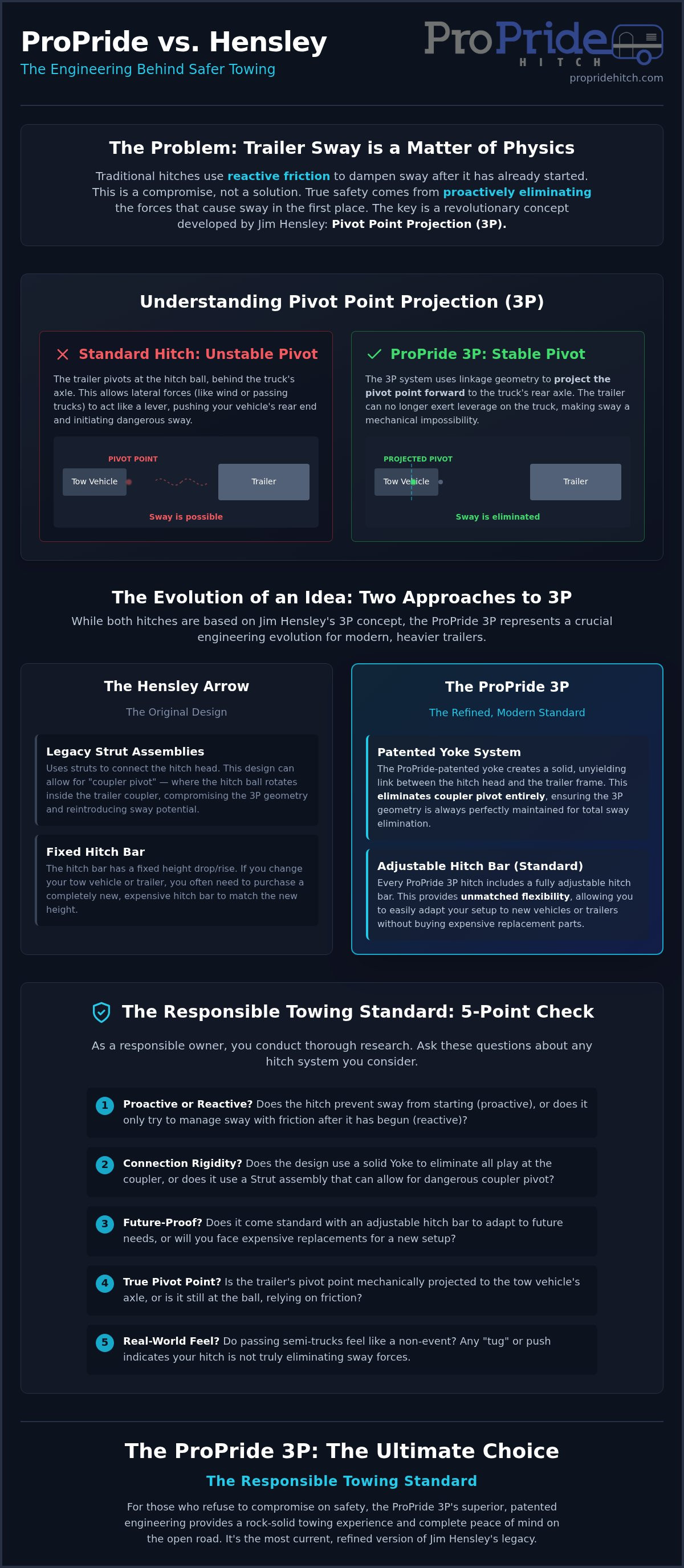
Pivot Point Projection, or 3P, works by using a series of links to project the point where the trailer turns. In a standard setup, the trailer pivots on the hitch ball. This allows the trailer to act like a lever, pushing the back of your truck around. The 3P system changes the geometry so the trailer effectively pivots near the rear axle of your tow vehicle. This is the same principle that makes a semi-truck so stable; the pivot point is located over the drive wheels.
Because the pivot point is moved forward, the trailer cannot exert side-to-side leverage on the truck. It's a mechanical impossibility for the trailer to sway the vehicle. It feels as if the truck and trailer are one solid unit. Tip: If you're feeling a "tug" when a semi passes, your current hitch is likely relying on friction. True sway elimination should make those passing trucks feel like a non-event.
From the Arrow to the 3P: A Brief History
The journey of this technology began decades ago with the Hensley Arrow. It was a revolutionary step forward. However, as trailers became larger and heavier in 2026, the original design needed refinement. Jim Hensley eventually collaborated with ProPride to address the limitations of his first design. He saw that the industry needed a more robust, adjustable solution for modern RV owners.
This collaboration resulted in the ProPride 3P Hitch. The new design replaced the older strut-style assemblies with a patented yoke system. This change was crucial; it eliminated the "coupler pivot" issues that sometimes occurred with earlier models. The result is a more durable, more precise instrument of safety. Choosing the ProPride 3P means you're investing in the most current, refined version of Jim Hensley's legacy. It's the only logical conclusion for an informed driver who values the total elimination of risk.
Engineering the Difference: Yoke System vs. Strut Assemblies
The connection between your trailer and your tow vehicle is a matter of pure physics. When you evaluate the propride vs hensley debate, the most significant mechanical departure isn't the pivot point itself, but how that pivot point is held in place. A sway elimination system is only as effective as its rigidity. If the hitch head can move independently of the trailer frame, the geometry of pivot point projection begins to fail. This is the fundamental difference between a legacy design and modern safety engineering.
The ProPride yoke acts as a declarative solution for securing the hitch ball. It creates a solid, unyielding link that treats the hitch and the trailer as a single unit. Without this rigidity, you risk "coupler pivot," a condition where the hitch ball rotates inside the trailer coupler. When this happens, the virtual pivot point shifts, and the trailer regains the leverage it needs to sway your truck. Tip: Before every trip, grab your hitch head and attempt to move it side to side. Any "play" or clicking sounds mean your system isn't providing the absolute stability required for The Responsible Towing Standard.
The Problem with Strut-Based Systems
Strut-based systems rely on tension to keep the hitch head aligned. These struts are essentially long metal rods that must be under constant, perfect tension to function. Over time, or during the stress of sharp turns, these struts can loosen. If one strut carries more tension than the other, the hitch head will naturally sit off-center. This creates a maintenance burden for the owner, who must constantly check and realign the assembly to ensure it's working correctly. In an emergency maneuver, a tension-based system is simply more prone to shifting than a fixed mechanical link.
Why the ProPride 3P Yoke is the Superior Evolution
The patented ProPride yoke is a "set it and forget it" design. Instead of relying on rods that can stretch or loosen, the yoke uses a heavy-duty steel structure to lock the hitch head to the trailer frame. It eliminates the need for drilling into your trailer, which preserves the integrity of your frame and simplifies the installation process. By creating a rigid bridge, the yoke ensures that the pivot point stays exactly where the engineers intended, regardless of road conditions or wind gusts.
This mechanical superiority is why many experienced RVers consider The ProPride 3P Hitch: The Ultimate Engineering Solution. It provides the peace of mind that comes from knowing your equipment isn't just "controlling" sway, but mechanically preventing it. If you value a stress-free highway experience, you can find the ProPride 3P Hitch here to complete your safety setup.
Adjustable Hitch Bars vs. Fixed Bars: Flexibility for the Modern RVer
Changing your tow vehicle or trailer shouldn't mean starting your safety setup from scratch. When you evaluate the hardware included in the propride vs hensley comparison, one of the most practical differences you'll encounter is the hitch bar. A fixed hitch bar is essentially a gamble on your current vehicle's dimensions. If you upgrade your truck or even change your trailer's tire size, a fixed bar often becomes an expensive paperweight. We believe that a safety system should adapt to your life, not the other way around.
This is why every ProPride 3P includes an adjustable hitch bar as standard equipment. It's a core component of The Responsible Towing Standard. True safety requires a perfectly level tow, and you can't achieve that precision with a "close enough" fixed bar. Tip: Measure your truck's receiver height from the ground to the top of the inside of the receiver tube both before and after loading your trailer. This simple measurement reveals how much your suspension is compressing and whether your weight distribution needs adjustment.
The Convenience of Infinite Adjustability
Modern trucks come with a wide variety of receiver heights, and luxury trailers in 2026 are heavier than ever. If you switch from a standard half-ton truck to a heavy-duty model, the receiver height can change by several inches. With the ProPride 3P, you can adapt to these changes in minutes using the adjustable bar. This flexibility also allows you to fine-tune your weight distribution. Weight distribution is the process of using the hitch to move trailer tongue weight off the truck's rear axle and onto the front axle. This prevents "squat," which is when the back of the truck sinks too low, causing light steering and poor braking performance.
Long-Term Value and The Responsible Choice
While some manufacturers position fixed bars as a "lightweight" choice, the reality is that they often lead to higher lifetime costs. Every time your towing geometry changes, a fixed bar requires a new purchase. By including an adjustable bar from the start, we ensure your investment is protected for the long haul. Precision leveling isn't a luxury; it's a fundamental requirement for maintaining the correct geometry for pivot point projection. You can dive deeper into these technical nuances by reading our Sway Control Hitch Comparisons. Choosing an adjustable system is the only way to ensure your family's safety remains consistent, regardless of what vehicle you choose to drive next year.
Evaluating Your Setup: Is Your Hitch Ready for the Open Road?
A responsible driver knows that safety doesn't happen by accident. It's the result of meticulous preparation and a refusal to accept "good enough" as a standard for their family's protection. Before you head out on your next journey, you must objectively evaluate whether your current equipment is truly capable of managing the forces it will encounter. High winds, uneven pavement, and the bow wake of passing semis are not just inconveniences; they are physical tests of your hitch's engineering. Tip: Conduct a "semi-pass" evaluation on a safe stretch of highway. If you feel a suck-and-push sensation that requires you to steer into the trailer's movement, your current setup is relying on reactive friction rather than proactive elimination.
The Responsible Towing Checklist
To ensure you're meeting The Responsible Towing Standard, perform this 5-point inspection before every departure:
- Frame-to-Hitch Rigidity: Attempt to move the hitch head side to side. Any independent movement at the ball or frame brackets indicates a loss of control geometry.
- Weight Distribution Tension: Verify that your spring bars are under the correct tension to return weight to the front steering axle. A light front end leads to poor braking and steering response.
- Friction Component Integrity: If you use a traditional hitch, inspect the friction pads for glaze or wear. Remember that friction-based sway control loses effectiveness in wet or greasy conditions.
- Tongue Weight Verification: Ensure your tongue weight is between 10% and 15% of your total loaded trailer weight. Proper weight is essential for any pivot point projection system to function as designed.
- Leveling Accuracy: Use your adjustable hitch bar to ensure the trailer is perfectly level. A nose-high trailer is a primary cause of high-speed instability.
When to Upgrade to a 3P System
If your inspection reveals consistent "play" in your setup or if you're experiencing trailer "push," it's time to consider a more robust solution. Larger, high-profile trailers like those from Airstream or Grand Design act like giant sails in the wind. These setups demand technology that can handle the increased lateral pressure without flinching. When you weigh the merits of propride vs hensley, you're looking for the system that maintains its geometric integrity under the most extreme conditions. Legacy designs often struggle with maintenance-heavy components that can fail when you need them most.
Transitioning to a modern system is about more than just convenience; it's about the total elimination of risk. You can explore the technical data behind these choices in our guide on Trailer Sway Solutions. If you've realized that your current hitch can't provide the absolute confidence you require, you can select the ProPride 3P Hitch to secure your family's future on the road.
Why the ProPride 3P is the Ultimate Choice for Responsible Towing
Choosing between propride vs hensley is the final step in a journey of self-education. You've analyzed the physics, compared the yoke to legacy strut designs, and weighed the long-term value of adjustability. Now, it's about the lived experience on the open road. The ProPride 3P doesn't just reduce the stress of towing; it removes the physiological fear response many drivers feel when a crosswind hits or a semi-truck passes at highway speeds. When you eliminate the possibility of sway, you gain the freedom to focus on the destination rather than surviving the journey.
Investing in this system is a commitment to a lifetime of safer travel. With a maximum towing capacity of 14,000 lbs and a maximum tongue weight of 1,400 lbs, the 3P is engineered to handle the largest luxury trailers on the market in 2026. Because we provide a lifetime warranty, this is likely the last hitch you'll ever need to buy. Tip: Before finalizing your purchase, double-check your trailer's "ready-to-camp" tongue weight. This ensures you select the correct spring bar weight for optimal weight distribution and steering control.
Unmatched Support and Engineering Excellence
One of the most significant advantages of the ProPride 3P is the support system behind it. When you have technical questions, you speak directly with the experts who live and breathe this technology every day. This level of professional authority is a hallmark of our brand. We don't just sell parts; we partner with you to ensure your setup is perfect.
Drivers often find that the 3P makes their trailer handle with "5th-wheel precision." Because the pivot point is projected forward, the trailer follows the truck's path much more accurately during backing maneuvers. You don't have to worry about the "jackknife" anxiety that plagues traditional ball-and-coupler setups. It's a cleaner, more intuitive way to move your investment into a tight campsite. This level of control is exactly why we've established The Responsible Towing Standard.
Your Next Steps Toward Safety
The transition to a stress-free towing lifestyle begins with a single, responsible decision. You've done the research and you understand that "good enough" equipment is a risk you aren't willing to take with your family in the vehicle. Join the thousands of informed RVers who have moved past the limitations of legacy designs to embrace the ultimate in sway elimination. Take the first step toward total confidence on the highway and order your ProPride 3P Hitch today. The road ahead is long; make sure you're prepared to handle every mile with absolute stability.
Take Command of Your Towing Future
Choosing between propride vs hensley isn't just about picking a part; it's about deciding how much you value your peace of mind on the open road. You've learned that while both systems share Jim Hensley's evolved design legacy, only the ProPride 3P offers the patented yoke system that eliminates the risks of coupler pivot. By prioritizing precision engineering over "good enough" traditional equipment, you're setting a new benchmark for your family's safety. Tip: Keep our expert support number in your glove box for immediate access to lifetime technical support from towing experts whenever you hit the road.
Your journey toward absolute stability is backed by patented Pivot Point Projection technology. This system ensures that your truck and trailer act as a single, immovable unit against the forces of wind and traffic. It's time to leave the white-knuckle driving behind and embrace a stress-free travel experience. Secure your family's safety with the ProPride 3P Hitch, The Responsible Towing Standard.
The road is waiting for you. Drive with the firm confidence that you have the best protection available for your investment and your loved ones.
Frequently Asked Questions
Is ProPride better than Hensley for sway elimination?
The ProPride 3P is the superior choice because it represents the matured, third generation of Jim Hensley's original design. While both systems use pivot point projection, the ProPride 3P utilizes a patented yoke that creates a rigid mechanical link. This design prevents the "coupler pivot" that can occur in legacy strut-based systems, ensuring that your trailer remains locked in place regardless of wind or road conditions.
Can you back up a trailer with a ProPride 3P hitch installed?
You can back up your trailer with total confidence and precision when the ProPride 3P is installed. Because the system projects the pivot point forward toward the truck's rear axle, the trailer responds to steering inputs much like a 5th-wheel trailer. You don't need to remove any parts or worry about the binding issues that often plague traditional friction-based sway control setups during tight maneuvers.
Who is Jim Hensley and what was his role in ProPride?
Jim Hensley was the visionary inventor who first applied the laws of physics to eliminate trailer sway through pivot point projection. After his initial designs were brought to market, he chose to collaborate directly with ProPride to refine his work. This partnership allowed him to address the limitations of his earlier inventions, resulting in the ProPride 3P, which stands as the definitive version of his life's work in towing safety.
Does the ProPride 3P hitch require drilling into the trailer frame?
The ProPride 3P hitch does not require any drilling or permanent modification to your trailer frame. It features a robust bolt-on design that preserves the structural integrity and resale value of your RV. This makes it an ideal solution for owners of premium trailers who want the highest level of safety without compromising the manufacturer's frame warranty or dealing with the hassle of professional shop tools.
What is the difference between the yoke on a ProPride and the struts on a Hensley?
The main technical difference in the propride vs hensley comparison is how the hitch is secured to the trailer. The ProPride yoke provides a solid, unyielding bridge that keeps the hitch head perfectly aligned. Legacy systems use tension-based struts that can loosen over time or during sharp turns. If these struts lose tension, the hitch ball can pivot inside the coupler, which undermines the entire geometry of sway elimination.
Is the ProPride 3P hitch worth the extra cost over a friction hitch?
Investing in the ProPride 3P is the only way to achieve true sway elimination rather than simple sway dampening. Friction hitches are reactive; they only work after your trailer has already started to move, and they lose effectiveness in rain or high winds. The 3P system is a proactive engineering solution that makes sway mechanically impossible, providing the peace of mind that comes from knowing your family is protected by the ultimate safety standard.
How does the adjustable hitch bar on a ProPride benefit the user?
The adjustable hitch bar provides the flexibility to maintain a perfectly level tow even if you change tow vehicles or trailers. Instead of buying a new fixed bar every time your truck's receiver height changes, you can simply adjust the 3P bar in minutes. This ensures your weight distribution remains accurate, which is essential for steering control and braking performance. It's a long-term value that supports your journey toward The Responsible Towing Standard.
Can I install the ProPride 3P hitch myself or do I need a professional?
Most owners can successfully install the ProPride 3P hitch themselves using standard hand tools and our detailed instructions. The system is designed for a straightforward bolt-on process, and we provide lifetime technical support to assist you with any questions. Tip: Plan for about three to four hours for your first installation to ensure you have plenty of time to torque every bolt to the correct specification for maximum safety.