
Could the right stinger still leave your trailer out of level? It can if you choose an offset before measuring the height difference between your tow vehicle and trailer. Measuring for the correct ProPride stinger starts with a level trailer and careful, consistent measurements, not guesswork. The goal is to compare the trailer’s coupler height with the vehicle’s receiver height using the reference points specified in ProPride’s guidance.
This guide walks through preparing your setup, recording the measurements, and using them to understand the height relationship. That comparison helps inform the position of the ProPride adjustable hitch bar, but it is not a complete offset calculation. Stinger position is also separate from hitch capacity: the ProPride 3P Hitch is available in 600 lb, 800 lb, 1000 lb, and 1400 lb capacity options. Use the right information for each decision as you work toward The Responsible Towing Standard.
Key Takeaways
- For measuring for the correct ProPride stinger, record the tow vehicle and level trailer heights using consistent reference points.
- Compare the measurements to understand the height relationship, but don’t treat the difference as a complete offset calculation.
- Keep stinger offset separate from hitch capacity. They describe different parts of the selection process.
- Repeat measurements taken on uneven ground or with mismatched reference points before using them to select a bar position.
- The ProPride adjustable hitch bar has multiple offset positions and is replaceable, giving you options for matching vehicle and trailer heights.
Before measuring for a ProPride stinger, separate offset from hitch capacity
Before choosing a bar position, be clear about what the measurement tells you. The stinger is the adjustable hitch bar that connects the tow vehicle’s receiver to the ProPride hitch assembly. Its offset describes the bar position used to accommodate the height relationship between the vehicle and trailer. That is a fit question, not a measure of how much weight the hitch is designed to handle.
Stinger offset helps match the hitch connection to the height relationship between your tow vehicle and level trailer. Height measurements can inform bar selection, but they don’t determine hitch capacity or replace the product’s installation instructions.
The aim is a level towing setup. If the receiver sits higher or lower than the trailer’s coupler in its intended level position, the comparison indicates the direction of the height difference. It does not, by itself, identify the exact offset to select. Apply the current ProPride measurement guidance to your readings rather than treating a rough comparison as a complete calculation. This guide covers measurement and selection, not hitch installation.
Understanding the parts helps put the stinger in context. A general overview of tow hitch types and functions can clarify how hitch components serve different roles. In the ProPride 3P Hitch, the adjustable bar works alongside the hitch’s other systems. Choosing its position is one part of a considered setup, not a substitute for following the complete installation guidance. The bar is adjustable and replaceable, not welded. Review the ProPride 3P Hitch details as you prepare to make a selection.
What does the adjustable ProPride stinger do?
The bar has multiple offset positions to accommodate differences in tow-vehicle and trailer heights. A suitable position helps align the connection so the trailer can tow level. Think of the adjustment as matching the heights, not changing the hitch’s weight rating. Record the measurements, then use ProPride’s guidance to connect those readings to a bar selection.
Stinger offset versus hitch capacity
Capacity is a separate selection decision. The ProPride 3P Hitch is available in 600 lb, 800 lb, 1000 lb, and 1400 lb capacity options. Those ratings are not offset positions, and comparing receiver and coupler heights does not tell you which capacity is appropriate. Keep the height notes for choosing the bar position, and assess capacity separately using the relevant hitch and towing information. Treating these as two distinct questions is a practical step toward The Responsible Towing Standard.
Gather consistent tow-vehicle and trailer measurements
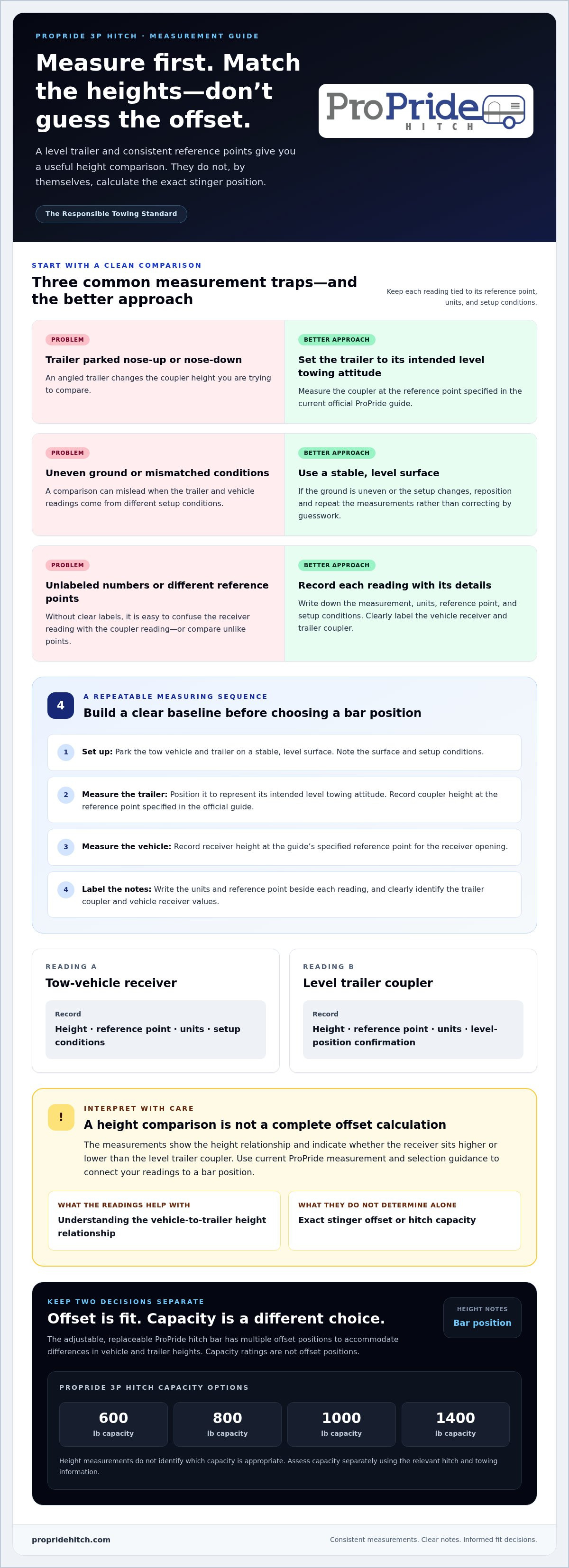
Useful measurements start with a repeatable setup. Uneven ground, or measuring the trailer at an angle instead of in its intended level towing position, can distort the comparison. Choose a stable, level surface, use the reference points in the ProPride guide, and note how you positioned each vehicle. That record makes it easier to compare the readings and spot mistakes.
Consistent measurements let you compare vehicle and trailer heights on equal terms. A different surface or reference point can make the comparison misleading.
Prepare the tow vehicle and trailer for measuring
Position the tow vehicle and trailer on a stable, level surface. Set the trailer coupler at the height that represents the trailer’s intended level towing attitude. Don’t estimate from a trailer parked nose-up or nose-down: its angle changes the height you’re trying to compare. Use the current official ProPride installation guide for the exact measurement points and diagram.
Use this sequence to create a clear baseline:
- Park the tow vehicle and trailer on a stable, level surface. Note the surface and setup conditions.
- Position the trailer to represent its intended level towing attitude, then measure and record the coupler height at the reference point specified in the official guide.
- Measure and record the tow vehicle’s receiver height at the guide’s specified reference point for the receiver opening.
- Write the units and reference point beside each reading. Label the trailer coupler and vehicle receiver values clearly.
Don’t compare readings taken under different conditions. For example, a coupler measurement taken while the trailer is angled and a receiver measurement taken on level ground don’t provide a sound comparison. If the setup changes or the ground is uneven, reposition and repeat the measurements instead of trying to correct the numbers by guesswork. Follow the official guide for details about how to measure from each reference point.
Create a measurement record before choosing an offset
A short written record can prevent a simple mix-up later. For each reading, include the measurement, unit, reference point, and setup condition. If you repeat a measurement, mark the new value clearly rather than leaving multiple unlabeled numbers in your notes. This makes it easier to identify a reading taken with the trailer out of level or from a different point.
- Tow vehicle: receiver height, reference point, units, and setup conditions.
- Trailer: coupler height, reference point, units, and confirmation that it was positioned level.
These are baseline measurements, not a complete offset selection. The ProPride 3P Hitch overview explains how the hitch fits into the broader towing setup. Once your notes are consistent, use the official selection guidance to interpret them. Keep the measurement record alongside the product information so the vehicle and trailer details stay clear as you choose a bar.
Interpret the measurements without guessing the stinger offset
Once you have consistent readings, compare the receiver height with the coupler height recorded while the trailer is level. This shows the basic height relationship between the tow vehicle and trailer, including whether the receiver sits above or below the coupler at the measured reference points. It does not identify a specific stinger position on its own.
Use your notes to organize the comparison, not to invent a selection rule. Keep the units and reference points visible so you’re comparing like with like.
For instance, if your notes show the receiver higher than the level-trailer coupler, the two measured connection points are at different heights. If the coupler is higher, the relationship is the reverse. These observations describe the readings; they are not a rise-or-drop calculation. Don’t convert them into a specific bar position unless the official selection guidance directs you to do so.
Compare receiver height with the level-trailer coupler position
The comparison shows how the vehicle’s receiver relates to the trailer’s coupler in its intended level position. Before drawing a conclusion, check that both readings use the specified reference points and the same units. If those details don’t match, pause and review the measurements. A difference based on inconsistent references can point you in the wrong direction.
Don’t rely on one measurement in isolation. A receiver reading alone doesn’t show how it relates to the trailer’s level coupler position, and the coupler reading alone can’t tell you the needed stinger offset. The ProPride adjustable bar has multiple positions to accommodate different vehicle and trailer heights, but selecting the appropriate position requires applying the official measurement guidance to the complete comparison.
Use the official measurement guidance to select the bar
Use the current ProPride measurement diagram or selection instructions to match your recorded heights to a bar position. That guidance governs the exact selection. Don’t substitute an assumed formula, an informal chart, or a guessed dimension. The adjustable bar is designed to accommodate different height relationships, but a single measurement can’t guarantee fit or establish every detail required for installation.
Height readings also don’t establish hitch capacity. The height relationship can’t tell you which capacity option is appropriate, and the two readings can’t answer every installation question. Follow the official installation instructions for the full setup. Let the measurements inform bar selection, and use the guide for the exact choice and installation details.
Avoid common stinger measurement mistakes before ordering
A careful comparison can still go wrong if measurements weren’t taken under matching conditions or the notes are unclear. Before choosing a bar position, review how each reading was collected. If the values don’t seem consistent with the trailer’s intended level position, verify the setup rather than selecting an offset by guesswork.
Measurement errors that can distort the comparison
Check for these common sources of confusion:
- Uneven ground: A sloped or uneven surface can affect how the vehicle and trailer sit, making their heights harder to compare.
- Different setup conditions: Measurements taken with the trailer at different angles or in different positions may not describe the same height relationship.
- Mixed reference points: Measuring from different points on the receiver or coupler can make two readings seem comparable when they aren’t.
- Unclear labels or units: A number without its unit and reference point can be misread or assigned to the wrong component.
- Confusing offset with capacity: Offset relates to height fit. Capacity is a separate hitch selection question, not another name for a bar position.
Keep each value beside its label, reference point, unit, and setup condition. If you can’t tell which reading belongs to the receiver or coupler, check the official measurement diagram and repeat the measurement as directed. Don’t add assumptions about vehicle loading or suspension. Follow the current ProPride guidance for its specified conditions and reference points.
If the numbers conflict with the trailer’s intended level position, return to the setup before interpreting them. Confirm that the trailer is positioned as intended, the surface is suitable, and you used the same reference points and units. Then take fresh readings and replace unclear notes with a clearly labeled record. Don’t average conflicting values or turn them into an offset estimate.
Check fit information before moving to installation
Use the official ProPride instructions to resolve uncertainty about reference points and bar selection. A measurement can help identify the height relationship, but it can’t establish every fit detail or installation requirement. Don’t substitute a guessed offset for the manufacturer’s selection guidance. Keep this stage focused on measurement and selection; installation is a separate process governed by its own instructions.
If a broader setup concern remains after you’ve checked your readings, the ProPride hitch troubleshooting guide may help put the issue in context. For measuring for the correct ProPride stinger, resolve unclear readings before ordering rather than forcing a choice from incomplete notes.
Once your record is clear, use the official selection guidance alongside the ProPride 3P Hitch information as you consider the bar for your setup. Precision before selection is part of The Responsible Towing Standard.
Choose the ProPride adjustable stinger with a responsible next step
You’ve prepared the setup and recorded the receiver and level-trailer coupler heights. Before choosing a bar position, check that your notes are clear and apply them to the current official ProPride measurement guidance. Your readings describe the height relationship; they don’t replace the manufacturer’s selection instructions.
Use clearly recorded measurements alongside the official ProPride selection guidance to choose a stinger position, rather than estimating from the numbers alone.
A concise measurement-to-selection checklist
Work through these steps in order. If a reading is unclear or the setup changes, resolve that before making a selection.
- Confirm that the vehicle and trailer measurements were taken under consistent conditions.
- Check that each value is labeled with its component, reference point, and units.
- Compare the recorded values, then use the official ProPride selection guidance to identify the appropriate bar position.
- Keep bar selection separate from capacity selection, and use the relevant hitch and towing information for that distinct decision.
- Use the installation instructions for the next stage. Measurement and bar selection don’t replace them.
The ProPride adjustable hitch bar has multiple offset positions and is replaceable. These features accommodate different vehicle and trailer heights, but they don’t make careful selection optional. If your readings don’t clearly align with the official guidance, recheck your notes and setup instead of forcing a choice.
Continue with the ProPride 3P Hitch information
Measuring for the correct ProPride stinger is one practical part of preparing a considered towing setup. Apply the selection guidance to your recorded measurements, then use the full instructions for the steps beyond measurement. That steady, informed approach reflects The Responsible Towing Standard without treating any single reading as a guarantee of fit or outcome.
Explore the ProPride 3P Hitch product details to see how its adjustable bar fits into your towing setup and make an informed selection.
Make your next towing decision with confidence
Choosing a stinger is one part of building a towing setup around the actual relationship between your vehicle and trailer. Your measurements provide a practical starting point. The ProPride 3P Hitch combines an adjustable bar, integrated weight distribution, and Pivot-Point Projection technology, with each feature serving a distinct role. Consider the complete setup rather than treating one measurement as the whole answer.
Taking time with measuring for the correct ProPride stinger reflects a larger principle: sound decisions start with useful information and careful attention to how the components work together. That’s the intent behind The Responsible Towing Standard. No measurement alone guarantees an outcome, but following the official guidance gives you a clearer basis for selecting your hitch bar and preparing for the next steps.
Explore the engineering and features of the ProPride 3P Hitch as you consider your towing setup. Review the product details and use the ProPride selection guidance to choose a bar position based on your measurements.
Frequently Asked Questions
How do I measure for the correct ProPride stinger?
Use the current ProPride guide to identify the specified measurement points, then record the receiver and coupler readings for the exact tow vehicle and trailer you plan to use. Measuring for the correct ProPride stinger is setup-specific, so label your notes with the vehicle and trailer rather than relying on measurements from another combination. If you keep records for multiple setups, give each pair its own clearly marked entry.
Should I measure the trailer level or as it sits parked?
Measure the trailer in its intended level towing position, not at an arbitrary angle caused by the parking spot. A parked trailer can sit differently from one location to another, so that reading may not represent the setup you want. If you’re preparing notes ahead of a future trip, record that the measurement represents the level towing position and follow the guide’s reference points.
Is the ProPride stinger adjustable?
Yes. Its adjustable positions allow the bar to accommodate different tow-vehicle and trailer heights. If you tow with more than one vehicle, don’t assume a position chosen for one combination applies to another. Keep separate measurement records for each setup, then use the official selection guidance for the vehicle and trailer you intend to pair. This helps distinguish a real setup change from a note-taking mix-up.
Are stinger offset and ProPride hitch capacity the same thing?
No. They refer to separate selection questions. Label your notes “bar position” and “hitch capacity” rather than grouping both decisions under a general heading like “hitch size.” Use the hitch and towing information relevant to your setup when evaluating capacity. Don’t infer a capacity choice from a height reading, and don’t use a capacity label to determine bar position.
Can I replace the ProPride hitch bar if my setup changes?
Yes, the hitch bar is replaceable. A new tow vehicle or trailer is a good reason to review your setup rather than assume the existing bar remains the right match. Take measurements for the new combination and follow the applicable ProPride selection and replacement instructions. Keep the old and new setup notes separate so the measurements clearly correspond to the equipment you’re preparing to tow with.
Does installing the ProPride 3P Hitch require drilling into the trailer frame?
No. The ProPride 3P Hitch installation doesn’t require drilling into the trailer frame. Still, “no drilling” doesn’t mean every installation step can be improvised. Use the official installation instructions for the complete process, including the components and procedures relevant to your setup. Keep measurement and installation guidance together, but use each for its intended purpose.
Is the ProPride 3P Hitch suitable for a half-ton truck?
Yes, it can be suitable for a half-ton truck, depending on the specific tow vehicle and trailer combination. The truck’s class alone doesn’t establish that match. Review the vehicle’s towing information alongside the trailer and hitch information for your setup, and keep those checks distinct from choosing the bar position. A height comparison helps with stinger selection, but it can’t answer every question about the overall towing combination.