
A hitch can make a strong first impression and still be the wrong fit for years of ownership. A useful long term ProPride 3P review looks beyond product claims to the questions that shape everyday use: Does it suit your trailer and tow vehicle? How much setup and upkeep will you manage? And what do owners’ firsthand accounts actually show?
It makes sense to ask how the ProPride 3P holds up over time before investing in a specialized hitch. Manufacturer information explains the design, including Pivot Point Projection, but it is not independent proof of long-term results. Owner reports need context, too. Time owned, towing conditions, and setup changes can all affect what an account tells you.
This review will help you assess fit, hitching routines, maintenance questions, towing experience, and long-term value using evidence rather than assumptions. You’ll also learn what to verify with the manufacturer and what to arrange independently, since ProPride does not provide direct installation services. The goal is a well-informed decision grounded in The Responsible Towing Standard and in what matters for your rig.
Key Takeaways
- Use a long term ProPride 3P review to distinguish firsthand owner observations from manufacturer descriptions and unanswered questions.
- Understand how Pivot Point Projection is intended to work, while treating performance descriptions as claims to assess rather than independent proof.
- Compare setup, hitching routines, adjustment, storage, and inspection needs with how you actually tow and maintain your trailer.
- Assess whether the hitch fits your trailer and tow vehicle, your towing priorities, and your willingness to learn a specialized system.
- Before buying, verify compatibility, current product details and instructions, and the source and context of owner accounts.
What a Long-Term ProPride 3P Review Can and Cannot Tell You
A first tow can reveal an initial impression, but it cannot show how a hitch fits into repeated use, changing loads, or a regular hitching routine. A useful long term ProPride 3P review needs context, not just a verdict.
A review is genuinely long-term when it documents repeated ownership and towing over a stated period, with enough setup and use details to make the observations meaningful. That standard helps separate firsthand experience from marketing language and conclusions that go beyond the evidence.
For one owner’s perspective, watch this review, then assess its details alongside your own research:
How to judge whether an owner review is useful
Look for a stated ownership duration and repeated use, rather than an undated first impression. Useful accounts also identify the trailer and tow vehicle and explain relevant conditions, such as how the rig was loaded or what kinds of trips the owner took. These details do not prove you will have the same outcome, but they help you judge whether the experience resembles yours.
Separate what the reviewer directly noticed from what they conclude. “This is what I experienced with my setup” is a firsthand observation. “This works the same for every trailer” is a broader claim that requires broader evidence. The available information does not establish verified long-term owner results, so do not treat an individual video or forum post as conclusive without checking its duration and context.
What the available evidence does not establish
Manufacturer information explains the intended design, not independent proof of long-term outcomes. ProPride describes its patented Pivot Point Projection technology as designed to eliminate trailer sway. For design context, read the ProPride 3P engineering overview, while keeping the company’s description distinct from verified owner experience.
The trailer, tow vehicle, setup, loading, and use all shape what an account can tell you. A weight-distributing hitch is a useful general reference for understanding hitch types, but it cannot establish how a particular rig will perform. The available information does not establish a failure rate, lifespan, or universal result. Treat that uncertainty as a reason to investigate carefully, not to fill gaps with assumptions. That is a practical step toward The Responsible Towing Standard.
How Pivot Point Projection Shapes the ProPride 3P Ownership Experience
Picture a trailer turning behind a tow vehicle. The point where the trailer pivots affects how its movement relates to the vehicle’s movement. The ProPride 3P’s Pivot Point Projection design is intended to move the effective pivot point forward from the hitch ball, closer to the tow vehicle’s rear axle. In simple terms, the design aims to make the trailer’s response follow the tow vehicle more closely, rather than pivot freely at the ball.
That is the core idea behind the system’s stated sway-control role. ProPride describes Pivot Point Projection as designed to eliminate trailer sway. This is the manufacturer’s description of the design, not independent proof that every rig will behave identically. The engineering principle explains what the hitch is intended to do. A particular owner’s experience depends on the complete towing setup and how it is used.
What owners can observe on the road
A useful review describes specific handling impressions and the conditions in which they occurred. Did the trailer move independently, or did a gust seem to push the truck and trailer together? The distinction matters: sway is trailer oscillation, while a push is a side force moving the rig as a whole. A hitch’s stated sway-control purpose should not be read as a promise that wind, road conditions, loading, or other towing risks disappear.
Look for accounts that identify the trailer and tow vehicle, explain how the rig was loaded and set up, and describe more than one isolated moment. Reports from different trips can give a fuller picture of one owner’s experience, but they still apply first to that owner’s combination. If two accounts differ, compare their setups and conditions before deciding one must be wrong.
Separate design from individual results
A hitch’s design principle explains how it is intended to manage trailer movement. An individual owner’s result shows what happened with one particular towing setup. Keep that distinction in view as you assess claims and firsthand reports. For a broader look at how sway-control approaches are compared, read the sway control hitch comparison.
For a long term ProPride 3P review, note whether the reviewer reports consistent observations over varied trips and provides enough context to interpret them. Then compare the stated mechanism with the official ProPride 3P Hitch product information. This lets you investigate the design without treating a technical explanation or one owner’s account as a universal result.
Long-Term ProPride 3P Ownership: Evaluate Setup, Routine, and Upkeep
A long-term review should describe more than how the ProPride 3P feels on the road. Ownership also involves learning the setup, repeating hitching steps, understanding when adjustments may be needed, and knowing how to store and inspect the equipment. These details help you decide whether the system’s day-to-day demands suit your routine. They should not be confused with towing performance.
Use the table as a checklist when reading owner accounts. Look for specific examples and conditions, not broad labels such as “easy” or “difficult.”
| Ownership factor | What to investigate |
|---|---|
| Initial learning | Does the owner describe what took practice and under what conditions? Separate a first-time setup from experience gained through repeated use. |
| Routine hitching | What steps does the owner say are involved in connecting and disconnecting? Consider whether that routine fits your available time, space, and towing habits. |
| Adjustment | Does the account explain why an adjustment was made and what guidance was followed? Do not copy adjustment instructions from an owner post. Check current official product instructions. |
| Storage | How does the owner store the hitch between trips, and what circumstances affect that choice? Treat the account as personal practice, not a manufacturer requirement. |
| Inspection and upkeep | Are reported concerns described with a date, source, and relevant use context? Verify maintenance steps and intervals against current manufacturer instructions. |
Separate routine from road performance
A reviewer may find the hitching routine demanding yet report a positive towing experience. Another may describe a straightforward routine without having taken enough trips to judge handling over time. These are different observations. In your notes, track setup and everyday effort separately from towing impressions. Check whether the owner explains their trailer, tow vehicle, loading, and frequency of use.
If an account mentions wear, a repair, or a service concern, record exactly what was reported and when. One account can raise a useful question, but it cannot establish a general failure pattern or product lifespan. Look for corroboration and compare the details with current official guidance before drawing conclusions. For troubleshooting, consult the manufacturer’s current resources and instructions rather than relying on an undated forum reply.
A careful long term ProPride 3P review treats upkeep as something to verify, not guess at. Before buying, find the current product instructions and confirm the setup, adjustment, storage, and inspection guidance for your hitch. That preparation supports informed ownership and The Responsible Towing Standard.
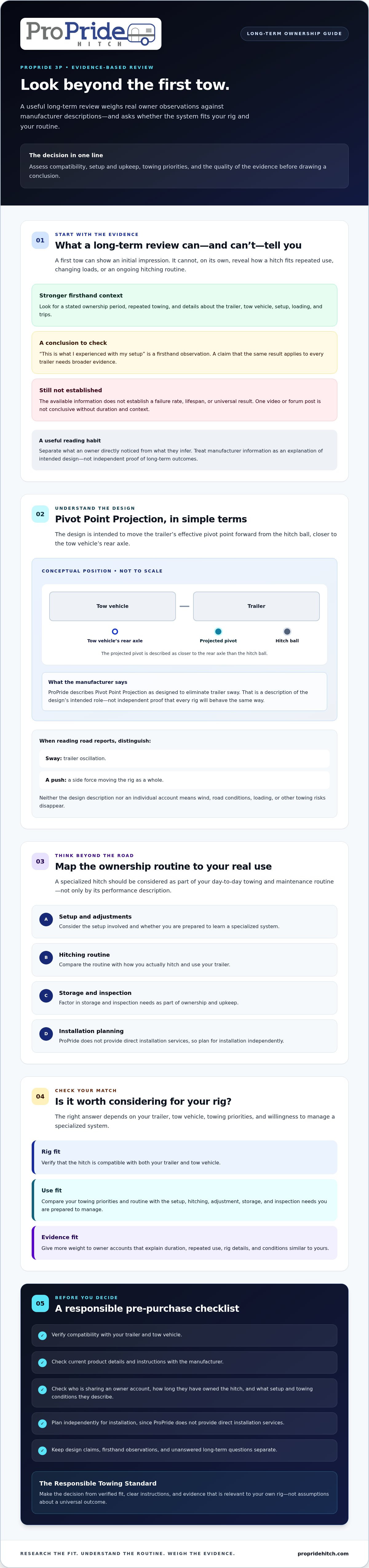
Is the ProPride 3P Worth Considering for Your Trailer and Tow Vehicle?
There is no responsible yes-or-no answer that fits every towing combination. The ProPride 3P may be worth investigating if its stated sway-control approach matches your priorities, current product information confirms compatibility with your trailer and tow vehicle, and you are prepared to learn its setup and routine. These are separate questions. A positive owner account can be encouraging, but it cannot confirm fit for your rig.
Questions to answer before deciding
Start with your actual combination, not a general description of your trailer. Check the manufacturer’s current product information for compatibility and setup details, then compare those requirements with your tow vehicle, trailer, and loading plans. ProPride offers solutions for travel trailers including Airstream, Jayco, and Grand Design models, but confirm that the specific product details match your setup. If anything is unclear, resolve it before buying rather than assuming a similar rig is close enough.
Next, identify the towing concerns that matter most to you. Are you trying to address trailer sway, understand handling in the conditions you encounter, or find a hitch routine you can manage consistently? Decide what evidence would help answer each question. A firsthand account is more relevant when its trailer, tow vehicle, setup, and use resemble yours, and when the reviewer explains what they directly observed.
Finally, consider the ownership routine. Are you willing to learn a specialized setup and hitching process? Have you accounted for arranging installation independently, since ProPride does not provide direct installation services? Even a system that aligns with your priorities needs to fit the practical realities of your trips.
Weigh benefits, trade-offs, and uncertainty
ProPride describes Pivot Point Projection as a design intended to eliminate trailer sway. Treat that as the company’s stated design benefit, then assess owner feedback separately. An owner’s handling impressions may be useful, but they reflect that person’s setup and operating conditions, not a guaranteed result for yours.
Value involves more than the purchase decision today. Consider how often you tow, how much the hitch’s intended role matters to you, and whether its setup and ongoing routine feel worthwhile for your use. Do not assume it will save money or suit a future trailer unless you have verified those points against current product information. Limited evidence is a reason to ask better questions, not proof of a defect or a reason to assume success.
For a practical next step, compare your rig and priorities with the ProPride 3P hitch details, and note any compatibility or ownership questions that remain. A careful decision based on fit and evidence is The Responsible Towing Standard.
A Responsible Checklist Before Buying the ProPride 3P
Good research should leave you with fewer assumptions, not just more opinions. Before deciding, collect the details for your specific rig, compare them with current manufacturer information, and write down anything you still need clarified. This checklist turns a long term ProPride 3P review into practical next steps.
A five-step evidence and fit check
- Record your setup. Note your trailer and tow-vehicle details, along with relevant loading information. Use these specifics when checking compatibility rather than relying on a general description of a similar rig.
- Read current product information and instructions. Confirm product details and review official setup, use, and maintenance guidance. Do not fill gaps with assumptions or instructions copied from an unrelated setup.
- Find owner accounts you can assess. Look for dated reviews that state how long the hitch was used, identify the trailer and tow vehicle, and describe the trips or conditions involved. Treat firsthand observations as evidence about that setup, not every towing combination.
- List the questions still open. Write down anything unclear about compatibility, setup, adjustment, upkeep, or support. Seek clarification before purchase rather than guessing at specifications or requirements.
- Compare the evidence with your priorities. Ask whether the hitch’s stated design approach and ownership routine address what matters to you, and whether the available owner accounts are relevant enough to inform your decision.
Make the next step an informed one
Keep manufacturer statements and owner reports in separate notes. ProPride describes its Pivot Point Projection technology as designed to eliminate trailer sway. That is the company’s description of its design. Owner accounts can add useful real-world context, but their value depends on the reviewer’s setup, use, and how clearly the experience is documented. Missing evidence is not proof of a defect or proof that a product will suit your rig. It is a reason to investigate further.
Before deciding, revisit your written questions and confirm current product details and instructions through official information. If the stated design, verified fit, and ownership routine align with your priorities, review the official ProPride 3P product page for purchase information. ProPride does not provide direct installation services, so include arranging installation independently in your planning.
Choose with preparation, not promises of risk-free towing. The Responsible Towing Standard starts with understanding your setup, checking the evidence, and making a decision you can explain with confidence.
Make Your Next Towing Decision With Confidence
A useful long term ProPride 3P review looks beyond a single drive. It weighs the hitch’s intended design against owner accounts with clear setup and use details, then considers whether the learning curve and upkeep fit your routine. ProPride, Inc. identifies patented Pivot Point Projection as the system’s core technology and describes the hitch as an advanced evolution in sway-elimination engineering. Those details explain the product’s engineering story, while your fit decision still requires current compatibility information and relevant evidence.
Before you decide, verify the hitch’s fit with your trailer and tow vehicle, review official instructions, and write down any unanswered questions. Take your time. Responsible preparation is part of The Responsible Towing Standard, and no hitch removes the need for attentive, careful towing.
Ready to check the details against your setup? Review the ProPride 3P Hitch product details and make an informed decision that suits your needs. A thoughtful choice is a strong place to start.
Frequently Asked Questions
Is the ProPride 3P worth it for long-term ownership?
It may be worth considering if the hitch’s stated design, verified compatibility, and ownership routine align with your needs. A long term ProPride 3P review is most useful when it includes dated, firsthand experience and details about the trailer, tow vehicle, setup, and use. Compare those observations with current manufacturer information, then weigh the learning and upkeep questions against how often you tow and what matters most to you.
Does the ProPride 3P eliminate trailer sway?
ProPride says its patented Pivot Point Projection technology is designed to eliminate trailer sway. That describes the company’s intended design function, not a guarantee that every rig will behave the same or that all towing risks disappear. Handling also depends on the full towing setup and operating conditions. A responsible assessment distinguishes the manufacturer’s explanation from independently verified owner observations and keeps careful driving central to safe towing.
How long does a ProPride 3P Hitch last?
The available information does not establish a lifespan for the ProPride 3P Hitch. Do not infer one from a single owner’s account or from the hitch’s design description. If you find a long-term ownership report, check whether it states how long the hitch was used, how it was maintained, and what trailer and tow vehicle were involved. Confirm current product care guidance through official instructions before drawing conclusions about durability.
Does the ProPride 3P require regular maintenance?
Check the current manufacturer instructions for the maintenance steps and intervals that apply to your hitch. Do not rely on assumptions or copy advice from an owner with a different setup. If a review mentions wear, adjustment, or a service concern, note the source, date, and use context, then compare it with official guidance. This helps distinguish a documented requirement from an individual owner’s routine or an isolated concern.
Is the ProPride 3P difficult to hitch and unhitch?
How manageable hitching and unhitching feels can depend on your familiarity with the system, setup, and routine. Look for owner accounts that describe the steps they follow and whether their impressions changed with repeated use. Separate the effort of connecting or disconnecting from the towing experience on the road. Before deciding, review current official instructions and consider whether the process fits your available time and travel habits.
What should I check before buying a ProPride 3P?
Start by confirming compatibility with your specific trailer and tow vehicle through current manufacturer information. Review official product details and instructions, then seek dated owner accounts that describe comparable setups and use. Write down unanswered questions about setup, adjustment, maintenance, and installation arrangements rather than guessing. ProPride does not provide direct installation services, so include arranging installation independently in your planning before you make a purchase decision.