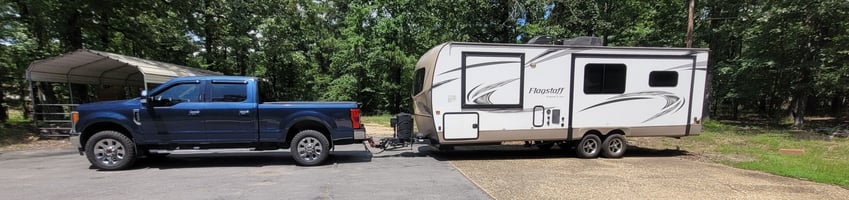
One of the most common questions prospective buyers ask is:
"My trailer isn't that big. Is the ProPride 3P® really necessary?"
It's a fair question.
When many RV owners think about trailer sway, they picture a 35-foot travel trailer being pushed around by crosswinds on the interstate. That image leads to a common assumption:
Smaller trailers don't sway enough to justify a premium hitch.
In reality, trailer stability depends on much more than overall size.
Factors such as hitch geometry, trailer design, loading, wind conditions, road surfaces, tow vehicle characteristics, and driver expectations all play a role in how confidently a trailer tows.
If you're wondering whether the ProPride 3P® is "too much hitch" for your camper, the better question may be:
What kind of towing experience do you want every time you hit the road?
The Myth: Small Trailers Don't Sway
Many first-time RV owners believe sway is only a concern for long, heavy travel trailers.
Unfortunately, physics doesn't work that way.
Any conventional bumper-pull trailer connected by a hitch ball can be influenced by lateral forces, including:
- Crosswinds
- Passing semi-trucks
- Uneven pavement
- Sudden steering inputs
- Emergency lane changes
- Road shoulders
- Gusty weather
Smaller trailers may present less side area to the wind than larger RVs, but they are not immune to these forces.
The conventional hitch-ball pivot still allows the trailer to rotate when side loads are introduced.
Trailer Weight Isn't the Whole Story
Many buyers focus almost exclusively on trailer weight.
Weight certainly matters for towing capacity and proper vehicle matching, but it doesn't tell the entire stability story.
Other important factors include:
Trailer Length
A relatively light trailer can still generate significant leverage because of its length.
Side Profile
Tall travel trailers present more surface area for crosswinds than utility trailers of similar weight.
Wheelbase of the Tow Vehicle
A longer-wheelbase truck often feels more composed than a short-wheelbase SUV when towing the same trailer.
Hitch Design
The way the trailer connects to the tow vehicle has a major influence on how side forces are transferred through the combination.
Why Many Owners Upgrade After Buying a Smaller Trailer
Interestingly, many ProPride owners didn't start with a large luxury RV.
They began with a modest travel trailer and expected towing to feel easy.
Then they experienced:
- White-knuckle driving in crosswinds
- Steering corrections when passing semi-trucks
- Fatigue after a few hours behind the wheel
- Nervous passengers
- Reduced confidence on the interstate
In many cases, the issue wasn't that the trailer exceeded the truck's ratings—it was that the towing combination wasn't as stable as they expected.
Bigger Doesn't Always Mean More Dangerous
It's easy to assume larger trailers are automatically less stable.
Yet many experienced RV owners report that a well-balanced, properly equipped larger trailer can tow more comfortably than a poorly configured smaller one.
Why?
Because stability depends on the entire towing system—not just the trailer's dimensions.
A properly matched tow vehicle, appropriate hitch setup, correct weight distribution, and sound hitch design all contribute to predictable handling.
How the ProPride 3P® Is Different
The ProPride 3P® approaches trailer stability differently than conventional sway-control hitches.
Instead of relying primarily on friction or mechanical resistance to reduce trailer movement after it begins, the hitch uses patented Pivot Point Projection™ (3P) technology.
Its converging-link design projects the trailer's effective pivot point forward toward the rear axle of the tow vehicle.
A patented one-piece yoke prevents conventional side-to-side pivoting at the hitch ball.
By changing how lateral forces are transmitted through the towing system, the ProPride 3P® uses geometry rather than resistance as the foundation of its design.
Isn't That More Than a Small Trailer Needs?
It depends on your priorities.
If your goal is simply to meet the minimum towing requirements, a conventional weight distribution hitch may be appropriate for many applications.
However, if your priorities include:
- Reduced steering corrections
- Improved confidence on highways
- Better composure in crosswinds
- More relaxed long-distance travel
- A premium towing experience
Then hitch design becomes an important consideration regardless of trailer size.
Long-Term Value Matters
Many RV owners keep their hitch through multiple trailers.
The ProPride 3P® is designed with that in mind.
Features include:
- Adjustable hitch bar
- Multiple hitch weight capacities
- Heavy-duty steel construction
- Patented Pivot Point Projection™ technology
- Integrated weight distribution
- Made in the USA
- Lifetime Warranty
Because the adjustable hitch bar accommodates a variety of receiver heights and sizes, many owners continue using the hitch after changing tow vehicles or upgrading to a different travel trailer.
Who Is the ProPride 3P® Best Suited For?
The ProPride 3P® may be a strong fit for owners who:
- Frequently travel on interstate highways
- Tow in windy regions
- Make long-distance RV trips
- Prefer a relaxed towing experience
- Plan to keep their hitch for many years
- Expect to upgrade trailers in the future
- Want premium towing equipment from the beginning rather than upgrading later
Frequently Asked Questions
Is the ProPride 3P® too heavy for a small trailer?
The hitch should always be matched to the trailer's loaded hitch weight and the tow vehicle's ratings. Selecting the proper model is important for safe operation.
Can a lightweight travel trailer sway?
Yes. Any conventional bumper-pull trailer can be affected by lateral forces such as wind, passing vehicles, or abrupt steering inputs.
Does trailer length matter more than weight?
Both matter. Length, side profile, hitch geometry, tow vehicle, and loading all influence towing stability.
Is the ProPride 3P® only for large RVs?
No. Owners of both smaller and larger travel trailers choose the ProPride 3P® for its engineering approach and integrated weight distribution.
Will I still need proper weight distribution?
Absolutely. Weight distribution remains an essential part of safe towing and is integrated into the ProPride 3P® design through heavy-duty adjustable jacks.
Can I use the hitch if I upgrade my trailer later?
In many cases, yes. The adjustable hitch bar and multiple hitch weight models make the ProPride 3P® a long-term investment that can often be used with future tow vehicles or trailers when properly matched.
Final Thoughts
Calling the ProPride 3P® "overkill" assumes that trailer stability is only important for large RVs.
In reality, the forces that influence towing don't disappear simply because a trailer is shorter or lighter.
Crosswinds, passing trucks, emergency maneuvers, and uneven roads affect conventional bumper-pull trailers of many sizes.
The difference lies in how the hitch manages those forces.
The ProPride 3P® approaches trailer stability through patented Pivot Point Projection™ technology, changing the geometry of the towing system while also providing robust weight distribution.
For some RV owners, a conventional hitch may meet their needs.
For others—especially those who value confidence, comfort, and long-term ownership—the ProPride 3P® isn't about having "more hitch than necessary." It's about choosing a towing system designed to deliver a more stable and predictable experience every mile of the journey.