You're cruising down the interstate at 65 mph when a semi-truck barrels past, sending a violent shudder through your steering wheel that makes your heart skip a beat. It's a terrifying moment that leaves you white-knuckled, wondering if you've pushed your equipment past its physical breaking point. You aren't alone in asking, "is my travel trailer too big for my truck," especially when dealerships often prioritize sales over your actual comfort and safety on the road. Many responsible owners find that the numbers on a manufacturer's sticker don't always translate to a stable or predictable driving experience.
We believe in "The Responsible Towing Standard," which means looking beyond basic tow ratings to understand the immutable laws of physics. This guide will teach you how to evaluate the physical and mechanical limits of your specific setup to ensure your family stays safe. We'll break down complex concepts like weight distribution and safety margins into actionable steps you can use to stabilize your current rig. By the end, you'll have a clear understanding of how to eliminate the fear of wind or passing traffic, providing the peace of mind required for a truly stress-free travel experience.
Key Takeaways
- Understand why your truck's payload capacity is a more critical safety limit than the maximum towing number displayed on the bumper.
- Learn how the physical length of your trailer acts as a lever against your truck's wheelbase and why this relationship impacts steering stability.
- Identify the physical warning signs of an unstable rig to help you determine if my travel trailer too big for my truck based on engineering facts.
- Discover how to use a CAT scale and the 80% rule to establish a safety margin that meets The Responsible Towing Standard.
- Explore how Pivot Point Projection technology eliminates sway by moving the trailer's pivot point forward to the truck's rear axle.
Beyond Towing Capacity: Why Weight Is Only Half the Story
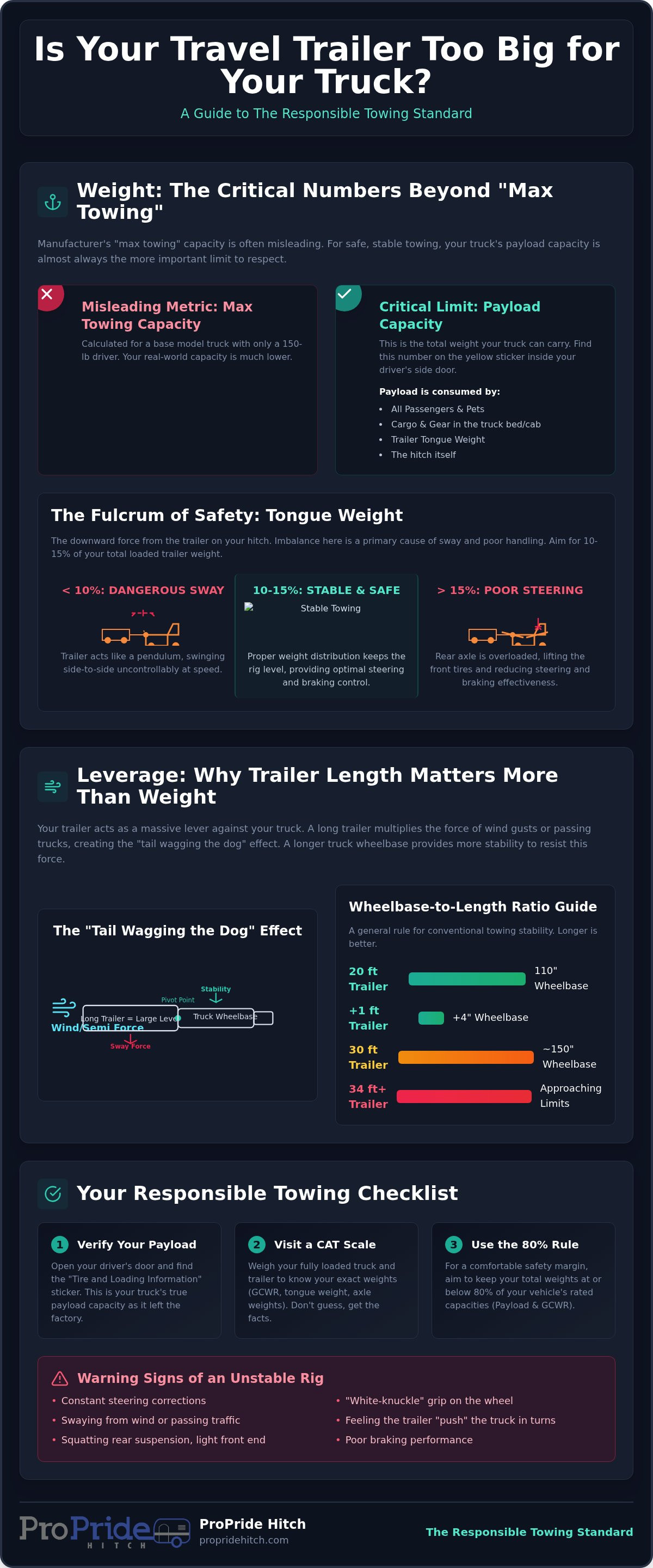
When you ask, "is my travel trailer too big for my truck," you're likely looking at the towing capacity printed in your owner's manual or on your rear bumper. While understanding Towing capacity basics is a necessary starting point, that "max towing" number is often the most misleading statistic in the industry. Manufacturers typically calculate these ratings using base-model trucks with zero options, a single 150-pound driver, and no cargo. In the real world, your truck is loaded with family, gear, and fuel, which significantly reduces what you can safely pull.
A more critical metric is the Gross Combined Weight Rating (GCWR). This represents the absolute maximum weight of your truck and trailer combined, as determined by the engineers who designed your vehicle's cooling, braking, and drivetrain systems. If you exceed this limit, you aren't just wearing out your transmission; you're compromising your ability to stop and steer during an emergency. Adhering to "The Responsible Towing Standard" requires looking past the marketing fluff and focusing on these hard engineering limits.
Actionable Tip: Don't rely on the brochure. Open your driver's side door and locate the yellow "Tire and Loading Information" sticker. This provides the exact payload capacity for your specific vehicle as it left the factory.
The Payload Pitfall: Why Your Truck Squats
Payload capacity is almost always the first limit you'll hit. This number represents how much weight your truck's frame, suspension, and tires can carry. Every pound you add to the truck eats into this margin. This includes your spouse, the kids, the dog, your tools, and even the weight of the hitch itself. For those using a heavy-duty solution like the ProPride 3P Hitch, you must account for that weight in your calculations. Exceeding payload is arguably more dangerous than being slightly over your towing capacity because it lifts weight off your front tires, which are responsible for steering and the majority of your braking power.
Tongue Weight: The Fulcrum of Towing Safety
Tongue weight is the downward force exerted by the trailer coupler. To maintain stability and prevent dangerous sway, your tongue weight should typically fall between 10% and 15% of your total loaded trailer weight. If this weight is too low, the trailer will act like a pendulum, swinging uncontrollably at highway speeds. If it's too high, it creates a "teeter-totter" effect on your rear axle, pushing the back of the truck down and pulling the front wheels up. This imbalance is a primary cause of white-knuckle driving. Balancing this load is a fundamental requirement for anyone committed to "The Responsible Towing Standard."
The Physics of Leverage: Trailer Length vs. Truck Wheelbase
Weight is often the first thing people check, but length is what determines how your truck handles on the open road. When asking if my travel trailer too big for my truck, you must consider that your trailer acts as a massive lever. The hitch ball serves as the pivot point, and the distance from that ball to the trailer's axles creates a lever arm. When a gust of wind or a passing semi pushes against the side of a 30-foot trailer, that force is multiplied before it ever reaches your truck's tires.
A short wheelbase truck struggles in this scenario because it lacks the lateral resistance to counteract the trailer's movement. This is the "tail wagging the dog" phenomenon. If the trailer has more leverage than the truck, it will physically push the rear of the tow vehicle out of its lane. Larger trailers also have more surface area, which captures more wind and increases the lateral force applied to your hitch. Understanding the physics of trailer sway is essential for anyone who wants to uphold The Responsible Towing Standard.
The Wheelbase-to-Length Ratio Guide
A longer truck provides a more stable anchor because its own wheelbase acts as a counter-lever. A general rule for safe towing is to have at least 110 inches of wheelbase for a 20-foot trailer. For every additional foot of trailer length, you should ideally have another 4 inches of truck wheelbase. If your truck has a 145-inch wheelbase, a 30-foot trailer is approaching the upper limit of physical stability for a standard ball-and-coupler setup. You can find your wheelbase by measuring from the center of the front wheel hub to the center of the rear wheel hub.
Dynamic Stability: What Happens at 65 MPH
Static weight on a scale doesn't tell the whole story. At highway speeds, dynamic forces take over. The distance from your truck's rear axle to the hitch ball is the "overhang," and this distance is the trailer's primary point of attack. The longer this overhang, the easier it is for the trailer to steer your truck. The Responsible Towing Standard requires a mechanical solution that can counteract these forces before they become dangerous. If you find your current truck feels mismatched for your trailer's length, considering the ProPride 3P Hitch can effectively eliminate the leverage problem by projecting the pivot point forward to the rear axle. This effectively removes the leverage the trailer has over your truck, restoring total control to the driver.
Recognizing the Warning Signs: Is Your Setup Unstable?
If you're constantly correcting the steering wheel just to stay centered in your lane, you're likely feeling the first symptoms of a mechanical mismatch. Many owners ignore these sensations until a crisis occurs, but determining is my travel trailer too big for my truck requires an honest assessment of how the rig behaves under pressure. There is a fundamental difference between natural movement and dangerous trailer sway. Natural movement occurs when the truck and trailer move as a single, cohesive unit in response to a road bump or a gentle gust. Sway, however, is an independent oscillation where the trailer pivots at the hitch ball, forcing the truck to react to its momentum.
When a semi-truck passes you, it pushes a massive volume of air forward and outward. This pressure wave first hits the rear of your trailer, pushing it away from the semi. As the semi pulls alongside, a vacuum effect pulls the trailer toward the truck. If your setup lacks the mechanical stability to resist these forces, you'll feel a violent "suck-and-push" motion that can easily lead to a loss of control. This experience is a primary indicator that your current towing solution isn't meeting the physical demands of your trailer's size.
Actionable Tip: If your trailer begins to oscillate, do not slam on your vehicle brakes. Instead, stay calm, keep your steering wheel straight, and manually activate the trailer brakes using the override slider on your brake controller. This creates tension that pulls the trailer back into a straight line behind the truck.
The White-Knuckle Test: Assessing Your Comfort Level
Driving should be a relaxed experience, not an exhausting physical struggle. If you arrive at your destination with sore shoulders and a racing heart, your setup has failed the white-knuckle test. "The Responsible Towing Standard" dictates that your equipment should handle the work, not your muscles. If you're asking is my travel trailer too big for my truck, the answer often lies in how much effort it takes to keep the rig in its lane. Signs of an overloaded suspension include "porpoising," where the front of the truck bounces after a dip, or steering that feels light and disconnected. These are clear indicators that your weight distribution is either improperly adjusted or inadequate for the load.
External Factors That Expose Setup Weaknesses
High winds act as the ultimate stress test for any rig. A setup that feels fine on a calm day can become dangerous when crosswinds hit the large surface area of a travel trailer. Similarly, descending steep grades tests your braking convergence. If the trailer is too heavy or the hitch is unstable, the trailer can begin to push the truck during deceleration, which significantly increases the risk of a jackknife. For a deeper look at the mechanics of these forces, read our guide on Trailer Sway Solutions: The Science and Safety of Stable Towing in 2026.
Creating Your Safety Margin: Calculations for the Responsible RVer
Determining if is my travel trailer too big for my truck requires moving away from guesswork and toward hard data. The 80% Rule is a cornerstone of "The Responsible Towing Standard." This guideline suggests that you should never exceed 80% of your vehicle's rated capacity for towing or payload. This 20% buffer isn't just a suggestion; it's a critical safety margin that accounts for steep grades, high winds, and emergency maneuvers. Operating at the absolute edge of your truck's mechanical limits leaves zero room for error. Real-world conditions are rarely as perfect as the testing grounds used by manufacturers, so creating this cushion is essential for your family's safety.
Calculating your true available payload is the next step in this process. Start with the payload number on your yellow door sticker and subtract the weight of all passengers, fuel, and aftermarket accessories like bed covers or heavy floor mats. What remains is the actual weight your truck can support on its rear axle. If your trailer's tongue weight consumes nearly all of this remaining capacity, you have no margin for safety. High-end consumers understand that safety is a matter of engineering, not just "feeling" okay on the road.
Step 1: Weighing Your Truck and Trailer
You cannot manage what you do not measure. To get accurate data, visit a CAT scale at a local truck stop. You'll need to perform a two-pass weigh-in. First, weigh your truck and trailer together, ensuring the truck's front axle, rear axle, and the trailer's axles are all on separate scale pads. This provides your Gross Combined Weight. For the second pass, weigh the truck alone with the same passengers and fuel on board. By subtracting the truck-only weight from the truck's weight when hitched, you'll discover your actual tongue weight.
Actionable Tip: Before you head to the scale, ensure your fresh water tanks are empty and your standard camping gear is loaded. This provides the most accurate "ready to camp" weight and prevents you from underestimating your load.
Step 2: Analyzing the Data
Once you have your scale tickets, compare those numbers to the manufacturer's door sticker. If your rear axle weight is approaching the Gross Axle Weight Rating (GAWR), your rig is physically overmatched. A responsible RVer prioritizes actual scale data over marketing brochures. If the numbers are within the 80% margin but you still experience sway, the issue is likely mechanical rather than purely weight-based. To ensure your vehicle's drivetrain and suspension are in peak condition for these stresses, you can explore 4x4 Servicing with Motortech 4X4. For those who want to ensure their setup meets the highest safety standards, the ProPride 3P Hitch is the only logical conclusion for total stability and peace of mind.
Many people will tell you that the only solution to the question, "is my travel trailer too big for my truck," is to trade in your vehicle for a massive heavy-duty dually. While a larger truck can offer a higher safety margin, it does not change the fundamental physics of a standard bumper-pull connection. Traditional ball-and-coupler hitches create a pivot point several feet behind your rear axle, giving the trailer a mechanical advantage over your steering. The ProPride 3P Hitch changes this dynamic entirely by utilizing Pivot Point Projection. Instead of trying to manage sway after it starts, this technology uses advanced geometry to eliminate the possibility of sway occurring in the first place.
Positioning yourself as a leader in "The Responsible Towing Standard" means moving beyond "good enough" equipment. Standard friction hitches only dampen movement; they don't stop it. By contrast, the 3P hitch is an investment in engineering excellence that transforms the towing experience from a stressful chore into a stable, predictable journey. It is the ultimate tool for the RVer who values data and safety over marketing promises.
The Physics of Pivot Point Projection
Traditional hitches act like a brake pad, attempting to slow down the trailer's side-to-side movement once it has already begun. This is a reactive approach to a dangerous problem. The ProPride 3P Trailer Sway Control Hitch uses a series of heavy-duty links to project the trailer's pivot point forward, directly over the rear axle of your tow vehicle. By moving this point, the trailer loses the leverage it once had over your truck. When you turn, the trailer follows perfectly, but when the trailer is hit by a side wind, it cannot pivot independently. The truck and trailer move as a single, rigid unit, effectively negating the destabilizing forces of a long trailer.
Why "Good Enough" Isn’t Enough for Your Family
Protecting your family and your investment requires a commitment to the highest safety standards available. Many drivers accept white-knuckle driving as a normal part of the lifestyle, but friction bars can fail or lose effectiveness in rain and high winds. The laws of physics, however, are constant. Using a hitch rooted in the Jim Hensley design legacy ensures that your setup remains stable regardless of road conditions. This is why we refer to it as "The Best Hitch on the Planet."
Actionable Tip: Ensure your weight distribution jacks are adjusted to return your truck's front wheel well height to its unhitched measurement. This ensures the 3P system can properly distribute weight and maintain the steering geometry required for total control.
Joining the community of owners who adhere to "The Responsible Towing Standard" means you no longer have to wonder if my travel trailer too big for my truck. You can drive with the quiet confidence that comes from true mechanical superiority. Stop fighting the wind and start enjoying the peace of mind that only the ProPride system can provide.
Master Your Road Safety with Confidence
Achieving a stable towing experience requires more than just checking a manufacturer's brochure. You now understand that payload limits and the physical leverage of your trailer's length are the true indicators of control. By applying the 80% rule and verifying your weights at a CAT scale, you've taken the first steps toward "The Responsible Towing Standard." You no longer have to guess and wonder, "is my travel trailer too big for my truck," because you have the mechanical data to back up your decisions.
When the physics of a long trailer still challenge your truck's wheelbase, it's time to upgrade your equipment for total stability. Invest in The Responsible Towing Standard with the ProPride 3P Hitch. This system eliminates trailer sway using patented Pivot Point Projection and the legendary Jim Hensley design legacy. Its heavy-duty construction is built for long-term durability and ultimate safety. You deserve to travel without the fear of passing semis or unpredictable crosswinds. Take control of your journey today and enjoy the peace of mind that comes with the best engineering on the planet. Safe travels await you and your family.
Frequently Asked Questions
How do I know if my trailer is too heavy for my truck?
Check your truck's Gross Combined Weight Rating (GCWR) and your actual payload capacity on the driver's side door sticker. If your loaded trailer exceeds these numbers, or if you find yourself asking "is my travel trailer too big for my truck" because the rig feels unstable, you've likely crossed a safety line. Visit a CAT scale to get real-world weights for your axles. This data ensures you are operating within The Responsible Towing Standard.
What is the 80/20 rule in towing?
The 80% rule suggests you should never tow more than 80% of your vehicle's maximum rated capacity. This 20% buffer provides a critical safety margin for unpredictable factors like steep mountain grades, emergency braking, or sudden crosswinds. Operating at 100% capacity leaves no room for error. Adhering to this standard protects your transmission, brakes, and most importantly, your family during long travels across the country.
Does a weight distribution hitch increase my truck's towing capacity?
No, a weight distribution hitch does not increase your truck's towing capacity. These hitches are designed to distribute the tongue weight across the truck’s axles and back to the trailer axles to level the rig. While this improves steering and braking, the mechanical limits of your engine, cooling system, and frame remain the same. You must always stay within the manufacturer's original weight ratings to maintain The Responsible Towing Standard.
What happens if I tow a trailer that is too long for my truck?
Towing a trailer that is too long for your truck's wheelbase creates a significant leverage problem. The trailer acts as a long lever that can physically push your truck's rear end during turns or wind gusts. This results in the "tail wagging the dog" sensation, where the trailer dictates the direction of the truck. This instability makes it difficult to maintain a straight line and increases the risk of a jackknife.
How can I stop my trailer from swaying in the wind?
The most effective way to stop trailer sway is to eliminate the pivot point at the hitch ball. Traditional friction based sway bars only attempt to dampen sway after it has already started. For a permanent solution, the ProPride 3P Hitch uses Pivot Point Projection to move the trailer's effective pivot point forward to the truck's rear axle. This mechanical advantage stops the wind from using the trailer as a lever against your vehicle.
Is tongue weight part of my truck's payload capacity?
Yes, tongue weight is a direct component of your truck's payload capacity. Every pound of downward force the trailer exerts on the hitch coupler counts against the total weight your truck is rated to carry. This includes passengers, cargo, and fuel. When calculating "is my travel trailer too big for my truck," you must subtract the loaded tongue weight from your yellow door sticker's payload number to see what remains for your gear.
Can a better hitch allow me to tow a larger trailer safely?
A superior hitch can allow you to tow a trailer at the upper end of your truck's weight rating with much higher stability. While it cannot change the legal weight limits of your truck, technology like Pivot Point Projection negates the leverage of a larger trailer. This restores steering control and eliminates sway, making a larger setup feel as stable as a much smaller one. It is the ultimate investment in safety.
What are the signs of an overloaded towing setup?
Common signs of an overloaded setup include excessive rear end squat, light or "floaty" steering, and porpoising, which is a rhythmic bouncing after hitting road bumps. You might also notice increased braking distances or high transmission temperatures. If you feel physically exhausted from constant steering corrections, your rig is likely mismatched. These physical warnings indicate that the trailer's mass is overwhelming the truck's suspension and braking capabilities.